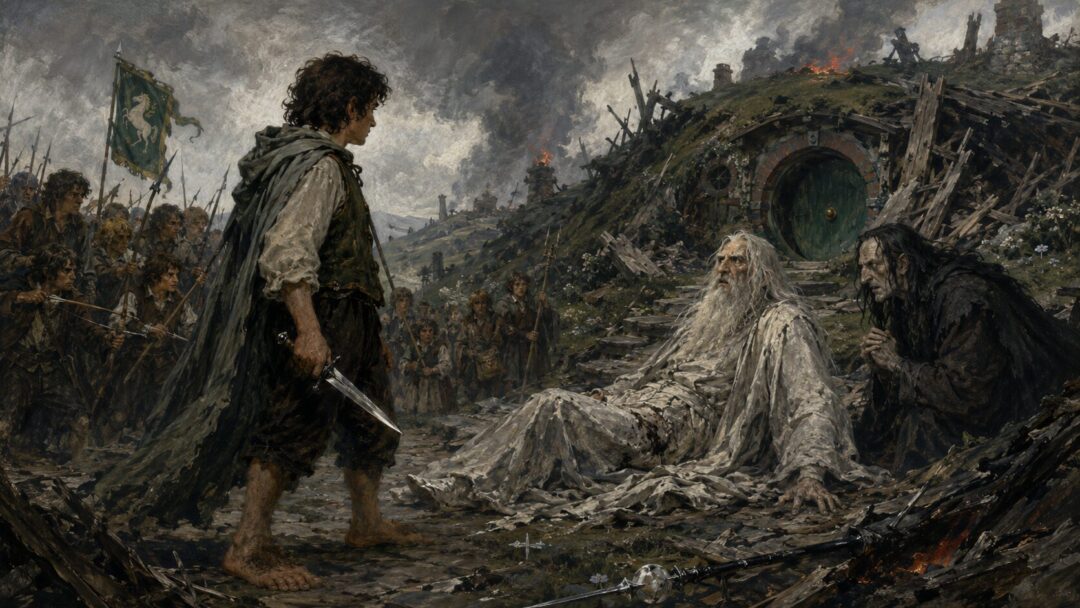
At first glance, Frodo forgiving Saruman looks almost impossible.
Saruman has not merely fallen from greatness. He has chosen pettiness after ruin. He has lost Isengard, lost his staff, lost his authority, and then spent his last strength spoiling the Shire out of malice.
He does not come to Hobbiton as a repentant old enemy.
He comes as “Sharkey.”
By the time Frodo meets him again, the damage is everywhere. Trees have been cut down. Homes have been altered or destroyed. The old Mill has been replaced by something uglier and fouler. Hobbits have been bullied, imprisoned, and ordered about by Men who should never have had power there at all.
And at the center of it stands Saruman.
So why does Frodo forgive him?
Not excuse him.
Not trust him.
Not restore him.
Forgive him.
That distinction matters.
Because Frodo’s mercy in the Shire is not sentimental. It is one of the clearest signs that his journey has changed him more deeply than anyone around him can understand.
Frodo Has Already Learned the Cost of Pity
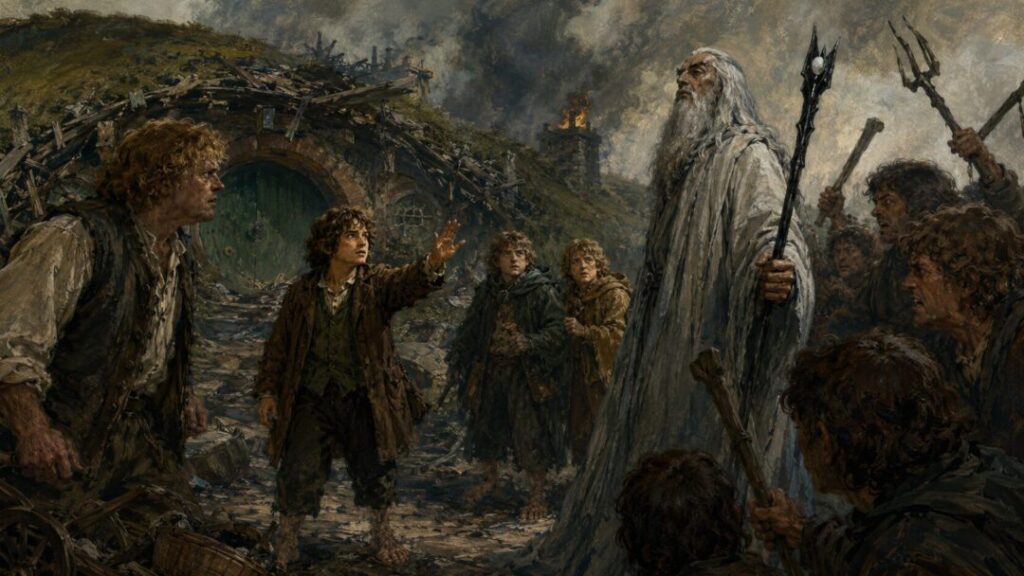
Frodo’s mercy toward Saruman cannot be understood without Gollum.
Early in the story, Frodo does not begin as a figure of perfect compassion. When he first hears how dangerous Gollum has become, his instinct is harsh. He wishes Bilbo had killed him when he had the chance.
Gandalf’s answer becomes one of the moral foundations of the entire story: pity and mercy are not weakness when there is no need to strike.
That lesson does not remain abstract.
Frodo later has Gollum in his power. He sees him not as a rumor, not as a monster in a story, but as a ruined being twisted by the Ring. Frodo does not pretend Gollum is harmless. He does not misunderstand him. He knows Gollum is treacherous, hungry, and dangerous.
But Frodo also recognizes something terrible in him.
Gollum is what the Ring does to a soul over time.
That recognition changes Frodo. He pities Gollum not because Gollum is innocent, but because Gollum is enslaved, diminished, and not beyond the reach of some final purpose.
And in the end, Gollum’s spared life matters.
Frodo cannot willingly destroy the Ring at the Sammath Naur. The burden becomes too great. The Ring is destroyed only because Gollum is still there to seize it and fall.
The story never turns this into a simple reward system. Mercy does not make Gollum good. It does not prevent betrayal. It does not remove danger.
But mercy preserves the possibility through which the Quest is completed.
By the time Frodo returns to the Shire, he knows this in his bones.
Saruman Is Not Another Gollum
Saruman is not Gollum, and Frodo does not treat him as if he is.
This is important.
Gollum is a ruined Ring-bearer, long enslaved by desire. Saruman is something else: a great being who chose domination, deceit, and revenge. As one of the Wizards, he had been sent into Middle-earth to oppose Sauron, not imitate him. His fall is therefore not merely tragic. It is corrupt.
Frodo does not deny that.
When Saruman is revealed in the Shire, Frodo does not invite him back into trust. He does not give him authority. He does not say the harm is forgotten. He tells him to go.
That is the shape of Frodo’s forgiveness.
It is not reconciliation.
It is not restoration.
It is not pretending evil was small.
It is refusing to kill when killing is no longer necessary.
This is where the scene becomes sharper than many readers remember. Frodo’s mercy is not passive. He is actively drawing a boundary around what the Shire must not become.
Saruman has already made the Shire meaner, uglier, more suspicious, and more cruel. If the hobbits answer his final defeat with needless vengeance, then Saruman has won one last victory over them.
Frodo sees that.
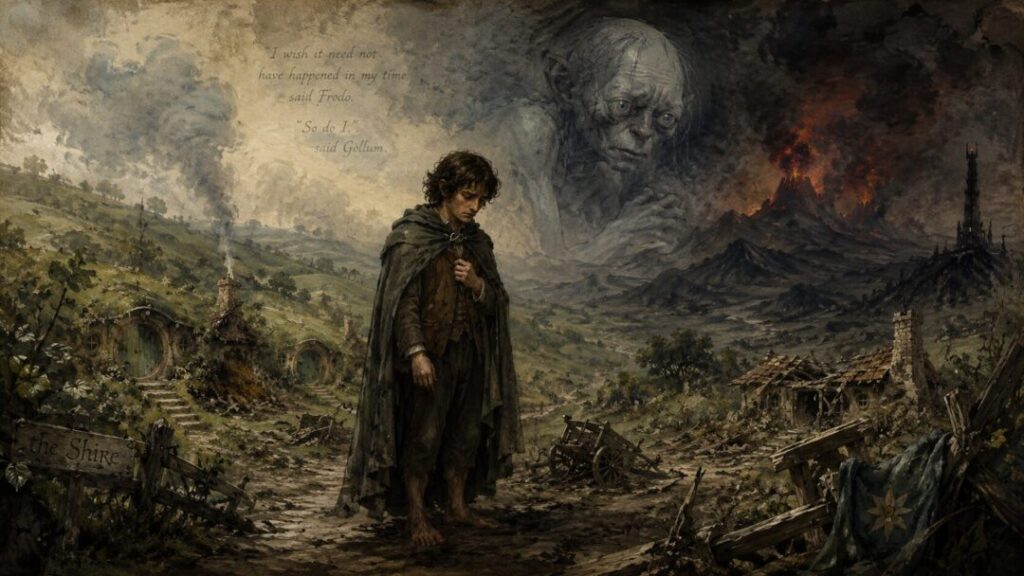
The Shire Must Be Healed, Not Avenged
The Scouring of the Shire is not just about removing ruffians.
It is about what happens when war comes home.
Merry and Pippin understand that the Shire must be defended. They have learned courage in Rohan and Gondor, and their leadership helps the hobbits rise against Sharkey’s Men. The Battle of Bywater is necessary within the story. Frodo does not prevent the Shire from defending itself.
But Frodo’s role is different.
He is trying to limit what the violence does to the hearts of the hobbits.
He does not want unnecessary killing. He does not want vengeance mistaken for justice. He does not want the Shire’s recovery to begin with the deliberate execution of a defeated enemy.
This is not because Frodo is untouched by evil.
It is because he has been touched by it more deeply than anyone else there.
Frodo knows what it is to be consumed by a will that seeks possession and mastery. He knows what hatred and domination do from inside the shadow of the Ring. And because of that, he recognizes that the Shire cannot be cleansed by becoming more like the things that harmed it.
Saruman’s body can be driven out.
But Saruman’s spirit—his contempt, his bitterness, his hunger to belittle and control—must not be allowed to remain in the hobbits’ actions.
That is why Frodo’s mercy matters.
Saruman Has Become Small
One of the most striking parts of the scene is Frodo’s perception of Saruman.
Saruman once stood among the Wise. He was head of the White Council. His voice could persuade and command. He studied the devices of Sauron and became ensnared by the desire to rival him.
By the time he reaches the Shire, almost all of that grandeur is gone.
He is still dangerous, but he is diminished. His power has narrowed into spite. He cannot conquer kingdoms, so he injures gardens. He cannot rule the West, so he bullies hobbits. He cannot become a lord of the Ring, so he makes Bag End into the center of a petty tyranny.
Frodo sees the horror in that.
But he also sees the smallness.
When Saruman tries to stab him and the blade fails against the hidden mithril coat, the moment should invite retaliation. Saruman has been defeated, exposed, and has now attempted murder.
Yet Frodo still stops the others.
He recognizes that Saruman was once great, and that his fall has made him wretched. Frodo’s mercy does not erase Saruman’s guilt. If anything, it exposes it more fully.
Because Saruman is given one last chance to leave.
And he cannot bear it.
Forgiveness Is Not the Same as Safety
Frodo’s forgiveness does not save Saruman from the consequences of his choices.
This is one of the most important points in the scene.
Saruman is spared by Frodo, but he is not healed by Frodo. He is offered mercy, but he does not receive it with humility. Instead, he responds with bitterness. Frodo’s clemency enrages him because it reveals how far he has fallen.
Saruman can endure hatred more easily than pity.
Hatred would still treat him as powerful. Fear would still flatter him. Revenge would make him the center of the moment.
But Frodo’s mercy does something worse to Saruman’s pride.
It sees him clearly.
Not as a Dark Lord.
Not as a mighty rival.
Not as a figure still worthy of terror.
But as a ruined being who no longer needs to be killed.
That is unbearable to him.
And so Saruman turns his cruelty again toward Wormtongue.
Wormtongue Shows the Limit of Saruman’s Power
Frodo’s mercy extends even to Gríma Wormtongue.
This is easy to overlook, because the scene moves quickly. Frodo sees Wormtongue’s misery and suggests that he need not follow Saruman any longer. He offers him the possibility of freedom.
Again, Frodo is not naïve. Wormtongue has done evil. He served Saruman in Rohan, and in the Shire he is implicated in the darkness around Lotho’s end. But Frodo still sees a creature degraded by servitude and fear.
Saruman immediately destroys the moment.
He reveals Wormtongue’s guilt in Lotho’s death and humiliates him. Wormtongue says Saruman made him do it. The text does not turn that into a legal argument; it simply shows the poisonous bond between master and servant finally breaking.
Wormtongue kills Saruman.
Then the hobbits shoot Wormtongue as he runs.
Frodo had tried to stop the chain of ruin. Saruman continues it. Wormtongue completes it.
This is not a failure of mercy.
It is a revelation of what Saruman has become.
Even when offered release, he chooses domination. Even when spared, he chooses contempt. Even at the end, he must make someone smaller than himself suffer.
The West Wind and the Final Rejection
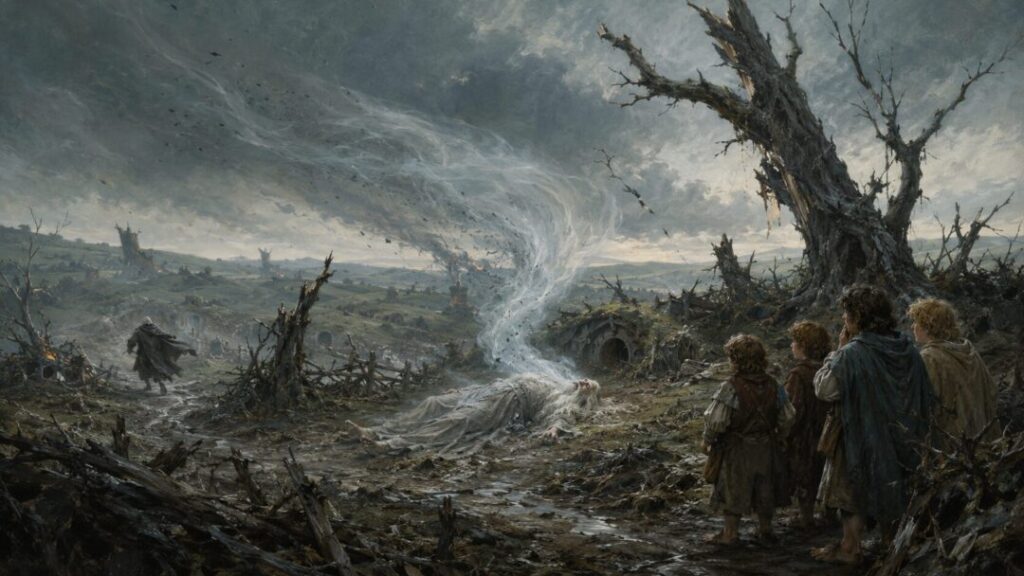
Saruman’s death is followed by one of the most chilling images in the chapter.
A grey mist rises from his body and looks toward the West. Then a wind comes, and the shape bends away and dissolves.
The text does not pause to explain this in doctrinal terms. It does not give a formal judgment. But the image is severe.
Saruman had been one of the Istari, a being sent from the West into Middle-earth. His mission was to resist Sauron, not seek power for himself. At the end, what remains of him turns westward, and the West does not receive him.
That should be phrased carefully. The story implies rejection through image, not through a spoken decree. But the implication is difficult to miss.
Frodo does not need to condemn Saruman.
Saruman’s own life has done that.
This is why Frodo’s forgiveness is so powerful. He does not have to take judgment into his own hands. He can release Saruman from vengeance without pretending Saruman is innocent.
Mercy and judgment are not the same thing.
Frodo chooses the first.
The story still allows the second.
Frodo’s Mercy Is His Last Victory in the Shire
Frodo returns home as one of the saviors of Middle-earth, but he does not return healed.
The Shire can be restored. The trees can be replanted. The homes can be repaired. Sam’s labor, aided by the gift from Galadriel’s garden, helps bring about a year of extraordinary renewal.
But Frodo himself does not fully recover.
That makes his mercy toward Saruman even more remarkable.
He is not forgiving from a place of comfort. He is not untouched by trauma. He has every reason to be bitter. He has lost more than the Shire can see, and he knows he may never again belong wholly to the peace he helped save.
Yet he refuses to let his pain become cruelty.
That is the quiet triumph of the scene.
Frodo cannot undo what Saruman did. He cannot make Wormtongue repent. He cannot restore Lotho. He cannot remove every scar from the Shire, or from himself.
But he can decide what kind of ending the Shire will have.
Not an ending ruled by revenge.
Not an ending that makes killing feel clean.
Not an ending where pity is discarded because the enemy is hateful.
Frodo forgives Saruman because he has learned that mercy is not a decoration added after victory.
It is part of what victory means.
Why Frodo Could Forgive Him
Frodo could forgive Saruman because he understood evil more deeply than before.
He had seen how power diminishes those who worship it. He had seen how pity, even when misunderstood, could preserve the possibility of grace. He had carried a burden that brought him to the edge of failure, and he had been saved by a mercy that began long before he understood it.
So when Saruman stands before him in the Shire, Frodo sees both guilt and ruin.
He sees a fallen enemy.
He sees a once-great being made small by pride.
He sees someone who must be stopped, but no longer needs to be slain.
That is why the scene matters.
Frodo’s forgiveness is not weakness.
It is discernment.
It is the refusal to let Saruman decide the moral terms of the ending. It is the final proof that Frodo’s journey has not made him harder in the way Saruman would understand. It has made him sadder, wiser, and more merciful.
Saruman leaves the world in bitterness.
Frodo leaves the Shire in sorrow.
But only one of them leaves it with his soul still turned toward healing.
Sources & Notes
- J.R.R. Tolkien, The Lord of the Rings, Book VI, Chapter 8, “The Scouring of the Shire” — the central scene: Frodo restrains vengeance, spares Saruman after the failed stabbing, offers Wormtongue a way out, and witnesses Saruman’s bitter end.
- J.R.R. Tolkien, The Lord of the Rings, Book I, Chapter 2, “The Shadow of the Past” — Gandalf’s teaching on Bilbo’s pity for Gollum gives the moral foundation behind Frodo’s later refusal to kill defeated enemies needlessly.
- J.R.R. Tolkien, The Lord of the Rings, Book VI, Chapter 3, “Mount Doom” — shows how the earlier mercy toward Gollum becomes bound up with the Ring’s destruction, shaping Frodo’s understanding of pity after the Quest.
- J.R.R. Tolkien, Unfinished Tales, “The Istari” — explains the Wizards’ mission to oppose Sauron and guide resistance, which sharpens the tragedy of Saruman choosing domination and imitation of the Enemy instead.
- J.R.R. Tolkien, The Lord of the Rings, Book VI, Chapter 9, “The Grey Havens” — places Frodo’s mercy in the context of his lasting wounds, the Shire’s restoration, and his inability to find full healing at home.