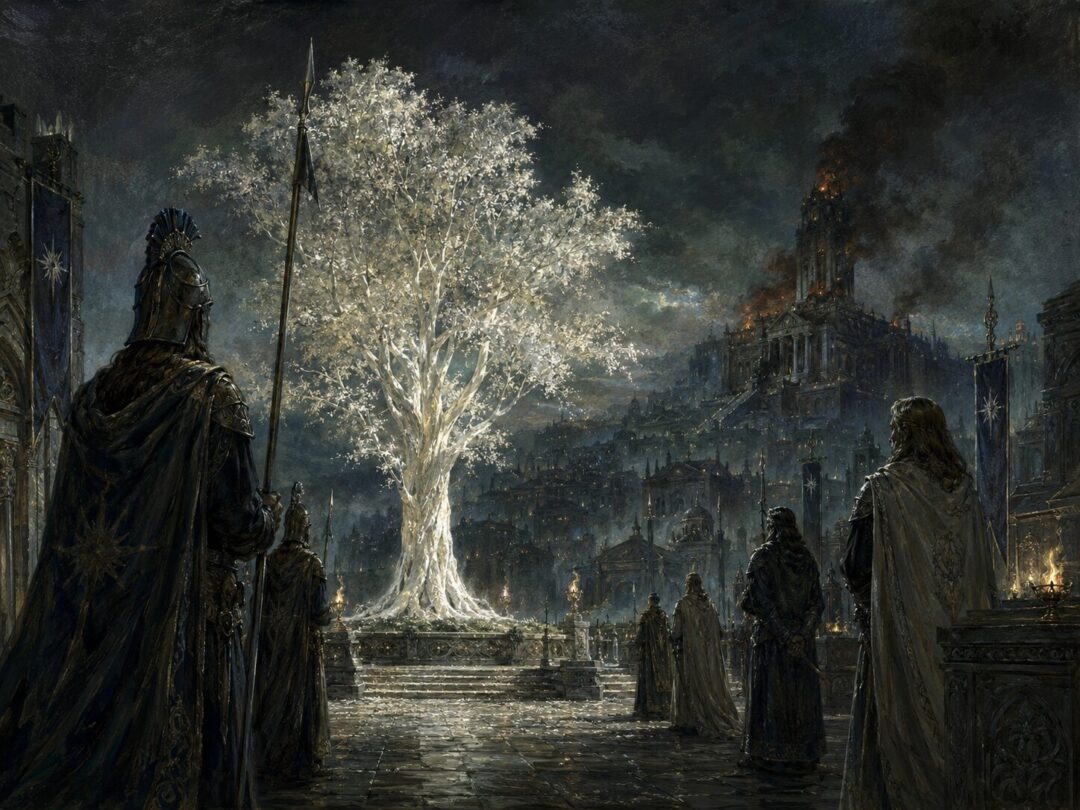
At first glance, Númenor looks like Sauron’s greatest victory.
He enters the island as a captive. He leaves it ruined beneath the Sea. Between those two moments, the mightiest kingdom of Men is turned from reverence into rebellion, from wisdom into tyranny, from fear of death into worship of darkness.
But that is only the surface of the story.
The stranger truth is that Númenor is not merely an episode in Sauron’s past. It explains the shape of his later evil.
After the Downfall, Sauron does not simply continue as before. He returns to Middle-earth changed. His body has been destroyed. His ability to take a fair and persuasive form is lost. The old mask is gone.
And yet the lesson of Númenor remains.
Sauron has seen something that open war alone could never have taught him: even the proudest and strongest of Men can be made to serve their own ruin, if their deepest fear is named, fed, and turned into a weapon.
That lesson echoes all the way into the War of the Ring.
Númenor Was Not Defeated in Battle
The first thing to notice is how Sauron reaches Númenor.
He does not conquer it.
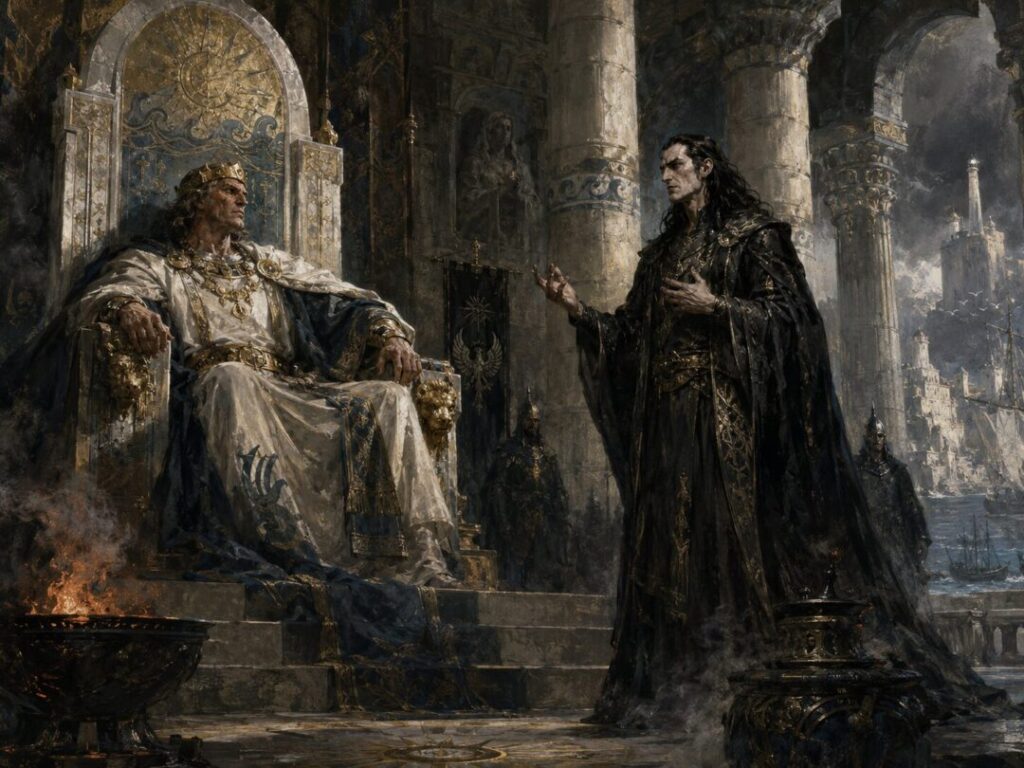
By the late Second Age, Sauron has become powerful in Middle-earth and has taken lordly titles for himself. Ar-Pharazôn, last king of Númenor, responds with overwhelming force. He comes to Middle-earth with such military strength that Sauron’s servants desert him.
This is important.
Sauron does not win that confrontation by arms. The text presents the Númenórean host as too great for his forces to withstand. So Sauron humbles himself and is taken back to Númenor as a prisoner.
On paper, this looks like defeat.
But Sauron understands something Ar-Pharazôn does not. A prison can become a throne if the prisoner understands the king’s hunger better than the king does.
Sauron cannot overpower Númenor from outside. So he begins to work from within.
The Wound Was Already There
Sauron does not invent Númenor’s fear of death.
That fear is older than his arrival.
The Númenóreans had been granted long life, wisdom, skill, and a blessed island kingdom between Middle-earth and the Undying Lands. But they were still mortal. The Ban of the Valar forbade them to sail so far west that they could no longer see their own shores. The reason was not cruelty. The Undying Lands did not make mortals deathless.
But over time, many Númenóreans began to misunderstand the gift of Men. They envied the Elves. They resented the Ban. They began to see death not as part of their appointed nature, but as a punishment being withheld from others.
This is the opening Sauron uses.
He does not need to create a new desire. He only has to corrupt an existing one.
That is one of his most dangerous patterns. He takes what already lives in the heart and bends it toward domination, despair, or rebellion.
In Númenor, the desire is not merely for longer life. It is for escape from mortality itself.
Sauron Turns Fear Into Worship
Once Sauron gains influence over Ar-Pharazôn, the corruption deepens.
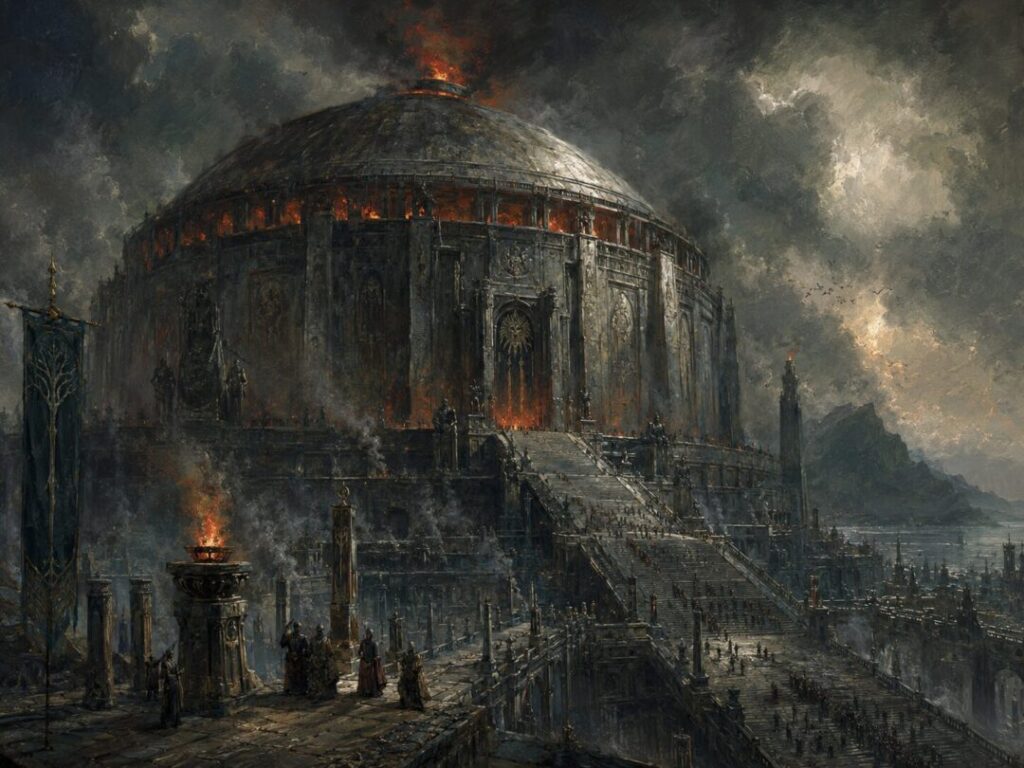
The old reverence of Númenor is displaced. Sauron teaches the worship of Melkor, whom he presents as a power able to deliver what the Valar supposedly deny. A great Temple is built in Armenelos. Nimloth, the White Tree connected with Númenor’s ancient friendship with the Eldar and the West, is cut down and burned.
These acts are not random blasphemies.
They are symbolic replacements.
The Tree represented memory, humility, and the old allegiance. The Temple represents a new order built on fear, cruelty, and the promise of power over death. The Faithful suffer. Men from Middle-earth are also brought under the shadow of Númenórean oppression.
Sauron’s triumph is not that he makes Númenor weak.
It is that he makes Númenor strong in the wrong direction.
The island does not fall because it becomes timid. It falls because its strength is severed from wisdom. Its ships, armies, wealth, and pride are all turned toward a single impossible demand: immortality by force.
The Final Lie
Sauron’s last counsel to Ar-Pharazôn is the most revealing.
He urges the king to make war upon the Valar and seize the Undying Lands. The lie depends on a confusion that had already poisoned Númenor: that deathlessness is somehow stored in the West, and that it can be taken by conquest.
This is not just deception. It is a perfect expression of Sauron’s mind.
For Sauron, power is the answer to every limit. If something is withheld, seize it. If something cannot be endured, dominate it. If a boundary exists, break it.
But the Ban of the Valar is not a military challenge. Mortality is not a fortress. Aman is not a prize to be captured by ships.
Ar-Pharazôn cannot conquer the nature of Men by sailing west.
His assault brings the Downfall.
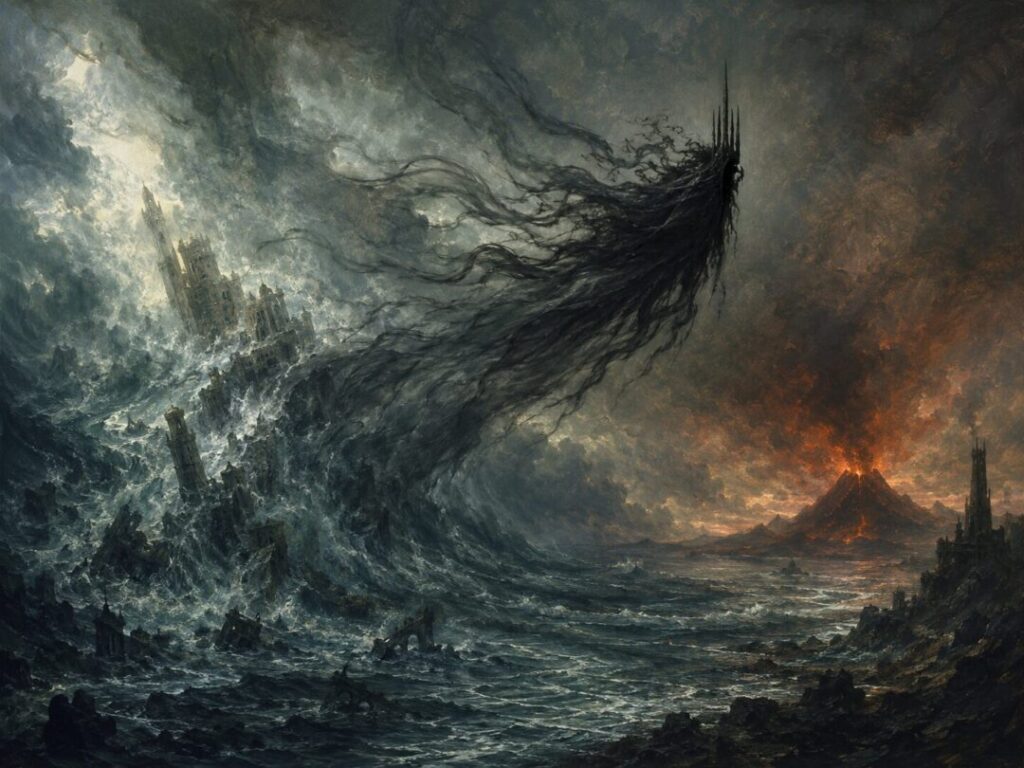
Númenor is drowned. The world is changed. Aman is removed from the circles of the world, so that mortal ships can no longer reach it by ordinary sailing. Ar-Pharazôn and his host do not return.
And Sauron, who had laughed in the Temple and believed himself secure, is caught in the catastrophe.
Sauron Wins and Loses at the Same Time
This is where Númenor becomes so important for understanding what comes later.
Sauron survives. His spirit returns to Middle-earth, and the One Ring remains central to his power. But he does not escape unharmed.
The Downfall destroys his body, and after this he can no longer take a form that appears fair to Men. That loss matters enormously.
Before Númenor, Sauron could deceive through beauty, wisdom, and apparent benevolence. In the Second Age, he had already used fair-seeming counsel in Eregion under the name Annatar, though the Three Rings were made without his direct touch and the Elves eventually perceived his treachery.
In Númenor, he again succeeds through persuasion, counsel, and religious deception.
After the Downfall, that mode of evil is diminished. He can still deceive. He can still manipulate. He can still use lies, fear, spies, servants, and instruments of power. But the beautiful mask is gone.
His later strategy becomes less intimate and more remote.
He becomes the will behind the fortress.
The Eye searching from afar.
The master whose servants carry his terror before him.
The Third Age Strategy: Pressure, Not Persuasion Alone
By the time of the War of the Ring, Sauron’s method has changed.
He does not walk into Minas Tirith as a fair counselor. He does not sit beside Théoden in golden disguise. He does not appear before the Council of Elrond to offer gifts.
Instead, he works through pressure.
The Nazgûl ride in his service. Mordor gathers armies. Orcs, Easterlings, Southrons, and other servants are drawn into war. Strongholds matter. Fear matters. Surveillance matters. The Palantír becomes one means by which minds can be shaken, though the texts treat different cases carefully: Saruman is ensnared, while Denethor is not simply possessed, but is driven toward despair through what he sees and how he interprets it.
This is not the same as Númenor.
But it grows from the same understanding.
Sauron looks for the inward weakness that can make outward strength collapse.
In Saruman, the weakness is pride and the desire to rival or replace Sauron’s power.
In Denethor, it is despair sharpened by knowledge, grief, and the belief that defeat is inevitable.
In Boromir, it is the desperate hope that the Ring might be used as a weapon for Gondor.
These are not identical temptations. But they reveal the same dark logic: Sauron does not need every person to love evil. He only needs them to grasp at power, surrender to fear, or mistake domination for salvation.
Númenor Explains His Blind Spot
There is also another lesson Sauron seems to take from Númenor.
He believes that the desire for power is reliable.
In Númenor, he watched a great king risk everything for the promise of escaping death. He watched a mighty civilization accept cruelty when cruelty was dressed as deliverance. He watched fear become worship and pride become obedience.
So when the One Ring is found again in the Third Age, Sauron does not imagine its enemies will try to destroy it.
This is one of the great ironies of The Lord of the Rings.
Sauron understands domination brilliantly. He understands the hunger to possess. He understands why the powerful would want a weapon. He understands kings, captains, lords, and would-be masters.
What he does not understand is renunciation.
That failure is not incidental. It is rooted in his whole way of seeing the world. To Sauron, power exists to be used. If a weapon can win a war, someone will claim it. If a Ring can command wills, someone will try to wield it.
Númenor confirmed this worldview for him.
The downfall of Ar-Pharazôn proved, in Sauron’s mind, that even the greatest Men could be turned by the promise of more life, more glory, more mastery.
He could not imagine that the Ring’s enemies would send the small, the humble, and the seemingly powerless into Mordor not to use the Ring, but to unmake it.
Why Terror Replaces the Fair Mask
After Númenor, Sauron’s evil becomes more visibly tyrannical.
This does not mean he becomes less subtle. The War of the Ring is full of misdirection, timing, manipulation, and psychological warfare. But his center of gravity changes.
He no longer needs to appear as a giver of gifts. He rules through dread, distance, and domination.
The Nazgûl are the clearest sign of this. They are not merely captains. They are embodied consequences of Sauron’s old promises. Men who accepted Rings of Power became great in their time, but their end was bondage. Their existence is the Númenórean temptation reduced to its most terrible form: the desire to overcome death leading not to life, but to a kind of living death under another will.
That is why the Ringwraiths are so fitting as Sauron’s servants in the Third Age.
They are not just monsters.
They are arguments.
They show what Sauron’s gifts finally mean.
The Downfall Becomes a Pattern
Númenor’s Fall explains Sauron’s later strategy because it reveals the pattern he trusts most.
Do not merely attack the walls.
Attack the fear behind them.
Do not merely defeat a kingdom.
Turn its virtues into weapons against itself.
Courage becomes arrogance.
Long life becomes terror of death.
Strength becomes oppression.
Wisdom becomes calculation.
Hope becomes the desire for a weapon too dangerous to bear.
This is why the moral center of The Lord of the Rings is so different from Sauron’s expectations. The Ring is not defeated by a stronger Ring. Mordor is not overthrown because the West discovers a greater machinery of control. The final answer to Sauron is not a better version of Sauron.
It is pity.
Mercy.
Endurance.
Refusal.
The willingness to let go of power even when every worldly argument says to seize it.
That is what Númenor could not do.
And that is what Sauron, shaped by Númenor’s ruin, cannot understand.
The Real Lesson of Númenor
Númenor does not show that Sauron could corrupt anyone automatically. The Faithful endured. Elendil and his sons survived the Downfall and carried forward what could be saved. The story is not saying that Men are helpless before evil.
It is saying something more precise.
Even the greatest civilization can fall when it begins to treat limits as insults, mortality as theft, and power as the cure for fear.
Sauron learns that lesson in the darkest possible way. He learns how to make people choose chains while believing they are choosing freedom. He learns that despair and pride can be more useful than armies. He learns that the strongest enemy may be broken by the thing it most wants to deny.
But he also learns the wrong lesson.
He believes this is the final truth about all people.
And in the end, that belief helps destroy him.
Because the Ring goes into Mordor not in the hand of a conqueror, but around the neck of a Hobbit who does not understand power the way Sauron does.
Númenor explains Sauron’s later strategy.
But the Shire explains why that strategy fails.
Sources & Notes
- J.R.R. Tolkien, The Silmarillion, “Akallabêth” — recounts Ar-Pharazôn bringing Sauron to Númenor as a prisoner, Sauron’s rise as counselor, the Melkor cult, Nimloth’s burning, and the assault on Aman.
- J.R.R. Tolkien, The Silmarillion, “Akallabêth” — frames the Númenórean fear of death, envy of the Eldar, and misunderstanding of the Ban of the Valar that Sauron exploits rather than invents.
- J.R.R. Tolkien, The Silmarillion, “Of the Rings of Power and the Third Age” — explains Sauron’s return after the Downfall, the loss of his ability to appear fair, and the later rule of the Nazgûl and Mordor.
- J.R.R. Tolkien, The Lord of the Rings, Book II, Chapter 2, “The Council of Elrond” — sets out the Ring’s danger as a weapon of domination and shows why Boromir’s hope of using it for Gondor repeats Sauron’s logic.
- J.R.R. Tolkien, The Lord of the Rings, Book V, Chapter 9, “The Last Debate” — Gandalf says Sauron cannot imagine that the West seeks to destroy the Ring, only that some lord will try to wield it.
- J.R.R. Tolkien, Letter 131 — Tolkien’s account of Sauron’s desire for order, control, and domination gives storycraft context for the article’s link between Númenor, the Ring, and Sauron’s strategic blind spot.