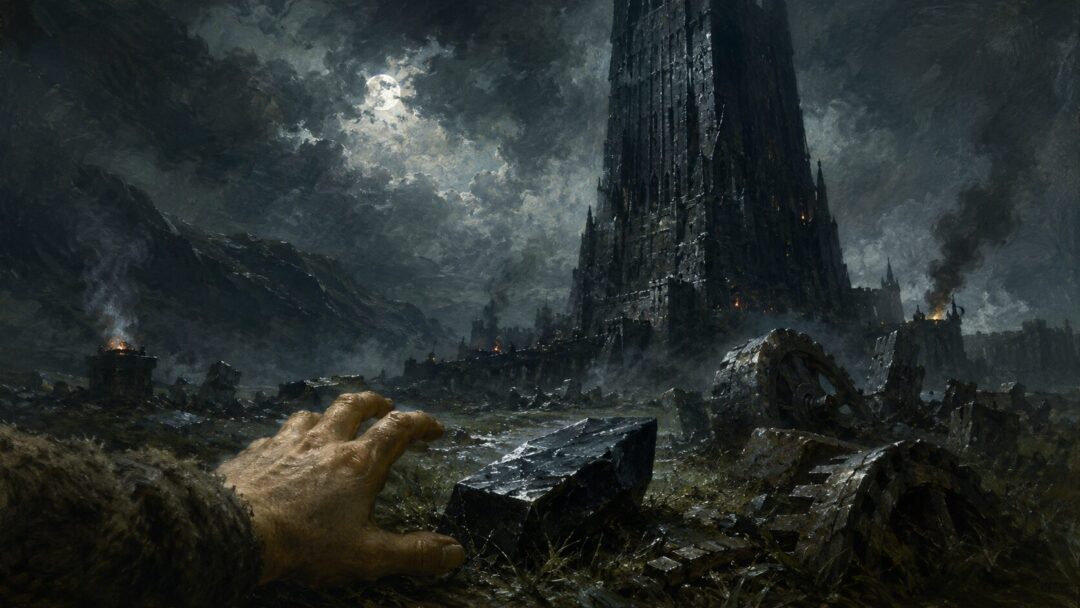
A black stone rolls from Orthanc, hard and dark and strangely beautiful. Pippin Took picks it up, not knowing that he has touched one of the oldest and most perilous objects left in Middle-earth. It is not a Ring. It does not whisper promises of invisibility. It does not openly command.
It shows.
That is what makes the palantíri so frightening. Their danger does not come from ordinary falsehood. The Seeing-stones were not simple tools of deception. In the lore of Middle-earth, they were ancient instruments of vision and communication, associated with the high craft of the Eldar and brought to Middle-earth by Elendil and his sons after the Downfall of Númenor. They belonged originally to a world of trust, kingship, long memory, and ordered rule.
Yet by the War of the Ring, these same stones had become snares. Saruman was bent through one. Denethor was driven into despair through another. Pippin nearly revealed more than he understood. Aragorn alone used one in a way that turned danger back upon the Enemy.
The deepest horror of the palantíri is not that they made lies look true. It is that they made partial truth unbearable.
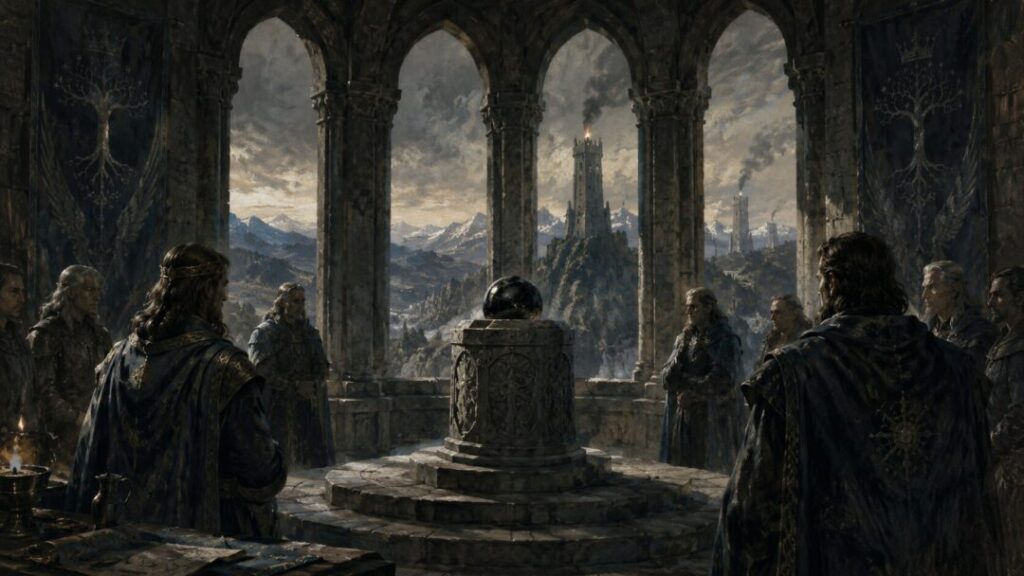
The Stones Were Not Evil in Themselves
The palantíri were not made as weapons of darkness. They were “Seeing-stones,” far-sighted instruments through which distant places, and especially other stones, could be perceived. Their original purpose was noble: communication across the realms of the Dúnedain, the keeping of counsel between far-separated towers and cities, and the preservation of unity between kingdoms that stretched across great distances.
This matters because the palantíri are often mistaken for cursed objects. They are not like the One Ring, which was made by Sauron for domination. The stones did not belong to Sauron by nature, nor did they become evil simply because he later possessed one.
Their danger came from contact, will, and context.
A Seeing-stone in the hands of a rightful ruler, used with knowledge and discipline, could serve the realm. A Seeing-stone in an age of decline, when most of the stones were lost, hidden, or captured, became something far more dangerous. The same power that once joined distant allies could now expose the mind of the user to an unseen adversary.
That is the first tragic irony: the palantíri were made for connection, but in the late Third Age they became instruments of isolation.
Saruman looked into Orthanc alone. Denethor looked from Minas Tirith under the burden of a failing war. Pippin looked in ignorance. Each encounter reveals a different danger: ambition, despair, and innocence without understanding.
The Stones Did Not Need to Lie
One of the most important rules about the palantíri is that they did not simply invent false images. The texts make clear that their visions were bound to reality. Sauron’s advantage lay not in making the stones show outright fiction, but in controlling, pressuring, selecting, and framing what weaker or vulnerable minds perceived.
That distinction changes everything.
A lie can be rejected once it is exposed. A half-truth is harder to escape because it has evidence inside it. The palantír could show a real army, a real fleet, a real ruin, a real sign of defeat. But it did not have to show the whole pattern. It did not have to show hope approaching behind the terror. It did not have to explain what the image meant.
The stone could reveal truth without wisdom.
That is why the palantíri are so thematically powerful. They separate sight from understanding. A person may see farther than any ordinary mortal and yet judge more poorly than before. Vision becomes a burden when the heart is already bent toward fear, pride, or control.
Middle-earth repeatedly warns that knowledge and wisdom are not the same thing. The palantíri turn that warning into an object.
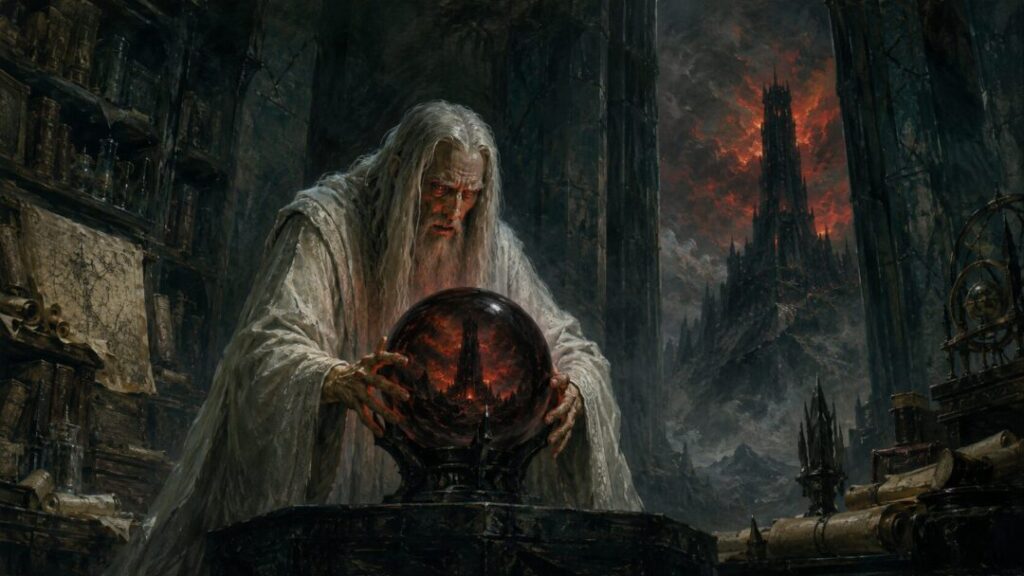
Saruman: Knowledge Without Humility
Saruman’s fall began before his visible defeat. His use of the Orthanc-stone fits the pattern of a mind already moving toward secrecy, calculation, and self-exaltation. He was learned, powerful, and skilled in persuasion. He studied the devices and histories of power. He desired knowledge not merely to resist Sauron, but increasingly to rival him.
The Orthanc-stone gave such a mind exactly the wrong gift.
Through it, Saruman could be drawn into contact with the Dark Tower. The texts do not require us to imagine that Sauron conquered him by a single magical blow. The more careful reading is more chilling: Saruman was gradually ensnared because the stone gave him access to the scale of Sauron’s power, and because he believed himself capable of mastering the game.
He saw enough truth to become afraid. He saw enough to become calculating. He saw enough to decide that open resistance was hopeless, unless he could seize the Ring or secure his own position.
The stone did not need to tell Saruman, “Serve Sauron.” It only had to show him power without mercy, armies without end, and the apparent inevitability of Mordor. Saruman’s pride did the rest.
His tragedy is not ignorance. It is knowledge severed from humility. He looks far, but not deeply. He sees the machinery of war and domination, but fails to understand the small, hidden forces that will undo them: pity, loyalty, endurance, mercy, and the refusal of the humble to become what they oppose.
Denethor: Truth Without Hope
Denethor’s case is different from Saruman’s and should not be flattened into the same moral failure. Denethor was not a traitor. He was the Steward of Gondor, a formidable ruler, and a man of great will. His use of the Anor-stone was tied to vigilance over his realm in a desperate age. He was not simply fooled like a child.
That makes his fall more tragic.
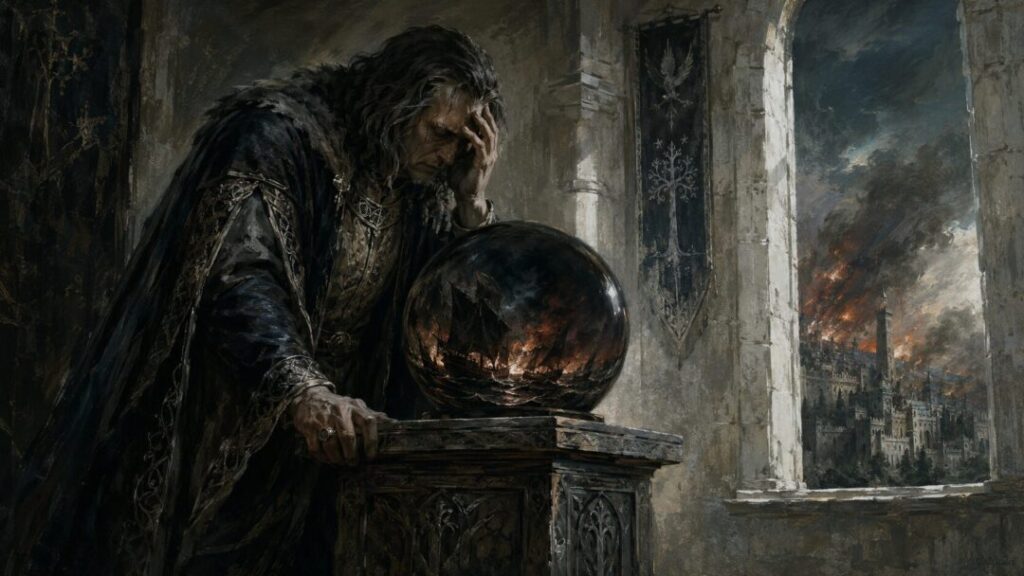
Denethor saw real things. He saw the strength gathering against Gondor. He saw the long preparation of Mordor. He saw, or was shown, images that confirmed the terrible pressure under which his city stood. Most famously, he believed the black-sailed fleet coming up the Anduin meant ruin. The ships were real; the interpretation was fatal. Aragorn had taken the fleet, but Denethor read the image as another proof that all hope had failed.
This is the palantír at its most devastating: not falsehood, but truth arranged into despair.
Denethor’s mind was already burdened by grief, pride, loneliness, and the immense weight of stewardship. Boromir was dead. Faramir seemed lost to him. The heir of Isildur had returned in the wider story, but Denethor’s own relationship to kingship, authority, and Gondor’s future was tangled with suspicion and resentment. Under such pressure, the stone became not a source of counsel but a chamber of dark confirmation.
He did not merely see danger. He accepted Sauron’s framing of danger as destiny.
That is the moral collapse. The Enemy does not have to make a brave man cowardly in a simple sense. He only has to persuade him that courage no longer matters.
Pippin: Innocence Before Terrible Knowledge
Pippin’s encounter with the Orthanc-stone shows another side of the danger. He is not proud like Saruman or despairing like Denethor. He is curious, impulsive, and inexperienced. His mistake is small in motive but enormous in consequence.
When he looks into the stone, he comes under the attention of Sauron. He cannot understand the full machinery of what he has entered. To him, the palantír is first a mystery, then a terror. His encounter reveals how dangerous these ancient tools had become in a broken age. They required knowledge, strength, and rightful authority; Pippin has none of those things.
Yet even this mistake is folded into providence and strategy. Sauron draws a wrong conclusion from what he sees. He believes, or at least strongly suspects, that a hobbit connected with the Ring is in Saruman’s keeping at Orthanc. Later, Aragorn’s deliberate use of the stone intensifies Sauron’s fear and draws his attention toward the wrong threat.
So the palantír does not only endanger the West. It also exposes Sauron’s own weakness: his inability to imagine that the Ring would be carried toward destruction rather than wielded by a rival.
The stones show truth, but even Sauron can misread what truth means.
Aragorn: Rightful Use and Terrible Risk
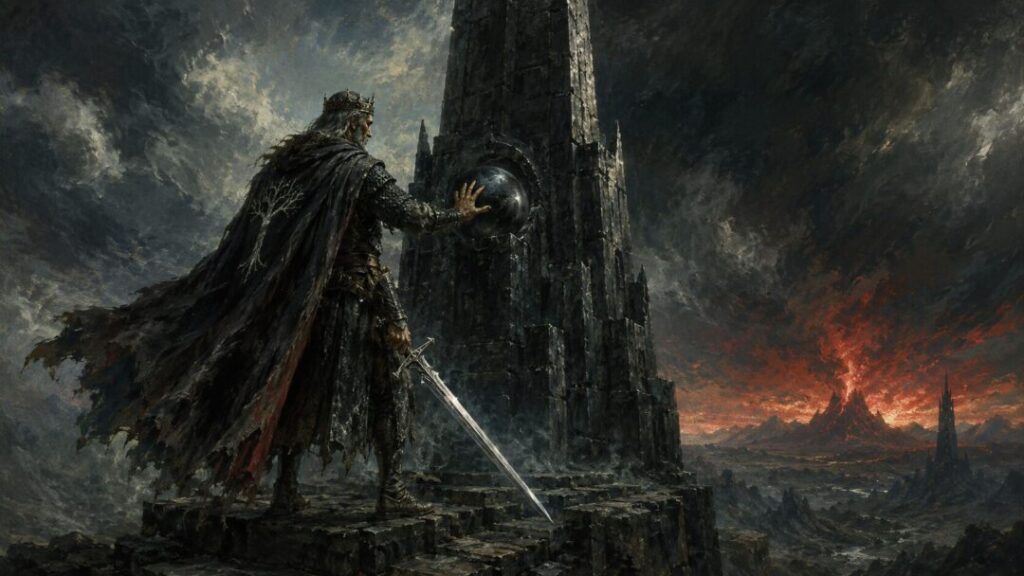
Aragorn’s use of the Orthanc-stone is the great counterexample. Unlike Pippin, he knows the danger. Unlike Saruman, he does not seek to bargain with evil. Unlike Denethor, he does not look in order to confirm despair. He uses the stone as heir of Elendil, with a claim of authority over the palantíri that Saruman never truly possessed.
Even then, the act is perilous.
Aragorn reveals himself to Sauron before the time Sauron expected. He shows the reforged sword and forces the Enemy to confront the possibility that the heir of Isildur has come openly into the war. This is not casual bravery; it is strategic self-exposure. Aragorn uses truth as a weapon, but he does so with discipline and purpose. He does not ask the stone to comfort him. He does not surrender interpretation to the Enemy.
He looks, contests, and acts.
The result helps draw Sauron’s attention toward the military challenge before the Black Gate and away from the hidden road into Mordor. In that sense, Aragorn succeeds where Saruman and Denethor fail: he understands that seeing is not enough. Truth must be placed within wisdom, courage, timing, and self-command.
Why Truth Became More Dangerous Than Lies
The palantíri made truth dangerous because they gave their users more vision than their hearts could safely bear.
Saruman saw power and concluded that domination must be answered by domination. Denethor saw defeat approaching and concluded that hope itself had become a lie. Pippin saw beyond his station and nearly became a doorway for disaster. Aragorn saw danger too, but he used the vision without surrendering judgment.
That is the hidden rule of the palantíri: they reveal not only distant things, but the inner condition of the one who looks.
To the proud, they offer comparison with greater power.
To the fearful, they offer evidence for despair.
To the curious, they offer knowledge without protection.
To the rightful and disciplined, they remain dangerous, but not unconquerable.
In a simpler story, evil would win by hiding the truth. In The Lord of the Rings, evil often works by showing enough truth to crush the will. Mordor does not need Denethor to believe that no armies exist; it needs him to see armies and forget everything else. It does not need Saruman to deny Sauron’s strength; it needs him to believe strength is the only reality that matters.
The palantíri are therefore among the most unsettling objects in Middle-earth. They do not merely ask, “What can you see?” They ask, “What will sight do to you?”
And that question remains terrifying because it is not confined to fantasy. A mind can be ruined by facts when facts are torn away from proportion, mercy, patience, and hope. The stones show that truth without wisdom can become a weapon, and that despair may begin not with a lie, but with a true image seen in the dark.
Sources & Notes
- J.R.R. Tolkien, Unfinished Tales, “The Palantíri” — gives the stones’ origin, normal uses, limits, and the crucial rule that they showed real things rather than invented lies.
- J.R.R. Tolkien, The Lord of the Rings, Book III, Chapter 11, “The Palantír” — Pippin’s look into the Orthanc-stone brings him under Sauron’s gaze, and Gandalf explains how Saruman was ensnared through it.
- J.R.R. Tolkien, The Lord of the Rings, Book V, Chapter 2, “The Passing of the Grey Company” — Aragorn deliberately uses the Orthanc-stone, reveals himself to Sauron, and learns of the Corsair threat.
- J.R.R. Tolkien, The Lord of the Rings, Book V, Chapter 4, “The Siege of Gondor” — Denethor’s despair is intensified by what he has seen, especially the black-sailed fleet coming up the Anduin.
- J.R.R. Tolkien, The Lord of the Rings, Book V, Chapter 7, “The Pyre of Denethor” — Gandalf identifies Denethor’s Anor-stone and explains how Sauron could use true visions to bend his judgment toward hopelessness.