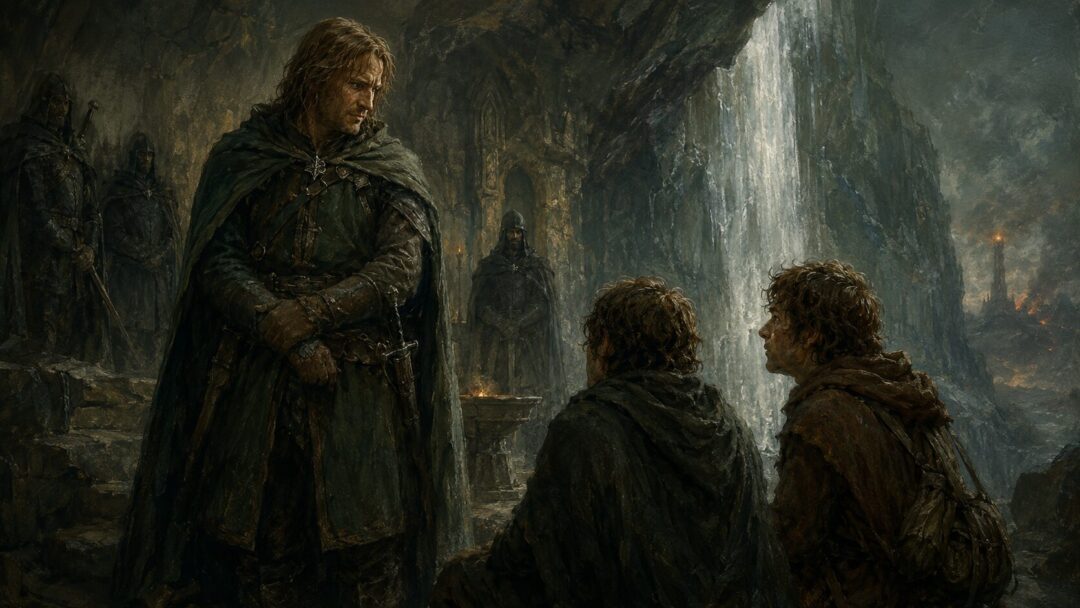
The One Ring had already broken stronger-looking men before Faramir ever saw Frodo in Ithilien.
It had whispered to Isildur after the overthrow of Sauron. It had consumed Sméagol in a single violent moment. It had stirred Boromir, son of Denethor, into desperation at the edge of the Anduin. By the time Frodo and Sam were brought under guard to Henneth Annûn, the pattern seemed clear: place the Ring near power, fear, military need, or wounded pride, and ruin would follow.
Then Faramir did the thing that looks almost impossibly simple.
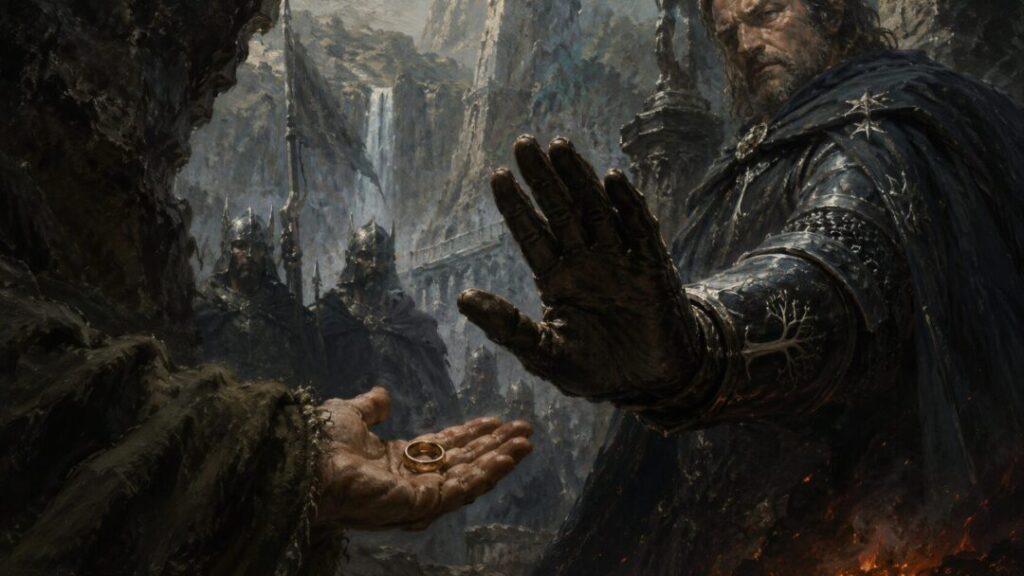
He refused it.
But that refusal was not safe, easy, or merely noble. In the text, Faramir’s choice is dangerous precisely because he makes it while surrounded by good reasons to do otherwise. He is not sitting in a peaceful library, judging the Ring from a distance. He is a captain of Gondor in enemy-held country, leading men in a losing war, after the death of his brother, under the shadow of Mordor, with two suspicious strangers carrying a secret that might decide the fate of the world.
His greatness is not that the Ring somehow had no relevance to him. It is that everything about his position made the temptation more complicated than it first appears.
Faramir Meets the Ring in the Middle of a War
Faramir’s encounter with Frodo and Sam happens in Ithilien, a land once fair and now contested under the shadow of Mordor. This matters. He is not an abstract moral philosopher; he is operating as a soldier behind dangerous lines.
When his men capture Frodo and Sam, Faramir has every practical reason to be suspicious. They are found moving secretly near Mordor. They are accompanied, though not at first openly, by Gollum. They are evasive about their errand. They have known Boromir, who is now dead. And they are carrying something of immense importance, though Faramir does not immediately know what.
The tension in the scene is not just “Will Faramir be tempted?” It is also “What does a just man do when justice itself is unclear?”
If he lets Frodo go too easily, he may be releasing spies or fools into Mordor. If he detains him too long, the Quest may fail. If he sends him to Minas Tirith, the Ring may fall into the hands of Denethor. If he seizes the Ring for Gondor, he becomes exactly what the Wise feared: another good person trying to use evil as a tool.
That is why Faramir’s refusal is more dangerous than it looks. It is not only a private act of self-denial. It is a military decision, a political decision, and a spiritual decision made under pressure.
He Refuses Before He Fully Knows the Test
One of the most important details is that Faramir speaks against seizing an unknown treasure before Sam’s accidental revelation makes the matter clear.
He tells Frodo that he would not snare even an Orc with a falsehood, and he rejects the idea of taking something dangerous merely because it might be useful. He says, in effect, that he would not pick up such a thing even if it lay by the road. When Sam later reveals that Boromir desired the Enemy’s Ring, Faramir realizes what Frodo carries.
This means his refusal is not improvised only after the Ring is named. His character has already been shown. He has already placed limits on what he will do for victory.
That is crucial. Faramir does not defeat the Ring by proving he is immune to temptation. The text never says he is immune. Rather, he has built a moral boundary before the temptation is fully exposed. He has already decided that some weapons are not worth using.
That earlier discipline protects him when knowledge arrives.

The Ring’s Danger Is Not Only Greed
It is easy to reduce the Ring’s temptation to simple greed: someone wants power, sees the Ring, and reaches for it. But in The Lord of the Rings, the Ring often works through desires that can appear noble or understandable.
Boromir does not begin as a villain. He wants to save Gondor. His temptation is tied to duty, fear, and the terrible pressure of defending his people. Galadriel’s imagined temptation is not petty wealth or comfort, but overwhelming beauty, authority, and dominion. Even Gandalf refuses the Ring because the wish to do good through it would become too dangerous.
Faramir faces the same kind of peril. He is not tempted, at least not openly in the text, by luxury or personal glory. The danger is subtler: the Ring could be framed as Gondor’s answer to despair.
That makes his refusal morally harder, not easier. To reject the Ring is not merely to reject evil. It is to reject a weapon that might appear to offer salvation when all other hopes are failing.
Faramir has to believe that a victory achieved through the Enemy’s own ruling power would not truly save Gondor. That belief is not naïve. It is one of the deepest moral laws in the story.
Boromir’s Shadow Makes the Choice More Painful
Faramir’s refusal cannot be separated from Boromir.
By the time Frodo reaches Ithilien, Boromir is dead, though the full story is still painful and incomplete. Faramir loved his brother, and the text gives no reason to treat that bond lightly. Yet he also has to confront the terrible implication that Boromir tried to take the Ring.
That knowledge could have pushed Faramir in several dangerous directions.
He might have denied it, refusing to believe that Boromir could fall. He might have tried to “redeem” Boromir’s desire by doing what Boromir could not. He might have interpreted the Ring as something fate meant to deliver to Gondor after all. He might even have seen Frodo as the cause of his brother’s downfall.
Instead, Faramir does something far more difficult. He grieves, judges carefully, and does not let grief become entitlement.
This is one of the quietest forms of strength in the book. Faramir is not merely refusing a golden object. He is refusing the emotional logic that says loss gives him a right to possess what wounded his house.

Denethor Makes the Refusal Politically Dangerous
Faramir’s decision also has consequences at home.
Denethor, Steward of Gondor, is not simply a distant father. He is Faramir’s lord, commander, and judge. Later, in Minas Tirith, Denethor bitterly criticizes Faramir’s choice not to bring the Ring to him. Denethor’s reaction confirms that Faramir’s refusal was not the obvious political move inside Gondor’s leadership.
From Denethor’s perspective, Gondor is on the edge of annihilation. A weapon of the Enemy passing through his realm without being brought to him could look like madness, disloyalty, or weakness. Faramir knows enough of his father’s mind to understand that mercy and restraint may not be rewarded.
That makes his choice dangerous in a human sense. He risks not only his life in Ithilien but his standing in his father’s eyes. He chooses what he believes is right while knowing it may be judged as failure by the very authority he serves.
This is where Faramir’s nobility becomes painful. He is not rewarded immediately with understanding. He carries the cost of being wiser than the expectations placed upon him.
He Does Not Treat Frodo as a Tool
Another overlooked danger lies in how Faramir treats Frodo.
A harsher captain might not have seized the Ring personally, yet still tried to control the Ring-bearer. He could have detained Frodo indefinitely. He could have sent guards with him to command the route. He could have delivered him to Minas Tirith under the excuse of safety. He could have made the Quest serve Gondor’s chain of command.
Faramir does none of these things.
This restraint is remarkable because Frodo’s mission is almost unbelievable. Faramir is being asked, in effect, to trust that two small strangers and a treacherous guide are part of the only real hope left. He does not know everything the reader knows. He has no full council before him, no complete map of providence, no guarantee that Frodo will succeed.
He chooses to aid rather than possess.
That distinction matters throughout The Lord of the Rings. Many characters claim to want to help the Ring-bearer. The real test is whether they can help without taking control.

The Refusal Still Sends Frodo Toward Terrible Peril
Faramir’s choice is morally right within the story, but it is not comfortable.
By releasing Frodo and Sam, he allows them to continue toward the Morgul Vale and the pass above Minas Morgul. He also knows Gollum is dangerous, though he does not know the full part Gollum will play. He warns Frodo, offers what aid he can, and lets them go.
This is not a sentimental decision. It is a frightening one.
Faramir cannot make the road safe. He cannot remove the burden. He cannot replace Frodo. His mercy does not cancel danger; it permits the dangerous mission to continue.
That is part of the hidden cost of wisdom in Tolkien’s world. The right choice does not always feel like rescue. Sometimes it means refusing the obvious means of control and allowing another person to walk into darkness because that is the only path left.
Faramir’s Strength Is Humility, Not Invulnerability
A common overstatement is that Faramir “could resist the Ring” as if he possessed a special immunity. The text is more careful than that.
Faramir never claims to be beyond corruption. He does not test himself by handling the Ring. He does not ask Frodo to show it to him so that he may dramatically overcome it. In fact, part of his wisdom is that he avoids entering into a contest of possession at all.
This is important because the Ring is not defeated by confidence. Again and again, the proud belief that one can master it is itself part of the danger. Faramir’s strength lies in not needing to prove mastery.
He refuses at the level of desire, policy, and imagination. He will not take it. He will not route it through Gondor’s war machine. He will not recast evil as a necessary instrument of good.
That makes his refusal less theatrical but more profound.
The Real Danger Was That His Choice Looked Like Weakness
Faramir’s decision could easily be mistaken for passivity.
He does not seize the weapon. He does not claim glory. He does not drag Frodo before Denethor. He does not avenge Boromir by controlling the thing Boromir desired. In a world obsessed with strength, this can look like doing nothing.
But The Lord of the Rings repeatedly challenges that idea. Mercy, pity, patience, and restraint are not soft decorations around the real story of war. They are part of the deep structure by which victory becomes possible.
Faramir’s refusal matters because it keeps the Ring from being absorbed into another system of power. Gondor remains worth saving because at least some within it still understand that survival bought by corruption is not salvation.
He does not save the Quest by conquering anything. He saves it by not interrupting it.
The Captain Who Let Hope Pass By
Faramir’s refusal is dangerous because it happens at the crossing point of duty and surrender.
As a captain, he is responsible for Gondor’s security. As Denethor’s son, he lives under the shadow of comparison with Boromir. As a man of Númenórean inheritance, he belongs to a people whose greatness has always been threatened by pride, fear of death, and the desire to preserve what is fading. As a reader of the situation, he understands enough to know that the Ring is not merely a useful object.
So he lets it pass.
Not because it is harmless. Not because Frodo is safe. Not because the road ahead is clear. Not because Faramir has no wounds, no pride, no grief, and no loyalty to Gondor.
He lets it pass because taking it would be worse.
That is the quiet terror of the scene. Faramir’s noblest act is not a triumph over visible enemies, but a refusal to become one more hand reaching for power in the name of necessity. The Ring’s path to Mordor depends not only on courage from those who carry it, but on restraint from those who could have stopped them.
Faramir’s danger was that he had every reason to take the Ring seriously.
His greatness was that he took it seriously enough to refuse it.
Sources & Notes
- J.R.R. Tolkien, The Lord of the Rings, Book IV, Chapter 5, “The Window on the West” — Faramir questions Frodo and Sam in Ithilien, rejects false dealing, and says he would not take a perilous treasure even if he found it by the highway.
- J.R.R. Tolkien, The Lord of the Rings, Book IV, Chapter 6, “The Forbidden Pool” — Faramir spares Gollum, warns Frodo about his guide, and lets the Ring-bearer continue rather than bringing the Quest under Gondor’s control.
- J.R.R. Tolkien, The Lord of the Rings, Book V, Chapter 4, “The Siege of Gondor” — Denethor’s anger that Faramir did not bring the Ring to Minas Tirith shows the political and filial cost of that restraint.
- J.R.R. Tolkien, The Lord of the Rings, Book II, Chapter 10, “The Breaking of the Fellowship” — Boromir’s attempt to take the Ring for Gondor provides the immediate contrast and family shadow behind Faramir’s different choice.
- J.R.R. Tolkien, The Lord of the Rings, Book I, Chapter 2, “The Shadow of the Past” — Gandalf’s refusal to use the Ring for good explains why victory through the Enemy’s ruling power would become corruption rather than salvation.