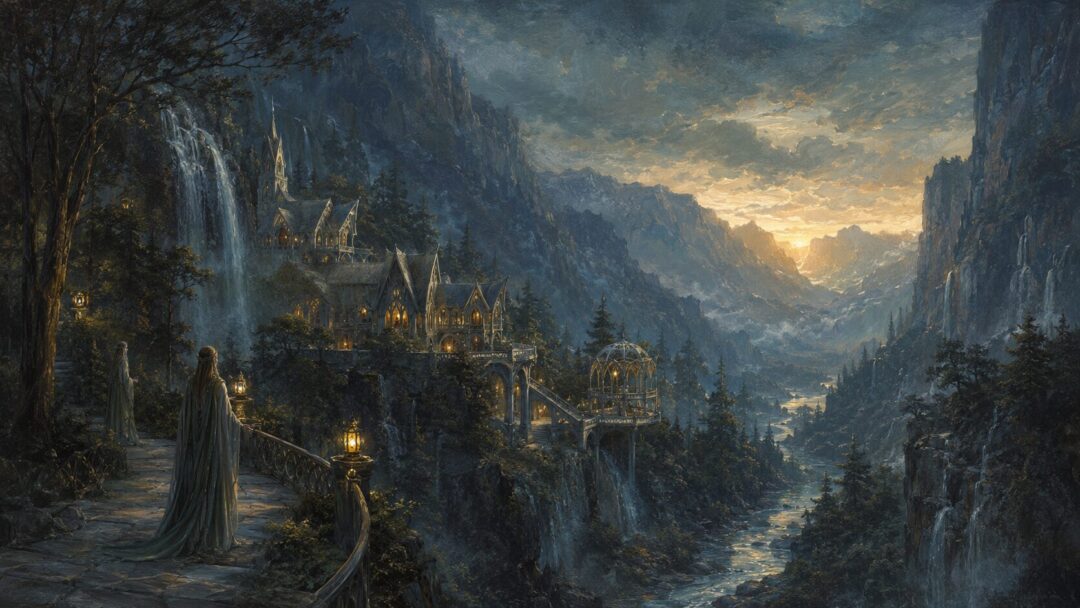
When Aragorn entered Minas Tirith as King Elessar, it looked like one of Middle-earth’s oldest wounds had finally closed. The White Tree flowered again. The line of Isildur was restored. Gondor had a king, Arnor had an heir, and the long defeat of the West had turned, at last, into victory.
But in Rivendell, victory did not mean healing in the same way.
Elrond’s house had spent ages preserving memory, sheltering the weary, guarding knowledge, and holding back darkness. It had protected the heirs of Isildur until one of them could become king. Yet when that king finally returned, the result was not the restoration of Elrond’s own house. It was the completion of its purpose — and therefore the beginning of its ending.
That is the quiet sorrow hidden beneath the triumph of The Lord of the Rings: the Return of the King heals the realm of Men, but it cannot heal the house that made that return possible.
Rivendell Was Never Built for Victory
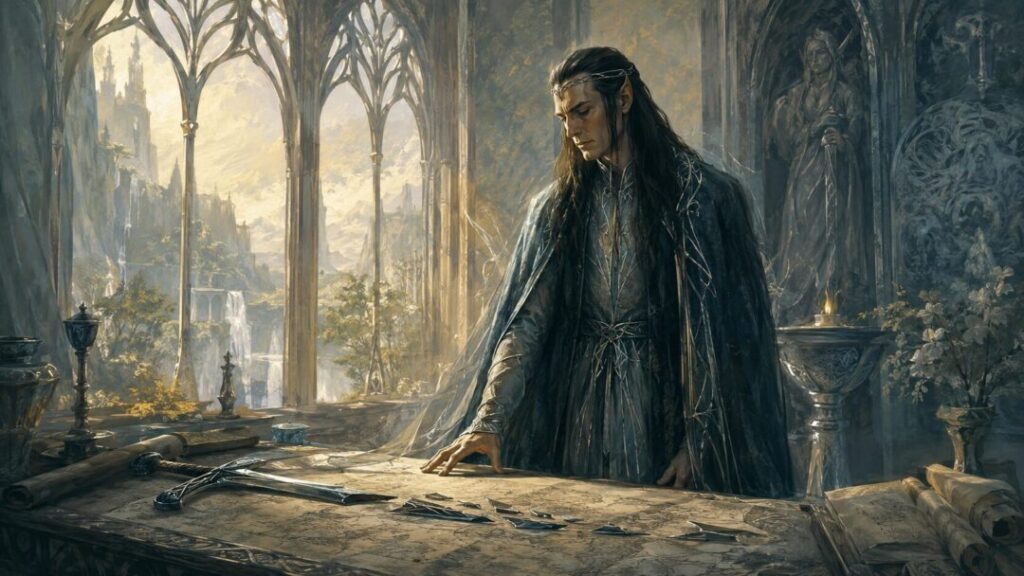
Rivendell, or Imladris, was founded by Elrond in the Second Age after the devastation of Eregion, when Sauron’s war against the Elves had broken one of the great Elvish realms of the West. It was not born as a capital of conquest. It was a refuge, a hidden stronghold, and later one of the chief remaining seats of Elvish strength in Middle-earth.
That matters because Rivendell’s deepest purpose was defensive and preservative. It existed to keep things alive that the world was losing: memory of the Elder Days, lore of the West, the line of Isildur, the wisdom of the Elves, and a kind of beauty already becoming rare east of the Sea.
Even its famous name in The Hobbit carries that mood. The Last Homely House is not merely cozy scenery. It is a threshold. For Bilbo and the Dwarves, it is the last deep breath before the wild. For Frodo, years later, it is a place of healing before the road becomes almost unbearable.
But a last homely house is still “last.” The phrase already contains an ending. Rivendell is precious because the world beyond it is dangerous, and because such places are becoming fewer.
The return of the king could restore thrones, laws, borders, and lineages. It could not restore the age in which Elrond’s kind of sanctuary belonged naturally to Middle-earth.
Elrond’s House Was Divided Before Aragorn Was Born
Elrond’s grief is not only political. It is woven into his bloodline.
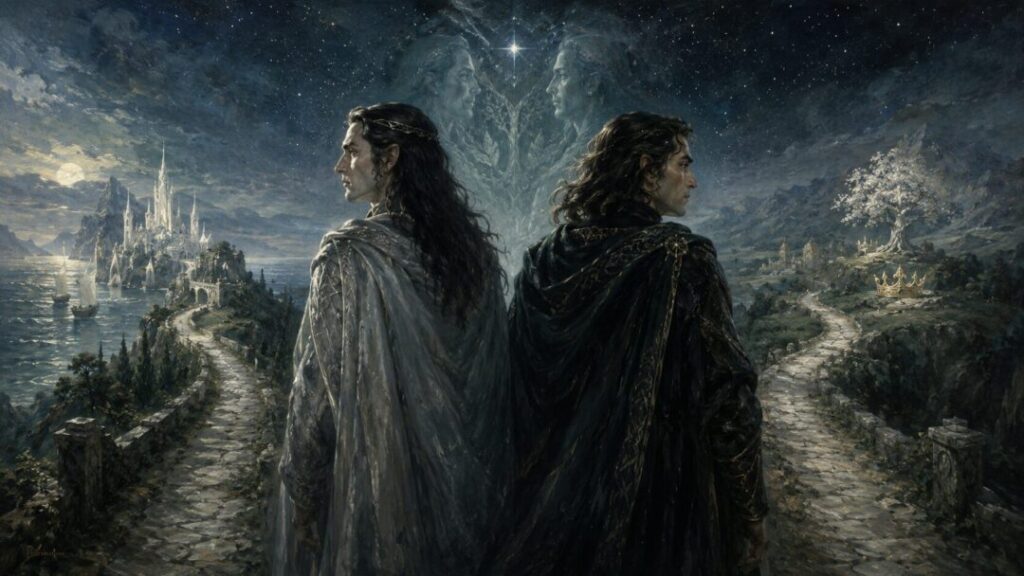
Elrond and his brother Elros were Half-elven, descended from both Elves and Men. Elrond chose the fate of the Elves, while Elros chose the fate of Men and became the first king of Númenor. From Elros came the royal line that eventually led, through many losses and diminutions, to Aragorn.
This means Aragorn’s return is not separate from Elrond’s family history. It is, in one sense, the return of Elros’ line.
That sounds beautiful, and it is. But it is also painful. The triumph of Aragorn is the triumph of the mortal branch of the family. It vindicates Elros’ line after the drowning of Númenor, the fall of Arnor, and the long wandering of the Dúnedain. Yet it does not reunite Elrond with what was lost. Elros remains long dead. Númenor remains drowned. The kings of old do not return with Aragorn.
The Return of the King proves that Elrond’s long guardianship was not in vain. But it also proves that the future now belongs to Men.
That is why Elrond’s position is so tragic. He has preserved the line that will inherit the world after his own people depart.
Aragorn’s Crown Cost Elrond His Daughter
The deepest wound is Arwen.
Elrond does not simply give political support to Aragorn. In the end, he gives his daughter to the mortal world. The Tale of Aragorn and Arwen in Appendix A makes clear that Arwen’s choice is bound to the fate of Men. She chooses Aragorn, and with him she chooses mortality. Tolkien’s texts do not reduce that choice to romance alone; it is a spiritual and existential crossing from one fate to another.
Elrond had already endured the ancient sundering between himself and Elros. Through Arwen, that sundering repeats itself inside his own household.
This is why the Return of the King cannot heal Elrond’s house. Aragorn’s kingship requires the fulfillment of the very union that separates Elrond from Arwen forever. The marriage of Aragorn and Arwen is the flowering of hope for Gondor and Arnor, but for Elrond it is also a farewell that no victory can undo.
The texts never portray Elrond as petty or resentful about this. He is grave, wise, and far-seeing. He knows what is at stake. He knows Aragorn must become more than a hidden Chieftain of the North. He knows the line of Men must be renewed.
But knowing the meaning of a sacrifice does not make it painless.
Arwen becomes Queen. Elrond becomes the father who must leave Middle-earth knowing that his daughter will remain behind, age, and die within the circles of the world.
The Three Rings Could Preserve, Not Restore
Another reason Rivendell cannot be healed lies in the fate of the Three Rings.
Elrond was the keeper of Vilya, the Ring of Sapphire, described in Tolkien’s tradition as the mightiest of the Three. The Three were not made as weapons of domination like the One. Their power is associated with preservation, protection, and the resistance of decay. But they were still bound to the fate of the One Ring. When the One was destroyed, the power of the Three passed away.
This is crucial. The victory over Sauron saves Middle-earth from enslavement, but it also ends the hidden power by which places like Rivendell and Lórien could remain strangely untouched by time.
That is one of the great moral complexities of the War of the Ring. To destroy the One is absolutely necessary. There is no good alternative. Yet the cost of destroying it is that the Elvish havens of the Third Age can no longer endure as they were.
So the Return of the King and the fading of Rivendell are not contradictions. They are two consequences of the same victory.
The world is saved from Sauron, but it is no longer preserved in the old Elvish mode. The age of guarded valleys, secret rings, lingering High Elves, and ancient memory embodied in living witnesses is passing away.
Elrond’s house could shelter Frodo long enough for the Quest to begin. It could not remain unchanged after the Quest succeeded.
The King Restored Men, Not the Elder Days
Aragorn’s reign is a true restoration, but it is not a return to everything that once was.
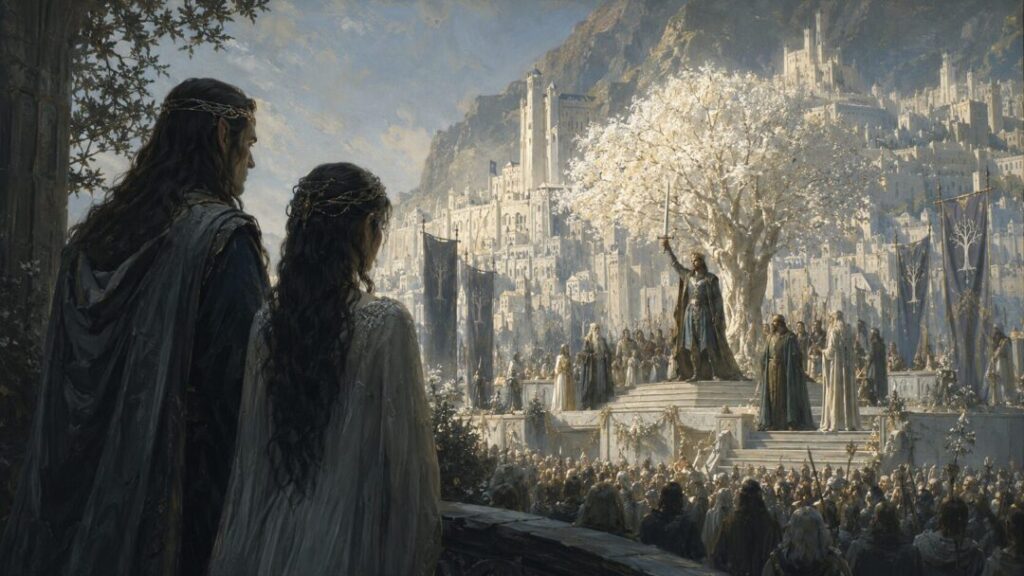
He restores the kingship of Gondor and Arnor. He renews the dignity of the Dúnedain. He brings healing hands to the Houses of Healing. He marries Arwen and unites the lines of Elros and Elrond in a new way. His rule signals a new peace after the Shadow.
But the Elder Days do not come back.
Gil-galad does not return. Celebrían, Elrond’s wife, had already passed over Sea after suffering torment and receiving healing in the West. The great Elvish wars of the past remain losses, not wounds that can simply close. The ancient realms of Beleriand are gone beneath the sea. Eregion is long destroyed. Númenor is drowned. The Last Alliance is memory.
Aragorn can inherit the noblest surviving legacy of Men. He cannot reverse the long fading of the Elves.
This is why the title “Return of the King” can be misleading if taken as universal healing. The king returns to Men. He does not return the world to the Second Age, and certainly not to the First. His crown marks renewal, but also succession. One people rises into its appointed time as another withdraws.
For Elrond, that means his victory is also his release from stewardship. He has kept the memory, guarded the heir, advised the Council, healed the wounded, and resisted Sauron across ages. Once Aragorn reigns, Elrond’s labor in Middle-earth is fulfilled.
Fulfillment is not the same as repair.
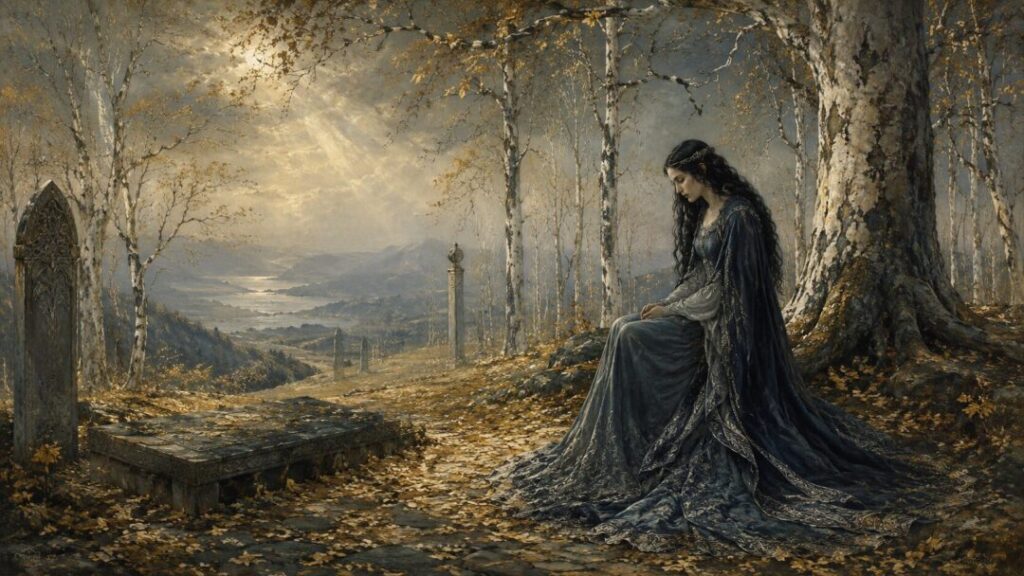
Arwen’s End Shows What Elrond Could Not Prevent
The final proof comes after Elrond has gone.
Appendix material records that Arwen outlives Aragorn for a short time, then goes to Lórien, now deserted, and lays down her life at Cerin Amroth in the Fourth Age.
That ending is devastating because it strips away any illusion that the marriage simply healed all divisions. Arwen’s choice was real. Her mortality was real. The separation from Elrond was real.
And Lórien itself being deserted matters. Arwen does not die in a flourishing Elvish realm surrounded by the old light of the Third Age. She dies in a place emptied by the same passing that took Rivendell’s power and sent the Keepers of the Rings over the Sea.
Her death is not presented as a failure of Aragorn’s love. It is the cost of the fate she chose. Nor is it a failure of Elrond’s wisdom. It is something wisdom could foresee but not prevent.
That is the heart of the tragedy. Elrond can understand the Music better than most in Middle-earth, but he cannot make its sorrow painless.
The House Was Healed Only by Letting Go
So why could Elrond’s house not be healed by the Return of the King?
Because Elrond’s house was not waiting for a king in order to become whole again. It was waiting for a king so that its long burden could end.
Rivendell’s purpose was to preserve what had to survive until the right moment: the heir, the lore, the counsel, the resistance to Sauron, the memory of older alliances between Elves and Men. Once Aragorn returned, that purpose was fulfilled. But fulfillment required departure, not restoration.
The house of Elrond had always stood between fates: Elf and Man, memory and history, preservation and change, the Undying Lands and Middle-earth. Aragorn’s kingship did not erase that division. It revealed its final shape.
For Gondor, the king’s return meant healing.
For Aragorn, it meant inheritance.
For Arwen, it meant love and mortality.
For Elrond, it meant the last surrender of the world he had spent ages protecting.
That is why his house could not be healed by the Return of the King. The king did not come to save Rivendell from ending. He came because Rivendell had succeeded.
And in Tolkien’s world, some victories are so complete that they leave the guardians with nothing left to guard.
Sources & Notes
- J.R.R. Tolkien, The Lord of the Rings, Appendix A, “The Tale of Aragorn and Arwen” — Elrond names the kingship of Gondor and Arnor as the condition of Aragorn and Arwen’s marriage, and Arwen’s later death shows the mortal cost of that union.
- J.R.R. Tolkien, The Lord of the Rings, Book VI, Chapter 9, “The Grey Havens” — Elrond departs Middle-earth with the other Ring-bearers while Arwen remains as Queen, making the victory also a final sundering of his house.
- J.R.R. Tolkien, The Lord of the Rings, Book II, Chapter 2, “The Council of Elrond” — Rivendell gathers memory, counsel, and the heir of Isildur at the moment when the old guardianship must pass into action.
- J.R.R. Tolkien, The Silmarillion, “Of the Rings of Power and the Third Age” — Imladris is founded as Elrond’s refuge after Sauron’s war in Eriador, and the Three Rings lose their power when the One is destroyed.
- J.R.R. Tolkien, The Lord of the Rings, Appendix A, “The Númenórean Kings” — the divergent choices of Elrond and Elros, and the descent of Aragorn from Elros, frame Aragorn’s restoration as the triumph of the mortal branch of Elrond’s kin.