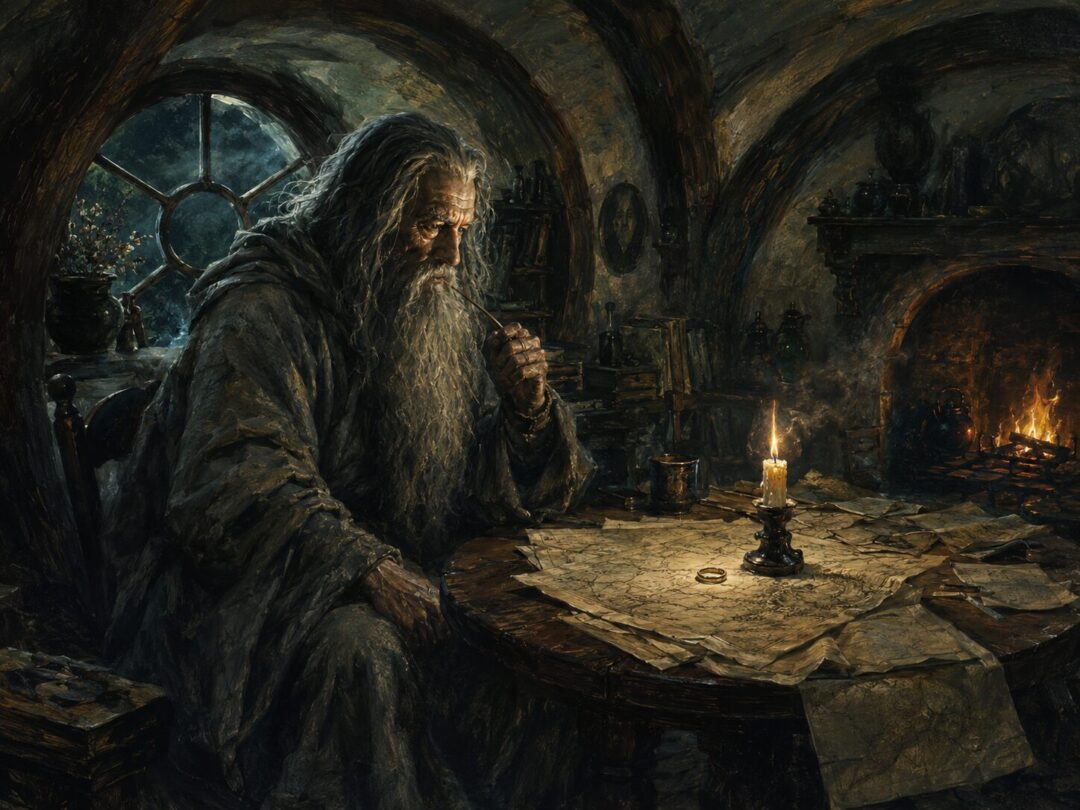
The Ring is the easiest object in Middle-earth to fear. It shines with a small beauty, slips onto a finger, and turns the visible world into shadow. Yet one of the most important things Gandalf ever says about it is not a spell, a command, or a strategy. It is a warning about pity.
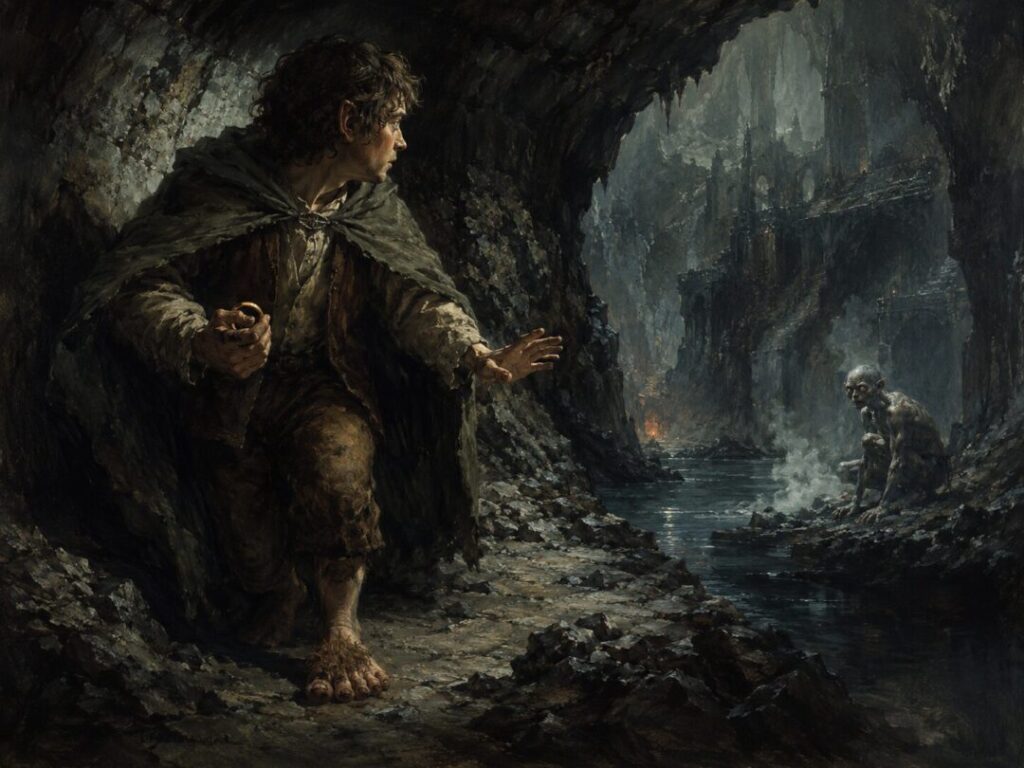
When Frodo wishes that Bilbo had killed Gollum, Gandalf does not answer like a warrior calculating losses. He answers like someone who has waited long enough to see that small acts may become hinges of history. Bilbo’s mercy in the dark under the Misty Mountains was not sentimental weakness. It was one of the hidden foundations on which the fate of the Ring would later turn.
That is where Gandalf’s patience becomes more than a personality trait. It reveals one of the deepest patterns in The Lord of the Rings: providence does not usually arrive as a blazing miracle. It works through delayed understanding, reluctant mercy, incomplete knowledge, and people who keep choosing the good before they know what their choice will cost.
Gandalf Is Not Patient Because He Knows Everything
A common misunderstanding is that Gandalf simply sees the whole design from the beginning. The texts do not support that. Gandalf is wise, ancient, and spiritually powerful, but he is not omniscient. He does not immediately know that Bilbo’s ring is the One Ring. He suspects, studies, questions, travels, waits, and tests.
In “The Shadow of the Past,” Gandalf explains that he wondered how Gollum came by a Great Ring, and that the matter troubled him. But suspicion is not certainty. The Ring had passed out of history. Saruman, head of the White Council, had claimed that the One had been carried down the Anduin to the Sea. Gandalf had reasons to doubt and reasons to fear, but not enough to act as if every answer were already known.
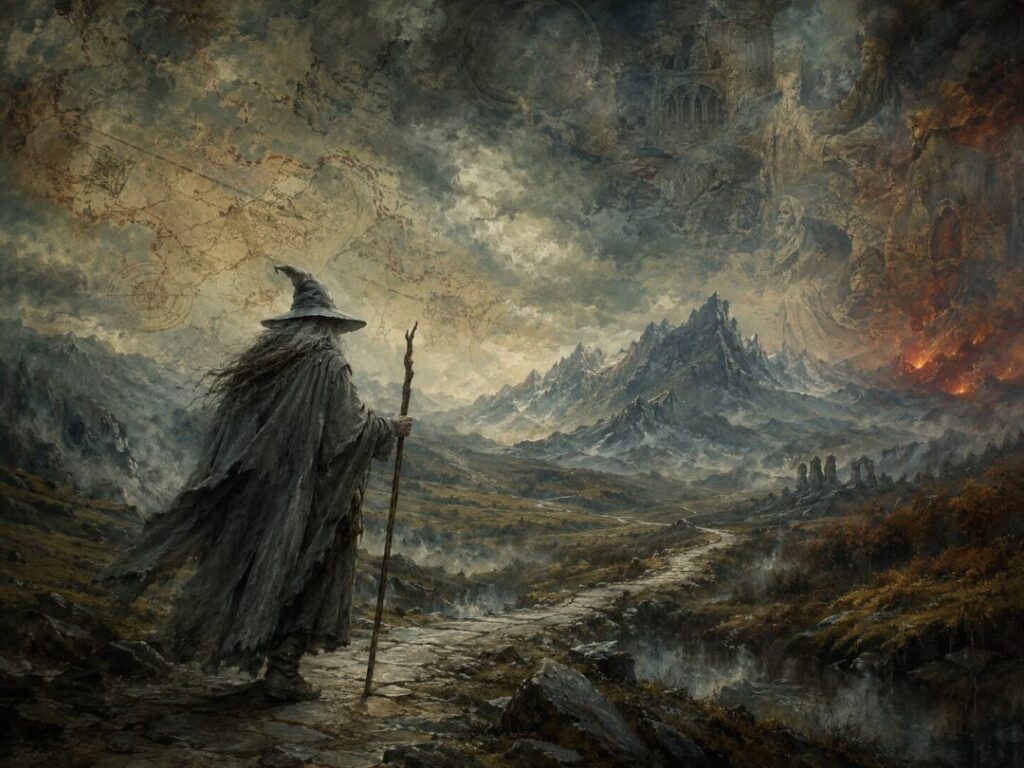
This matters because Gandalf’s patience is not the calm of someone holding a complete map. It is the discipline of someone moving faithfully through fog. He does not force the story into clarity before its hour. He keeps watch. He gathers evidence. He listens to small inconsistencies, such as Bilbo’s strange account of how he obtained the Ring. He refuses both panic and complacency.
That kind of patience is harder than certainty. It means acting when action is required, but also enduring the shame of not yet knowing.
The Patience Gandalf Learned Before Middle-earth
Gandalf’s patience also has roots beyond the Shire. In the lore of the Istari, he is Olórin, one of the Maiar, sent into Middle-earth in the form of an old man. The Wizards were not sent to conquer Sauron by matching power with power. Their task was to counsel, encourage, and kindle resistance among the Free Peoples rather than rule them directly. Reputable lore summaries of the Istari preserve this point, and Tolkien Gateway also notes the tradition that Olórin learned pity and patience from Nienna, the Vala associated with grief and compassion.
That background is important, but it should be handled carefully. Gandalf is not a simple allegory of pity, nor does every decision he makes come with an explained theological footnote. Still, the pattern is unmistakable. His greatest wisdom often appears where others see only delay, weakness, or foolish mercy.
He does not seize power in order to save the world. He refuses the Ring when Frodo offers it to him. He fears what he might become if he tried to use it, even for good. His patience is bound to humility: he knows that some powers cannot be used cleanly, even by the wise.
This is one of the hidden rules of Middle-earth. The desire to do good by domination is already perilously close to the logic of the Enemy.
“Meant” Does Not Mean Forced
The most direct doorway into providence comes when Gandalf tells Frodo that Bilbo was “meant” to find the Ring, and not by its maker. He then extends that meaning to Frodo’s own possession of it. The words are careful. Gandalf does not say that Bilbo was controlled like a puppet. He does not say that Sauron planned it. He says the opposite: the Ring’s maker did not intend this outcome.
This is providence in Tolkien’s world: not the erasure of free will, but a deeper ordering that can work through free choices, accidents, losses, and even evil designs. The Ring tries to return to its master. Gollum’s possessiveness, Bilbo’s chance discovery, Frodo’s inheritance, and the long road to Mordor are all full of personal choices and genuine danger. Yet the text repeatedly suggests that more is at work than blind chance.
The important point is that providence does not make the journey painless or morally simple. Frodo is not spared because he was “meant” to bear the Ring. In some ways, being chosen means suffering more deeply. Bilbo is not made immune to the Ring’s effects. Gollum is not healed by narrative convenience. Gandalf’s words offer meaning, not comfort in the cheap sense.
Providence gives the road significance. It does not remove the road.
The Long Delay Was Not Empty
Between Bilbo’s adventure and Frodo’s departure, decades pass. From a dramatic point of view, it can look like Gandalf waits too long. But within the story, that long patience reflects the difficulty of acting rightly without full knowledge.
Had Gandalf tried to take the Ring from Bilbo by force, he might have done spiritual violence to the very person he hoped to protect. Had he declared the Ring’s identity too early without proof, he might have caused panic or drawn attention. Had he trusted Saruman completely, the Ring might have been betrayed to a worse fate. Had he ignored the matter, Sauron’s servants might have found the Shire unprepared.
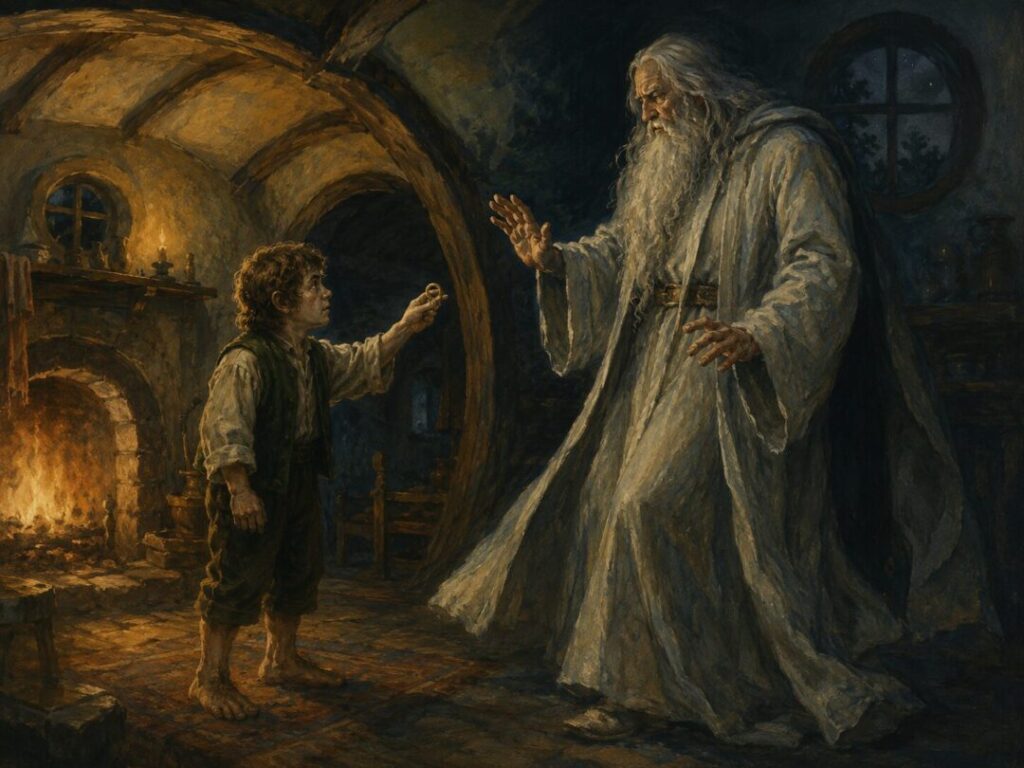
Instead, Gandalf watches Bilbo. He notes the unnerving effect of the Ring on him. He seeks Gollum. He searches records in Minas Tirith. The famous test in Bag End, when the Ring is cast into fire and its inscription is revealed, comes not as a sudden guess but as the end of a long, fearful inquiry.
This is patience as moral labor. Gandalf’s waiting is not passivity. It is investigation, restraint, and readiness. In Middle-earth, haste can be as dangerous as delay. Saruman’s impatience becomes corruption: he wants knowledge, order, machines, and power now. Gandalf’s patience keeps him poor, wandering, underestimated, and free.
Mercy as Cooperation With Providence
The strangest part of Gandalf’s patience is that it leaves room for Gollum.
Gollum is not romanticized. He murders Déagol. He is consumed by the Ring. He lies, sneaks, bites, curses, and betrays. The text never asks readers to pretend that he is harmless. Yet Gandalf insists that Frodo should not be eager to deal out death in judgment. Many who live deserve death, and some who die deserve life; the wise cannot always see all ends.
This is not a denial of justice. It is a warning against the arrogance of final judgment. Gandalf does not say Gollum is innocent. He says Gollum may still have some part to play, for good or ill, before the end.
That phrase is one of the keys to the entire story. Gollum’s life is preserved by Bilbo’s pity, then by Frodo’s mercy, then by the practical need for a guide. Sam’s suspicion of him is often justified; Frodo’s pity is also necessary. The story refuses to flatten the problem. Mercy does not make Gollum trustworthy. But without mercy, he would not be there at the Sammath Naur.
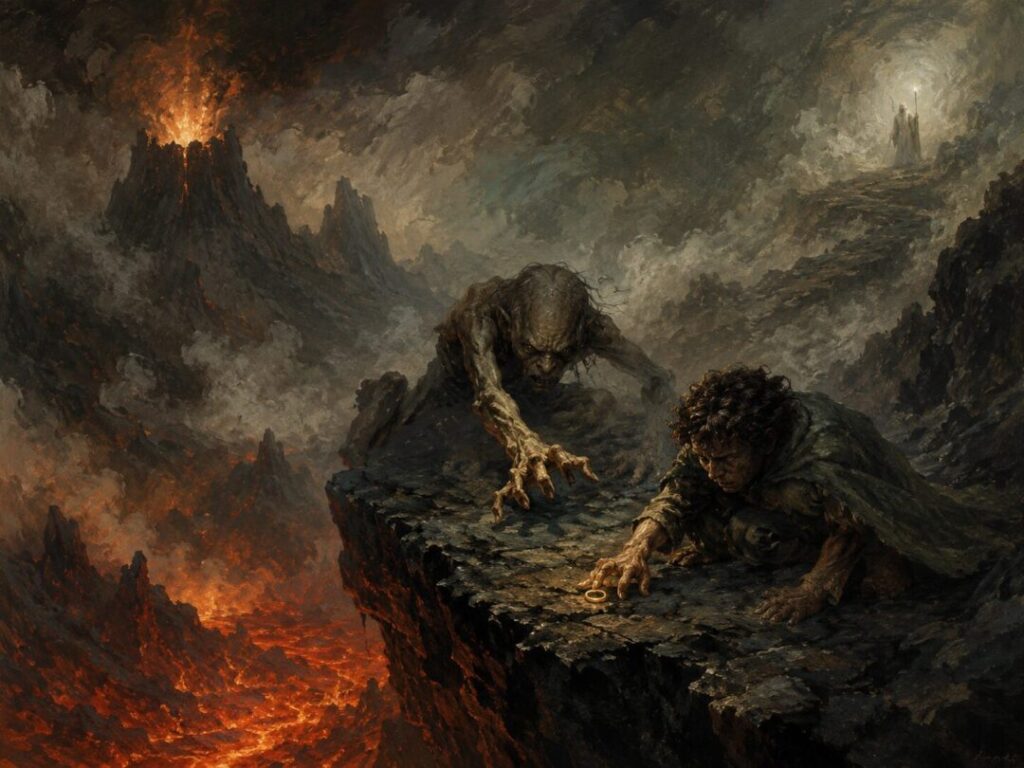
At the Cracks of Doom, Frodo fails to destroy the Ring by his own will. That failure should not be softened into a simple victory. The Ring overmasters him at the place of its greatest power. Gollum then attacks, takes the Ring, and falls with it into the Fire. Tolkien’s own later reflections on Frodo’s failure emphasize that Frodo had spent himself completely and that his mercy toward Gollum mattered deeply in the final outcome; this is commonly discussed in connection with Letter 246.
The result is not a tidy moral equation. It is a terrible mercy. Frodo’s pity does not redeem Gollum in a simple way. But it creates the condition in which evil destroys itself.
Gandalf’s Patience Is Hope Without Control
Gandalf’s long patience reveals that hope in Middle-earth is not the same as optimism. Optimism expects things to improve. Hope remains faithful when no clear improvement can be seen.
Again and again, Gandalf acts without controlling the outcome. He helps form the Fellowship, but it breaks. He falls in Moria, and others must go on without him. He returns as the White, but even then he cannot carry the Ring, cannot command Frodo’s road, and cannot guarantee victory. At Minas Tirith, he can resist despair, organize defense, and confront terror, but the final destruction of the Ring happens far away from his sight.
This is why Gandalf is so different from Sauron. Sauron’s will seeks to gather all things into one controlling gaze. Gandalf’s wisdom accepts that the good cannot be preserved by becoming another Dark Lord. He guides, but he does not possess. He urges, but he does not dominate. He waits, but he does not abandon.
Providence, as the story presents it, seems to favor that kind of humility. Not because humble people always win in obvious ways, but because they leave space for grace, mercy, and unexpected turns.
The Hidden Strength of Not Seeing All Ends
Gandalf tells Frodo that even the very wise cannot see all ends. That is not merely advice for Frodo. It is the principle by which Gandalf himself lives.
He cannot see the full end of Bilbo’s pity. He cannot see every consequence of sparing Gollum. He cannot see exactly how Frodo’s road will end. He cannot even prevent some disasters along the way. But he trusts that the refusal to do evil, the refusal to dominate, and the refusal to despise pity are not wasted.
This is the moral architecture beneath the adventure. The fate of Middle-earth depends on battles, swords, councils, and ancient powers. But it also depends on an old wizard’s patience with a frightened hobbit, a hobbit’s pity for a ruined creature, and the belief that mercy may matter beyond what anyone can foresee.
Gandalf’s patience does not reveal a world where everything is easy because providence exists. It reveals almost the opposite: a world where providence works through the costly endurance of those who keep faith without possessing certainty.
The Ring is destroyed not because every good character understands the whole design, but because enough of them remain faithful inside their own small part of it. Bilbo does not know what his pity will do. Frodo does not know how far his mercy will reach. Sam does not know that his loyalty will carry the quest when strength fails. Gandalf does not know all ends.
And yet, through those incomplete choices, the impossible road remains open.
That is the deep comfort of Gandalf’s long patience. Not that we can see the pattern. Not that we can master the outcome. But that in Middle-earth, mercy, restraint, and faithfulness may become part of a design larger than the wisdom of the wise.
Sources & Notes
- J.R.R. Tolkien, The Lord of the Rings, Book I, Chapter 2, “The Shadow of the Past” — Gandalf explains Bilbo’s pity, says Bilbo was “meant” to find the Ring, warns that the wise cannot see all ends, and reaches certainty only after long inquiry.
- J.R.R. Tolkien, The Lord of the Rings, Book II, Chapter 2, “The Council of Elrond” — Gandalf recounts his search for Gollum, Saruman’s misleading counsel, and the peril of trusting haste or power over patient discernment.
- J.R.R. Tolkien, Unfinished Tales, “The Istari” — the Wizards are sent to counsel and encourage resistance to Sauron rather than defeat him by domination, and Olórin is associated with pity and patience.
- J.R.R. Tolkien, The Lord of the Rings, Book VI, Chapter 3, “Mount Doom” — Frodo is overmastered at the Cracks of Doom, and Gollum’s preserved life becomes the immediate means by which the Ring is destroyed.
- J.R.R. Tolkien, The Letters of J.R.R. Tolkien, Letter 246 — Tolkien’s later discussion of Frodo’s failure and Gollum’s role supports the article’s reading of mercy, exhaustion, and providential outcome without making the ending morally simple.