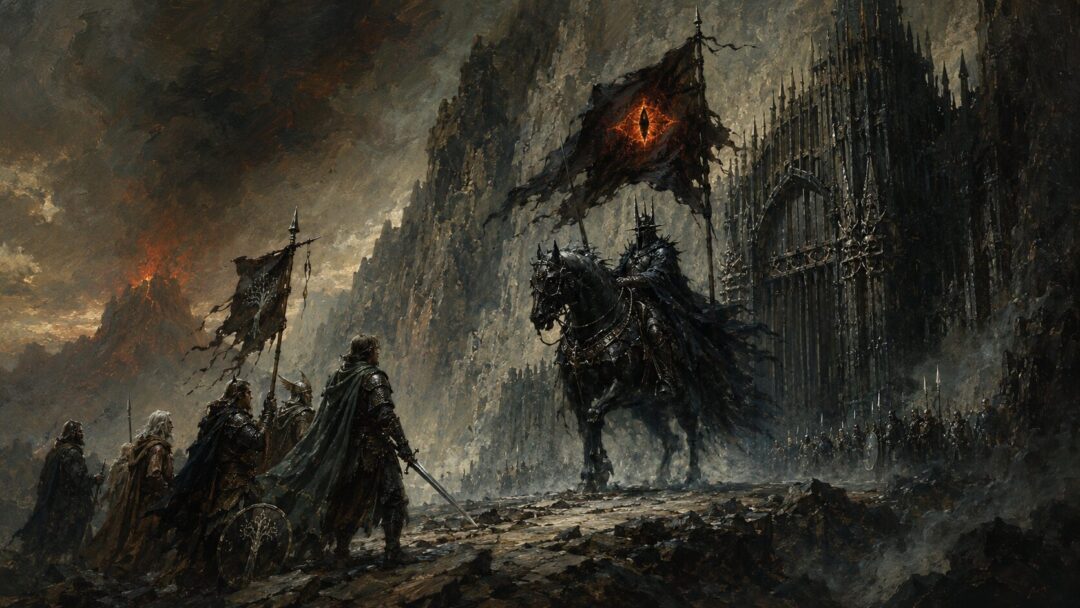
At the Black Gate, Sauron does not first answer the Captains of the West with a sword.
He answers with a voice.
That is easy to overlook, because the scene stands on the edge of open war. Aragorn, Gandalf, Éomer, Imrahil, and the remaining strength of the West have come before the Morannon with a force far too small to conquer Mordor. Behind the Gate wait armies they cannot defeat by ordinary means. Above all of it is Sauron, unseen but terrible, believing his enemies have come in desperation.
Yet the most dangerous thing he sends out before the battle is not a Nazgûl, not a troll, not a host of Orcs. It is a Man: the Mouth of Sauron.
His danger is not mainly physical. The text never presents him as a battlefield champion whose sword will decide the war. His power lies elsewhere. He is dangerous because he turns words into weapons, evidence into despair, and mercy into a trap. He is Sauron’s voice made flesh: not merely a messenger, but a living attempt to make the Free Peoples surrender inwardly before they are destroyed outwardly.
A Servant Who Has Become a Voice
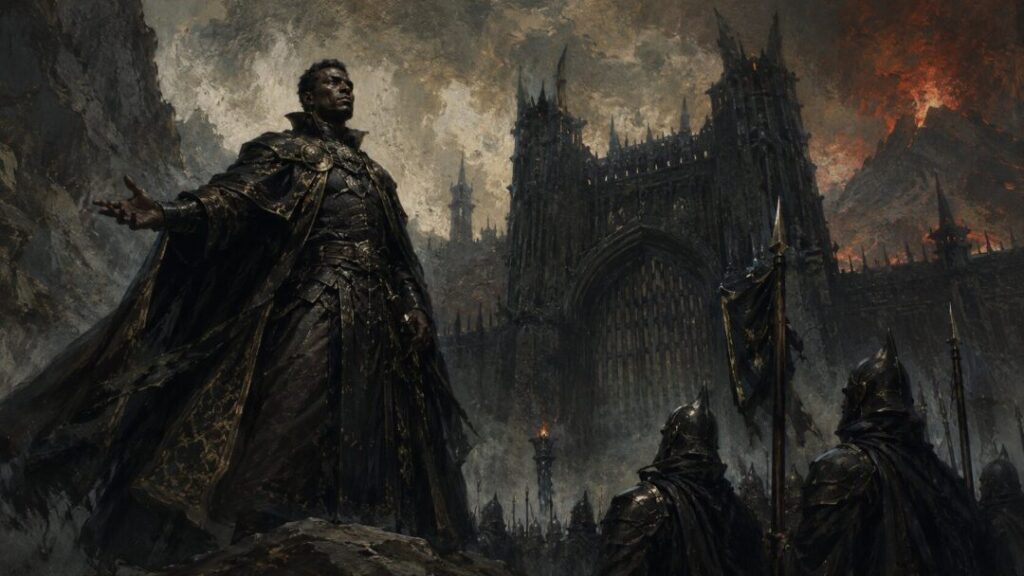
The Mouth of Sauron is introduced with unusual horror because he is not simply a monster from Mordor. He is a Man, described as one of the Black Númenóreans, a renegade from a people already burdened with a long history of pride, decline, and corruption. His name is not remembered; indeed, he himself has forgotten it. That detail is one of the most chilling things about him.
In Middle-earth, names matter. They carry memory, lineage, allegiance, and identity. To forget one’s name is not just to lose a label. It suggests that this man has surrendered so much of himself to the Dark Tower that he no longer stands before the world as a person in his own right. He says, “I am the Mouth of Sauron,” and that is the entire tragedy.
He has not merely served evil. He has allowed evil to define him.
The text says he learned great sorcery and knew much of Sauron’s mind. That does not make him equal to Sauron, nor does it make him one of the Nazgûl. The safer reading is more precise: he is a high servant, a lieutenant, a messenger, and an instrument trained in the will and methods of the Dark Lord. He is dangerous because he knows how Sauron thinks, how Sauron bargains, how Sauron threatens, and how Sauron twists hope into weakness.
He is not the Dark Lord’s hand.
He is the Dark Lord’s speech.
Why Sauron Sends a Messenger at All
By the time the Captains reach the Black Gate, their military position is hopeless if judged by numbers. Their march to Mordor is not a conventional invasion. Its real purpose is to draw Sauron’s attention away from Frodo and Sam, who are moving through Mordor toward Mount Doom. The Captains know they cannot overthrow Sauron by strength of arms alone.
But Sauron does not fully understand their plan. He sees boldness and interprets it through his own imagination of power. One likely reading is that he assumes Aragorn, newly revealed and carrying the sword reforged, may have the Ring or may be attempting to wield it. Sauron’s pride makes it difficult for him to imagine that his enemies would seek to destroy the Ring rather than claim it.
That misunderstanding is vital. The Mouth of Sauron comes out not merely to insult them, but to test them, break them, and, if possible, make them accept defeat without requiring Mordor to spend more strength than necessary. His appearance delays the battle for a moment, but more importantly, it attacks the hidden center of the West’s courage.
The Captains have come pretending to challenge Sauron openly, while secretly trusting in two small figures beyond their sight. The Mouth strikes exactly there.
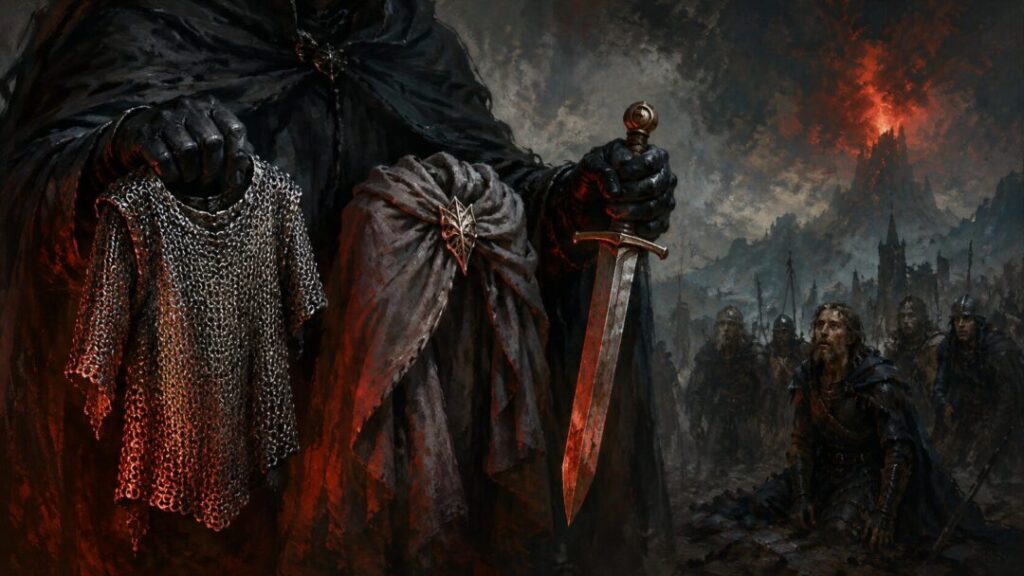
He produces tokens taken from Frodo and Sam: the mithril-coat, the grey cloak, and Sam’s sword. He does not need to show Frodo himself. The objects are enough. They carry the emotional force of proof.
The genius of the lie is that it is not built from nothing. The items are real. They have truly been taken. Frodo truly was captured in the Tower of Cirith Ungol. Sam truly had to leave some things behind. The Mouth’s deception is therefore more dangerous than a simple falsehood. It is a lie wrapped around fragments of truth.
That is often how evil works in Tolkien’s world: not by inventing an entirely new reality, but by bending a true thing until it becomes a weapon against hope.
The Attack on Hope
The Mouth of Sauron’s most dangerous act is not threatening torture. It is making the Captains imagine that their entire sacrifice has already failed.
The Western army has marched to the Black Gate with almost no expectation of survival. What sustains them is not military confidence but the possibility that Frodo still moves unseen. If the Ring-bearer has been captured, then the march is meaningless. The war is lost. Gondor and Rohan have not bought time; they have merely delivered their last defenders to slaughter.
That is the wound the Mouth tries to open.
He shows the tokens and lets the Captains draw the most devastating conclusion. He suggests that the spy they sent has been taken. He withholds the full truth because he does not know it. Sauron’s servants have found the gear, but they do not understand the whole mission. They do not know that the Ring has come so close to the Fire. They do not know that Sam still lives and that Frodo is moving again. Their ignorance is hidden beneath arrogance.
This makes the scene tense in a very specific way. The Mouth is terrifying, but he is also wrong. His confidence is real, but it rests on incomplete knowledge. He can break hearts with evidence, but he cannot see the whole story.
That is why Gandalf’s response matters so deeply. He does not accept the interpretation the Mouth offers. He takes back the tokens, but refuses the surrender. He calls out the cruelty and deceit of the messenger’s terms. Gandalf does not know everything either, but he understands enough to reject despair as a conclusion forced by the enemy.
The Mouth’s weapon is psychological certainty: “Your hope is dead; therefore obey.”
Gandalf’s resistance is moral clarity: “You do not get to define the meaning of what we have seen.”
The Terms of Sauron’s Mercy
The Mouth does not simply threaten death. He offers terms. That makes him more dangerous, because domination often arrives dressed as reasonableness.
The terms he presents are not peace in any true sense. They would leave Sauron supreme over the East, reduce the West to submission, disarm resistance, and place the defeated peoples under the shadow of Mordor’s will. The offer is designed to sound like an alternative to annihilation, but it is really another form of conquest.
This is one of the great moral traps of the scene. If the Captains believe Frodo is captured and tortured, then surrender might appear compassionate. Perhaps they could spare him pain. Perhaps they could save some lives. Perhaps they could preserve a diminished remnant of their peoples.
But the Mouth’s “mercy” is not mercy. It is control. It asks the West to betray its own freedom, abandon its duty, and trust the word of a power that has already shown itself faithless. The Mouth’s danger is that he tries to make surrender look like pity and cowardice look like wisdom.
This is not brute strength. It is corruption by negotiation.
Sauron’s rule has always involved more than armies. The Rings themselves were instruments of domination through desire, fear, and the promise of power. The Mouth of Sauron belongs to that same pattern. He does not need to defeat the Captains physically if he can persuade them to defeat themselves.
Aragorn’s Silent Answer
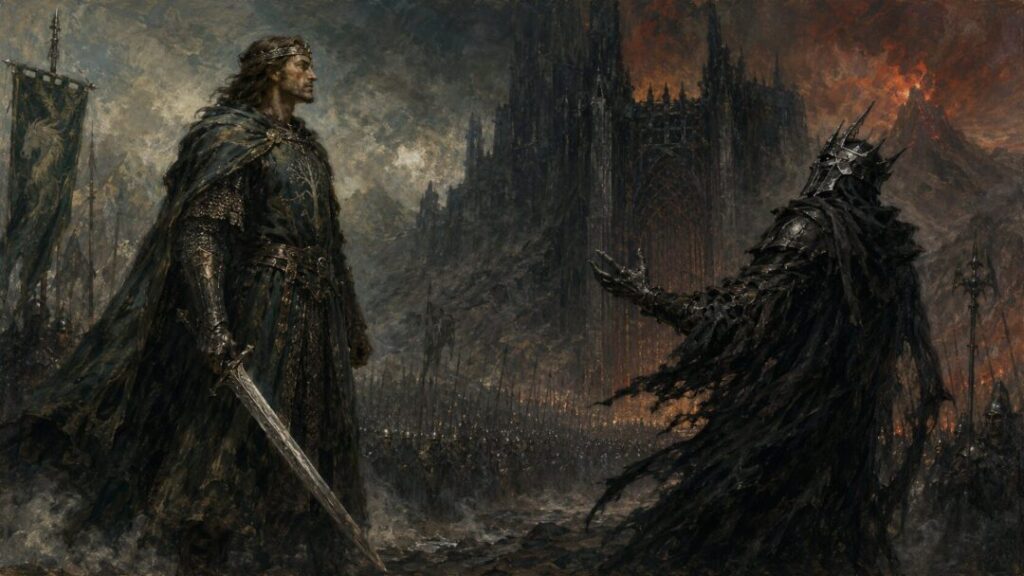
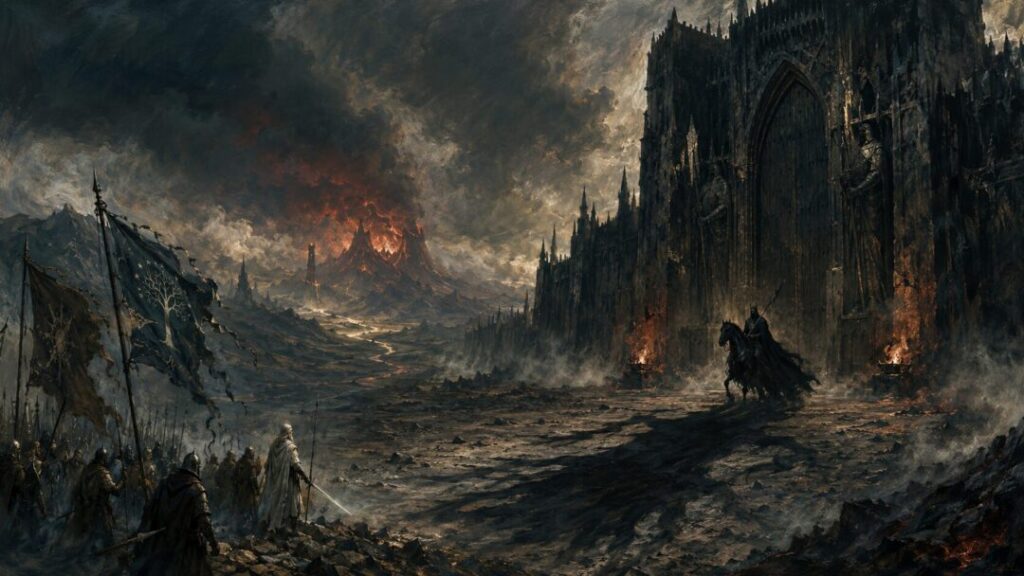
One of the most striking moments in the parley is Aragorn’s silence. He does not answer the Mouth with a speech. He simply looks at him, and the Mouth quails.
This should not be exaggerated into a magical duel beyond what the text states. But it is still significant. Aragorn is not merely a warrior here. He is the heir of Elendil standing before a corrupted Númenórean servant of Sauron. The contrast is sharp: one man has inherited ancient dignity through humility, endurance, and service; the other has inherited the ruin of pride and has become nameless in another’s will.
Aragorn’s gaze exposes something the Mouth cannot bear. The lieutenant of Barad-dûr is accustomed to fear, flattery, obedience, and command. He speaks for a master who rules by domination. But before Aragorn he meets a different kind of authority, one rooted not in possession but in rightful kingship and moral courage.
The Mouth is not destroyed by that glance. He recovers and continues his errand. Yet for a moment, the servant of Sauron gives ground without a blow being struck. It is a small but revealing defeat. His power depends on making others feel helpless. When he faces someone who will not be inwardly mastered, his own confidence falters.
More Dangerous Than Strength
So why was the Mouth of Sauron more dangerous than strength?
Because strength can be measured. Armies can be counted. Gates can be seen. But the Mouth attacks the unseen battlefield where the fate of the West truly hangs: courage, trust, interpretation, and hope.
He arrives at the precise moment when the Captains are most vulnerable. He possesses real tokens from their friends. He speaks with the authority of Mordor. He offers a story that seems plausible and devastating. He tempts them to believe that love itself requires surrender. He turns Frodo’s suffering into leverage. He turns uncertainty into despair.
That is more subtle than an Orc-charge and, in some ways, more perilous. If the Captains had accepted his version of reality, the war could have been lost before the battle began. Not because Mordor had struck harder, but because the West had ceased to stand.
The Mouth of Sauron embodies one of the darkest truths in the story: evil does not only seek to kill the body. It seeks to command the meaning of events. It wants its victims to see every wound as proof that hope was foolish, every loss as proof that resistance was vain, every act of mercy as weakness, and every delay as defeat.
But at the Black Gate, the lie fails.
The Captains do not know that Frodo and Sam are still moving. They do not know how close the end is. They cannot see the path inside Mordor. All they can do is refuse to let Sauron’s messenger interpret the world for them.
That refusal is one of the hidden victories of the chapter.
Before the Ring falls into the Fire, before Barad-dûr collapses, before the armies of Mordor break, the Mouth of Sauron is already answered. Not by greater force, but by a deeper fidelity: the refusal to surrender hope to the enemy’s story.
And that is why he is so dangerous.
Not because he is stronger than the Captains of the West.
Because, for one terrible moment, he almost makes despair sound like truth.
Sources & Notes
- J.R.R. Tolkien, The Lord of the Rings, Book V, Chapter 10, “The Black Gate Opens” — the Mouth of Sauron appears as Sauron’s nameless Black Númenórean messenger, displays Frodo and Sam’s tokens, offers false terms, and tries to turn uncertainty into surrender.
- J.R.R. Tolkien, The Lord of the Rings, Book VI, Chapter 1, “The Tower of Cirith Ungol” — Frodo’s capture, the stripping of his gear, and Sam’s recovery of his master show why the Mouth’s evidence is real but his conclusion is dangerously incomplete.
- J.R.R. Tolkien, The Lord of the Rings, Book V, Chapter 9, “The Last Debate” — Gandalf and the Captains deliberately march on Mordor as a diversion, knowing they cannot win by arms but hoping to draw Sauron’s eye from the Ring-bearer.
- J.R.R. Tolkien, The Silmarillion, “Of the Rings of Power and the Third Age” — Sauron’s rule is framed around domination, deceit, fear, and the Rings as instruments for bending other wills, matching the Mouth’s weaponized negotiation.
- J.R.R. Tolkien, The Letters of J.R.R. Tolkien, Letter 131 — Tolkien describes Sauron’s central motive as ordering and controlling all things according to his own will, which supports the article’s emphasis on despair and domination rather than mere battlefield strength.