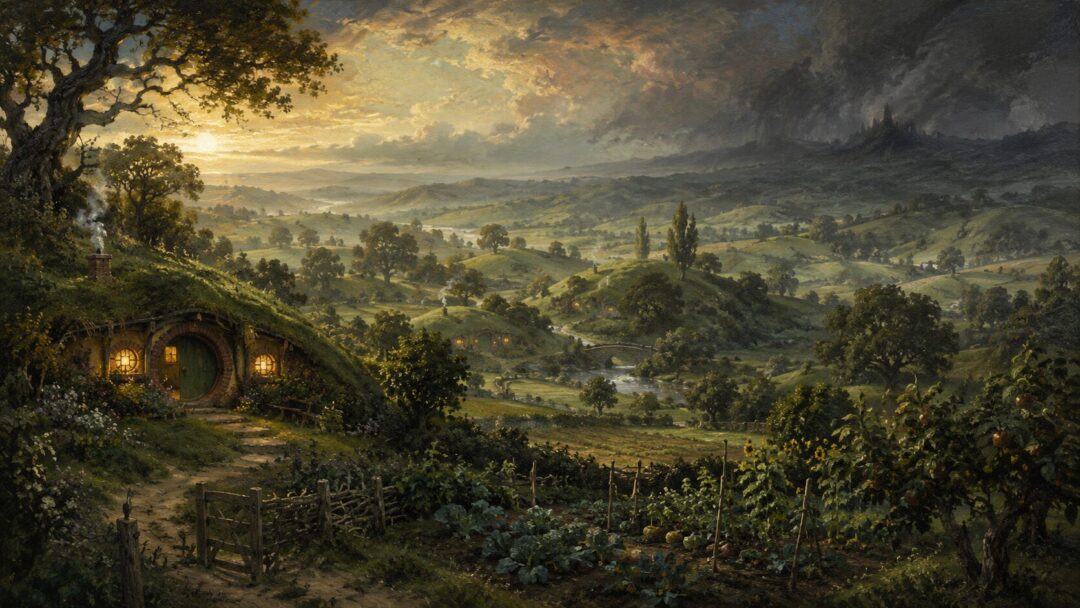
The Shire feels safe because it is small. Its lanes are narrow, its fields are familiar, its gardens are loved, and its dangers usually arrive as rumors from somewhere else. Yet one of the strangest questions in The Lord of the Rings quietly bends that comfort out of shape: could the lost Entwives have liked such a place?
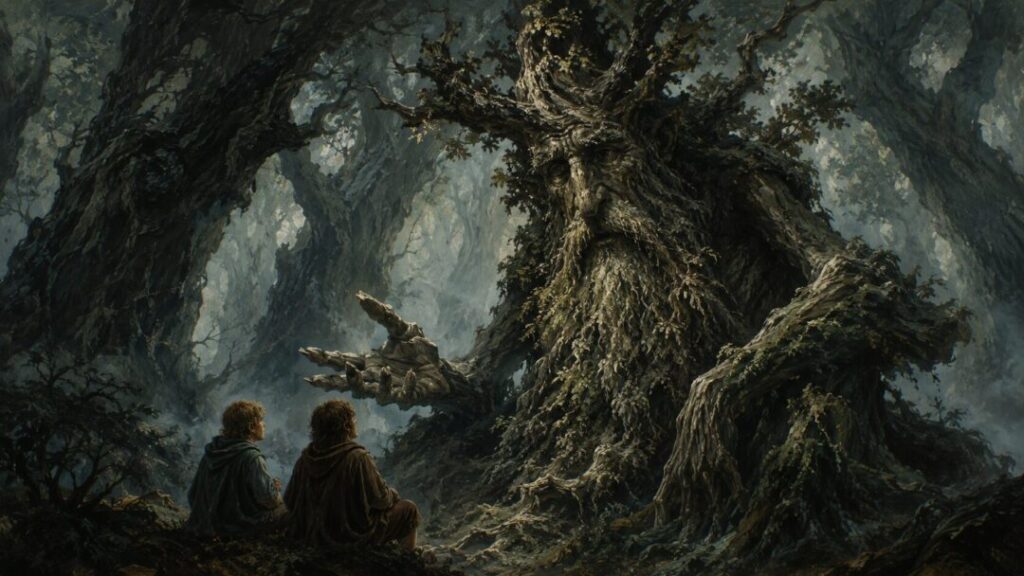
Treebeard does not ask Merry and Pippin about armies, kings, or Rings first. When the hobbits describe their country, his old mind turns toward something more painful. The Shire sounds, to him, like the kind of land the Entwives would have cherished. Not Fangorn’s deep, ancient, perilous forest, but gardens, tilled earth, ordered growth, fruitfulness, domestic beauty. That single association changes the Shire. It stops being merely a cozy refuge at the edge of the map and begins to resemble the last echo of something much older, something already lost.
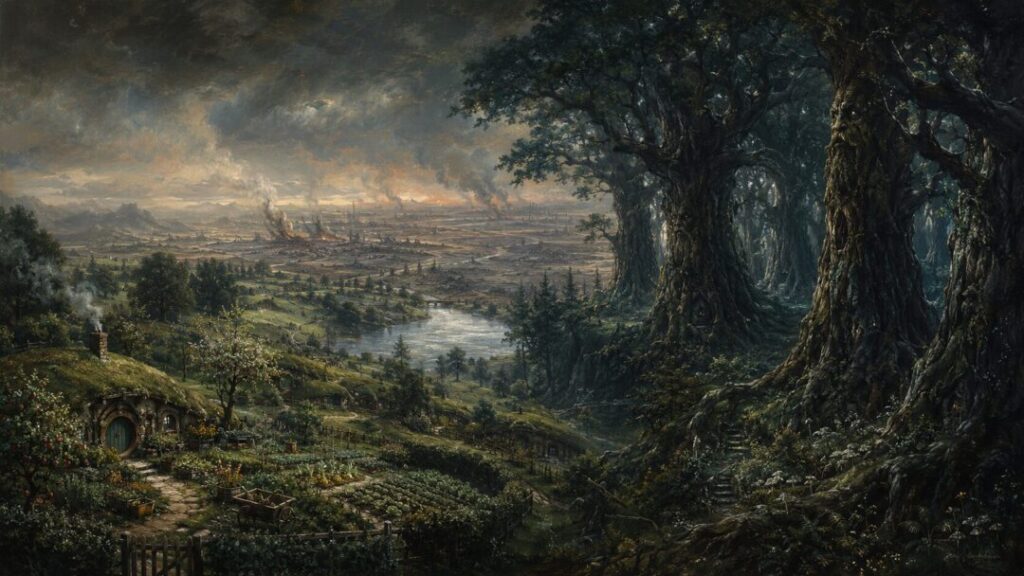
The disappearance of the Entwives makes the Shire feel more fragile because it reveals that even gentle, cultivated places are not outside the tragedies of Middle-earth. Gardens can vanish. Peace can be burned. A way of living can survive only as memory, habit, and longing.
The Entwives Were Not Simply “Female Ents”
The Entwives are easy to reduce into a missing category: the lost wives of the Ents. But Treebeard’s account gives them a distinct spiritual and ecological role. The Ents loved the great trees and the wild woods. The Entwives, by contrast, loved smaller growing things: plants, fields, fruit, flowers, grasses, and the ordered care of the earth. They wanted things to grow according to their tending. They taught, cultivated, and made gardens.
This difference is not presented as villainy on either side. It is a separation of loves. The Ents became increasingly bound to the deep forests, while the Entwives moved away and made gardens in lands later associated with the Brown Lands. Treebeard’s grief is not only romantic grief. It is the sorrow of two visions of living nature that drifted apart and never found their way back. The Entwives represent nature under care, agriculture before domination, cultivation before industry.
That is why the Shire matters. Hobbits are not forest spirits. They are not Ents. They farm, garden, brew, store, harvest, smoke, cook, and measure life by seasons and family customs. They belong to tilled land. When Treebeard hears of them, he recognizes a pattern. The Shire is not an Entwife settlement, and the text never says the Entwives went there. But it is exactly the sort of land that reminds him of them.
The Shire as an Entwife-Like Place
The Shire’s beauty is not the untouched wilderness of Lothlórien or the wild depth of Fangorn. It is hedges, fields, gardens, mills, orchards, lanes, and comfortable holes under green hills. Its ideal is not grandeur but rootedness. Its people do not think of themselves as guardians of some ancient ecological wisdom, but their ordinary habits preserve a quieter form of it.
This makes the Shire feel more vulnerable, not less. If the Entwives once made beloved gardens and still disappeared, then the Shire’s gentleness is no shield by itself. It can be loved and still be threatened. It can be fertile and still be destroyed. It can seem too small for history, and yet history can still reach it.
That is one of the deeper shocks of the Entwife mystery. The Shire resembles what has already been lost elsewhere. It is not merely a safe homeland waiting for the heroes to return. It is a living reminder that domestic peace is perishable.
The Brown Lands Are the Shire’s Dark Mirror
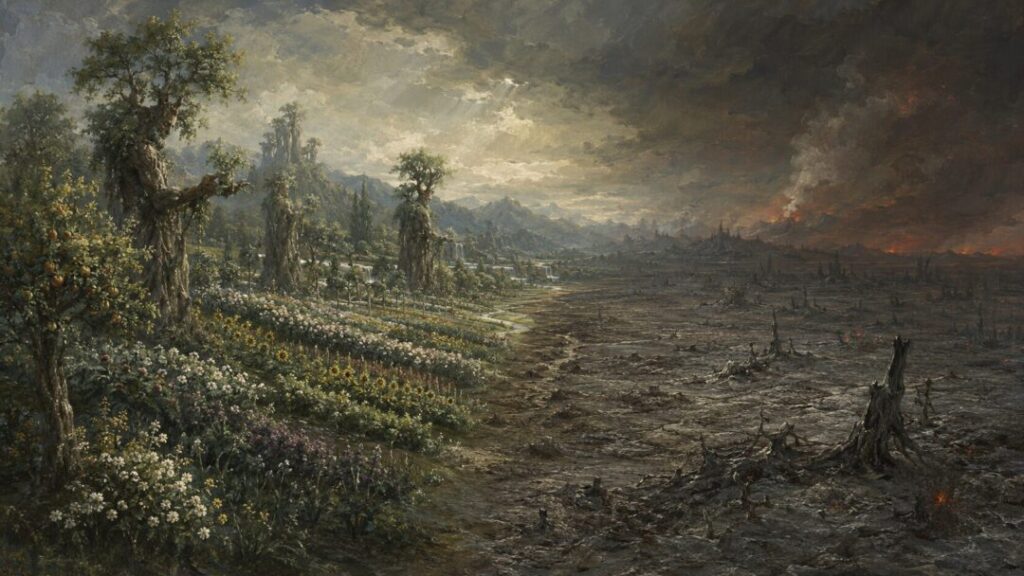
The Brown Lands appear in The Lord of the Rings as a desolate region east of the Anduin, a barren stretch seen by the Fellowship from the river. In the lore surrounding the Entwives, these lands are linked to their former gardens. Tolkien later suggested in a letter that the Entwives may have been destroyed with their gardens during the War of the Last Alliance, while also leaving room for uncertainty about whether some fled east or suffered some other fate. This is not a cleanly resolved historical fact within the narrative itself; it remains one of Middle-earth’s deliberate wounds.
That uncertainty is essential. If the Entwives had a clear ending, their story would become a tragic entry in a chronicle. Instead, their absence haunts the living characters. Treebeard does not speak as a historian closing a case. He speaks as someone still listening for footsteps that may never come.
The Brown Lands make the Shire feel fragile because they show what a garden can become after war. A cultivated paradise can be reduced to a name of colorless ruin. The Shire’s green fields are not guaranteed by the moral innocence of hobbits. They endure because evil has not yet fully turned its machinery upon them.
Sam’s Garden and the Memory of the Entwives
No hobbit is more connected to this theme than Sam Gamgee. Sam is not a king, wizard, or warrior by nature. He is a gardener. His deepest instincts are not conquest or glory, but care: putting things back, making them grow again, preserving what is small and beloved. That is why the Entwives’ disappearance casts such a long shadow over him, even indirectly.
Sam never meets an Entwife. He never solves their mystery. But in the emotional architecture of the story, he carries something close to their world: the love of earth under humble cultivation. His dream of the Shire is not abstract patriotism. It is beer, gardens, trees, food, doors, paths, and the people who belong among them.
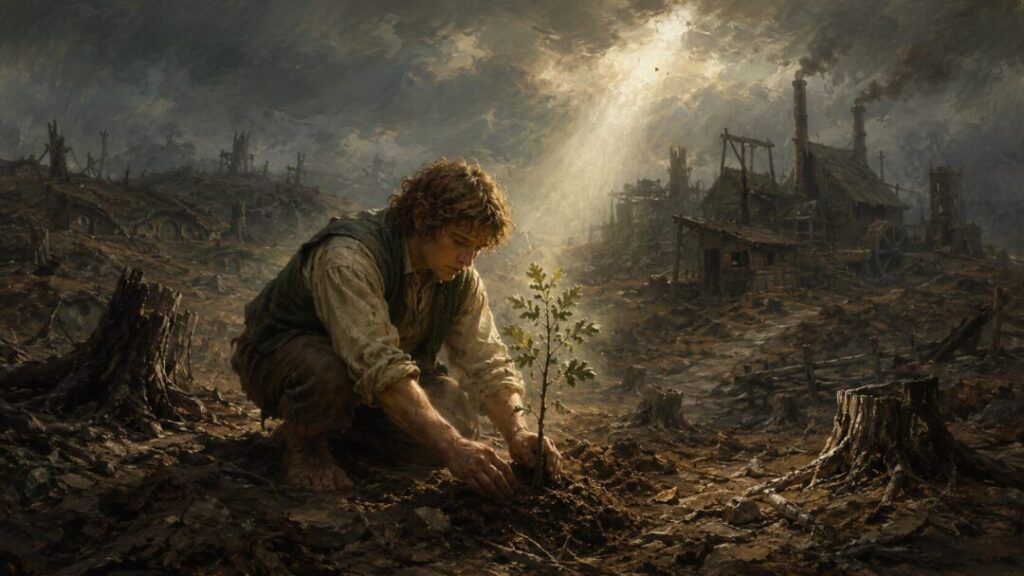
This is why the Scouring of the Shire feels so devastating. When the hobbits return, they do not find the Shire untouched by the War. They find trees cut down, ugly structures raised, food controlled, local life bullied, and the land wounded by petty industrial tyranny. The Shire becomes, briefly and terribly, a small version of the same principle that destroyed other green places: order twisted into domination, productivity severed from love.
The Entwives’ absence prepares the reader for this. The story has already taught us that gardens can be lost.
The Shire Was Never Outside the War
The hobbits begin with the comforting belief that great events happen elsewhere. Mordor is far away. Isengard is unknown. Fangorn is a legend. The Entwives, if the hobbits have heard of them at all, belong to a world too ancient and strange to touch their own.
But the deeper movement of The Lord of the Rings is the collapse of that illusion. The Shire is not outside Middle-earth’s history. It is protected for a time by obscurity, by the Rangers, by Gandalf’s concern, and by the reluctance of great powers to notice small things. But obscurity is not invulnerability.
Treebeard’s question pierces that illusion. If the Entwives might have liked the Shire, then the Shire belongs to the same moral geography as Fangorn, the Brown Lands, Ithilien, and Mordor. Its gardens are part of the same threatened world. Its peace is not childish background scenery. It is one of the things the War is about.
The Entwives’ Fate Is More Frightening Because It Is Unfinished
Tolkien’s later comments lean toward a bleak possibility: that the Entwives disappeared for good, destroyed with their gardens. But within the story, Treebeard does not know. He hopes, searches, remembers, and asks the hobbits to send word if they hear anything. Reputable lore references preserve both sides of this tension: the narrative mystery and the later, darker authorial speculation.
That unfinished quality matters. A fully explained tragedy can be mourned and shelved. An unresolved disappearance remains active. It keeps asking questions.
What happened to the caretakers of cultivated growth? What happens when those who know how to tend the earth are separated from those who guard the wild? Can a culture of gardens survive war, displacement, and domination? Or does it survive only in fragments, passed down into the habits of Men and hobbits?
The Shire feels fragile because it may be living on inherited wisdom whose original guardians are gone.
Not a Theory That the Entwives Are Secretly in the Shire
It is tempting to turn Treebeard’s question into a hidden-answer puzzle: perhaps the Entwives are in the Shire; perhaps a walking tree glimpsed in the Northfarthing proves it; perhaps the hobbits have been living beside them all along. The text does not confirm this.
There is indeed a strange early report in the Shire of a “walking tree,” treated by hobbits with skepticism. Later, Treebeard’s interest in the Shire makes that detail feel more suggestive. But suggestion is not proof. The safer reading is that the Shire reminds Treebeard of the Entwives rather than revealing their location.
That restraint makes the connection more powerful. The point is not that the Shire secretly contains the answer to the Entwives’ disappearance. The point is that the Shire resembles the kind of world their loss makes precious.
The Scouring Turns the Entwife Theme Into Local Pain
When Sharkey’s men damage the Shire, the hobbits experience in miniature what older lands suffered on a greater scale. Trees are felled not because they must be, but because ugliness and control have become habits of power. Food is gathered and withheld. Mills and rules replace neighborly life. The Shire’s harm is smaller than Mordor’s, but it is not symbolically small.
This is where the Entwives’ disappearance deepens the ending. The reader has already seen Fangorn’s wrath against Isengard, where living trees and Ents answer the axe, fire, and machinery of Saruman. But the Shire cannot be saved by Ents. It must be restored by hobbits.
Sam’s use of Galadriel’s gift after the Scouring becomes one of the story’s great acts of healing. He does not merely mourn the felled trees. He replants. He tends. He participates in restoration rather than conquest. This does not undo the Entwives’ loss, but it answers it in the only way the Shire can: by refusing to let beloved growing things remain ruined.
A Fragile Peace Is Still Worth Defending
The Entwives’ disappearance does not make the Shire meaningless. It makes it more meaningful. Its gardens are not safe because the world is kind. They are worth protecting because the world is not.
The Shire’s fragility is part of its moral force. A fortress can look important because it resists attack. A garden looks ordinary until someone tries to destroy it. Then its true value appears. The Entwives teach this by absence. Their lost gardens haunt every green hill and tilled field that remains.
By the end of The Lord of the Rings, the Shire is no longer an untouched childhood refuge. It has been wounded, defended, and replanted. Its peace has become conscious. The hobbits now know that home is not protected by pretending evil is far away. It is protected by courage, memory, labor, and love.
Treebeard’s old question lingers because it was never only about finding the Entwives. It was about recognizing what kind of place they would have loved. And once we see the Shire that way, it becomes more than cozy. It becomes endangered, irreplaceable, and heartbreakingly alive.
Sources & Notes
- J.R.R. Tolkien, The Lord of the Rings, Book III, Chapter 4, “Treebeard” — Treebeard contrasts the Ents’ love of forests with the Entwives’ love of gardens, fields, fruit, flowers, and ordered growing things.
- J.R.R. Tolkien, The Lord of the Rings, Book II, Chapter 9, “The Great River” — the Fellowship sees the Brown Lands as a bare, lifeless waste, the landscape later tied to the lost gardens of the Entwives.
- J.R.R. Tolkien, Letter 144 — Tolkien’s later explanation suggests the Entwives and their gardens were probably destroyed during Sauron’s war, while preserving the story’s sense of unresolved loss.
- J.R.R. Tolkien, The Lord of the Rings, Book I, Chapter 2, “The Shadow of the Past” — Sam’s report of a “walking tree” in the Northfarthing gives the Shire a faint, suggestive link to the Entwife mystery without proving it.
- J.R.R. Tolkien, The Lord of the Rings, Book VI, Chapter 8, “The Scouring of the Shire” — the damaged trees, rules, mills, and hoarded food show the Shire’s garden-like peace wounded by domination and petty industry.
- J.R.R. Tolkien, The Lord of the Rings, Book VI, Chapter 9, “The Grey Havens” — Sam uses Galadriel’s gift to replant and heal the Shire, answering destruction through humble cultivation rather than conquest.