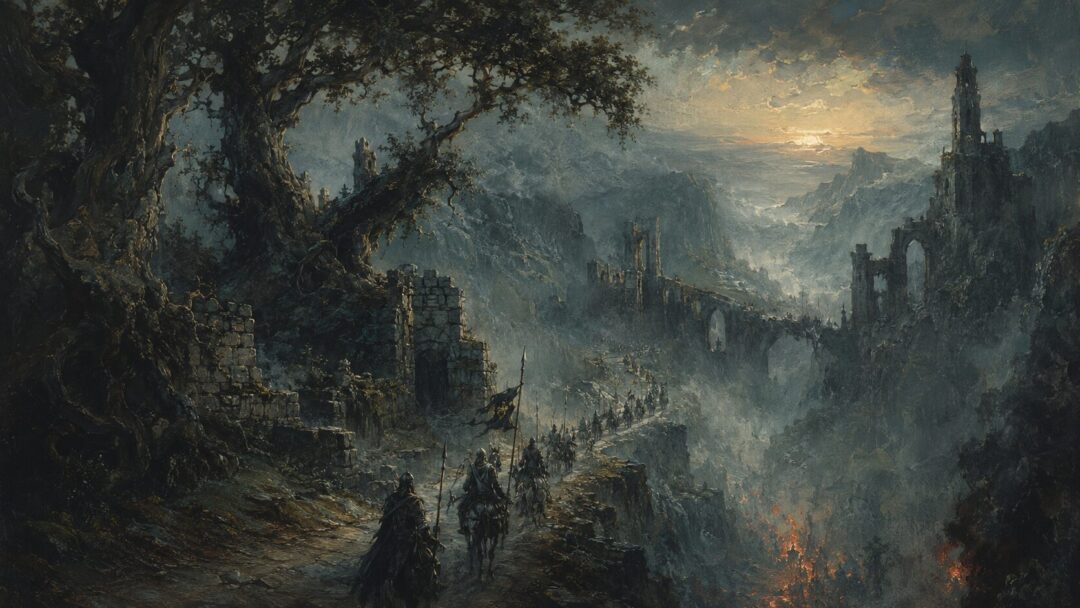
The Battle of the Pelennor Fields is usually remembered by sound: the horns of Rohan, the cry of Théoden, the thunder of hooves at dawn. Minas Tirith sees the Riders arrive like a sudden answer to despair, and the story seems to belong to kings, captains, and open war.
But before the horns sounded, the fate of Gondor passed through a darker and quieter place.
In the Drúadan Forest, far from the walls of Minas Tirith, the Rohirrim met a people many in the West had barely understood and often despised: the Drúedain, called Woses or Wild Men by others. Their leader, Ghân-buri-Ghân, did not ride in shining armor. He did not stand on the walls of the White City. He did not seek glory in the songs of Men.
Yet without him, the Riders of Rohan might have arrived too late — or not at all.
The strange irony is that Gondor’s deliverance depended, in part, on a people who lived at the edge of Gondor’s knowledge, remembered by outsiders more as rumor than as allies. The Drúedain changed the War of the Ring not by winning a battle, but by making the battle possible.
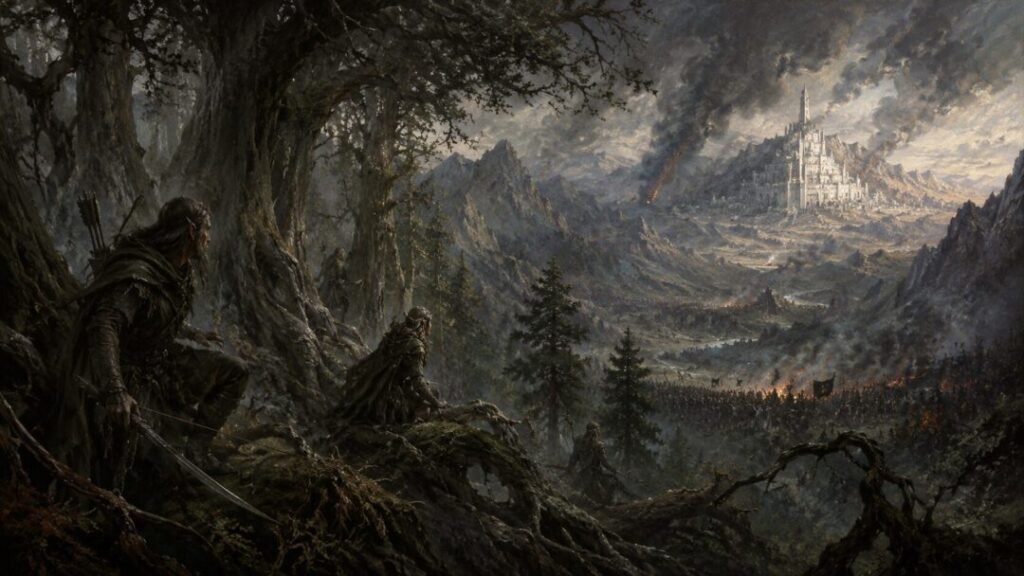
The Hidden Crisis Before the Charge
When Théoden led the Rohirrim toward Minas Tirith, speed was everything. Gondor was already under siege. The beacons had been lit. The Enemy’s forces had crossed into the lands before the White City, and every delay mattered.
But the road was not simply open.
In The Return of the King, the Rohirrim discover that the Enemy has forces watching and blocking the approach. This is one of the easily overlooked military dangers of the march: Rohan’s army is not just racing against time; it is trying to reach the Pelennor without being trapped, delayed, or revealed too soon.
The Enemy understands roads, signals, and reinforcements. If the Rohirrim are stopped in the wrong place, the siege of Minas Tirith continues without them. If they are spotted too early, the forces before the city can prepare. If they are forced to fight through a guarded passage, their arrival loses the shock that later matters so much.
This is where the Drúedain enter the story.
They do not give Théoden more soldiers. They give him something more valuable at that moment: hidden knowledge of the land.
Ghân-buri-Ghân knows paths through the Drúadan Forest and the Stonewain Valley that the Rohirrim do not. He knows where the Enemy is. He knows how many are nearby. He knows the old ways through the hills and trees. The texts present this knowledge not as courtly strategy, but as lived intimacy with a land older than Gondor’s road-system and older than Rohan’s presence there.
The great cavalry charge begins with an act of guidance.
A People Older Than the Kingdoms Around Them
The Drúedain are not merely a strange forest tribe invented for one chapter of the war. Other writings give them a deeper place in the history of Middle-earth.
In Unfinished Tales, they are treated as a distinct people of Men, known in older days by names such as Drughu or Drû. They are associated with the Edain in the First Age, especially in connection with the People of Haleth. The Eldar recognized them as Men, though different in appearance and culture from the better-known Houses of the Edain.
This matters because it prevents a shallow reading of Ghân-buri-Ghân as a sudden curiosity. The Drúedain are not outside history. They are part of its older, less celebrated layers.
By the end of the Third Age, however, the Drúedain of Anórien seem to be only a remnant. They live in the Drúadan Forest, near the road to Minas Tirith, close enough to Gondor to be affected by its power but distant enough to remain misunderstood. Their presence is a reminder that the map of Middle-earth is not only made of kingdoms. It is also made of surviving peoples, local memories, and old injuries.
The War of the Ring often turns on those who are easy to overlook: Hobbits, forest peoples, forgotten roads, old oaths, small acts of mercy. The Drúedain belong to that pattern.
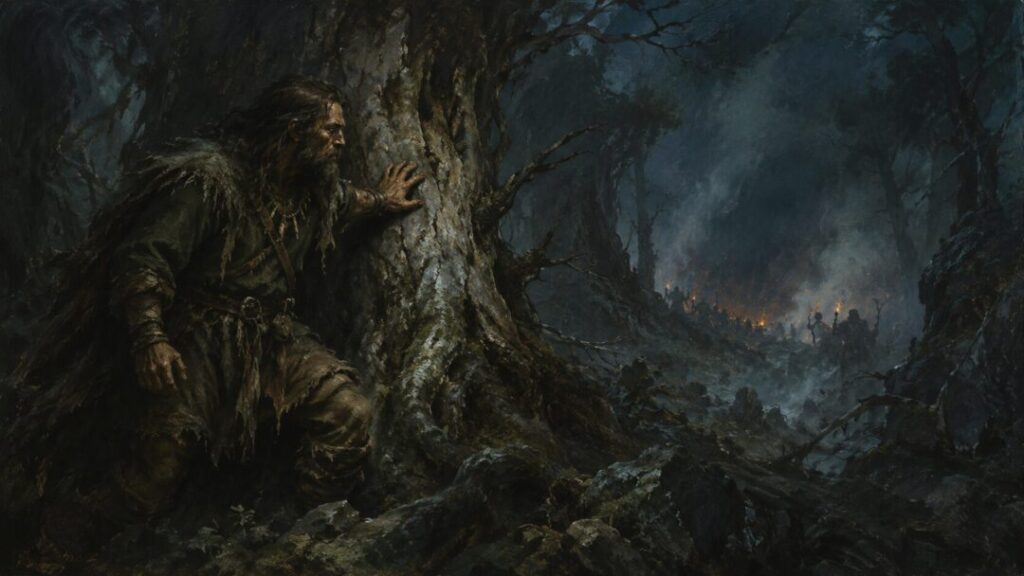
Ghân-buri-Ghân’s Bargain
Ghân-buri-Ghân does not approach Théoden like a servant begging favor. He comes as a leader making terms.
His offer is practical: he will guide the Rohirrim by a hidden way, helping them avoid the watching forces of the Enemy. But he also asks for something in return. He wants the “Wild Men” to be left in peace. The implication is painful: they have been treated not simply as strangers, but as creatures to be hunted.
This is one of the most morally sharp moments in the march to Minas Tirith. Rohan needs help from a people its own riders may have feared, mocked, or harmed. The West’s salvation depends on someone the West has not properly honored.
The texts do not turn Ghân-buri-Ghân into a sentimental figure. He speaks bluntly. He hates Orcs. He is wary of the Rohirrim. He is not absorbed into their culture or made to admire them. He helps because the Enemy is also his enemy, and because this moment gives him leverage to protect his people.
That makes the alliance more powerful, not less. It is not a simple friendship scene. It is a wartime bargain between unequal peoples, shaped by necessity, old fear, and a chance for justice.
What the Drúedain Actually Changed
The Drúedain changed the war in three connected ways.
First, they gave the Rohirrim information. Ghân-buri-Ghân knows the Enemy’s movements and numbers in the area. This intelligence matters because Théoden is moving through dangerous country with a large mounted force. A cavalry army is powerful in the open, but vulnerable to delay and obstruction when roads are watched or blocked.
Second, they gave the Rohirrim a route. The hidden road through the Stonewain Valley allows the Riders to bypass the Enemy’s watch. This is not a glamorous deed, but it is decisive. The great events on the Pelennor depend on the army reaching the field at the right time and in fighting condition.
Third, they helped preserve surprise. The arrival of Rohan at dawn is devastating because it comes when Minas Tirith is near despair and the Enemy is committed to the siege. The horns of Rohan are not merely symbolic; they announce a force that has successfully appeared where it was desperately needed.
The Drúedain do not destroy the Witch-king. They do not break the armies of Mordor by themselves. But their guidance helps place Théoden, Éomer, Merry, and the Riders exactly where the larger story needs them to be.
That is often how hidden power works in Tolkien’s world. It does not always look like command. Sometimes it looks like knowing the old road.
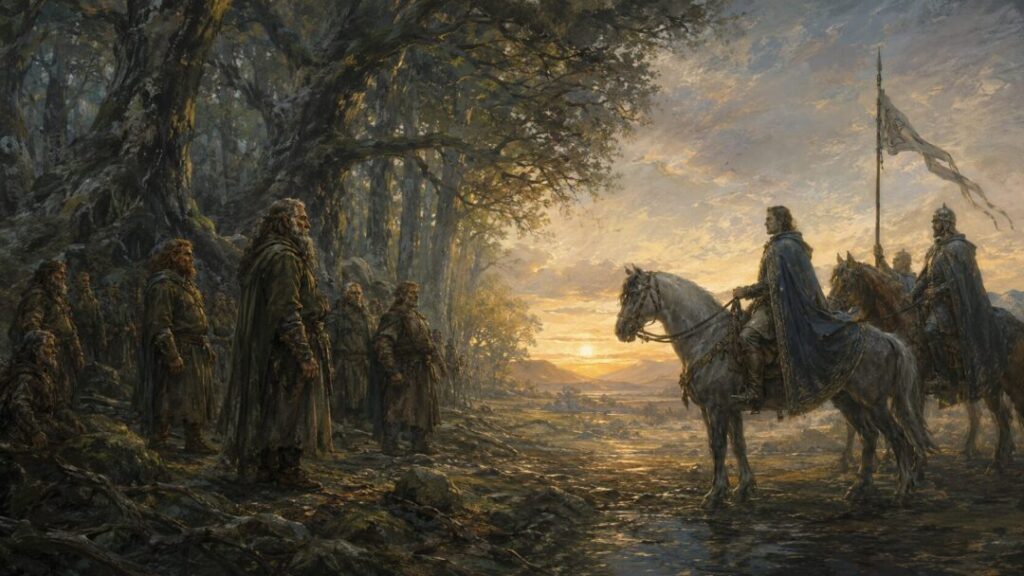
Gondor’s Blindness
The title of this story could almost be taken literally: Gondor never saw what the Drúedain did.
The defenders of Minas Tirith see the result. They see Rohan arrive. They hear the horns. They witness the charge. But they do not see the tense meeting in the forest, the old paths, the bargaining, or the people whose knowledge made the arrival possible.
That blindness is not only physical. It is cultural.
Gondor is ancient, noble, and learned, but it does not know everything within its own borders. Its great city looks east toward Mordor and upward toward its own high lineage, but the Drúedain live in the wooded margins of Anórien with memories and skills that the great powers do not possess.
This is not an argument that Gondor is evil. The story is more subtle than that. Gondor is one of the chief bulwarks against Sauron. Its courage is real. But even the noblest kingdoms can fail to see the full worth of those beyond their preferred image of civilization.
The Drúedain expose that limitation. They are not saved by Gondor; in this moment, they help save Gondor.
The Old Hatred of Orcs
One reason the alliance works is that Ghân-buri-Ghân and his people hate the Orcs. In The Return of the King, his word for Orcs, “gorgûn,” carries that hostility plainly. Unfinished Tales also presents the Drúedain as long-standing enemies of Orcs.
This hatred is not abstract politics. For a small forest people, Orcs mean terror, raids, and destruction. The war that great kings discuss in terms of realms and strategy reaches the Drúedain as an immediate threat to their woods and lives.
That gives their choice moral weight. They are not neutral guides hired for convenience. They have their own stake in Sauron’s defeat.
Still, the Drúedain do not become part of the armies of the West in the usual sense. They remain themselves. They guide, observe, and withdraw. This restraint is important. The story does not require them to become Rohirrim or Gondorians in order to matter.
They matter because they are Drúedain.
The King’s Later Justice
After the fall of Sauron, Aragorn as King Elessar grants protection to the Drúadan Forest. In The Return of the King, during the homeward journey, it is declared that the forest belongs to Ghân-buri-Ghân and his people, and that others are not to enter it without their leave.
This is one of the quietest but most meaningful political acts after the war.
The new king does not reward the Drúedain by absorbing them into Gondor’s order. He protects their separateness. He recognizes their right to their own land. In a story filled with restored crowns and renewed cities, this small decree matters because it answers Ghân-buri-Ghân’s earlier demand: leave my people in peace.
The mercy here is not pity. It is recognition.
The Drúedain helped save the city that barely knew them, and the restored king acknowledges a debt that might otherwise have vanished beneath grander songs.
The Unseen Pattern of the War
The War of the Ring is often decided by forces that Sauron dismisses and the proud overlook.
A Hobbit carries the Ring. Gollum, spared long before, becomes essential at the end. The Ents rise when Saruman has failed to understand them. The Dead fulfill an oath that living armies cannot replace. And in the Drúadan Forest, a people mocked as wild guide the Riders who will break the morning open before Minas Tirith.
The Drúedain’s role is small in page-count but large in consequence. They reveal that Middle-earth is not saved by one kind of greatness. It is saved by courage in many forms: royal courage, humble courage, ancient courage, local courage, and the courage of those who have little reason to trust the powerful but act against the darkness anyway.
What they changed was not only a route. They changed the moral shape of the victory.
They forced the great story of Gondor’s rescue to depend on people outside Gondor’s glory. They made the salvation of the White City pass through the knowledge of a forest people. They showed that the margins of the map were not empty.
When the horns of Rohan sounded on the Pelennor, Gondor heard deliverance.
But before that sound, under the trees, Ghân-buri-Ghân had already changed the war.
Sources & Notes
- J.R.R. Tolkien, The Lord of the Rings, Book V, Chapter 5, “The Ride of the Rohirrim” — Ghân-buri-Ghân guides Théoden by the forgotten Stonewain Valley and helps the Riders avoid the Enemy’s watch.
- J.R.R. Tolkien, The Lord of the Rings, Book V, Chapter 6, “The Battle of the Pelennor Fields” — shows the result of that hidden approach: Rohan reaches Minas Tirith at dawn and breaks into the battle at the crucial moment.
- J.R.R. Tolkien, Unfinished Tales, “The Drúedain” — gives the deeper history of the Drúedain/Drûg, including their connection with the People of Haleth and their long hostility to Orcs.
- J.R.R. Tolkien, The Lord of the Rings, Book VI, Chapter 6, “Many Partings” — records King Elessar’s later protection of the Drúadan Forest for Ghân-buri-Ghân and his people.
- J.R.R. Tolkien, The Lord of the Rings, Appendix F, “The Languages and Peoples of the Third Age” — provides useful context for the Wild Men of Drúadan Forest and how other peoples named and perceived them.