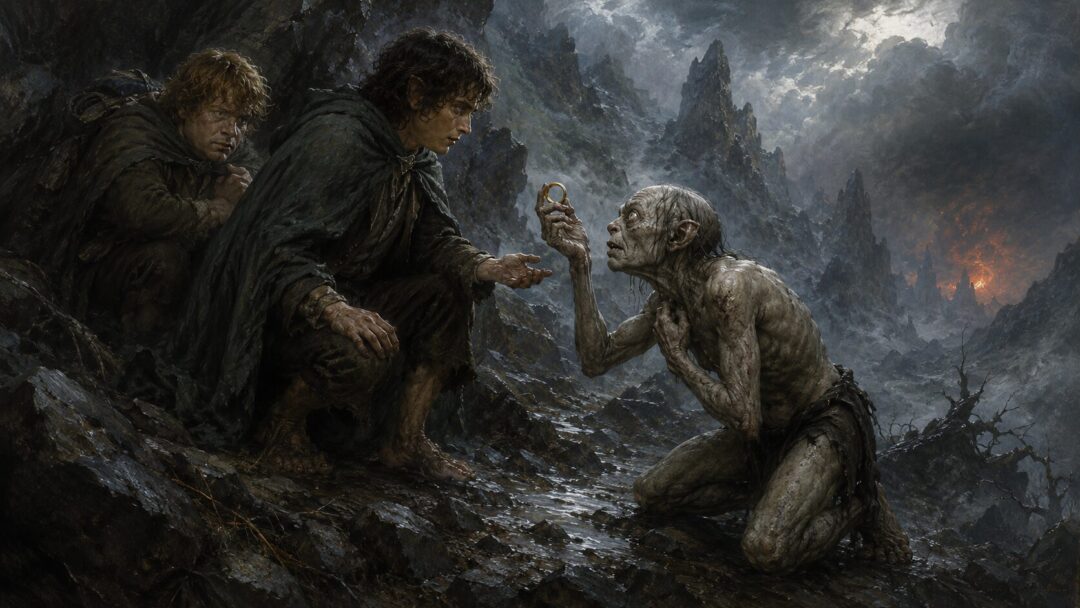
At the heart of Mount Doom, the fate of Middle-earth turns on something almost unbearably small: a step.
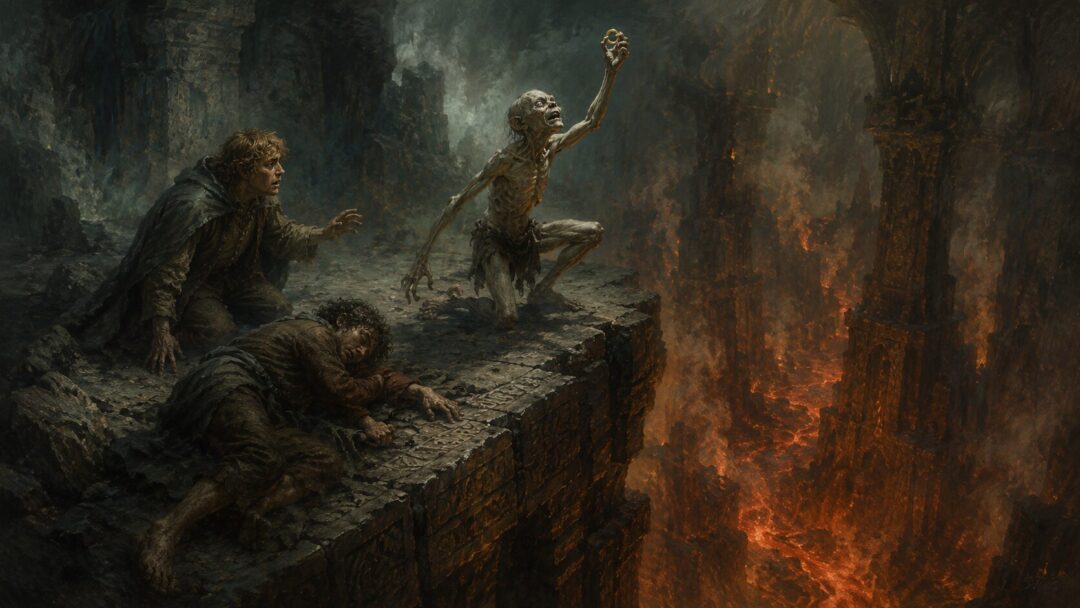
Not a sword-stroke. Not a spell. Not a final heroic act of will. Gollum, clutching the Ring he has just torn from Frodo’s hand, dances in triumph at the edge of the Fire. Then he steps too far, wavers, and falls.
For many readers, that moment raises an obvious question: did the Ring make Gollum trip?
The safest answer is: not in the simple sense of the Ring deliberately pushing him like an invisible hand. The text never says, “the Ring tripped Gollum.” But it also does not present his fall as mere random clumsiness. The ending is built from several forces that have been gathering for hundreds of pages: Gollum’s broken oath, Frodo’s terrible command, the Ring’s treachery, pity shown earlier when justice might have killed, and a providential pattern that works through free choices rather than replacing them.
Gollum falls because he steps too far. But why that step happens, and why it happens exactly there, is one of the deepest moral knots in The Lord of the Rings.
The Physical Fall Is Clear
In the book, Gollum does not drag Frodo over the edge, and Frodo does not wrestle him into the Fire. After Frodo claims the Ring for himself, Gollum attacks him, bites off the Ring-finger, and recovers his “Precious.” Then, in a frenzy of victory, he dances.
The wording matters. Gollum is not described as being seized by an outside force. He is overwhelmed by triumph, gloating over the Ring, and in that moment he steps too far. He topples, wavers on the brink, and falls into the Fire with the Ring.
So at the surface level, the immediate cause is Gollum’s own movement. He is ecstatic, careless, and consumed by possession. His body follows his desire. The Ring has not saved him; it has brought him to the very edge of the only place where it can be unmade.
That makes the ending morally sharper. Gollum is not an innocent victim accidentally shoved into doom. Nor is he a pure villain defeated by a conventional hero. He is a ruined creature whose final act is both theft and fulfillment. He gets exactly what he wants — and that desire destroys him.
The Ring’s Treachery Was Foreshadowed
The larger question is whether the Ring’s own nature helped bring about Gollum’s fall. Here the answer becomes more complicated.
Earlier, when Gollum swears by the Precious, Frodo warns him that the Ring is dangerous even as an object of oath. It will hold him, Frodo says in effect, but it may also twist his words. That warning is not decorative. It establishes a hidden rule: binding oneself by the Ring is perilous because the Ring is not neutral.
Gollum’s oath is tangled. He promises service to Frodo, but he does so by the very thing he desires above all else. He tries to use the Ring as a sacred guarantee, yet the Ring belongs to domination, possessiveness, and betrayal. From the moment he swears by it, his promise is unstable.
Later, Frodo warns Gollum even more directly. If Frodo were wearing the Ring and commanded him, Gollum might have to obey, even to the point of casting himself into fire. This is not exactly what happens at the end, but it prepares the reader for a terrible possibility: the Ring can bind wills, and Gollum has placed himself under that danger by oath, desire, and long corruption.
So did the Ring make him trip? The text does not state that mechanically. But it strongly implies that Gollum’s relationship to the Ring has trapped him in a doom he does not understand. The Ring’s power over him is not merely invisibility or addiction. It is bondage.
Frodo’s Command at the Mountain
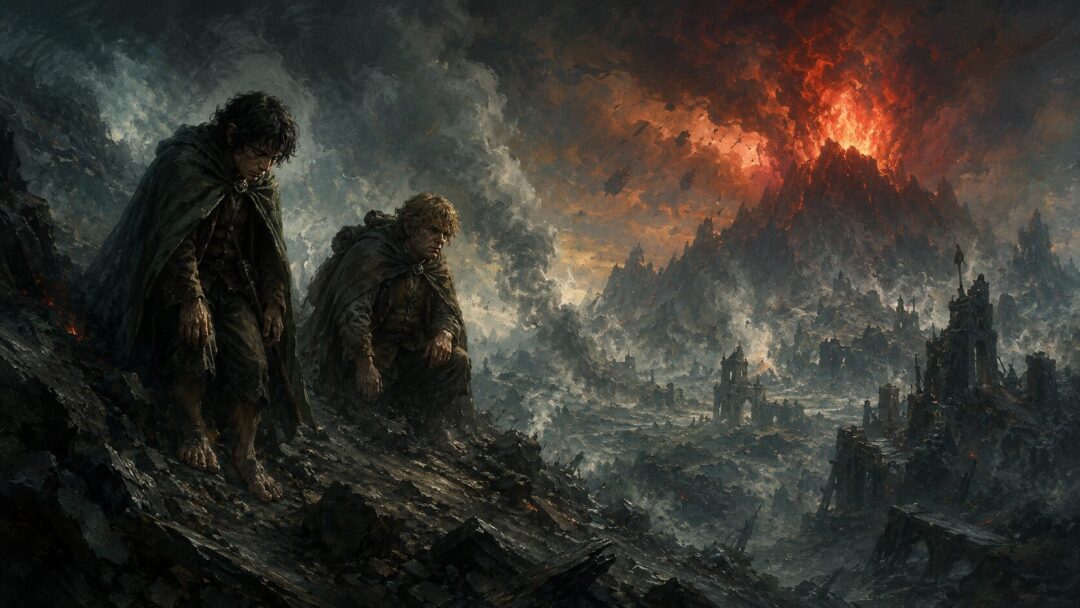
The most important moment before the final fall happens on the slopes of Mount Doom.
Gollum attacks Frodo and Sam, still desperate for the Ring. Frodo, nearly spent, clutches the Ring at his breast. Sam sees him with a changed vision: not simply as a weary hobbit, but as a figure robed in white, holding a wheel of fire. A commanding voice speaks from that fire, warning Gollum that if he touches Frodo again, he will be cast into the Fire of Doom.
This is one of the most mysterious passages in the whole story.
It is not easy to separate Frodo, the Ring, and the power speaking through that moment. Frodo is not yet wearing the Ring, but he is holding it. He has been enlarged and diminished by the burden. He is still himself, yet terribly near the Ring’s final mastery. The voice is described as coming from the fire, not simply from Frodo in an ordinary tone.
A cautious reading is best: Frodo pronounces a doom, but the Ring’s power and the place itself seem to give that doom a terrible force. The command does not prove that Frodo consciously “casts a spell” in a simple way. It does show that Gollum is warned, and that the warning is fulfilled when he touches Frodo again inside the Cracks of Doom.
That fulfillment is too exact to ignore. Gollum does touch Frodo again. He does take the Ring by violence. He is then cast into the Fire.
Not an Accident, Not a Simple Spell
The beauty of the ending is that it refuses a single flat explanation.
If we say, “Gollum simply slipped,” we miss the oath, the warning, the Ring’s treachery, and the long moral preparation of the story.
If we say, “the Ring made him trip,” we risk saying more than the text says. The Ring wants to survive. It is Sauron’s instrument, full of his will to dominate. It would be strange to imagine it consciously choosing its own destruction. Yet the Ring repeatedly betrays its possessors by inflaming their possessiveness, exposing them to danger, and twisting desire into ruin.
The Ring does not need to “want” destruction in order to cause it. Its nature is self-defeating. It drives Gollum to seize it, drives him to gloat, and brings him to the edge. In that sense, the Ring’s corruption helps create the conditions of its own end.
The same pattern appears throughout the story. Sauron cannot imagine that anyone would seek to destroy the Ring rather than use it. Boromir believes it could be wielded for good. Gollum believes recovering it will restore him. Frodo himself, at the last, cannot surrender it. Again and again, the Ring wins by making possession seem like victory.
At Mount Doom, that victory becomes fatal.
Mercy Put Gollum There
There is another force at work: mercy.
Gollum is alive at the end because Bilbo spared him, because Frodo later accepted Gandalf’s wisdom about pity, and because Sam, even after hatred and disgust, does not kill him on the mountain. None of these choices are sentimental. Gollum remains dangerous, treacherous, and pitiable all at once.
This is one reason the ending does not feel like luck in the ordinary sense. The Quest succeeds through mercy that looked impractical when it was given. Bilbo’s pity in the dark under the Misty Mountains seemed small. Frodo’s pity seemed risky. Sam’s final restraint seemed almost impossible after all Gollum had done.
Yet without Gollum, Frodo would not have destroyed the Ring. At the last moment, Frodo claims it. That is not a failure of courage in the simple sense; the Ring is at the place of its greatest power, and Frodo has spent everything to bring it there. But he cannot freely throw it away. No ordinary act of heroic will completes the Quest.
Instead, the saved life of a wretched creature becomes the instrument by which the Ring is destroyed.
Providence Without Puppet Strings
The Lord of the Rings often suggests that more is at work than chance. Gandalf tells Frodo early on that Bilbo was meant to find the Ring, and not by its maker. That does not erase choice. Bilbo still chooses pity. Frodo still chooses endurance. Sam still chooses loyalty. Gollum still chooses treachery and possession.
The ending works because providence and free will are woven together. Gollum is not a puppet without responsibility. Frodo is not a simple victor. The Ring is not a dumb object. The fall is not random. The story allows all these truths to stand at once.
So if we ask, “Did a higher power trip Gollum?” the conservative answer is again: the narrative does not describe a visible intervention. It does, however, frame the destruction of the Ring as the result of a larger design operating through mercy, endurance, oath, corruption, and consequence.
That is why the final step feels both accidental and inevitable.
The Ring’s Final Irony
The Ring’s deepest irony is that it is destroyed by the very cravings it creates.
It corrupts through possessiveness, and Gollum is the most complete image of possessiveness in the story. He has been hollowed by the Ring, made lonely, suspicious, and hungry. When he finally regains it, he has no thought for survival, no awareness of danger, no future beyond the circle in his hand. He has the Ring, and that is enough — until it is the end of him.
In that sense, the Ring does make Gollum fall, but not like a hand pushing his back. It makes him fall by making him Gollum: a creature so consumed by the Precious that he can dance on the edge of annihilation and see only triumph.
The final cause is not one thing. It is Gollum’s lust, Frodo’s doom-filled warning, the binding of the oath, the Ring’s corrupting nature, and the mercy that allowed Gollum to be present at all. The step itself is Gollum’s. The meaning of the step belongs to the whole story.
So the best answer is this: Gollum trips because he is careless in triumph, but his fall is no mere accident. The Ring does not simply push him into the Fire. It brings him, by desire and bondage, to the only place where his victory can become its destruction.
Sources & Notes
- J.R.R. Tolkien, The Lord of the Rings, Book VI, Chapter 3, “Mount Doom” — gives the immediate scene: Frodo claims the Ring, Gollum bites it from him, dances in triumph, steps too far, and falls into the Fire.
- J.R.R. Tolkien, The Lord of the Rings, Book IV, Chapter 1, “The Taming of Sméagol” — Gollum swears by the Precious, and Frodo warns that the Ring will hold him and may twist such an oath treacherously.
- J.R.R. Tolkien, The Lord of the Rings, Book VI, Chapter 3, “Mount Doom” — Frodo’s warning on the mountain that Gollum will be cast into the Fire if he touches him again is fulfilled inside the Sammath Naur.
- J.R.R. Tolkien, The Lord of the Rings, Book I, Chapter 2, “The Shadow of the Past” — Gandalf’s counsel on Bilbo’s pity and Gollum’s future part frames the ending as more than ordinary luck.
- J.R.R. Tolkien, The Letters of J.R.R. Tolkien, Letter 246 — Tolkien’s commentary on Frodo’s failure, Gollum’s intervention, and providence is directly relevant to reading the fall without reducing it to a simple accident or spell.