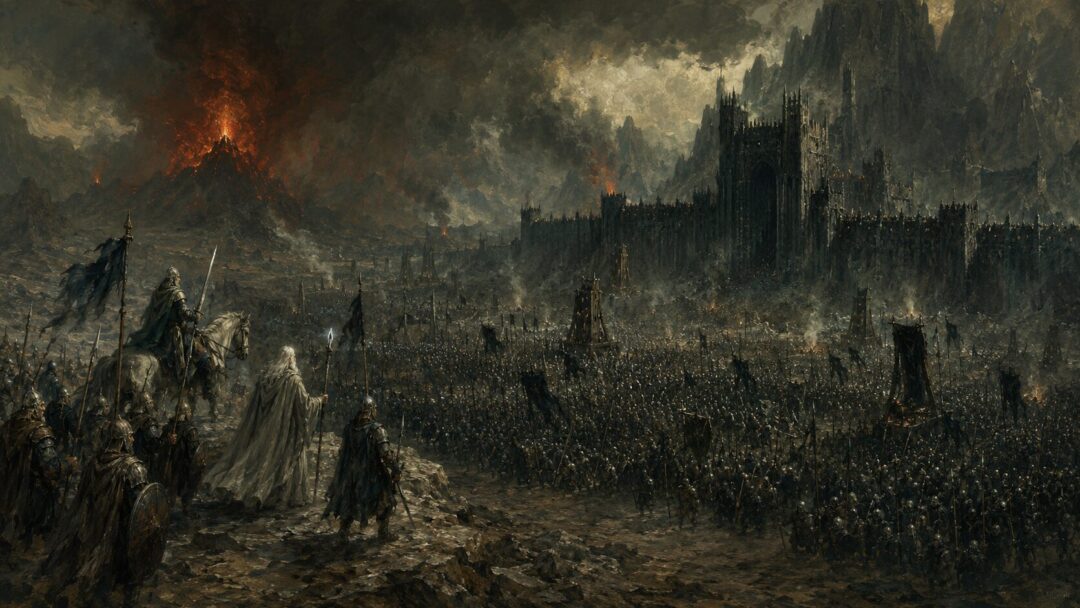
The Black Gate is one of the simplest images in The Lord of the Rings: a door, a wall, and an enemy waiting behind it. Yet the question behind that gate is much larger than the armies gathered before it. Was Sauron merely a terrifying tyrant with many soldiers, or did he truly have enough military power to bring all Middle-earth under his rule?
The unsettling answer is that, by the end of the Third Age, Sauron almost certainly had the military advantage over the Free Peoples of the West. But “control all Middle-earth” is not the same thing as “win every battle instantly.” His strength was immense, but it was not limitless. His victory depended on timing, fear, divided enemies, exhausted kingdoms, and above all the survival—or recovery—of the One Ring.
The War of the Ring is not a story in which the West defeats Mordor by superior strategy or greater numbers. It is a story in which conventional victory has become impossible, and the only hope lies in destroying the thing that makes Sauron’s power endure.
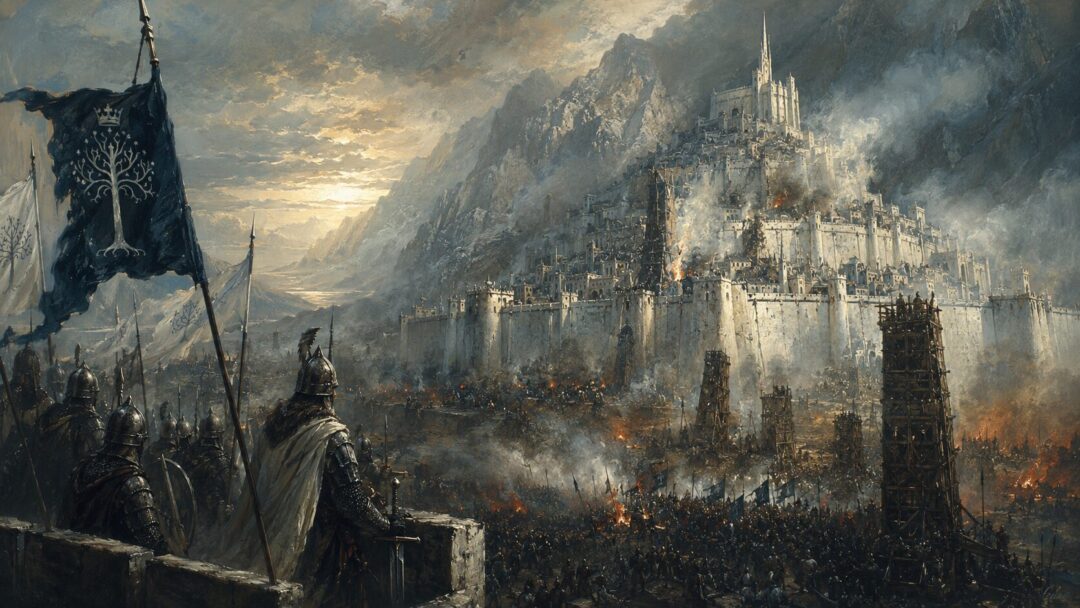
The West Was Already Losing Before the Final War Began
By the time Frodo leaves the Shire, the great strength of the West has already faded. The Elves are diminished. Arnor is gone. Gondor still stands, but it is a wounded realm defending a long frontier against an enemy that has been preparing for centuries. Rohan is brave and dangerous in open war, but it is not a vast empire. The Dwarves of Erebor and the Men of Dale are strong in the North, yet they too face pressure from the East.
This matters because Sauron does not need to conquer a united Middle-earth at the height of its power. He faces scattered peoples, separated by mountains, distance, suspicion, old griefs, and different immediate dangers.
The Council of Elrond makes this plain. The Free Peoples do not speak as if they are planning a grand military campaign to overthrow Mordor. They speak as people who know that Sauron’s strength is rising faster than theirs. The Ring is not treated as one weapon among many. It is the central question because without its destruction the military situation is ultimately hopeless.
That is the first hidden rule of the war: Sauron’s armies are not merely large. They are growing in a world where his enemies are not growing in the same way.
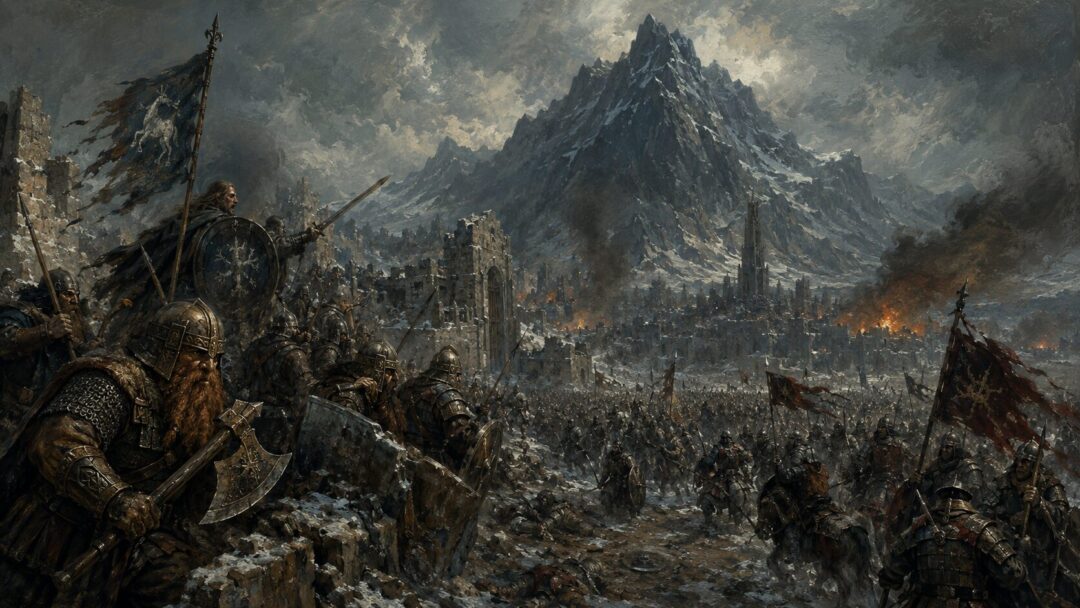
Mordor Was Not His Only Weapon
It is easy to imagine Sauron’s power as a single black mass pouring out of Mordor. But his military position was wider than that. Mordor was the heart of his strength, with Barad-dûr, the Black Gate, the lands of Gorgoroth, and the armies gathered under his direct command. Yet Sauron also used allied and subject peoples from the East and South, as well as other strongholds such as Dol Guldur.
This wider pressure is essential to understanding the war. Gondor was not only threatened from the direction of Minas Morgul and Mordor. The Corsairs of Umbar threatened the southern coasts, forcing Gondor’s fiefs to defend their own lands instead of sending full aid to Minas Tirith. In the North, Sauron’s allies attacked Dale and Erebor. Dol Guldur struck at Lórien and the Woodland Realm.
This was not accidental chaos. The effect was strategic: every free realm had to survive its own crisis. Sauron’s enemies could not simply combine all their strength and march east. They were pinned in place.
One reading is that Sauron’s real military genius lay not only in overwhelming force, but in making every resistance feel isolated. Minas Tirith, Lórien, Dale, Erebor, and the Woodland Realm were not fighting the same battle in one place. They were fighting separate fires across the map.
Gondor Was the Great Barrier
If Sauron wanted mastery of the West, Gondor was the chief obstacle. Minas Tirith was not merely a city; it was the last great fortress-realm standing directly against Mordor. Its fall would have opened the road to a very different war.
The Battle of the Pelennor Fields is sometimes remembered as a great victory of the West, and in one sense it is. The Witch-king is destroyed. Théoden falls gloriously. Éowyn and Merry achieve one of the most extraordinary reversals in the war. Aragorn arrives with strength from southern Gondor after defeating the Corsair threat through the Paths of the Dead.
Yet the victory is not enough to win the war.
This is crucial. After Pelennor, the Captains of the West do not believe they have broken Mordor’s power. They know Sauron still has great strength remaining. Their march to the Black Gate is not a conquest. It is a deliberate act of diversion, meant to draw Sauron’s Eye away from Frodo and Sam.
That fact alone answers much of the question. If the greatest victory of the West still leaves them unable to defeat Sauron by arms, then Sauron’s military superiority is clear.
Could Sauron Have Conquered Lórien, Rivendell, and the Elven Realms?
Here the answer becomes more careful. The texts imply that Sauron’s armies could threaten the Elven realms, but not every realm would fall in the same way or at the same speed.
Lórien is especially important. During the War of the Ring, it is assaulted from Dol Guldur three times. The attacks are repelled, and the power dwelling in Lórien is described as too great for those assaults to overcome unless Sauron himself had come there. This does not mean Lórien could defeat Mordor in open war. It means that Lórien, protected by its people, its Lady, and the power associated with Nenya, was not simply another fortress to be stormed by ordinary force.
Rivendell is even more difficult to assess because the texts do not give us a direct siege of Imladris during the War of the Ring. It was hidden, protected, and far from Mordor’s main line of attack. But it was not a kingdom with vast armies. Its power was wisdom, refuge, memory, and preservation, not imperial military strength.
So could Sauron have controlled the Elven strongholds? If he recovered the One Ring, almost certainly the whole situation would change catastrophically. Without it, the texts still suggest that the Elven realms could resist, perhaps fiercely and mysteriously, but not indefinitely if all other powers of the West were broken around them.
The conservative answer is this: Tolkien never gives us a simple campaign map in which Sauron conquers every Elven refuge one by one. But the story strongly implies that if the Ring survived and Gondor fell, the remaining sanctuaries would be left in a world increasingly dominated by Mordor.
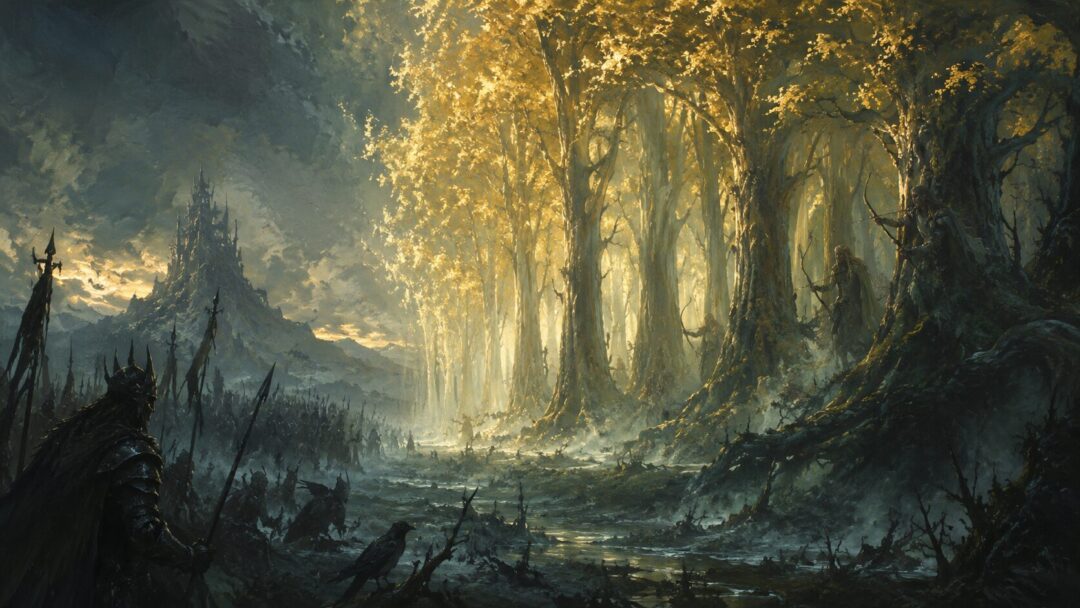
The Northern War Shows the Scale of the Threat
The Battle of Dale is one of the most overlooked parts of the War of the Ring. While Minas Tirith is under threat, the Men of Dale and the Dwarves of Erebor are fighting Sauron’s Easterling allies. King Brand of Dale and King Dáin Ironfoot both fall, and their peoples are besieged at the Lonely Mountain.
This matters because it shows that Sauron’s war was not limited to Gondor. The North was not safe. Erebor, Dale, the Woodland Realm, and Lórien were all part of the larger struggle.
The Hobbit’s world, with its mountain kingdom, dragon-hoard memories, lake-town lineage, and forest elves, is not separate from the War of the Ring. It is one of the reasons the West survives at all. Had the North collapsed quickly, Sauron’s forces and allies could have gained far greater freedom of movement.
The war in the North also shows why the Quest of Erebor mattered in hindsight. The death of Smaug and the restoration of strong peoples around the Lonely Mountain created resistance where otherwise there might have been devastation. This does not mean the northern victory defeated Sauron. It means it denied him an easier road.
Sauron’s Weakness Was Not Lack of Soldiers
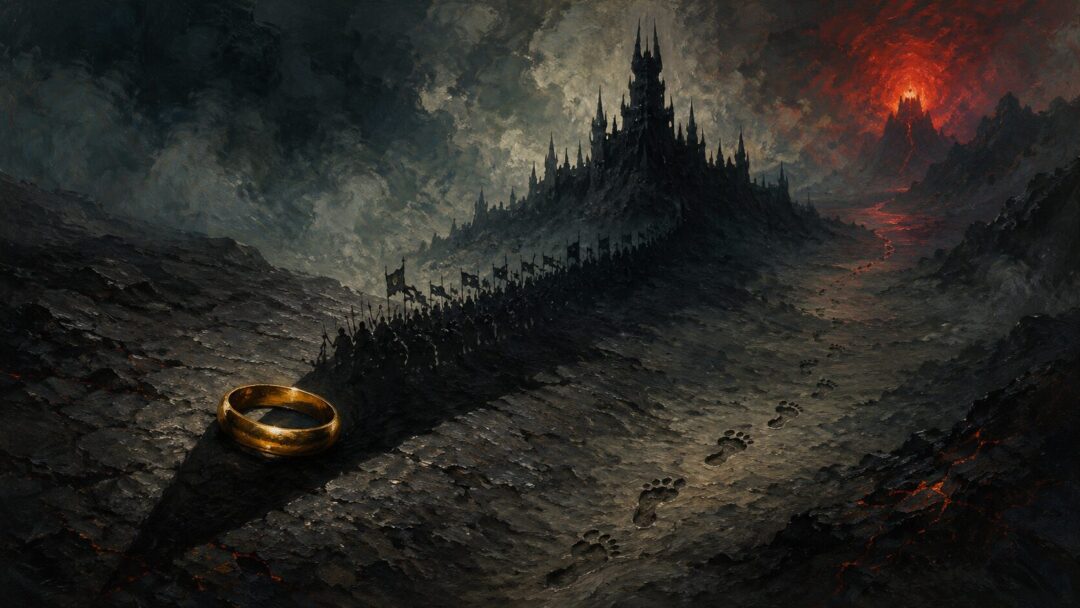
Sauron’s great weakness was not that he lacked military power. His weakness was spiritual, strategic, and imaginative. He could understand domination, fear, ambition, and the desire to wield power. He could not truly imagine that someone would carry the Ring into Mordor in order to destroy it.
That failure shaped the final campaign. When Aragorn revealed himself and later marched to the Black Gate, Sauron interpreted the challenge through his own logic. He believed a rival might be trying to use the Ring. The small army at the Morannon looked foolish unless it was bait—or unless someone with the Ring had grown bold.
In a purely military sense, the Host of the West at the Black Gate was doomed. That is the point. They were not there to win by force. They were there to hold Sauron’s attention for as long as possible.
Sauron had the armies. He had the fortresses. He had terror as a weapon. He had allies and servants spread across Middle-earth. But he did not understand humility, pity, or renunciation. The fate of his empire turned not on a stronger army, but on two small figures inside his own land and on Gollum’s final part in the Ring’s destruction.
What If Sauron Regained the One Ring?
If Sauron had recovered the One Ring, the question becomes darker. The Ring contained much of his own power, and its recovery would have made his victory far more certain. The Wise fear this outcome not because it would merely add another weapon to his treasury, but because it would complete the return of his dominating power.
It is also important to say what the texts do not say. They do not provide a detailed administrative plan for Sauron ruling every village, forest, mountain, and coastline. “Control all Middle-earth” should not be imagined as neat borders and governors everywhere. Sauron’s kind of dominion would likely mean the breaking of organized resistance, the enslavement or subordination of peoples, the corruption of rulers where possible, and the spread of fear from fortified centers of power.
His control would not need to be gentle, efficient, or universally present to be real. A world in which no free realm could openly defy him would be, in the moral and political sense of the story, a world under his Shadow.
So, Did He Have Enough Military Power?
Yes—with an important qualification.
Sauron appears to have had enough military power to defeat the Free Peoples of the West if the Ring was not destroyed. The Captains of the West understood that they could not overthrow him by arms. Gondor’s survival at Pelennor was a reprieve, not a final victory. The northern realms were under attack. Lórien and the Woodland Realm were pressed from Dol Guldur. Dale and Erebor were fighting for survival. Rohan’s strength mattered enormously, but even Rohan and Gondor together could not simply invade Mordor and win.
But Sauron’s power was not absolute in the sense of being effortless. He still had to wage war. He still needed time, armies, roads, commanders, allies, terror, and deception. Some places could resist him. Some victories cost him dearly. The West was not weak because it lacked courage; it was weak because the long ages had worn it down while Mordor had been gathering strength.
That is the tragedy behind the military question. Middle-earth was not saved because it finally produced a greater army than Sauron’s. It was saved because the central engine of his power was unmade.
The Black Gate did not fall because the West broke it. Barad-dûr did not collapse because Minas Tirith outmatched Mordor. Sauron’s military machine failed because the Ring, the hidden foundation beneath his terror, was destroyed.
In the end, he had enough power to conquer. He did not have enough wisdom to understand the kind of courage that would undo him.
Sources & Notes
- J.R.R. Tolkien, The Lord of the Rings, Book II, Chapter 2, “The Council of Elrond” — frames the military problem: the Wise cannot defeat Sauron by open strength, and the Ring’s destruction becomes the only real hope.
- J.R.R. Tolkien, The Lord of the Rings, Book V, Chapter 9, “The Last Debate” — the Captains of the West state plainly that they cannot win by arms and choose the march to Mordor as a diversion for Frodo.
- J.R.R. Tolkien, The Lord of the Rings, Book V, Chapter 10, “The Black Gate Opens” — shows how small and overmatched the Host of the West is before Mordor’s gathered forces.
- J.R.R. Tolkien, The Lord of the Rings, Appendix B, “The Great Years” — records the wider war: attacks on Lórien and the Woodland Realm, the fighting at Dale and Erebor, and pressure from Sauron’s allies beyond Gondor.
- J.R.R. Tolkien, Unfinished Tales, “The Quest of Erebor” — Gandalf’s later explanation links Smaug, Erebor, Dale, and the northern theatre to Sauron’s broader strategic threat.
- J.R.R. Tolkien, The Letters of J.R.R. Tolkien, Letter 131 — Tolkien describes Sauron’s will to order and domination, useful background for the article’s distinction between military conquest and tyrannical control.