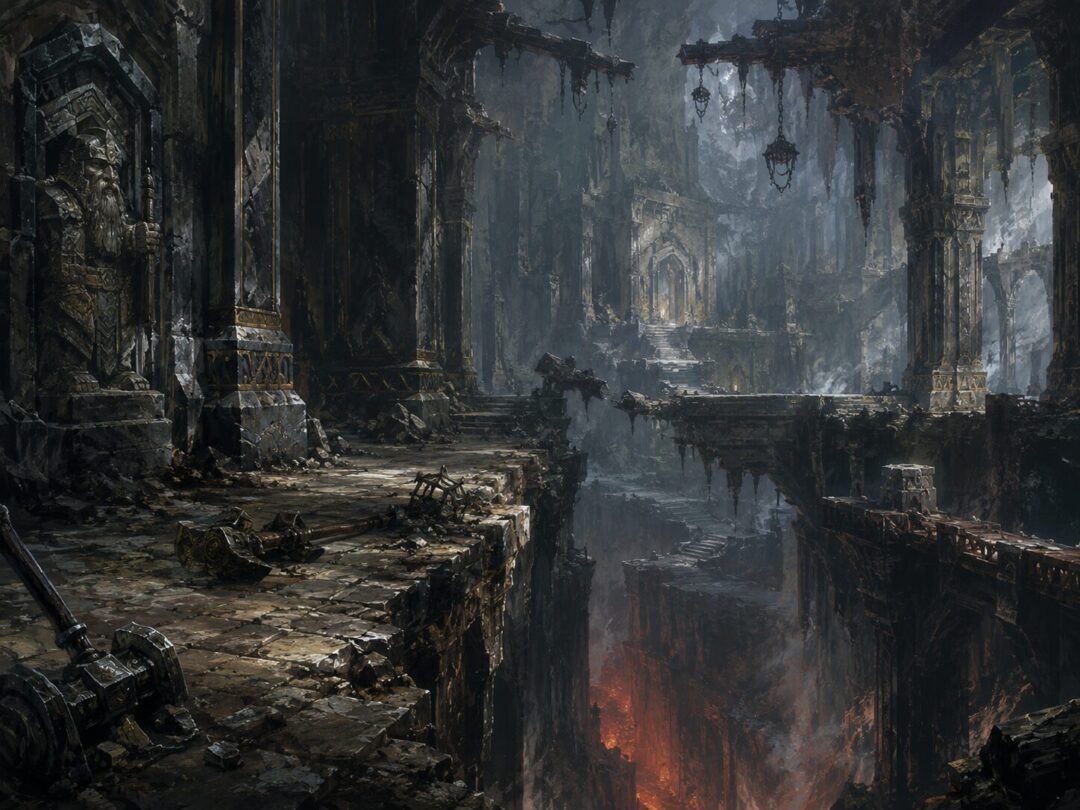
When most readers first enter Moria, they enter it as a warning.
A dark lake waits before the western gate. The doors open by moonlight and memory. Inside there is dust, silence, dead halls, black chasms, Orcs in the deep, and finally the shadow and flame of Durin’s Bane. By the time the Fellowship passes through, Khazad-dûm feels less like a kingdom than a tomb that still has something alive inside it.
But that is the tragic distortion of the place.
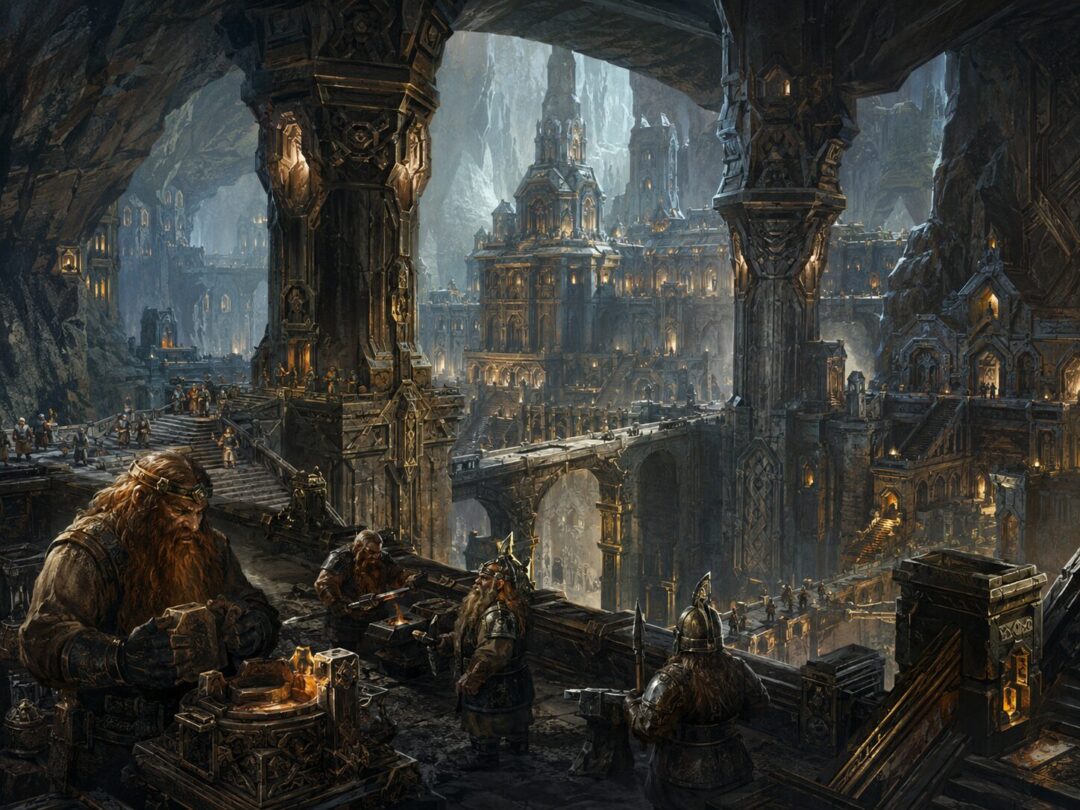
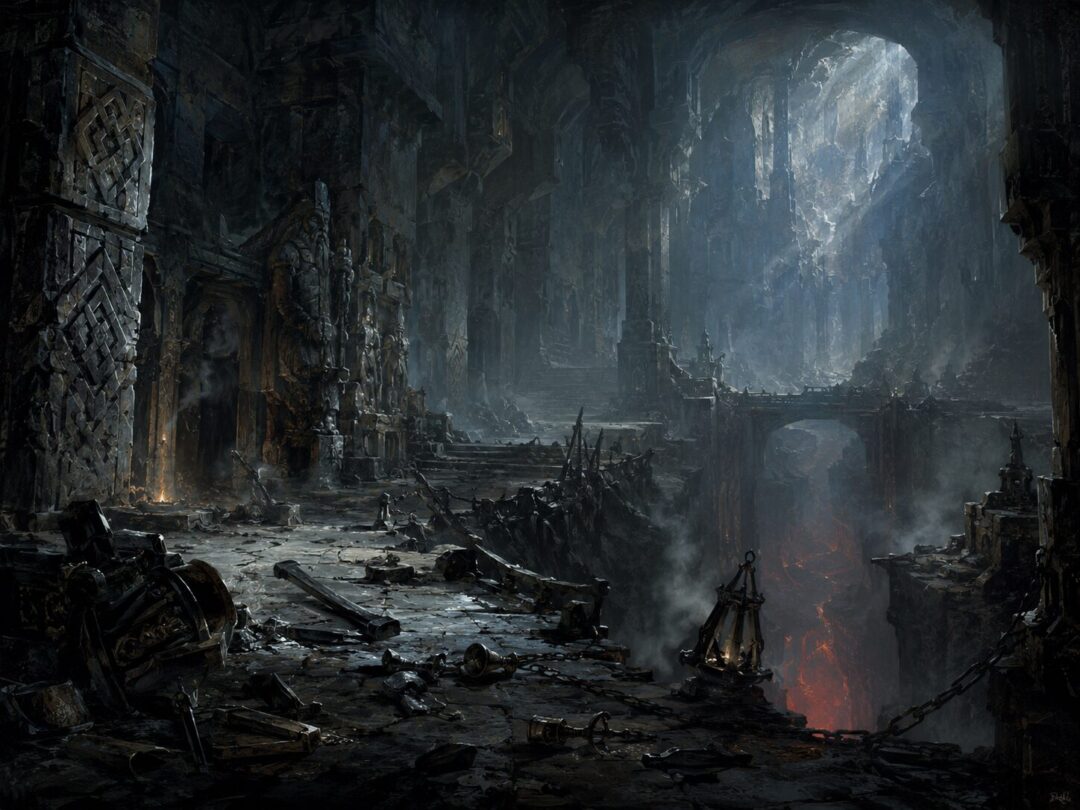
Khazad-dûm was not built to be a horror story. It was not founded as a pit of greed, nor as a cursed mine waiting for punishment. Before it became Moria, before the Black Pit, before Balin’s failed colony and the drums in the deep, it was one of the greatest achievements of Dwarven civilization in Middle-earth: a hidden kingdom of craft, memory, kingship, wealth, beauty, and endurance.
The horror matters because it came after greatness. The darkness of Moria is frightening because it is the darkness of something that once shone.
Durin’s Vision Beside the Mirrormere
The story begins not with fire, but with still water.
According to the traditions preserved around Durin’s Folk, Durin the Deathless awoke in the north of the Misty Mountains and journeyed south through lands that were still wild and unnamed. He came at last to the valley later called Dimrill Dale, where the lake Kheled-zâram, the Mirrormere, lay beneath the mountains.
There he saw stars reflected in the water, appearing like a crown above his head. The texts treat this not as a casual sight, but as a sign. Durin took it as the mark of his destiny and founded his great city in the caves above the lake.
That detail changes how we should imagine Khazad-dûm.
Its beginning was not merely practical. It was not just “there were minerals here, so the Dwarves dug.” Its founding memory was almost sacred: a king alone in a silent valley, seeing a crown in the water before he had a throne in the stone. Durin’s Stone later marked the place where he looked into the Mirrormere, preserving the moment as part of the identity of his people.
So before Khazad-dûm was a mine, it was a chosen home. Before it was associated with falling, it was associated with recognition.
Durin did not simply find a mountain. He found a sign that told him where his people belonged.
A Kingdom, Not Just a Mine
It is easy to reduce Khazad-dûm to its mines because that is how the disaster is remembered: the Dwarves delved too deep, awakened a terror, and lost their home. But the older name, Khazad-dûm, means the Dwarrowdelf: the mansion or dwelling of the Dwarves.
That word matters. It was not only an industrial place. It was a city, a kingdom, a royal house, a treasury, a road through the mountains, and the heart of Durin’s Folk.
The Dwarves were not living in temporary tunnels while chasing metal. They were building a civilization under the Misty Mountains. Its halls, bridges, pillars, chambers, roads, and gates were the visible form of a culture that valued endurance, craft, lineage, and secrecy. Their architecture was not disposable. It was meant to last beyond ordinary lives.
This is why Gimli’s response to Moria is so important. To others, the place is dreadful. To him, it is also ancestral. He is not merely walking through a dangerous ruin. He is walking through the memory of a people.
In that sense, Khazad-dûm before its fall was one of the clearest expressions of Dwarven identity in all of Middle-earth. The Elves had their woods and hidden cities. Númenóreans had their towers and sea-kings. The Dwarves of Durin’s line had the mountain itself, hollowed into order and magnificence.
Its tragedy is that the same depth that made it mighty also made it vulnerable.
The Greatness Beneath the Misty Mountains
Khazad-dûm’s position gave it a unique importance.
It lay beneath the Misty Mountains, with a western entrance near Eregion and an eastern opening toward Dimrill Dale and the lands beyond. This made it more than an isolated underground stronghold. At its height, it was connected to the wider history of the Second Age: to Elven craft, trade, roads, and the movement of peoples across the mountains.
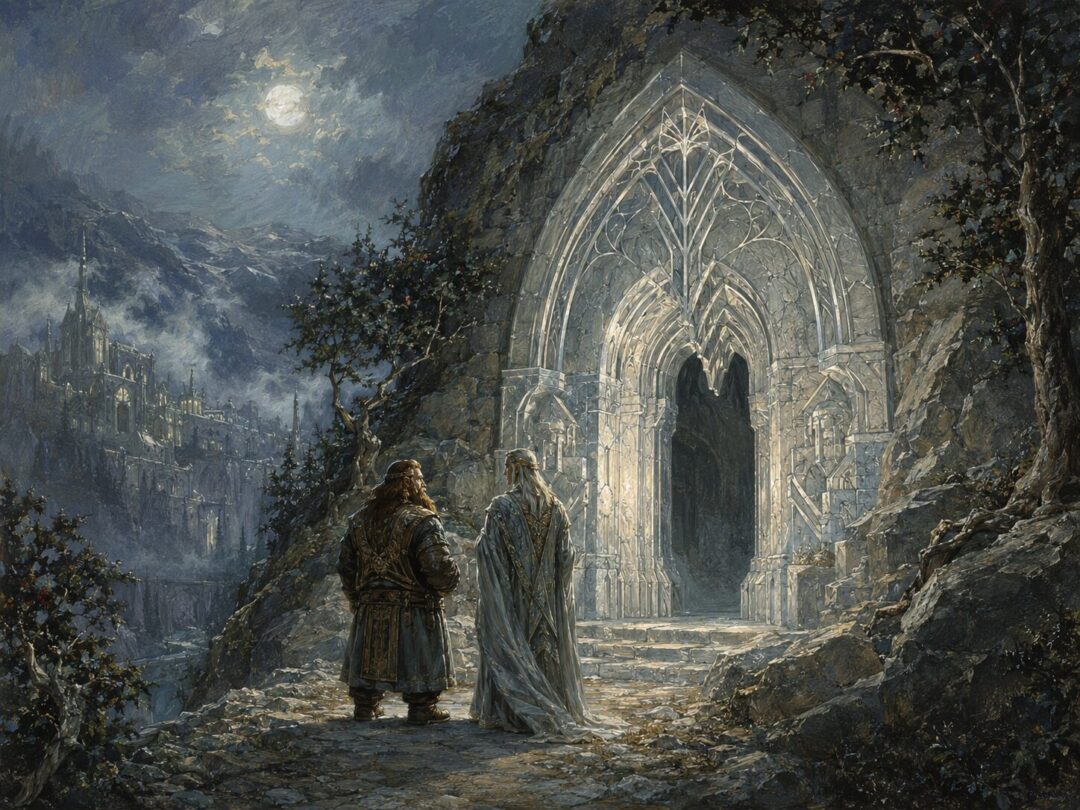
The friendship between the Dwarves of Khazad-dûm and the Elves of Eregion is one of the most revealing details about what the realm once was. The West-gate itself, later found shut and nearly forgotten by the Fellowship, preserves that older world. Its inscription names Narvi, a Dwarf, and Celebrimbor, an Elf. The door is not merely a clever puzzle in The Lord of the Rings. It is a monument to a time when the peoples on either side of the mountain could cooperate in beauty and skill.
That cooperation should not be romanticized into perfect harmony. Elves and Dwarves had old tensions, and Tolkien’s world rarely makes such relationships simple. But the Doors of Durin still show something real: Khazad-dûm was once open enough, wealthy enough, and respected enough to share work with the greatest craftsmen of Eregion.
The later silence of that door is therefore deeply ironic. When Gandalf stands before it, the gate of friendship has become a riddle before a grave.
Mithril and the Blessing That Became a Temptation
No account of Khazad-dûm can avoid mithril.
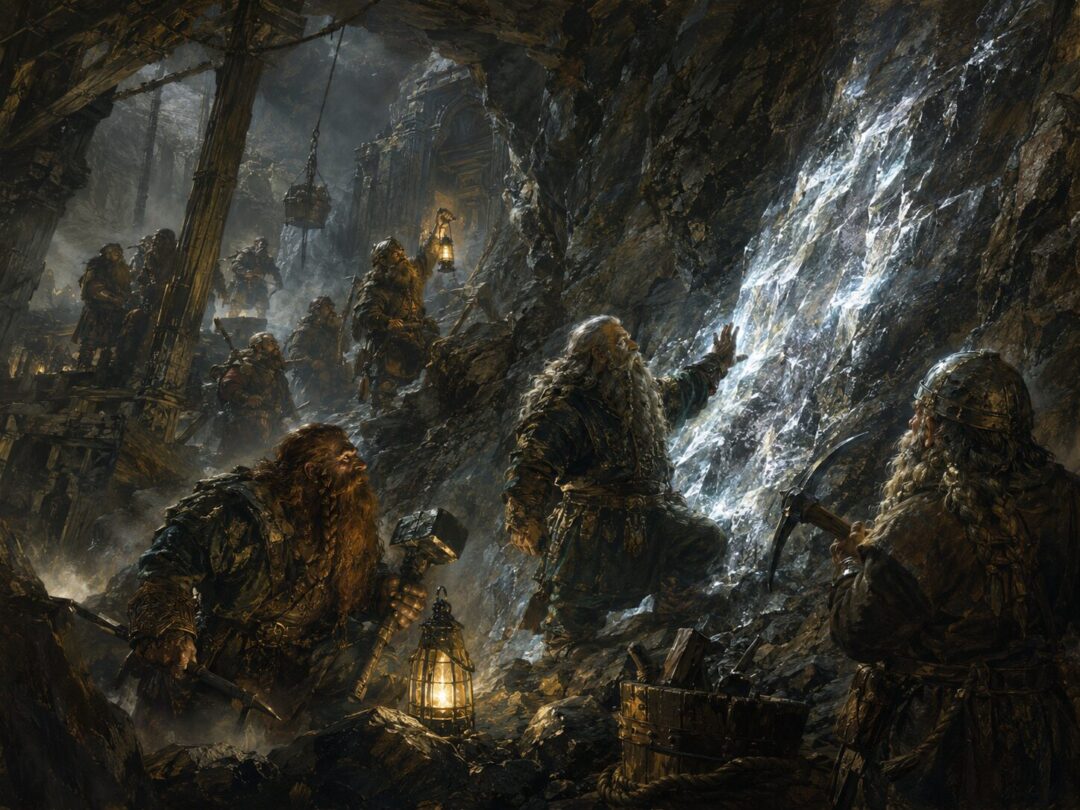
The precious metal, also called Moria-silver or true-silver, was the wonder of the Dwarven mines. It was light, strong, beautiful, and extraordinarily valuable. By the late Third Age it had become almost beyond price, and the Dwarves’ old supply in Khazad-dûm had become legendary.
But mithril should be handled carefully as a lore point. The texts do not say that mithril itself was evil. Nor do they say the Dwarves were doomed simply because they loved beautiful craft. Dwarven desire for treasure can become dangerous, but their craftsmanship is not presented as wicked in itself.
The tragedy is subtler. Mithril was both blessing and lure. It made Khazad-dûm richer, more important, and more glorious. It also drew the Dwarves deeper beneath the mountains. The famous judgment that they delved too greedily and too deep is spoken from within the later memory of catastrophe. It is true as a moral summary, but it should not erase the long, legitimate history of labor and craft that came before.
Khazad-dûm did not fall because beauty is evil. It fell because a people whose strength was depth, endurance, and making pressed into a darkness they did not understand.
That is a very Tolkienian kind of tragedy. The danger is not always in wanting something ugly. Sometimes it lies in wanting something genuinely wondrous too much, or trusting that skill and courage can master every hidden thing.
Before the Balrog, There Was Silence Below
Durin’s Bane was not created by the Dwarves, and the texts do not suggest that they knowingly awakened an enemy. The Balrog had fled from the ruin of the ancient wars and hidden itself deep beneath the roots of the mountains. For long ages it remained there, unknown.
That fact makes the fall of Khazad-dûm more terrifying.
The Dwarves were not digging toward an enemy fortress. They were not opening a sealed prison with a warning carved upon it. They were mining in their own realm, beneath a kingdom that had endured for ages. The horror was older than their disaster and deeper than their knowledge.
When they finally disturbed it in the Third Age, it slew King Durin VI. The following year, Náin I was also slain, and the Dwarves abandoned Khazad-dûm. After that, the old name increasingly gives way in the imagination to Moria, the Black Pit.
But the Balrog’s arrival in the story should not make us forget what it destroyed. It did not conquer an empty mine. It broke the heart of a people.
Why the Name Moria Feels Like an Injury
“Moria” is the name readers know best, but within the story it is not the original identity of the place. Khazad-dûm is the name of dignity, craft, and belonging. Moria is the name of dread.
That shift is more than linguistic. It is emotional history.
The same halls that once held music, labor, kingship, and pride became associated with fear. The same roads that once linked peoples became places where travelers whispered. The same depths that once promised wealth became a symbol of overreach. A living realm became a haunted absence.
This is why Gimli’s grief in Moria carries so much weight. He is not only mourning Balin’s expedition, though that loss is immediate and painful. He is also encountering the ruin of a larger inheritance. Every broken chamber and empty hall is a reminder that Dwarven greatness in Middle-earth has suffered losses that cannot simply be repaired by courage.
The fall of Khazad-dûm is not a minor historical background detail. It is one of the great wounds of the Dwarves.
The Forgotten Warmth of the Dwarrowdelf
Because the Fellowship experiences Moria in terror, it takes effort to imagine Khazad-dûm before the darkness.
But the clues are there.
There must have been light in its halls: lamps, furnaces, reflected gleams from polished stone and metal. There must have been roads and guarded gates, not merely tunnels. There must have been craft workshops, royal chambers, storehouses, stairways, bridges, and places where generations of Durin’s Folk knew the rhythms of ordinary life. The texts do not give us a domestic tour of Khazad-dûm, so we should not invent too much detail. But a kingdom cannot be only a mine. It must also be a world.
That is one of the most overlooked parts of Moria’s sadness. We tend to remember the drums, the Orcs, the Balrog, and the bridge. We forget that before the echoes became threatening, they may have carried songs, hammers, voices, and footsteps of people who were at home.
The horror story is built on absence. What frightens us is not merely what remains in Moria, but what is missing.
The Moral Cost of Going Too Deep
The fall of Khazad-dûm is often summarized as a warning against greed, and that reading has support. The Dwarves’ desire for mithril led them downward until they awakened something beyond their power.
But if we stop there, the story becomes too simple.
Khazad-dûm was not a shallow civilization punished for wanting treasure. It was a magnificent civilization undone at the point where its strength became excess. The Dwarves’ patience, courage, secrecy, and mastery of stone allowed them to build what few others could have imagined. Those same qualities also carried them deeper and deeper beneath the world.
That is the hidden rule inside the tragedy: a gift can become a danger when it loses its boundary.
The Dwarves were makers. Their greatness came from entering the stone and drawing wonder from it. Yet there were things under the mountains that did not belong to their craft, their kings, or their knowledge. When they crossed that unseen limit, Khazad-dûm ceased to be only a mansion of the Dwarves and became the place where the ancient fire found them.
What Khazad-dûm Really Was
So what was Khazad-dûm before it became a horror story?
It was Durin’s chosen city beneath the mountains. It was the ancestral heart of Durin’s Folk. It was a realm of craft and wealth, but also of memory and sacred beginning. It was a place where Dwarven identity took architectural form. It was connected, at least for a time, to one of the greatest ages of Elven craftsmanship. It was the source of mithril, the wonder that enriched it and helped lead to its undoing.
Above all, it was a home.
That is what makes Moria so powerful. The darkness is not frightening because it is strange. It is frightening because it has replaced something meaningful. The Black Pit is the corpse-shadow of the Dwarrowdelf.
When the Fellowship passes through Moria, they are not simply crossing an underground danger. They are walking through the ruins of a question that haunts much of Middle-earth: how can something made in beauty, strength, and hope become a place of fear?
Khazad-dûm’s answer is not that greatness is false. It is that greatness can fall. A kingdom can be both glorious and doomed. A treasure can be both beautiful and perilous. A people can build something worthy of awe and still awaken what they cannot defeat.
Before Moria was a nightmare, it was a crown reflected in still water.
And that is why its darkness hurts.
Sources & Notes
- J.R.R. Tolkien, The Lord of the Rings, Book II, Chapter 4, “A Journey in the Dark” — the Doors of Durin, Narvi and Celebrimbor’s work, and Gandalf’s account of mithril show Moria as the remnant of a once-great Dwarven realm.
- J.R.R. Tolkien, The Lord of the Rings, Book II, Chapter 4, “A Journey in the Dark” — Gimli’s song of Durin recalls Khazad-dûm in its splendour before shadow, with light, music, and royal memory beneath the mountains.
- J.R.R. Tolkien, The Lord of the Rings, Book II, Chapter 5, “The Bridge of Khazad-dûm” — Balin’s tomb, the drums in the deep, and Durin’s Bane frame the horror as the ruin of an older Dwarven inheritance.
- J.R.R. Tolkien, The Lord of the Rings, Appendix A, “Durin’s Folk” — gives the wider history of Durin the Deathless, Khazad-dûm, the mining of mithril, and the Balrog’s slaying of Durin VI and Náin I.
- J.R.R. Tolkien, The Silmarillion, “Of the Rings of Power and the Third Age” — places Moria beside Eregion in the Second Age and notes the friendship and traffic between the Dwarves of Khazad-dûm and the Elven-smiths.
- J.R.R. Tolkien, Unfinished Tales, “The History of Galadriel and Celeborn” — expands the Second Age setting around Eregion and Khazad-dûm, including the value of mithril and the strategic importance of the Dwarven kingdom.