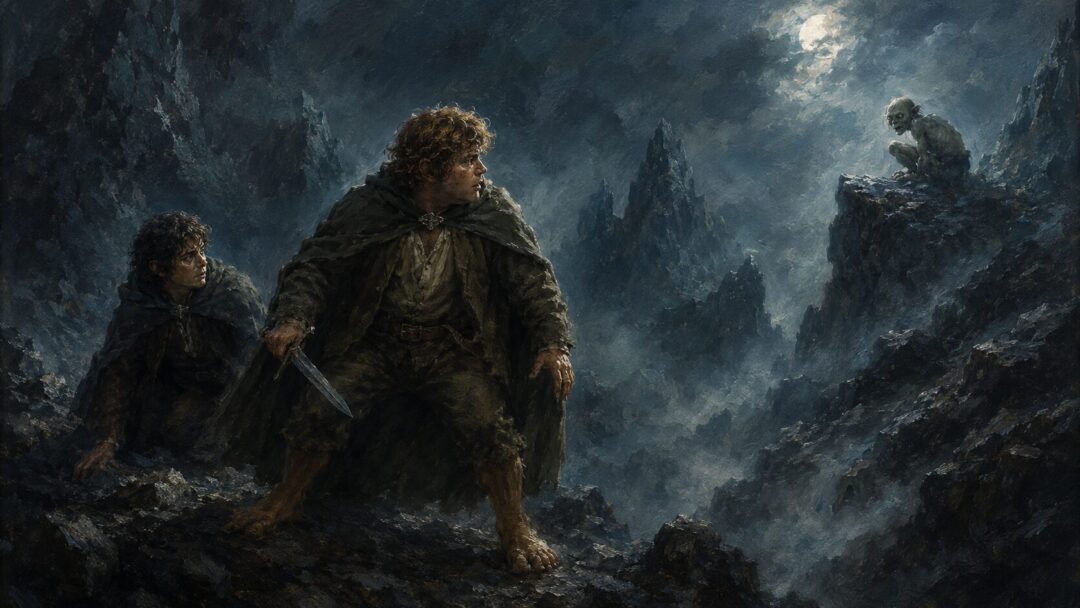
At the edge of the Cracks of Doom, the fate of Middle-earth turned not on a sword-stroke, a king’s command, or a wizard’s design, but on a ruined creature with nine fingers and an obsession he could not master. Gollum had followed, guided, betrayed, crawled, starved, pleaded, and attacked. To Samwise Gamgee, much of that journey seemed simple enough: Gollum was dangerous. Gollum was false. Gollum wanted the Ring. Gollum would betray them if he could.
Sam was not wrong.
That is what makes the tragedy sharper. Sam’s mistake was not that he failed to see Gollum’s evil. It was that he saw almost nothing else in him until the final moments, when the chance to understand him had already narrowed to a knife-edge.
Gollum was never safe. Yet he was also not merely a monster placed in the story for the heroes to defeat. He was a warning, a mirror, and finally an unwilling instrument of deliverance. Frodo sensed this earlier than Sam did. Sam loved Frodo too fiercely, too practically, and too defensively to see it. He understood hunger, fear, exhaustion, loyalty, and plain wickedness. What he did not fully understand was how close Frodo and Gollum were becoming under the same burden.
Sam Saw a Threat Before He Saw a Soul
Sam’s suspicion begins from good soil. He is Frodo’s servant, friend, and protector. After the breaking of the Fellowship, he has only one person left to guard, and the land ahead is hostile beyond anything a hobbit of the Shire was meant to face. When Gollum appears in the Emyn Muil, creeping after the Ring-bearer, Sam’s instinct is clear: this creature is a danger.
The text supports Sam’s caution. Gollum has already murdered Déagol long ago for the Ring. He has survived by secrecy, malice, and obsession. He follows Frodo and Sam not because he has nobly repented, but because he wants the “Precious.” Even when he becomes their guide, his loyalty is unstable. He swears by the Ring, but the oath itself is bound to the thing that enslaves him.
Sam’s nicknames for him, “Slinker” and “Stinker,” show both comic hobbit plainness and moral reduction. To Sam, the two sides of Gollum are not a mystery of a divided will; they are useful labels for behavior. Slinker can guide. Stinker cannot be trusted. This is understandable, but it is also incomplete.
Frodo sees more. He does not excuse Gollum. He knows Gollum’s danger. Yet Frodo also recognizes that Gollum has been under the Ring’s power for centuries and that pity has already shaped the Quest. Bilbo’s mercy in the dark beneath the Misty Mountains spared Gollum. Gandalf later taught Frodo that pity and mercy may have consequences beyond the foresight of the merciful. Frodo carries that lesson into Mordor. Sam hears and observes parts of it, but he does not yet inhabit it.
Frodo Recognized the Mirror Sam Wanted to Reject
The deeper reason Frodo understands Gollum is not abstract kindness. It is shared experience.
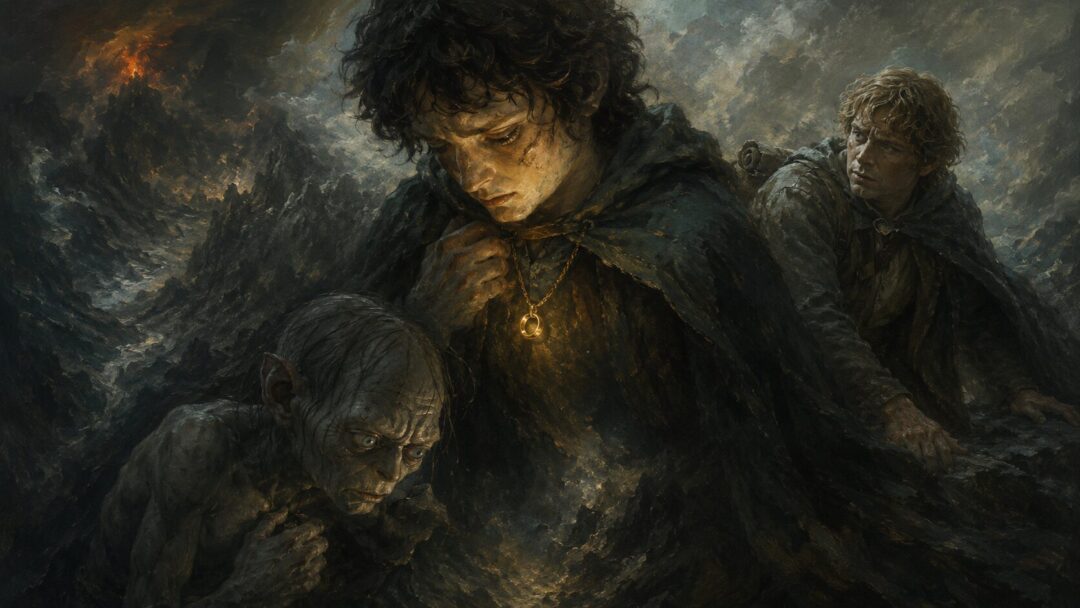
Frodo becomes increasingly aware that the Ring is not merely an object he carries. It presses on the will, isolates the bearer, and twists desire. By the later stages of the Quest, Frodo can barely remember ordinary comforts. His body weakens, his inner freedom diminishes, and the Ring grows heavier as it nears the place of its making. Gollum, horrifying as he is, represents one possible end of that road.
Sam does carry the Ring briefly after Shelob’s attack, and that experience matters. In Mordor he feels its temptation in terms suited to his own nature: visions of power, command, and even a transformed garden. But Sam’s contact with the Ring is short. His humility and love help him reject the fantasy, yet he never endures what Frodo endures for months, nor what Gollum endured for centuries.
This is one of the quiet asymmetries in the story. Sam understands Frodo’s suffering from the outside with extraordinary devotion. Gollum understands it from the inside in a corrupted, degraded, intimate way. That does not make Gollum Frodo’s friend in any ordinary sense. It does mean he knows the Ring’s hunger with a knowledge Sam cannot fully share.
Sam’s love for Frodo sometimes makes that recognition harder. He sees Gollum as an invader into the private loyalty between master and servant. He notices when Frodo speaks to Gollum with pity. He resents the creature’s nearness. And because Sam’s love is active and protective, he tends to answer danger with bluntness. In the Shire, bluntness can be a virtue. On the stairs of Cirith Ungol, it becomes costly.
The Stairs of Cirith Ungol and the Almost-Repentance
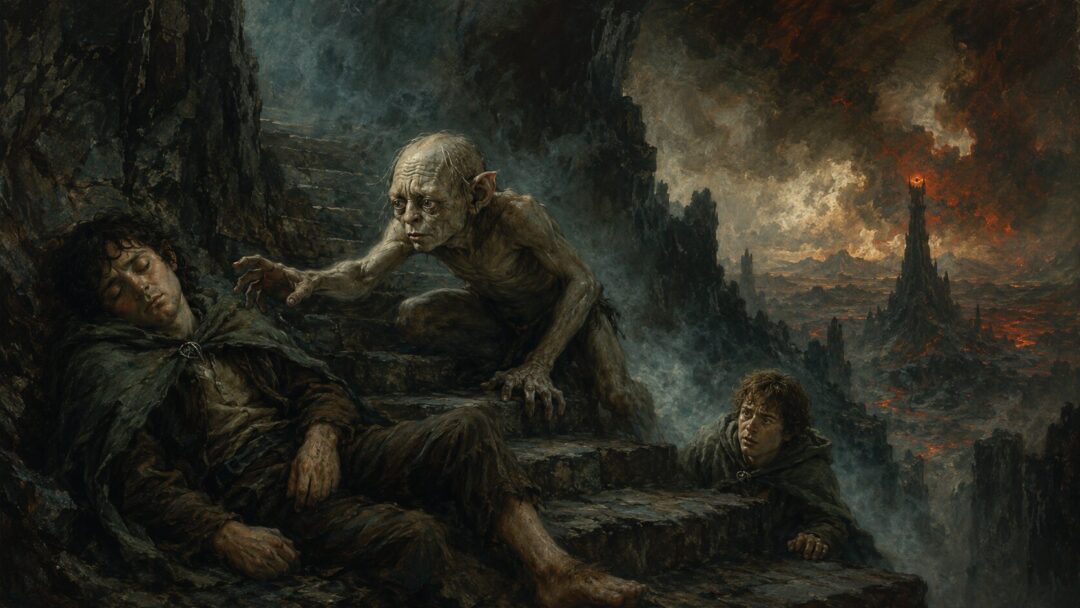
The most painful moment comes before Shelob’s Lair. Gollum has already planned betrayal. He intends to lead the hobbits to Shelob, hoping she will kill them and leave the Ring for him. That treachery is real. Yet on the stair, while Frodo sleeps and Sam dozes, Gollum returns and sees Frodo resting.
The scene is deliberately unsettling. Gollum looks at Frodo, and for a moment the text suggests a change: something like an old, starved humanity rises toward the surface. He reaches toward Frodo in a gesture that is not simply attack. The possibility of repentance appears, fragile and brief. It is not completed. It is not guaranteed. But the text allows the reader to see that Gollum is not beyond all movement of pity or longing.
Then Sam wakes and speaks harshly.
From Sam’s point of view, the reaction is rational. He sees Gollum near his sleeping master and assumes the worst. Given Gollum’s history and hidden plan, Sam has reason. But the timing is devastating. His words strike exactly where Gollum is most divided. The softer possibility collapses, and Gollum returns to bitterness and secrecy.
This does not mean Sam alone “caused” Gollum’s betrayal. Gollum had already chosen evil intentions. Nor does it mean a kinder word would certainly have saved him. The text is too morally serious for that kind of easy arithmetic. But it does imply that Sam failed to recognize the moment. He saw only the skulking enemy, not the creature trembling at the edge of a different choice.
That is the misunderstanding at its most tragic: Sam was morally right about the danger and spiritually late to the pity.
Sam Mistook Pity for Weakness
Sam often treats pity toward Gollum as if it were an impractical softness. In hard country, with Orcs nearby and the Ring at stake, that response seems natural. A guide who may betray you is not a problem to be sentimentally indulged. Sam’s instincts belong to survival.
But in The Lord of the Rings, pity is not mere softness. It is one of the hidden laws by which the Quest survives. Bilbo’s pity spared Gollum. Frodo’s pity continued that mercy. Even Sam, at the last, will be drawn into it. The pattern is not that mercy makes danger disappear. In fact, mercy leaves danger alive. Gollum remains a threat precisely because he has been spared.
Yet without that mercy, the Quest fails.
No one at the Council of Elrond could design a plan in which Frodo would overpower the Ring at the final moment. The nearer the Ring comes to the Fire, the less realistic that becomes. At the Sammath Naur, Frodo does not throw the Ring away. He claims it. This is not a simple collapse of character but the terrible climax of the burden he has carried. The Ring’s pressure at its own place of power is beyond ordinary moral calculation.
Gollum’s survival is therefore not a loose thread. It is the thread that mercy refused to cut.
Sam misunderstood this for most of the road. He thought the central question was whether Gollum would become useful or treacherous. Frodo’s deeper insight was that Gollum’s life mattered even when his usefulness could not be safely measured. Mercy was not a tactic, though it had consequences. It was a refusal to claim the right to destroy a miserable being merely because he deserved judgment.
The Final Pity on Mount Doom
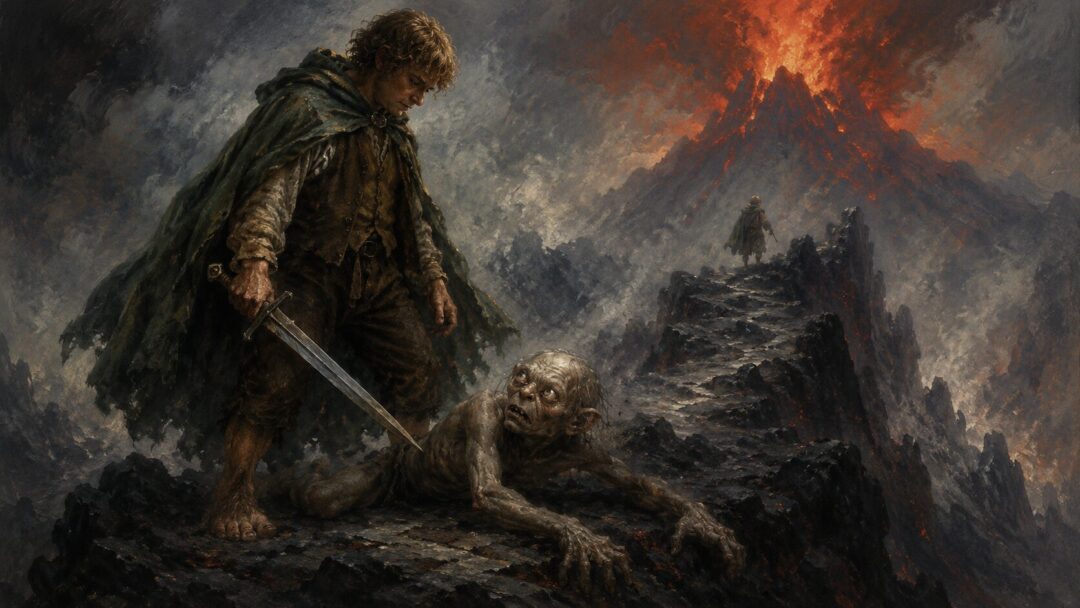
Sam’s understanding changes on the slopes of Mount Doom. After Gollum attacks them, Sam has the chance to kill him. The case for killing him seems overwhelming. Gollum is treacherous, murderous, and still dangerous. Sam is exhausted and enraged. Frodo is nearly spent. If ever “practical necessity” seemed to demand a death, this is the moment.
Yet Sam does not strike.
The text shows that he finally perceives Gollum’s misery in a way he had not before. He sees the creature as ruined, enslaved, and pitiable. Sam’s hand is stayed. This is not affection. It is not trust. It is pity arriving late, but not too late to matter.
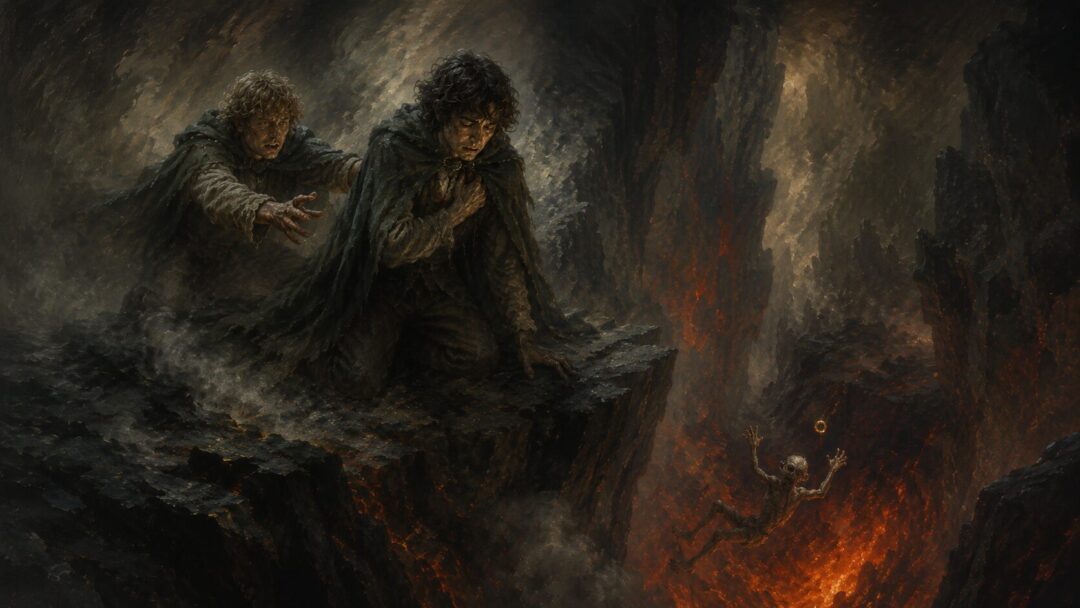
This moment is crucial because Sam’s mercy allows Gollum to live long enough to reach the Crack of Doom. There, after Frodo claims the Ring, Gollum attacks, bites the Ring from Frodo’s hand, and falls into the Fire with it. The destruction of the Ring comes through a convergence of Frodo’s endurance, earlier acts of mercy, Gollum’s obsession, and a providential shape the characters themselves do not control.
Sam’s final pity does not redeem Gollum in a simple sense. Gollum dies in the grip of the thing he worshipped. But Sam’s mercy means he does not become Gollum’s executioner. That distinction matters in Middle-earth. The good are repeatedly tested not only by whether they can defeat evil, but by what they become in the act of resisting it.
What Sam Learned Too Late
Sam misunderstood Gollum because he judged him almost entirely by the standard of loyalty. By that standard, Gollum failed again and again. Sam’s world is built around faithfulness: to Frodo, to home, to promises, to plain decency. Gollum is the opposite of that. He is appetite without trust, memory without healing, cunning without honor.
But the Ring creates victims as well as villains. Gollum is guilty, but he is also enslaved. He is dangerous, but he is also a prophecy of what the Ring can do to a soul. Frodo sees that because he is walking the same road. Sam sees it only when the ruin is fully visible and the road is almost ended.
This is why Sam’s misunderstanding is so human. He is not cruel in the ordinary sense. He is brave, loyal, and loving. His failure grows from virtues under strain. Protectiveness becomes suspicion. Plain speech becomes wounding speech. Moral clarity becomes partial blindness.
The tragedy is not that Sam lacked goodness. It is that goodness alone did not make him immediately wise.
The Mercy Hidden Inside the Victory
By the end, Sam’s earlier judgment of Gollum has been both confirmed and overturned. Confirmed, because Gollum does betray them. Confirmed, because he never becomes safe. Confirmed, because his desire for the Ring remains catastrophic.
But overturned, because the Quest depends on the life Sam would once have been glad to end.
Gollum is not the hero of Mount Doom. Frodo is not made irrelevant by Gollum’s final act. Sam is not condemned because he mistrusted a real threat. The power of the ending lies in the fact that all these truths stand together. Frodo carries the Ring farther than anyone could reasonably expect. Sam carries Frodo when Frodo can no longer carry himself. Gollum, spared by mercy he did not deserve, becomes the means by which the Ring is destroyed after Frodo’s strength fails.
What Sam misunderstood until it was almost too late was that pity is not opposed to the Quest. Pity is part of the Quest’s hidden architecture. Gollum’s life is a danger, a burden, and a mercy all at once.
That is why the story refuses the cleaner ending Sam might once have preferred. Evil is not defeated because the good kill every corrupted thing in time. It is defeated through endurance, mercy, suffering, and a final turn no one standing at the beginning could have planned.
Sam learned to pity Gollum only at the edge of the Fire. Late as it was, that pity helped leave room for the ending Middle-earth needed.
Sources & Notes
- J.R.R. Tolkien, The Lord of the Rings, Book I, Chapter 2, “The Shadow of the Past” — Gandalf’s teaching on Bilbo’s pity for Gollum establishes the mercy-chain that later proves essential to the Quest.
- J.R.R. Tolkien, The Lord of the Rings, Book IV, Chapter 1, “The Taming of Sméagol” — Frodo and Sam first master Gollum in the Emyn Muil, and Frodo’s pity begins to shape their use of him as guide rather than merely enemy.
- J.R.R. Tolkien, The Lord of the Rings, Book IV, Chapter 8, “The Stairs of Cirith Ungol” — Gollum’s near-tender moment beside the sleeping Frodo, followed by Sam’s harsh interruption, is the key scene behind the article’s “almost too late” reading.
- J.R.R. Tolkien, The Lord of the Rings, Book VI, Chapter 1, “The Tower of Cirith Ungol” — Sam’s brief bearing of the Ring shows both his own temptation and the limits of his experience compared with Frodo and Gollum.
- J.R.R. Tolkien, The Lord of the Rings, Book VI, Chapter 3, “Mount Doom” — Sam pities Gollum on the slopes, Frodo claims the Ring at the Fire, and Gollum’s final seizure of it becomes the means of its destruction.
- J.R.R. Tolkien, The Letters of J.R.R. Tolkien, Letter 246 — Tolkien explicitly reflects on Sam’s failure to understand Gollum at the stairs and on how mercy, failure, and providence converge at Mount Doom.