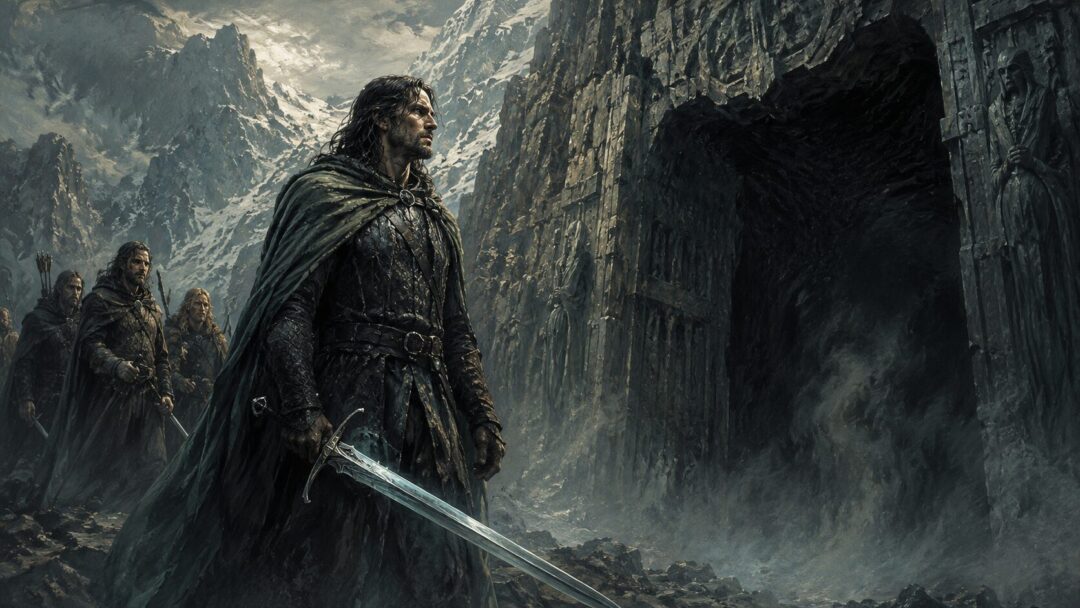
The Paths of the Dead are one of the strangest doors in The Lord of the Rings: not a gate of stone, not a battlefield, not a throne room, but a road under the mountain where fear itself seems to have a memory. Riders pause before it. Rohirrim whisper old warnings. Even brave men feel the air change. And at the heart of that dread waits a question that is easy to miss: if the Dead Men of Dunharrow had been trapped for thousands of years, why did they answer Aragorn — and apparently no other heir before him?
The answer is not simply “because Aragorn was royal.” Middle-earth is full of old bloodlines, forgotten claims, and half-buried kingdoms. But the Dead were not waiting for a king in a general sense. They were bound by a specific broken oath, made to a specific lord, under a specific curse, and released only when that oath could finally be fulfilled.
Aragorn did not merely inherit a name. He arrived as the living convergence of lineage, prophecy, need, and judgment.
The Oath Was Not To Gondor In General
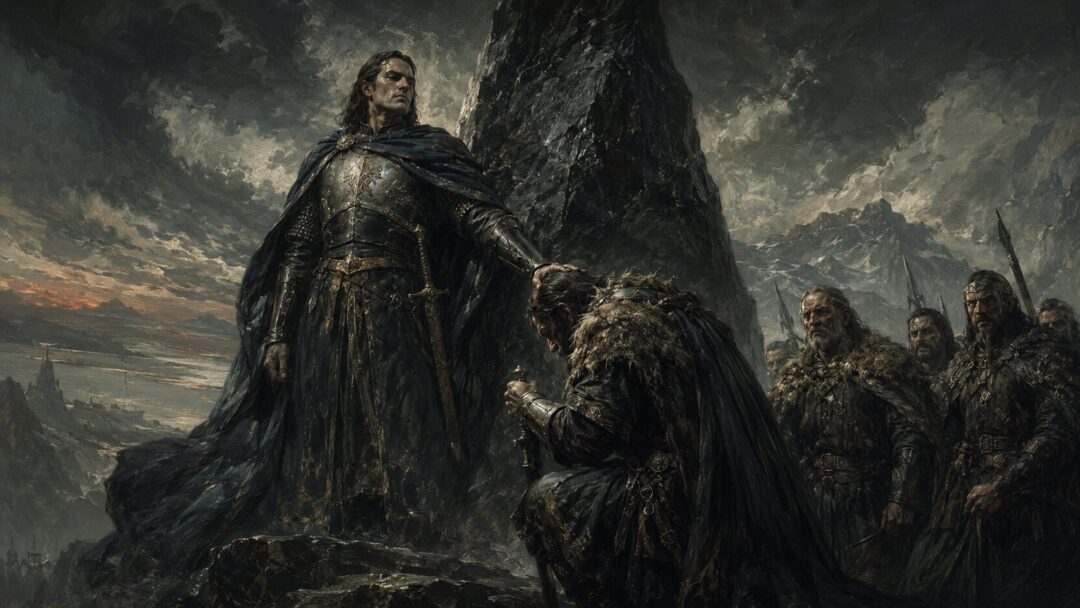
The Dead Men were originally Men of the Mountains, dwelling in the White Mountains near Erech and Dunharrow. In the late Second Age, their king swore allegiance to Isildur. This matters enormously. The oath was not made vaguely to “the West,” nor simply to the later kingdom of Gondor, nor to any ruler who happened to sit in Minas Tirith.
It was made to Isildur.
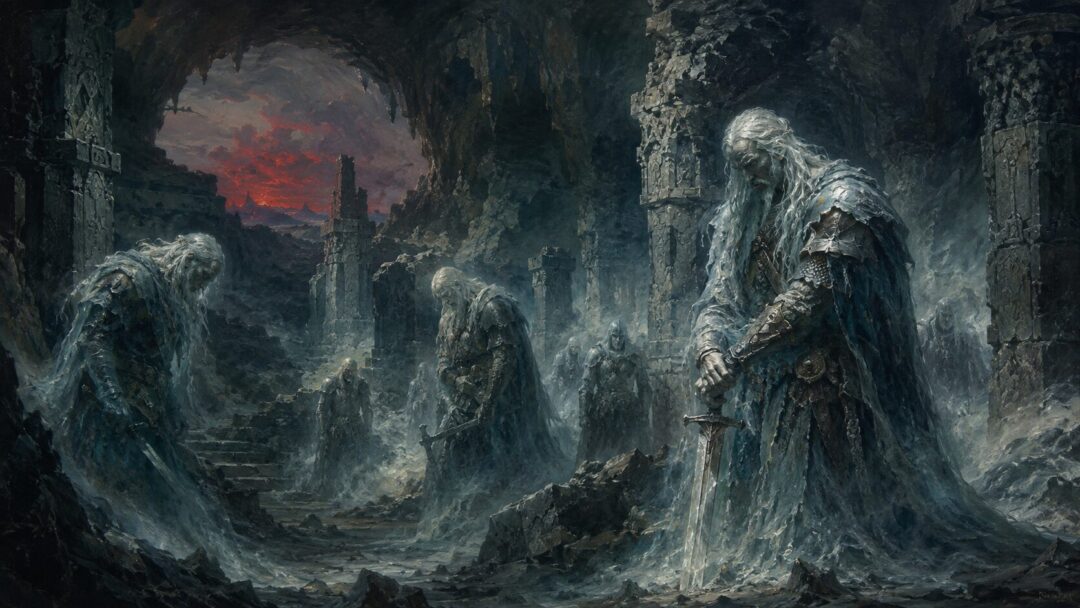
When Sauron returned and the Last Alliance gathered against him, these Men did not fulfill their promise. The texts say they had worshipped Sauron in the Dark Years, and when Isildur called them to fight, they refused. They would not serve Sauron openly in that war, but neither would they fight for Isildur. They fled into the mountains.
Their punishment was therefore shaped by the exact nature of their failure. They had sworn to aid Isildur against Sauron, and they failed at the hour when that oath mattered most. Isildur’s curse bound them to restlessness until they fulfilled what they had promised.
That is why Aragorn’s claim is so precise. He does not come to them as merely “a king.” He comes as Isildur’s heir.
The Curse Created A Debt, Not A Weapon
One common misunderstanding is that Aragorn simply “summons an undead army” because he has royal blood. In the book, the situation is more restrained, more legal, and more tragic.
The Dead are not a convenient supernatural force waiting to be used in any battle. They are oathbreakers. Their continued existence is not presented as a gift to the living but as a punishment upon themselves. They are bound because they failed to do one thing: stand against Sauron’s power when called by Isildur.
Aragorn’s power over them is therefore not like a necromancer’s command. He is not enslaving the dead. He is calling in an ancient debt.
This distinction matters because Tolkien’s world treats oaths with extraordinary seriousness. Words spoken in solemn promise can shape fate, identity, and doom. The Dead Men’s curse is terrifying precisely because it turns their broken word into a prison. They cannot pass beyond their failure until the failure is answered.
Aragorn gives them that chance.
Why Not The Kings Of Gondor?
At first glance, the Kings of Gondor seem like obvious candidates. They ruled close to the White Mountains. They inherited the southern kingdom founded by Elendil’s sons. Some faced great wars. Why did the Dead not answer one of them?
The strongest lore-grounded answer is that the oath was to Isildur, not simply to the southern throne. Gondor’s royal line descended chiefly from Anárion, Isildur’s brother, after Isildur departed north. The Kings of Gondor had Númenórean authority, but they were not the same as the direct northern Heirs of Isildur.
There is room for nuance here. The royal houses of the Dúnedain were related, and later claims to kingship become politically complex. But the language surrounding the Dead is consistently tied to Isildur and to the “Heir of Isildur.” That phrase is not decorative. It explains why Aragorn’s arrival is different from the presence of other rulers in the South.
The Dead had not betrayed some abstract institution. They had betrayed the lord to whom they had sworn.
Why Not The Chieftains Before Aragorn?
A sharper question remains: if the Heirs of Isildur survived in the North, why did no earlier Chieftain of the Dúnedain use the same claim?
Here the texts do not give a full list of failed attempts, and it is safest not to invent one. We are not told that earlier heirs marched into the Paths and were rejected. We are not told that they knew enough, dared enough, or had the right moment. What the story does give us is prophecy, timing, and need.
The prophecy of Malbeth the Seer points forward to a particular hour. It says that a time will come when the Dead will be summoned, when the heir of the one to whom the oath was sworn will come from the North, and when need will drive him to the Paths. The prophecy does not read like an open invitation available in every generation. It marks a destined crisis.
Earlier heirs may have had the blood, but not the hour. They may have had the claim, but not the need. They may have had courage, but not the historical moment in which the oath could be fulfilled against Sauron’s returning power.
Aragorn arrives when Sauron is openly rising again, when Gondor is under mortal threat, when the Corsairs of Umbar are sailing north, and when the War of the Ring is reaching its decisive crisis. The old oath had been made in a war against Sauron. Its fulfillment comes in another war against Sauron.
That symmetry is not accidental.
Aragorn Came With More Than Ancestry
Aragorn’s ancestry gives him the right to call the Dead. But the scene works because he has more than ancestry.
He carries Andúril, the sword reforged from the shards of Narsil. This is not just a weapon; it is a visible sign of restored inheritance. Narsil was the sword of Elendil, broken in the overthrow of Sauron, and its reforging announces that the scattered past is being gathered again. Aragorn also travels with the Grey Company, Rangers of the North who represent the long-hidden remnant of his people.
He does not enter the Paths as a wandering adventurer testing a rumor. He enters as a claimant finally stepping into the full burden of his identity.
That burden is important. Aragorn has spent much of his life in hidden service: guarding lands that do not know his name, fighting enemies without reward, waiting for a kingship that might never be accepted. The Paths of the Dead are one of the moments when concealment ends. He must act not only as Strider, the Ranger, but as the heir of Isildur.
The Dead answer because the hidden king is no longer hidden from them.
Fear Could Not Be The Test He Failed
The Paths are not only a legal threshold; they are a test of fear. The living dread them. The Rohirrim remember the place with horror. Baldor, son of Brego, once rashly entered the Paths and never returned. The mountain is surrounded by old grief and warning.
Aragorn does not go because he is fearless in a shallow sense. He goes because the need is greater than fear. That is another reason he differs from any ordinary claimant. The Dead cannot be reached by ceremony from a safe distance. The heir must go to them.
This is one of the great moral patterns of Aragorn’s story. His kingship is not proved by demanding honor. It is proved by walking into places others avoid: the wild, the darkness, the hopeless road, the burden no one else can carry. He earns public recognition later, but he first accepts hidden terror.
The Dead answer a king who comes to them under the mountain, not one who merely claims authority from a throne.
The Stone Of Erech And The Return Of The Past
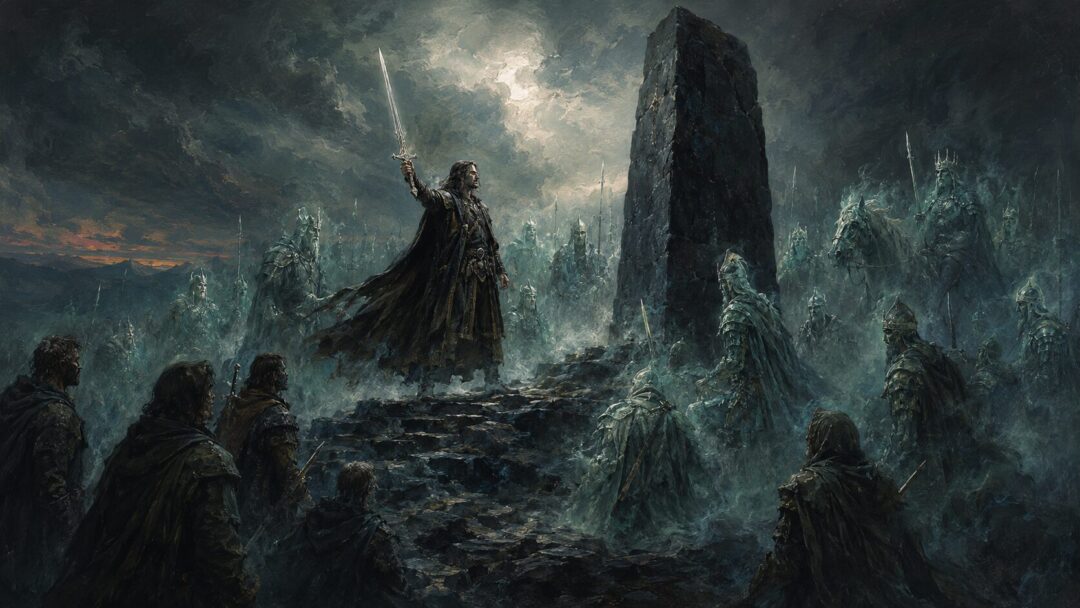
The Stone of Erech is central to the story because it anchors the oath in memory. Isildur brought it from Númenor, and it became the place where the King of the Mountains swore allegiance. When Aragorn comes to Erech, he is not improvising a magical command. He is returning to the site of the original obligation.
That makes the moment feel almost like a trial. The Dead are confronted not only by Aragorn but by the place where their word was given. Their ancient betrayal is no longer a rumor haunting the hills. It has been called back into the open.
Aragorn’s summons is severe, but it is also merciful. He does not call them to endless service. He does not use them for conquest. He requires them to fulfill the oath they broke, and then he releases them.
That release is essential. It shows that Aragorn’s authority is kingly rather than tyrannical. He binds the past long enough to heal it. He does not keep the Dead chained for his own glory.
What The Dead Actually Did In The Book
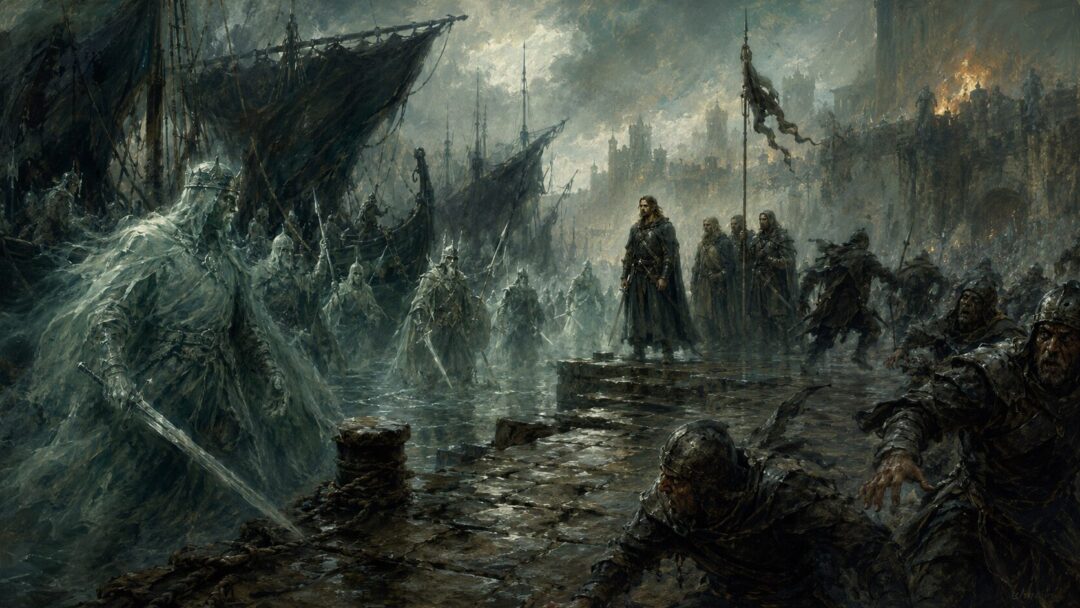
The book’s version is more restrained than many casual fans remember. The Dead do not sweep through the Pelennor Fields as an unstoppable ghost army. Their main role is to bring terror to Sauron’s allies in the south, especially at Pelargir, where the Corsairs’ threat is broken.
This matters for understanding why they answered Aragorn. Their task fits the oath. They stand against Sauron’s war by helping turn aside a deadly blow aimed at Gondor. Once they have done that, Aragorn declares their oath fulfilled and lets them depart.
The drama is not about undead spectacle. It is about an ancient moral account finally being settled.
Aragorn’s Authority Was Also His Mercy
The deepest reason the Dead answered Aragorn may be that he was the first heir in the story who came with both the right to command and the wisdom to release.
A lesser man might have been tempted to use them as a permanent weapon. A desperate ruler might have tried to drag them all the way to Minas Tirith. A proud claimant might have seen them as proof of his own greatness.
Aragorn does not. He calls them, receives their service, and frees them.
That is why the scene belongs so perfectly in his path to kingship. The true king is not merely the one whom the dead obey. He is the one who can judge the dead without becoming cruel, use power without being possessed by it, and redeem an old oath without turning it into a new slavery.
The Dead Men answered Aragorn because he was Isildur’s heir. But they followed him because, in that hour, he became more than a descendant. He became the living answer to a broken promise.
Their curse began when Men refused to stand against the Shadow. It ended when the right heir came from the North, entered the darkness, and gave them one last chance to do what they should have done long ago.
In Middle-earth, bloodlines matter. But they are never enough by themselves. Aragorn’s blood opened the door. His courage carried him through it. His mercy closed it behind him.
Sources & Notes
- J.R.R. Tolkien, The Lord of the Rings, The Return of the King, Book V, Chapter 2, “The Passing of the Grey Company” — Malbeth’s prophecy, the Paths of the Dead, the Stone of Erech, and Aragorn’s summons as Isildur’s heir.
- J.R.R. Tolkien, The Lord of the Rings, The Return of the King, Book V, Chapter 9, “The Last Debate” — Legolas and Gimli recount the Dead aiding Aragorn at Pelargir and being released after their oath is fulfilled.
- J.R.R. Tolkien, The Lord of the Rings, Appendix A, “Annals of the Kings and Rulers,” I: “The Númenórean Kings” — background on Elendil, Isildur, Anárion, and the divided lines of Arnor and Gondor.
- J.R.R. Tolkien, The Lord of the Rings, Appendix A, I(iv), “Gondor and the Heirs of Anárion” — context for Gondor’s southern royal line and why rule in Gondor is not identical with direct heirship from Isildur.
- J.R.R. Tolkien, The Silmarillion, “Of the Rings of Power and the Third Age” — summary of Sauron’s return, the Last Alliance, Isildur’s role, and the wider Second Age setting behind the broken oath.