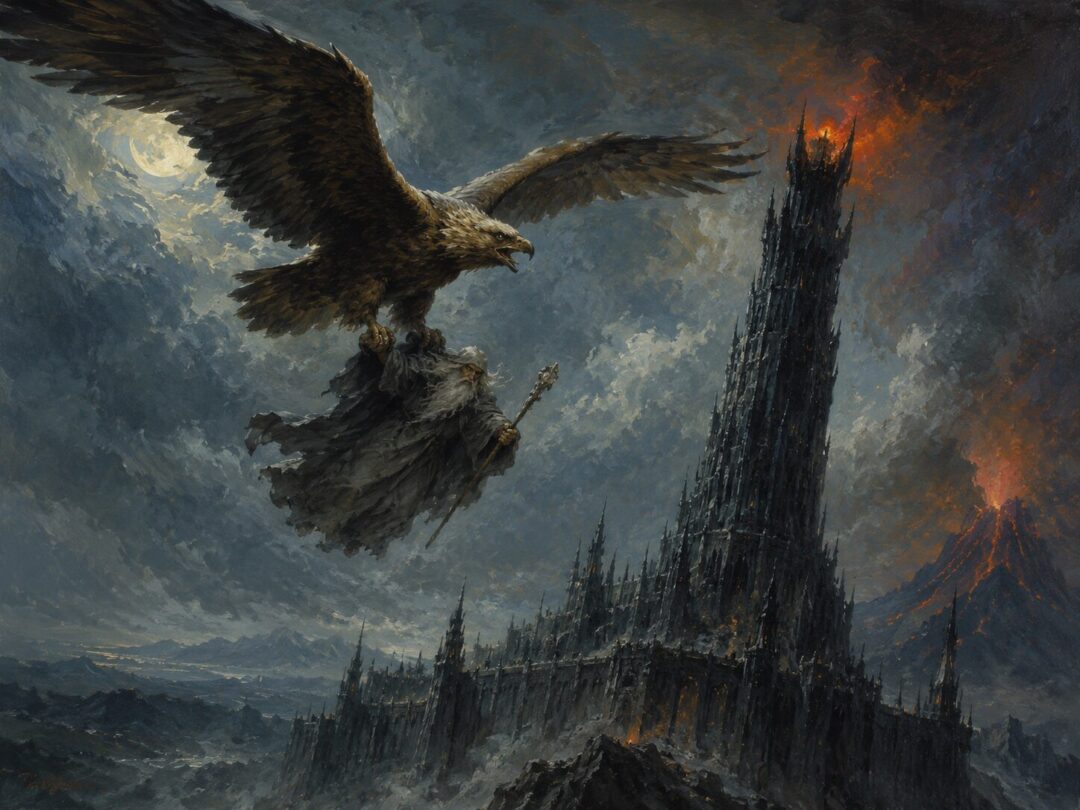
A giant Eagle can lift a wizard from the roof of Orthanc. He can find Gandalf again on the high, bitter peak of Zirakzigil. He can come at the end, when the Ring is gone and the slopes of Orodruin are breaking beneath Frodo and Sam. So the question feels almost unavoidable: if Gwaihir could rescue Gandalf, why did the Council of Elrond not simply send the Ring-bearer to Mordor on Eagle-back?
The strongest lore-grounded answer is not that the Eagles were weak, foolish, or forgotten. It is that their rescues belong to a very different kind of action than the Ring-quest itself. Gwaihir appears at moments of deliverance, reconnaissance, and aftermath. The Fellowship’s mission, by contrast, required secrecy, humility, endurance, and a kind of moral resistance that could not be outsourced to any mighty creature.
The Eagles could save someone from a desperate place. They could not make the Ring safe.
Gwaihir’s Help Was Real, But It Was Limited
Gwaihir, called the Windlord, is one of the Great Eagles of the late Third Age. The lore references identify him as the Eagle who rescued Gandalf from Orthanc, later found him on the peak of Celebdil after the battle with the Balrog, and finally helped rescue Frodo and Sam after the destruction of the Ring.
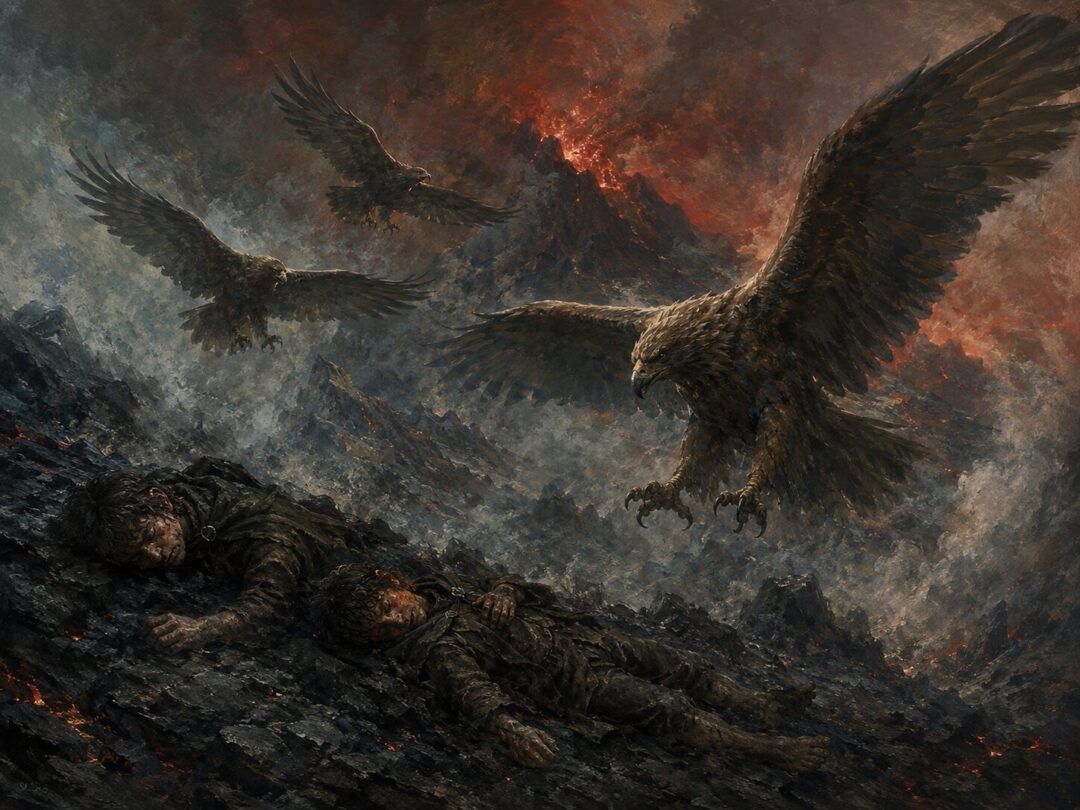
Those rescues matter. They are not decorative. Without Gwaihir, Gandalf’s escape from Saruman’s prison would have failed. Without the later rescue from the mountain, Gandalf the White would not have returned swiftly to the struggle. Without the Eagles at the end, Frodo and Sam would almost certainly have died in Mordor after completing the Quest.
But the texts also keep drawing boundaries around Eagle-help. Gwaihir does not become Gandalf’s mount. He does not remain at the wizard’s command. In the account of Orthanc, he is not dispatched as part of a military operation against Mordor. He is connected to Radagast’s sending of birds and beasts as messengers, and he comes as a rescuer at a crisis point, not as the beginning of a transport system. Reputable lore summaries likewise connect Radagast’s unwitting role with Gandalf’s escape from Orthanc.
The famous line matters: Gwaihir says he was sent to bear tidings, not burdens. That is not a throwaway excuse. It tells us how the Eagles understand their role. They can carry a person for a time. They are not pack animals. They are not a courier service for every desperate need of the Wise.
The Ring Quest Was Built on Secrecy, Not Speed
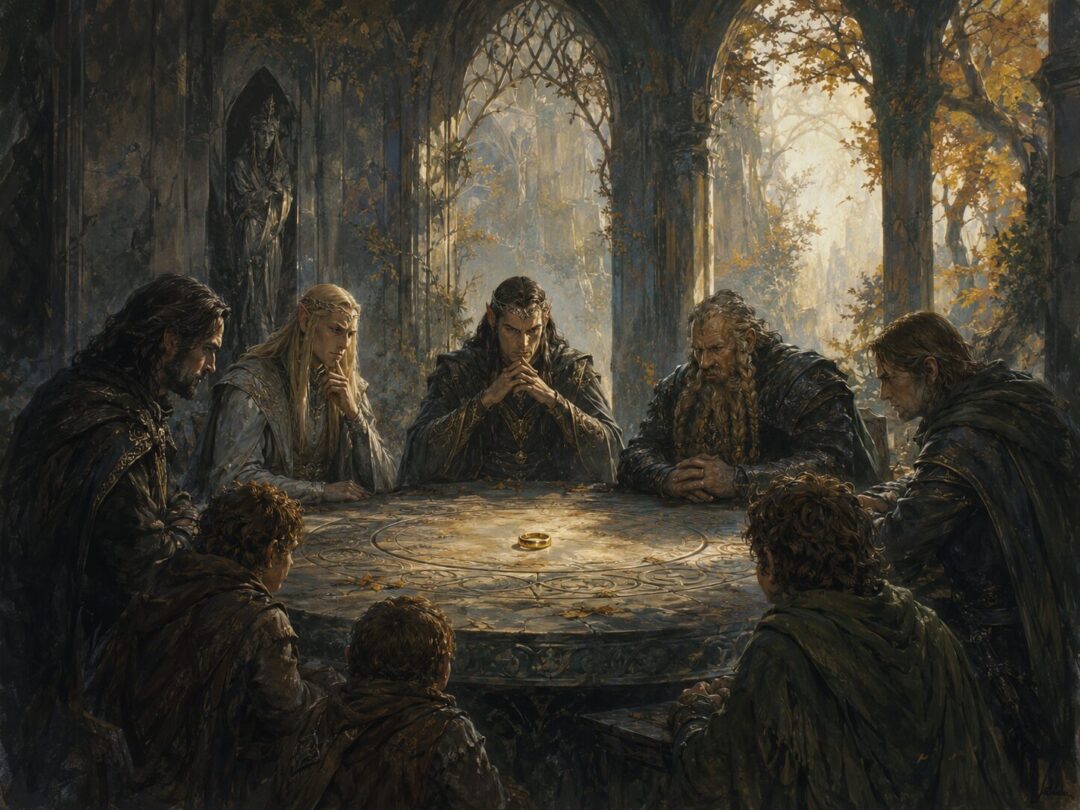
At the Council of Elrond, the central problem is not simply distance. It is knowledge. Sauron must not learn where the Ring is, who bears it, or what the Wise intend to do with it. The Council’s purpose is to determine the fate of the One Ring after it reaches Rivendell with Frodo.
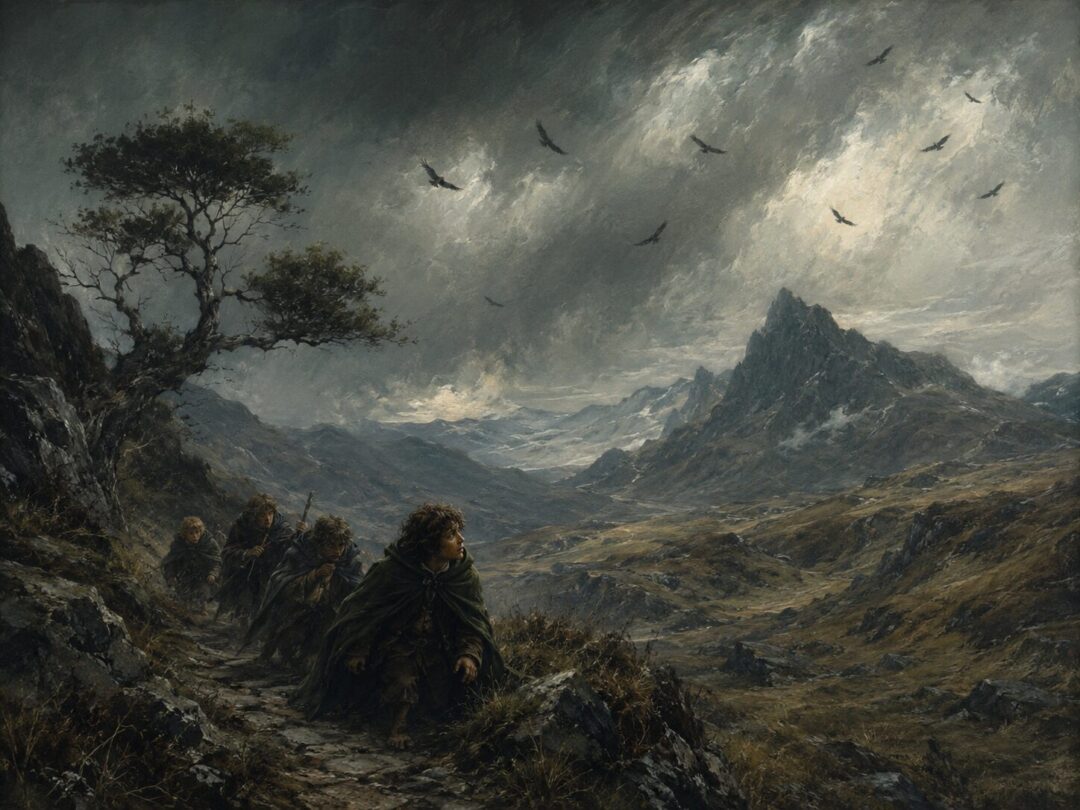
That point changes everything. A company moving quietly through wilderness is dangerous, but it is at least hidden. A group of Great Eagles flying toward Mordor would be the opposite of hidden. The texts repeatedly show that the Enemy uses watchers, servants, spies, and fear. Even before the Fellowship reaches the darker lands, they are watched by crebain from Dunland, and the open sky is not treated as safe space.
This is why “just fly there” misreads the kind of story the Quest is. The Ring is not a parcel to be delivered by the fastest route. It is the center of Sauron’s attention and the thing his whole will is bent toward recovering. A visible aerial approach to Mordor would announce urgency, direction, and importance. Even if Sauron did not immediately know the full truth, he would have reason to strike.
The Council chooses an almost absurdly small weapon against overwhelming power: a hobbit walking. That is not because walking is efficient. It is because a small, concealed, apparently unimportant bearer has a chance that open strength does not.
The Eagles Were Free Powers, Not Servants of the Fellowship
Another common mistake is to treat Gwaihir as if he were simply one more resource controlled by Gandalf. The texts do not present the Great Eagles that way. They are intelligent, proud, and independent. In The Hobbit, the Eagles help Thorin’s company, but they do not carry them all the way to their destination. They have their own concerns, their own limits, and their own unwillingness to come too near the settlements of Men, where they might be shot at because of old conflicts over livestock.
That older pattern carries into The Lord of the Rings. The Eagles intervene at great moments, but they are not absorbed into the command structure of Elrond, Gandalf, Aragorn, or the Fellowship. Gwaihir’s friendship with Gandalf is real, but friendship is not ownership. Lore references note the tradition that Gandalf once healed the Eagle’s wound, establishing a bond of friendship; that helps explain why Gwaihir aids him, but it does not make every plan involving the Eagles automatically available.
This matters morally. The Free Peoples are not Sauron’s mirror image. They cannot simply seize every strong creature and turn it into an instrument. The Quest is not only about defeating Sauron; it is about refusing the logic by which power treats others as tools.
Gwaihir helps because he chooses, or because he is sent within a larger providential pattern. He is not drafted into service.
Mordor Was Not Just Far Away — It Was Guarded by the Enemy’s Will
Flying toward Mount Doom sounds simple only if Mordor is imagined as an empty map with one dangerous volcano at the end. In the story, Mordor is the seat of Sauron’s power. Its borders are watched, its roads are militarized, and its air is not beyond danger.
The Nazgûl are especially important here. After losing their horses at the Ford of Bruinen, they later return mounted on flying creatures. By the time the war reaches its final movement, the sky itself has become part of Sauron’s terror. The Eagles do fight the Nazgûl near the Black Gate, but that happens during open war, when Aragorn’s host has deliberately drawn Sauron’s gaze away from the true Ring-bearer. Tolkien Gateway’s Eagle summary notes that the Eagles appear at the Battle of the Morannon and fight against the Nazgûl before rescuing Frodo and Sam after the Ring’s destruction.
That sequence is crucial. The Eagles come openly when secrecy no longer has to be preserved in the same way, and when the Ring has already reached its end. They do not escort the Ring into Mordor. They arrive after the impossible inward task has been completed.
One careful interpretation is that an Eagle-flight to Mordor would have forced the Quest into the form Sauron understood best: a contest of power, speed, and visible assault. That was precisely the kind of contest the West could not win.
The Ring Itself Makes “Use Greater Power” Dangerous
The One Ring does not merely sit in a pocket. It tempts. It magnifies desire. It offers domination according to the stature and imagination of the person who claims it. The greater the native power, the more terrible the possible fall.
The texts never explicitly say, “Gwaihir would have been corrupted if he carried the Ring-bearer.” So that claim should not be stated as fact. But it is fair to say the Ring makes any plan involving powerful beings morally dangerous. Gandalf refuses the Ring. Galadriel is tested by it. Boromir falls under its lure through fear and the desire to save his people. Even Frodo, chosen partly because he is small, merciful, and not hungry for rule, fails at the final moment inside Mount Doom.
So an Eagle-plan would not merely involve transport. It would place the Ring in close association with mighty, intelligent creatures flying directly toward the place of Sauron’s greatest pressure. The texts do not give us a scene of an Eagle being tempted, but the general logic of the Ring warns against bringing great power too near it unless absolutely necessary.
The Quest succeeds not because Frodo is incorruptible. He is not. It succeeds because mercy, endurance, secrecy, friendship, and events beyond calculation converge at the edge of failure.
Gwaihir’s Rescues Happen at Thresholds, Not as Shortcuts
Look closely at when Gwaihir appears. Orthanc: Gandalf is trapped by treachery and must escape in order to keep hope alive. Zirakzigil: Gandalf has passed through death and returns changed. Mount Doom: Frodo and Sam have completed the Quest and can go no farther.
These are thresholds. The Eagle does not remove the need for trial. He appears after trial has reached its breaking point.
That pattern also appears in The Hobbit, where the Eagles rescue the company from wolves and goblins but do not simply solve the entire journey. Later, at the Battle of Five Armies, they arrive as a decisive force, but not as a replacement for all the choices, greed, courage, and conflict that led there.
The Eagles often bring deliverance. They do not erase the road.
That distinction is the heart of the matter. The Fellowship’s road had to be walked because the Ring could only be unmade by getting it secretly into the one place where it was vulnerable. No army could do that. No lordly display could do that. Not even Gandalf could do that by strength.
The “Eagles Problem” Reveals the Story’s Hidden Rule
The great hidden rule of the Ring-quest is that power cannot be beaten simply by better power. If the Wise had used the Ring, they would have become like the Enemy. If they had marched openly into Mordor, they would have been crushed. If they had placed the fate of the world on a dramatic flight of Eagles, they would have turned a secret act of renunciation into an obvious act of force.
Gwaihir’s existence does not weaken the story’s logic. It clarifies it. Middle-earth contains mighty helpers, but they do not abolish moral burden. The Eagles can lift bodies from towers, mountains, and burning lands. They cannot carry the will of the Ring-bearer through temptation. They cannot make Sauron blind to obvious signs. They cannot turn the Ring into an ordinary object.
That is why Gwaihir can rescue Gandalf and still never become “the plan.” His wings belong to moments of grace, not convenience. He comes when hope is nearly spent, not when the road simply looks too long.
The Fellowship’s plan was not the fastest way to Mordor. It was the only kind of plan that still belonged to the free: small enough to be hidden, humble enough to refuse domination, and desperate enough to leave room for mercy.
Sources & Notes
- J.R.R. Tolkien, The Lord of the Rings, Book II, Ch. 2, “The Council of Elrond” — Elrond’s council frames the Ring-quest as a secret mission to destroy the Ring, and Gandalf recounts Gwaihir’s rescue from Orthanc, including the Eagle’s “tidings, not burdens” limit.
- J.R.R. Tolkien, The Lord of the Rings, Book II, Ch. 3, “The Ring Goes South” — the Fellowship’s departure and the crebain from Dunland illustrate why open movement, especially under the sky, threatened secrecy.
- J.R.R. Tolkien, The Lord of the Rings, Book III, Ch. 5, “The White Rider” — Gwaihir finds Gandalf after the battle with the Balrog and bears him from Zirakzigil/Celebdil to Lórien.
- J.R.R. Tolkien, The Lord of the Rings, Book V, Ch. 10, “The Black Gate Opens,” and Book VI, Ch. 4, “The Field of Cormallen” — the Eagles appear during the final diversion at the Morannon and rescue Frodo and Sam only after the Ring is destroyed.
- J.R.R. Tolkien, The Hobbit, Ch. 6, “Out of the Frying-Pan into the Fire” — the Eagles rescue Thorin’s company but refuse to carry them all the way, showing their independence and practical limits.
- J.R.R. Tolkien, The Letters of J.R.R. Tolkien, Letter 210 — Tolkien calls the Eagles a “dangerous machine” as a story device, supporting the idea that Eagle-rescue is exceptional rather than a general solution.