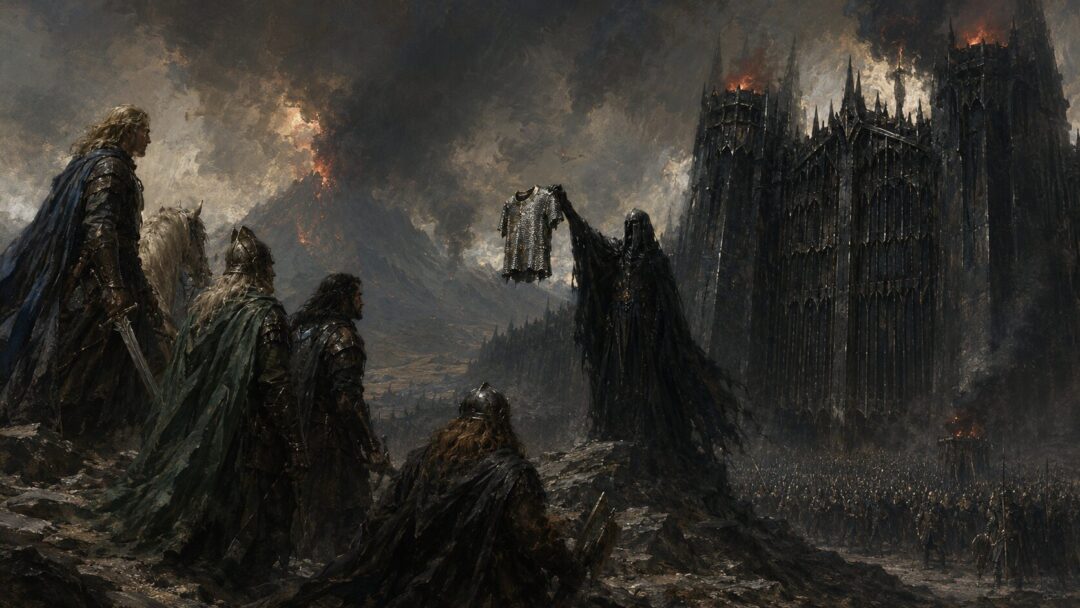
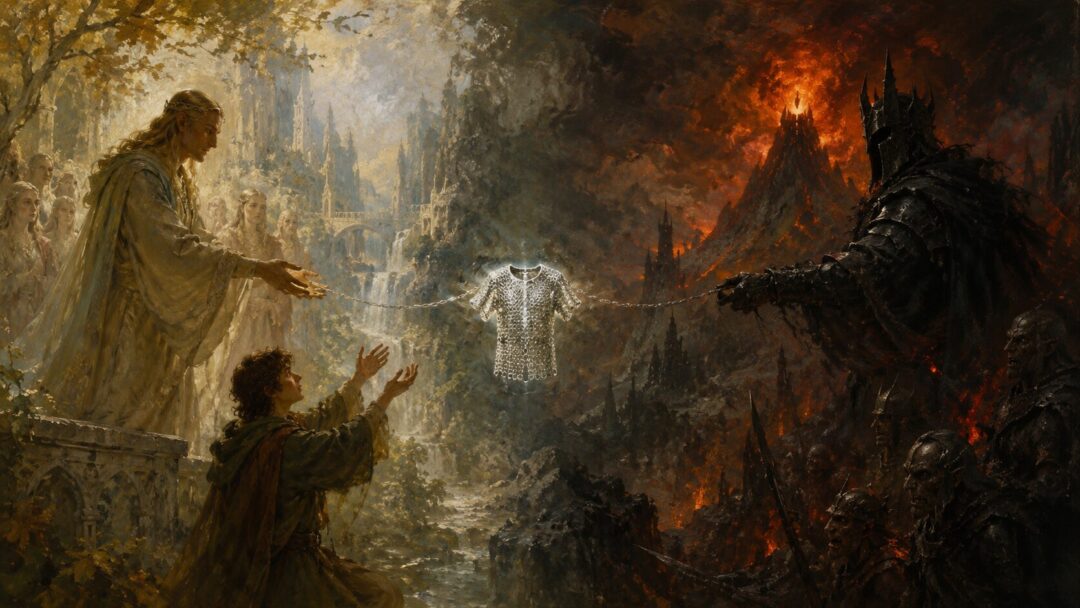
At the Black Gate, the smallest object in the war becomes one of the cruelest weapons: Frodo’s mithril shirt.
It is not a sword raised in battle, not a Ring blazing with power, not a banner of Mordor. It is a child-sized coat of shining mail, once given by Thorin’s company to Bilbo and later passed quietly to Frodo in Rivendell. It had already saved Frodo’s life in Moria, when a spear-thrust that should have killed him was turned aside by hidden dwarf-work. Yet by the end of the Quest, that same gift is held up by the Mouth of Sauron before the Captains of the West.
The message seems obvious: Frodo has been captured. The Quest has failed. Hope is dead.
But that is precisely the point. The mithril shirt is not proof. It is bait.
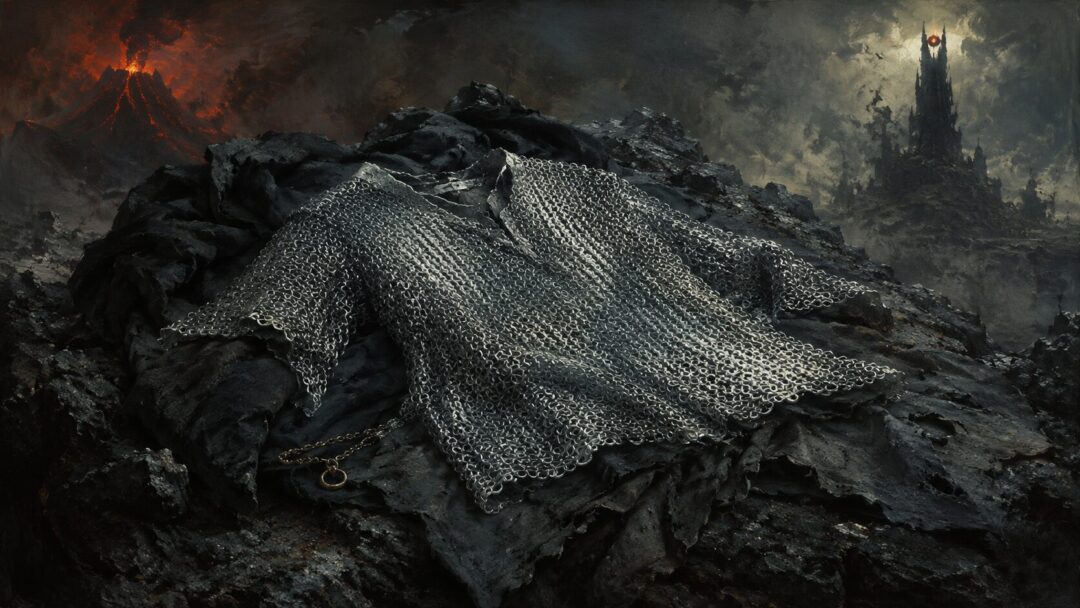
The Shirt Was Real, but the Story Around It Was Not
Sauron’s messenger does not arrive at the Morannon with Frodo himself. He does not bring the Ring. He does not even bring a clear report that the Ring-bearer is in chains. He brings objects: a cloak, a sword, the mithril coat, and other captured gear associated with the hobbits. In the book, the Mouth of Sauron uses these things to torment Gandalf and the Captains, claiming that one who wore them had been taken as a spy. The scene is designed to make the West imagine the worst, not to prove it.
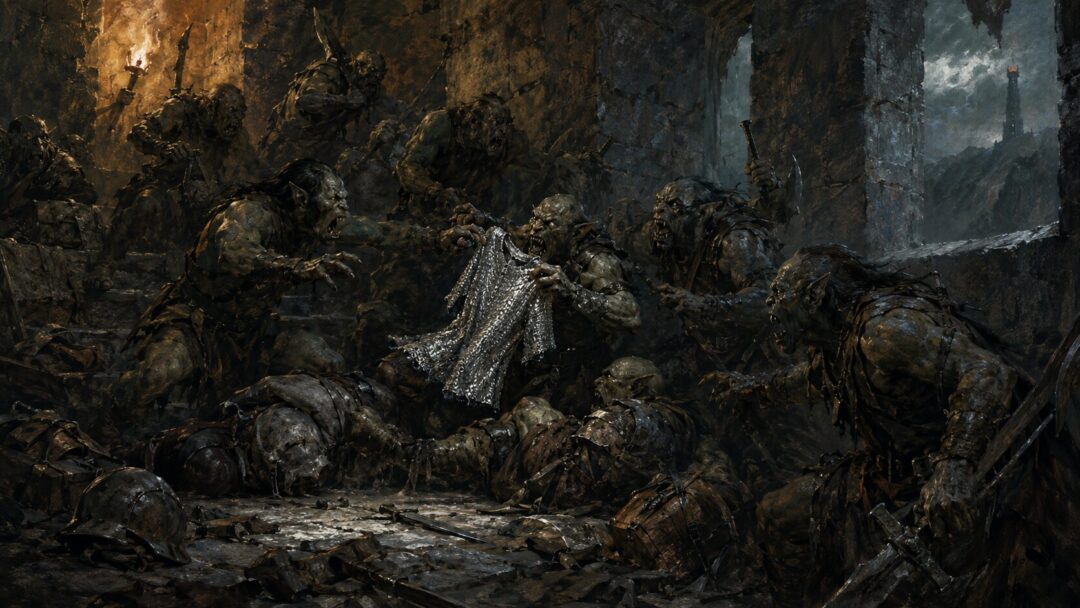
That distinction matters. The gear had indeed been taken after Frodo was stung by Shelob and carried to the Tower of Cirith Ungol. The Orcs there stripped and searched him, and the discovery of the mithril coat helped spark a deadly quarrel among the Orcs of the tower and the force from Minas Morgul. Shagrat escaped with captured items, and those items eventually reached Sauron’s side, which explains how the Mouth could display them at the Black Gate.
Yet the objects prove only that Frodo had been captured or searched at some point. They do not prove he was still a prisoner. They do not prove Sam was captured. They do not prove the Ring was found. And above all, they do not prove that Sauron understood the real purpose of the Quest.
The trap lies in that gap between fact and conclusion.
Sauron Had Evidence, but Not the Truth
Sauron’s strength is vast, but his knowledge is not perfect. This is one of the most important hidden rules of the War of the Ring. He sees much, commands much, and guesses shrewdly—but he still guesses. His error is not stupidity. It is moral imagination.
Sauron cannot easily conceive that his enemies would seek to destroy the Ring rather than wield it. The Ring is the supreme instrument of domination. To Sauron, anyone powerful enough to understand it would desire to use it. Aragorn’s challenge through the palantír, the victory at Pelennor, and the march to the Black Gate all encourage Sauron to believe that the West’s leaders are making a desperate power play. The Last Debate explicitly turns the Captains’ march into a diversion meant to draw Sauron’s Eye away from Frodo and Sam, even though the Captains know they cannot defeat Mordor by arms.
In that context, Frodo’s mithril shirt is not treated as a solved mystery. It becomes a weapon of misdirection.
If Sauron had possessed the Ring, there would be no need for negotiation. If he knew the Ring was moving through Mordor toward Orodruin, the entire logic of his response would change. Instead, he uses the captured gear to break the morale of the army outside his gate and to force surrender on political terms. That suggests he has alarming evidence, but not the central truth.
The Mouth of Sauron Is a Psychological Weapon
The Mouth of Sauron is not merely a messenger. He is the shape of Sauron’s warfare in speech: mockery, threat, half-truth, and controlled revelation. Lore references identify him as the Lieutenant of Barad-dûr, a Black Númenórean who had entered Sauron’s service and risen in power and favor. At the Black Gate, he appears as an emissary, but his “parley” is built on intimidation rather than honest negotiation.
His method is carefully staged. He does not begin by explaining everything. He produces tokens. He watches the reaction. The pain of Merry, Pippin, Gandalf, and the others matters because it tells him that the captured halfling was dear to them. In other words, the objects are not only evidence presented to the West; they are instruments for extracting emotional confirmation from the West.
This is why Gandalf’s restraint is so important. The Mouth wants grief to become confession. He wants shock to become surrender. He wants the Captains to reveal how much Frodo matters.
That is the trap: not simply “believe Frodo is dead,” but “show us what Frodo means.”
Why the Mithril Shirt Was the Perfect Token
The mithril shirt is uniquely suited to this kind of cruelty. It is precious, recognizable, and intimate.
It is precious because mithril is among the rarest substances in Middle-earth. It carries the memory of Khazad-dûm, dwarf-craft, lost wealth, and the deep places of the world. It is not just armor; it is a relic of vanished splendor.
It is recognizable because members of the Fellowship knew of it. Gandalf had seen its effect in Moria. Aragorn, Legolas, Gimli, Merry, and Pippin all belonged to the circle that had traveled with Frodo. The coat could strike them instantly in a way a random Orc report never could.
It is intimate because armor belongs close to the body. A captured sword may imply defeat. A captured cloak may imply pursuit. But a mail-shirt stripped from beneath clothing implies helplessness. It tells the imagination to fill in the silence with imprisonment, torture, and loss.
That is why Sauron’s side uses it. The shirt is a true object wrapped in a false certainty.
The Trap Was Aimed at Hope, Not Logic
The Mouth’s display does not need to withstand careful analysis. It only needs to work for a moment.
At the Black Gate, the Captains are already walking into danger with “small hope” for themselves. Their purpose is not victory in battle; it is delay and distraction. In that fragile hour, Frodo’s coat threatens to collapse the inner reason for their sacrifice. If Frodo has failed, why stand? If the Ring has been taken, why die? If Sauron already knows everything, why continue?
That is the psychological design. The mithril shirt is meant to make courage look foolish.
This is also why the scene is so powerful: the West cannot disprove the Mouth’s claim. They do not know where Frodo is. They do not know whether he lives. They do not know whether Sam is still with him. Their resistance must rest on something other than evidence. It must rest on discipline, faith, and refusal to hand Sauron the reaction he wants.
In Middle-earth, evil often tries to narrow the world until only fear seems rational. The Black Gate scene is one of the clearest examples.
Sauron’s Mistake Was Hidden Inside His Own Trap
The irony is that Sauron’s attempt to manipulate the Captains reveals his own misunderstanding.
If he truly understood the Quest, the captured gear would be a sign of immediate crisis inside Mordor. A halfling found near Cirith Ungol should raise the terrifying possibility that the Ring is not with Aragorn, not in Minas Tirith, not being claimed by a new lord, but moving secretly through the land Sauron believes to be his own. The Tower of Cirith Ungol should become the center of his fear.
Instead, the evidence is converted into theatre at the Black Gate.
This does not mean Sauron is careless. It means his interpretation is bent by his nature. He reads the world through power. He expects spies, rival claimants, military threats, and bargaining positions. He does not expect renunciation. He does not expect pity to have preserved Gollum. He does not expect small hands to carry the fate of his dominion into the fire.
The mithril shirt therefore becomes a symbol of Sauron’s blindness. He can possess the token and miss the meaning.
Gandalf’s Answer Is Refusal
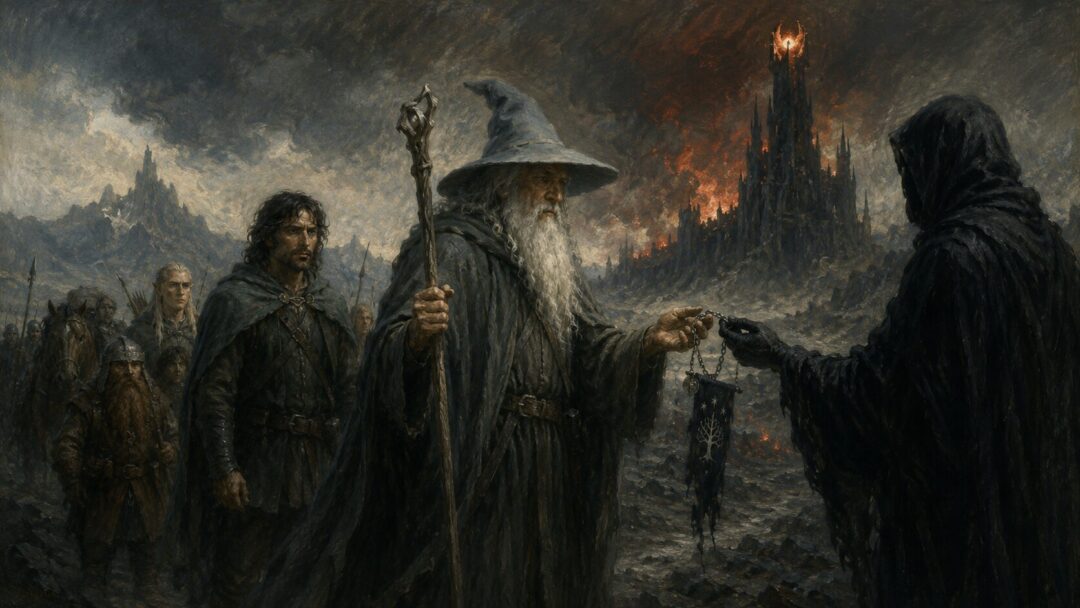
Gandalf’s response is not to solve the riddle aloud. He does not explain the Quest. He does not ask for Frodo. He does not bargain. He takes the tokens back and rejects the terms.
That action matters. Gandalf denies the Mouth control over the story. He does not accept Sauron’s framing: that the West must surrender because Sauron has produced an object associated with Frodo. He also does not reveal what Sauron most needs to know.
The refusal is both moral and strategic. Gandalf grieves, but he does not let grief become obedience.
In that moment, the Captains of the West pass one of the final tests of the story. They must stand without confirmation. Their hope is not optimism. It is fidelity to a task whose outcome they cannot see.
Not Proof, but a Last Attempt to Rule the Mind
The mithril shirt began as hidden protection. It saved Frodo because no one saw it until the blow had fallen. At the Black Gate, Sauron tries to reverse its meaning. He turns the hidden coat into a public spectacle. He takes a gift of friendship and makes it an instrument of despair.
But he cannot make it into proof.
The coat proves that Frodo was in peril. It proves that Mordor’s servants had touched the edges of the Quest. It proves that the margin between victory and ruin had become almost impossibly thin. But it does not prove that Frodo has failed, that the Ring has been recovered, or that hope is dead.
That is why the scene is so devastating and so revealing. Sauron’s power can seize objects, twist reports, threaten bodies, and terrify armies. Yet even at the gate of his own land, he is still fighting shadows of his own assumptions.
The mithril shirt is a trap because Sauron needs the West to complete the lie for him. He needs them to despair. He needs them to believe that the visible token contains the whole truth.
They do not.
And because they do not, Frodo and Sam are given the one thing no army could win for them: a little more time.
Sources & Notes
- J.R.R. Tolkien, The Lord of the Rings, Book II, ch. 3, “The Ring Goes South” — Bilbo gives Frodo the mithril-coat before the Fellowship leaves Rivendell.
- J.R.R. Tolkien, The Lord of the Rings, Book II, ch. 5, “The Bridge of Khazad-dûm” — Frodo’s hidden mithril shirt turns the orc spear-thrust in Moria.
- J.R.R. Tolkien, The Lord of the Rings, Book IV, ch. 10, “The Choices of Master Samwise” — Frodo is taken after Shelob’s attack and the Orcs discuss stripping/searching him.
- J.R.R. Tolkien, The Lord of the Rings, Book VI, ch. 1, “The Tower of Cirith Ungol” — the quarrel over Frodo’s gear and Shagrat’s escape explain how the tokens reach Sauron’s side.
- J.R.R. Tolkien, The Lord of the Rings, Book V, ch. 9, “The Last Debate” — the Captains deliberately march to the Black Gate as a diversion to draw Sauron’s attention from Frodo.
- J.R.R. Tolkien, The Lord of the Rings, Book V, ch. 10, “The Black Gate Opens” — the Mouth of Sauron displays Frodo’s mithril-coat and other tokens to intimidate the Captains, while Gandalf refuses the terms.