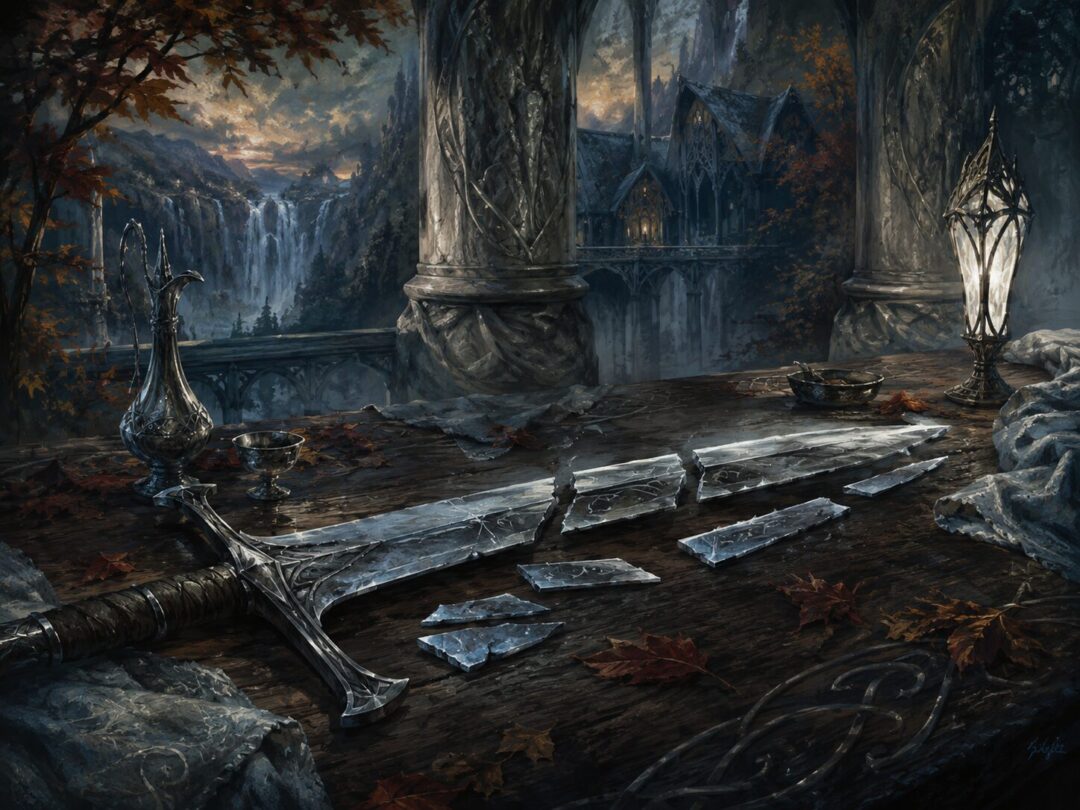
At Rivendell, the broken sword is more than an old weapon waiting for a smith. It is a question.
Boromir has come seeking an answer to a dream: “Seek for the Sword that was broken.” Aragorn carries that answer not as a shining blade, but as fragments. Narsil, the sword of Elendil, had shattered under its fallen master at the end of the Second Age. Isildur used a shard of it to cut the Ruling Ring from Sauron’s hand. After that, the broken sword passed down through the heirs of Isildur, long after kingdoms fell, thrones emptied, and the Dúnedain of the North became a wandering, hidden people.
So why not simply make Aragorn a new sword?
The practical answer is easy: a new weapon could cut. But Middle-earth is not a world where objects are only useful because of what they can physically do. Narsil had become a vessel of memory, legitimacy, prophecy, and unresolved history. Replacing it would have given Aragorn a weapon. Reforging it gave him a claim, a burden, and a sign that the long-broken line of the Kings was being made whole again.
Narsil Was Not Just Aragorn’s Sword
Narsil first matters because it belonged to Elendil, the great Númenórean king who escaped the Downfall of Númenor and founded the realms in exile. Through Elendil, Narsil is tied to the lost world of Númenor, to the kingdoms of Arnor and Gondor, and to the last alliance of Elves and Men against Sauron.
The sword’s maker also matters. Narsil was made by Telchar of Nogrod, one of the great Dwarven smiths of the Elder Days. This places the blade among the ancient works of Middle-earth, not as a random royal ornament, but as a thing already carrying the weight of older craft and older wars before it ever reached Elendil’s hand.
Yet its fame does not come only from its forging. Narsil becomes legendary because of its breaking.
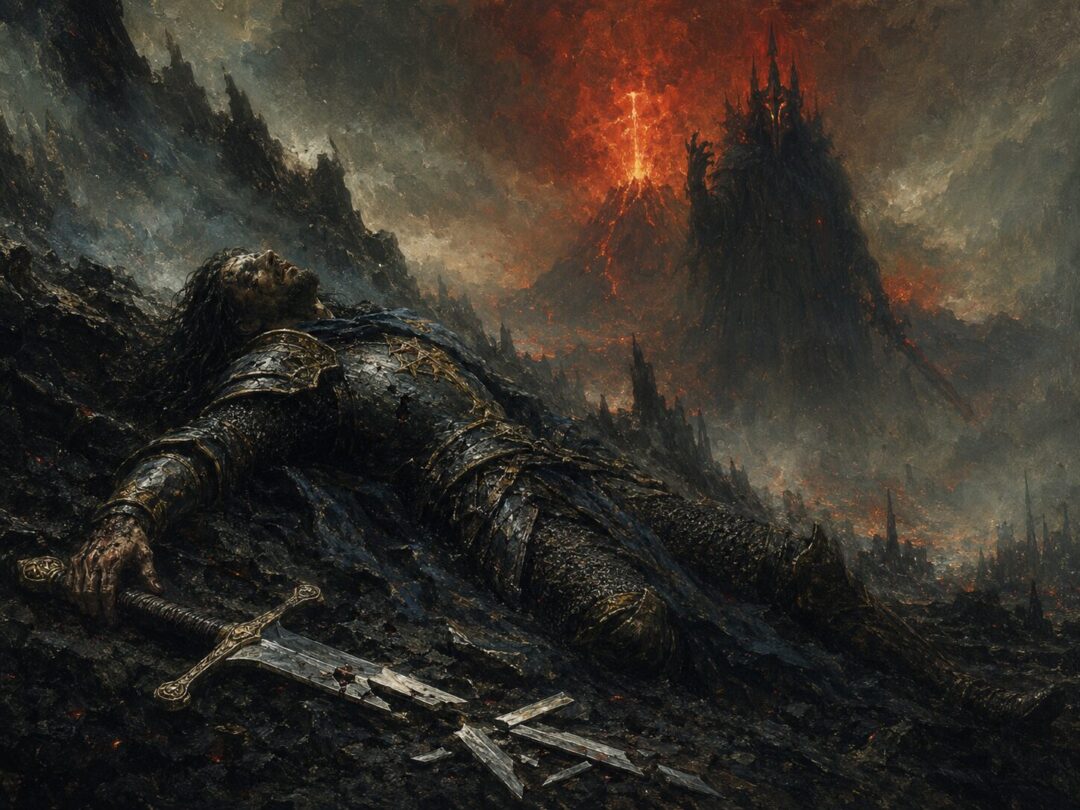
At the end of the Second Age, Elendil and Gil-galad fought Sauron. Both were slain, and Narsil broke beneath Elendil as he fell. Isildur then used the broken sword to cut the Ring from Sauron’s hand. That moment is morally complicated. It helped end Sauron’s immediate power, but it also began the long disaster of Isildur’s failure to destroy the Ring.
This is why Narsil is not a clean symbol of triumph. It remembers victory, death, inheritance, and failure all at once. A new sword could not carry that contradiction.
The Broken Sword Preserved a Broken History
The shards of Narsil were preserved by Isildur’s heirs. That fact is crucial. They were not discarded, melted down, or forgotten. Even when the North-kingdom declined and the heirs of Isildur lost almost every outward sign of royal power, the broken sword remained.
In The Lord of the Rings, Aragorn says that the sword had been treasured by his people when other heirlooms were lost. This is not a minor family keepsake. It is almost the opposite of a crown: useless in ordinary practical terms, but priceless as proof that the royal line had not vanished.
That is why replacing Narsil would have weakened the meaning of Aragorn’s return. His claim is not based on being a strong warrior who happens to need a blade. It rests on continuity. He is not inventing a new kingship. He is the heir of an ancient one.
The broken sword says: the line was damaged, hidden, and diminished, but not ended.
A replacement sword could imply a fresh start. Reforging Narsil implies restoration. That distinction is the heart of Aragorn’s story.
The Dream Did Not Say “Find a New Weapon”
Boromir and Faramir’s dream sends them toward Imladris with strange phrases: the broken sword, Isildur’s Bane, the halfling, and the awakening of hope. In that message, the sword’s brokenness is not incidental. It is the identifying mark.
The dream does not say that a warrior will arise with a great new blade. It says to seek the Sword that was broken.
That matters because the sign is rooted in memory. Gondor has endured for centuries under the Stewards. It has no king, and the return of one is not politically simple. Boromir’s reaction at the Council of Elrond reflects that tension. He does not instantly bend his mind around the idea that this weather-worn northern Ranger could be the answer to Gondor’s need.
The shards force the issue. They are a physical argument from the past. Aragorn’s identity is not merely asserted; it is attached to an heirloom known in the lore of Gondor and tied to Elendil and Isildur.
If Aragorn had arrived with a newly made sword, Boromir could admire it or doubt it. But the broken sword is not just equipment. It is evidence.
Reforging Marks the Moment When Waiting Ends
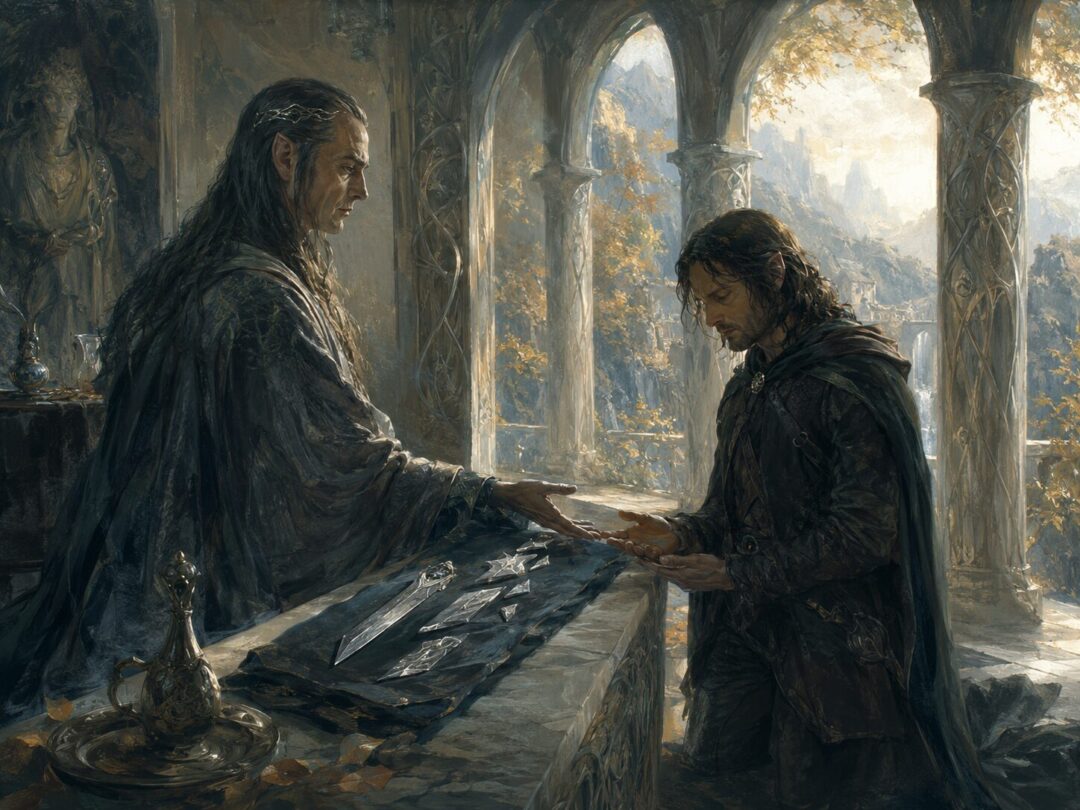
One of the most important details is that Narsil is not reforged as soon as Aragorn receives it. Elrond gives Aragorn the shards when Aragorn comes of age and learns his true name and lineage. Yet the sword remains broken for many years after that.
This delay is meaningful. The sword is not remade merely because Aragorn is the heir. It is remade when the Ring has been found and the great crisis has returned.
The old saying among the Dúnedain, as reported in the story, connects the remaking of the sword with the finding of the Ring, Isildur’s Bane. In other words, Narsil waits until the old wound of history is reopened. The same object that cut the Ring from Sauron must return when the Ring itself returns to the center of events.
This does not mean the sword has magical power over the Ring in a simple mechanical sense. The texts do not present Andúril as a Ring-destroying weapon. Its importance is symbolic, political, and providential rather than merely tactical.
But within the pattern of the story, the timing matters deeply. Narsil is reforged because the unfinished business of the Second Age has come back.
Andúril Is New, But Not Separate
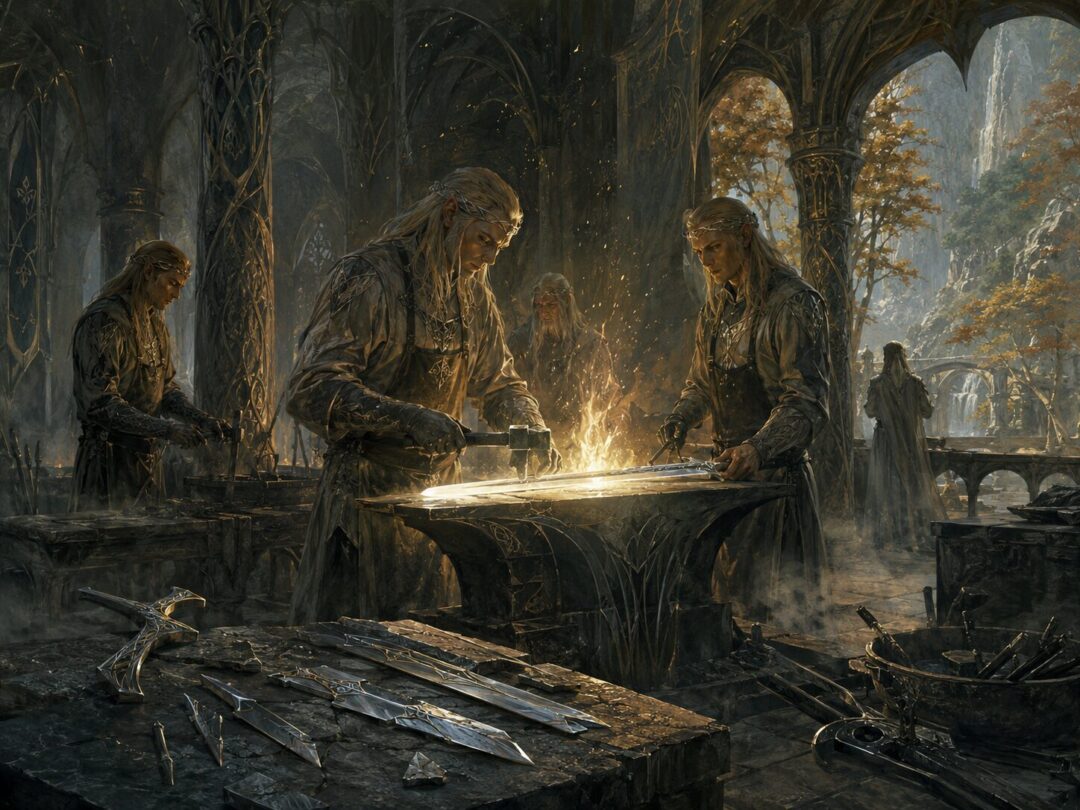
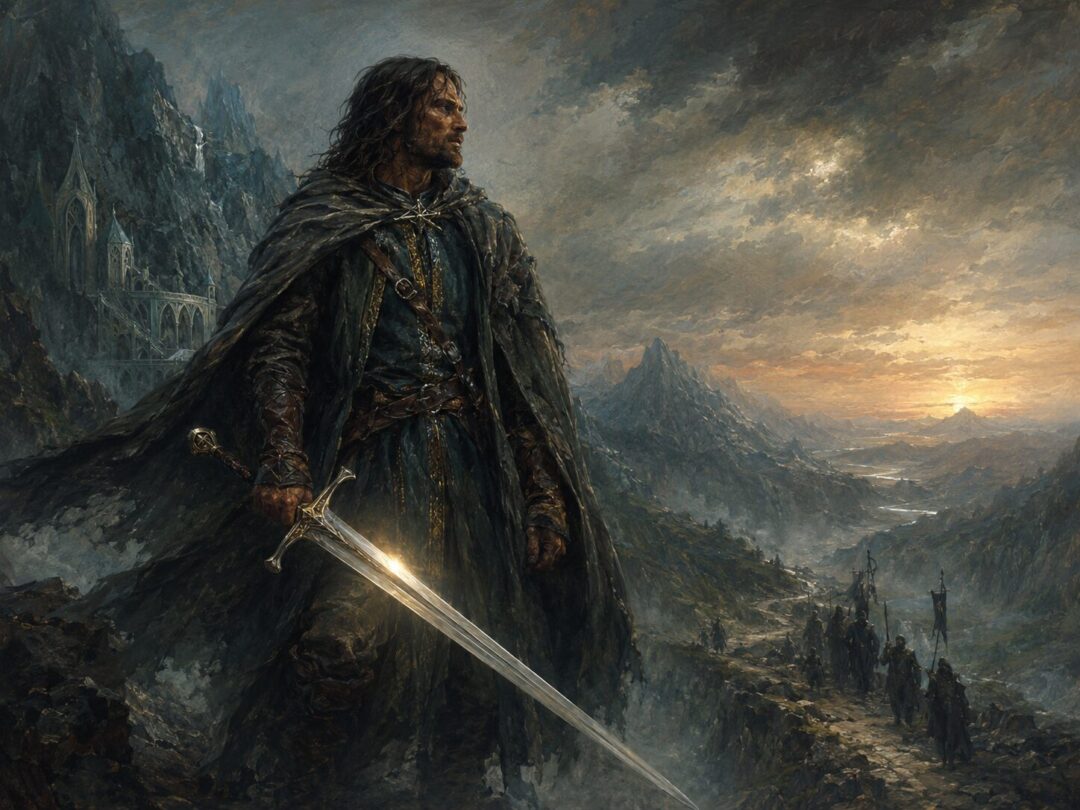
When Narsil is reforged, Aragorn names it Andúril, the Flame of the West. That name announces renewal. The sword is no longer only the relic of a fallen king; it has become the weapon of the returning one.
But the new name does not erase the old identity. Andúril is made from the shards of Narsil. Its power as a sign depends on that continuity. It is both old and new: the same royal memory, given a restored form.
This is very Tolkien-native. Middle-earth often treats renewal not as replacement, but as healing. The White Tree is not simply swapped for an unrelated symbol. The line of kings is not reinvented as a modern political office. Ancient things return, but changed by suffering and time.
Andúril therefore carries a double message. It says the past cannot be undone, but it can be taken up rightly. Elendil is dead. Isildur failed. The North-kingdom fell. Gondor has waited long under stewardship. Yet the story does not end with fragments on a table.
The sword is reforged because Aragorn’s kingship is not an escape from history. It is his acceptance of history.
A New Sword Would Not Heal the Line of Elendil
Aragorn’s claim to kingship is not only about blood. It is also about worthiness. He has served in disguise, guarded lands that barely remember his people, fought Sauron’s servants, and shown restraint where others might have grasped at power. Still, the visible signs of his lineage matter in the world of the story.
The shards of Narsil link Aragorn to Elendil in a way no new weapon could. They connect the Ranger of the North with the High King who stood against Sauron. They also connect him to Isildur, whose legacy is both heroic and disastrous.
That is important because Aragorn is not allowed to inherit only the glorious part. He inherits the failure too.
To replace Narsil would be to step around the wound. To reforge it is to face the wound directly. Aragorn does not pretend Isildur’s story never happened. He carries the sign of it into the war where Isildur’s unfinished choice must finally be answered.
This is why Andúril feels morally weightier than a beautiful new sword. It is not just the weapon of a king. It is the repaired shape of a broken inheritance.
The Sword Also Speaks to Gondor
Gondor’s relationship to Aragorn is complicated. The realm has survived without a king for a long time. The Stewards are not villains; they have preserved the kingdom through danger and decline. But the kingship has become distant, almost legendary.
Andúril cuts through that distance.
When Aragorn enters the story openly as Isildur’s heir, he does not come empty-handed. The reforged sword makes his claim visible. It is a sign the people of Gondor can understand because it belongs to the deep memory of their own realm.
This does not mean everyone must instantly accept him because of the sword alone. The story is more careful than that. Aragorn still proves himself through action: healing, leadership, humility, and courage. But Andúril gives form to what might otherwise seem impossible. The king has not appeared from nowhere. He comes bearing the remade sword of Elendil.
A new sword might say, “Here is a warrior.”
Andúril says, “Here is the heir.”
Reforging Turns Memory Into Action
Before Rivendell, the shards of Narsil are mostly a burden of remembrance. They preserve identity, but they do not yet act in the world as a sword. After the Council, when the Fellowship sets out, Andúril becomes active. Aragorn carries the past into present danger.
That transformation is one of the quiet emotional movements of the story. The past cannot remain only in song, dream, and heirloom. It must be tested again.
This is especially powerful because Aragorn does not use his inheritance as an excuse for domination. He does not seize the Ring. He does not storm into Minas Tirith demanding immediate obedience. His kingship unfolds through service and sacrifice. Andúril’s authority is real, but it is not crude.
The reforged sword therefore becomes an image of rightful power: ancient, restrained, and restored only at the moment of need.
The Broken Thing Had to Become Whole
Narsil had to be reforged instead of replaced because the problem was never a lack of sharp steel. The problem was a broken world.
The sword had broken when Elendil fell. The line of kings had been broken by war, loss, and exile. The alliance of the West had been broken by time and forgetfulness. Isildur’s victory had been broken by his refusal to destroy the Ring. Gondor itself was a kingdom waiting under stewardship, still noble, still fighting, but incomplete.
Andúril does not magically solve all of that. It does not win the war by itself. It does not make Aragorn king without suffering, risk, or consent. But it gathers the meaning of restoration into one visible object.
That is why a replacement would have been too small.
A new sword could have served Aragorn’s hand. Only Narsil reforged could serve Aragorn’s story.
Sources & Notes
- J.R.R. Tolkien, The Silmarillion, ‘Of the Rings of Power and the Third Age’ — Elendil’s fall, Narsil breaking beneath him, and Isildur cutting the Ring from Sauron’s hand with the broken blade.
- J.R.R. Tolkien, The Lord of the Rings, Book II, Chapter 2, ‘The Council of Elrond’ — Boromir’s dream names ‘the Sword that was broken,’ and Aragorn reveals the shards as the sign of Isildur’s heir.
- J.R.R. Tolkien, The Lord of the Rings, Book II, Chapter 3, ‘The Ring Goes South’ — Narsil is reforged in Rivendell, renamed Andúril, and carried by Aragorn as the Fellowship departs.
- J.R.R. Tolkien, The Lord of the Rings, Appendix A, ‘Annals of the Kings and Rulers’ — background on Elendil’s line, the heirs of Isildur, Aragorn’s lineage, and the preserved shards of Narsil.
- J.R.R. Tolkien, The Lord of the Rings, Appendix A, ‘The Tale of Aragorn and Arwen’ — Elrond gives Aragorn the heirlooms of his house and says the sword will not be reforged until the Ring is found again.
- J.R.R. Tolkien, Unfinished Tales, ‘The Disaster of the Gladden Fields’ — account of Isildur after the War of the Last Alliance and the survival of Narsil’s shards as heirlooms of the North-kingdom.