
The Old Forest is one of the first truly frightening places encountered in The Lord of the Rings. Long before Frodo reaches the terror of the Nazgûl, the darkness of Moria, or the desolation of Mordor, he and his companions find themselves trapped beneath ancient trees that seem aware, hostile, and patient.
Yet hidden within that same forest stands one of the safest places in Middle-earth.
Tom Bombadil’s house appears almost like a contradiction. The forest outside feels threatening and unnatural. The house inside feels warm, ordered, joyful, and strangely untouched by fear. The contrast is so dramatic that many readers remember the chapters as a transition from nightmare into refuge.
But why?
The answer goes deeper than simple hospitality. Bombadil’s home reveals something important about power, nature, and the limits of evil in Tolkien’s world. Its safety comes not from walls, weapons, or magical defenses, but from a fundamentally different relationship with the world around it.

The Old Forest Is Not Merely a Forest
To understand why Bombadil’s house feels safe, we first have to understand why the Old Forest feels dangerous.
The Hobbits enter a woodland unlike the familiar woods of the Shire. From the beginning, they sense that the trees are watching them. Paths seem to shift. Branches crowd around them. The forest appears determined to guide travelers toward the Withywindle valley.
The narrative strongly suggests that the trees possess some form of awareness. Merry explains that the forest has long had a reputation among the Bucklanders. The trees are considered hostile, and the Old Forest has an ancient history reaching back into forgotten ages.
Importantly, Tolkien never presents the forest as evil in the same way that Sauron is evil.
Instead, the forest feels old, resentful, and defensive.
The Bucklanders had cut trees and built hedges to keep the forest at bay. In return, the forest seemed to develop hostility toward those living nearby. The conflict resembles a long memory of injury rather than the organized malice of the Dark Lord.
This distinction matters. The Old Forest is dangerous because it possesses agency without mercy. It is nature that has become suspicious of outsiders.
The Hobbits are entering a realm where human and hobbit expectations no longer apply.
Old Man Willow Embodies the Forest’s Threat
The most frightening expression of the forest’s power is Old Man Willow.
Unlike ordinary trees, Old Man Willow appears capable of direct influence over living creatures. He can induce sleep, create enchantment, and physically trap those who come too close. Merry and Pippin are imprisoned within the tree itself, while Frodo nearly drowns after falling into the river.
The text presents Old Man Willow as an exceptionally powerful and ancient being.
Yet even here Tolkien avoids simple categories.
Old Man Willow is not described as a servant of Sauron. He is not part of some coordinated plan of evil. Instead, he appears to represent a form of natural power that has become dangerous through age, isolation, and resentment.
This makes him unsettling in a unique way.
Readers can understand Orcs. They serve an enemy. They follow orders. Their purpose is recognizable.
Old Man Willow operates according to entirely different principles. His motives remain obscure. His hostility seems deeply rooted and almost elemental.
The danger of the Old Forest comes partly from this unpredictability.

Tom Bombadil Enters as a Complete Contrast
When Tom Bombadil first appears, the mood changes immediately.
The Hobbits have lost control of their situation. They are trapped by powers they do not understand. Then Bombadil arrives singing.
His songs seem absurd when compared to the menace of the forest. Yet they are also effective.
Old Man Willow releases his prisoners when commanded by Bombadil. The ancient tree that could not be overcome by the Hobbits offers no meaningful resistance to him.
The remarkable part is not merely that Bombadil possesses power.
Many powerful figures exist in Middle-earth.
The remarkable part is the kind of power he possesses.
Bombadil does not fight the tree. He does not cast destructive spells. He simply speaks with authority.
The scene suggests a relationship rather than domination.
Bombadil understands the forest in a way the Hobbits do not. He belongs within its world without becoming trapped by its dangers.
This relationship becomes the foundation of the safety surrounding his home.
The House Is Safe Because Bombadil Is Completely At Home
One of the most striking features of Bombadil's house is how ordinary it appears.
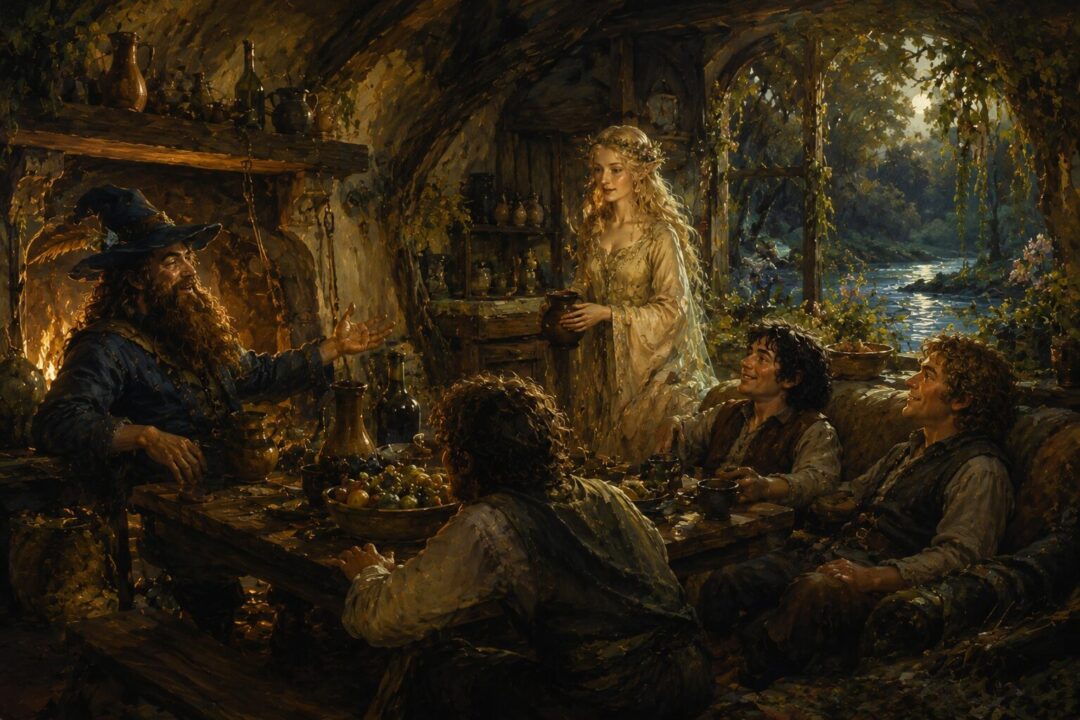
There are meals, songs, conversation, and rest. Goldberry welcomes guests. The atmosphere resembles an idealized home more than an enchanted fortress.
Yet the safety the Hobbits experience is profound.
For perhaps the first time since leaving the Shire, they sleep without fear.
The reason seems connected to Bombadil’s extraordinary sense of belonging.
Throughout The Lord of the Rings, many characters struggle against the world around them. Aragorn wanders in exile. Gandalf battles the Shadow. Elrond preserves a fading realm. Galadriel resists temptation.
Bombadil stands apart.
He does not seek mastery.
He does not attempt to preserve a kingdom.
He does not wage war against decline.
He simply exists where he belongs.
The texts repeatedly emphasize his ancient connection to the land. According to Bombadil himself, he remembers times before many other peoples arrived. Whether every aspect of his claim should be interpreted literally is debated, but the narrative clearly portrays him as unimaginably old and deeply rooted in his territory.
His house feels safe because it is the center of a perfectly established relationship between inhabitant and place.
Goldberry Reveals Another Side of the Safety
The safety of the house does not come from Bombadil alone.
Goldberry is equally important.
When Frodo first encounters her, she is associated with water, light, and natural beauty. She is introduced as the River-woman's daughter, a mysterious title that links her to the landscape itself.
The atmosphere surrounding Goldberry differs noticeably from the atmosphere surrounding Old Man Willow.
Both are connected to nature.
Yet one inspires fear while the other inspires peace.
This contrast highlights an important theme.
Nature in Tolkien is not inherently benevolent or hostile. It contains many possibilities.
The Old Forest demonstrates nature’s capacity for danger. Goldberry demonstrates its capacity for harmony.
Together, Tom and Goldberry create a household that reflects balance rather than conflict.
The result is a place where travelers feel protected without feeling imprisoned.
The Ring Cannot Disturb the House
Perhaps the strongest indication of the house’s unusual safety involves the One Ring itself.
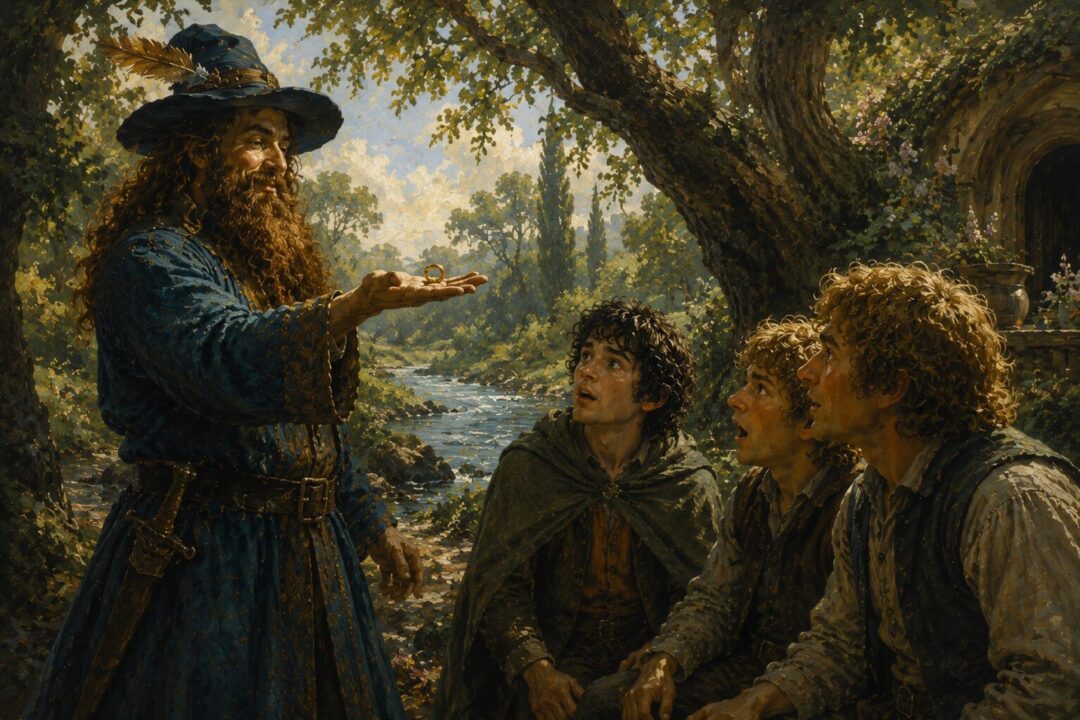
When Frodo puts on the Ring in Bombadil’s presence, something extraordinary happens.
Bombadil can still see him.
Even more surprising, Bombadil later handles the Ring without showing any sign of temptation.
This does not mean the Ring lacks power. The Council of Elrond later makes clear that Bombadil cannot simply solve the problem of Sauron.
However, the episode demonstrates that Bombadil relates to power differently from nearly everyone else in Middle-earth.
Most individuals are vulnerable because they desire something. They seek wisdom, authority, security, justice, victory, or preservation.
The Ring exploits those desires.
Bombadil appears uniquely detached from such ambitions.
Because he seeks neither domination nor possession, the Ring finds little leverage over him.
This contributes significantly to the feeling of safety in his home.
For a brief period, the Hobbits occupy one of the few places where the central corrupting force of the age seems unable to establish a foothold.
Safety Does Not Mean Absolute Protection
Despite its comfort, Bombadil’s house is not presented as the ultimate refuge of Middle-earth.
This is a crucial detail.
At the Council of Elrond, the possibility of entrusting the Ring to Bombadil is discussed and ultimately rejected.
The reasoning is revealing.
Bombadil’s safety is local rather than universal.
He can master matters within his own country. He understands his own domain. Yet he does not involve himself in the larger struggles of the world.
The Wise fear that if all other defenses failed, Bombadil would eventually be isolated.
His refuge would remain what it always was: a place of peace within a larger world at war.
This limitation makes the house more meaningful, not less.
Its safety is real, but it is not a solution to evil.
It represents a sanctuary rather than a victory.
The Deeper Meaning of Bombadil’s Refuge
The contrast between the Old Forest and Bombadil’s house reflects a recurring pattern throughout The Lord of the Rings.
Power often creates danger when it becomes possessive.
The forest resents intrusion.
Old Man Willow seeks control.
Sauron seeks domination over all peoples.
The Ring amplifies the desire to command.
Bombadil stands outside this pattern.
He exercises authority without ownership. He possesses knowledge without conquest. He inhabits the land without attempting to reshape it according to his will.
Whether readers interpret Bombadil as a nature spirit, an embodiment of a particular aspect of creation, or something even more mysterious, the effect remains the same.
His house feels safe because it is one of the rare places in Middle-earth where power exists without the desire to dominate.
The Old Forest is dangerous because it reminds travelers that nature can be ancient, alien, and hostile.
Bombadil’s house is safe because it reveals another possibility: a world where age, power, and knowledge exist in harmony.
For a few precious days, Frodo and his companions step into that harmony. They rest beside a fire, share food and songs, and experience a peace they will rarely find again.
The journey soon leads them back into a world of fear, pursuit, and war.
But the memory of Bombadil’s house remains.
It stands as proof that even in an age overshadowed by the Ring, there are still places where power has not become possession, where wisdom has not become control, and where safety comes not from walls or weapons, but from being exactly where one belongs.
Sources & Notes
- J.R.R. Tolkien, The Fellowship of the Ring, Book I, Chapter 6, “The Old Forest” — for the Old Forest’s hostile awareness, shifting paths, the Bucklanders’ history with the trees, and Old Man Willow’s attack on the hobbits.
- J.R.R. Tolkien, The Fellowship of the Ring, Book I, Chapter 7, “In the House of Tom Bombadil” — for Bombadil’s command over Old Man Willow, Goldberry’s welcome, the house as a place of rest, and Bombadil’s unusual freedom from the Ring’s effects.
- J.R.R. Tolkien, The Fellowship of the Ring, Book I, Chapter 8, “Fog on the Barrow-downs” — for the limits of Bombadil’s country and the idea that his protection is local rather than a general answer to danger.
- J.R.R. Tolkien, The Fellowship of the Ring, Book II, Chapter 2, “The Council of Elrond” — for the Council’s discussion of why the Ring cannot simply be entrusted to Bombadil and why his mastery is not a solution to Sauron.
- J.R.R. Tolkien, The Letters of J.R.R. Tolkien, Letter 144 (1954) — for Tolkien’s own comments on Bombadil as deliberately enigmatic and connected with a non-possessive, non-controlling relation to the natural world.