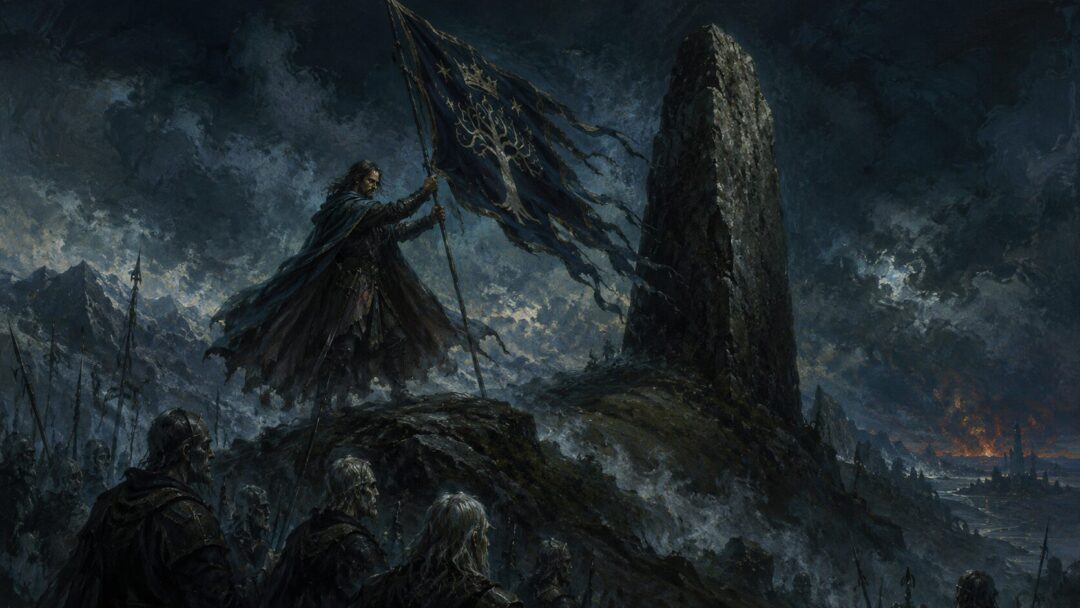
A black stone stands on a hill in southern Gondor, older than the War of the Ring, older than Aragorn’s crown, older than the fear that has gathered around the Paths of the Dead. The Stone of Erech is not merely a dramatic landmark. In the book, it is the place where memory, kingship, oath, fear, and mercy all meet.
That is the first major difference between the book’s Oathbreaker scene and the more familiar film version. In the film, the moment is framed as a supernatural bargain: Aragorn confronts a ghostly army, proves himself, and wins a terrifying military advantage. In the book, the scene is stranger and more solemn. Aragorn does not win the Dead by combat. He summons them by right.
The Dead Men of Dunharrow are not simply “an undead army” waiting to be used. They are the remains of a broken promise from the end of the Second Age. Their terror is real, but their purpose is not spectacle. They reveal what kind of king Aragorn is becoming: not a conqueror who bends death to his will, but the heir who can call the past to account and then release it.
The Oath Was Older Than Aragorn’s War
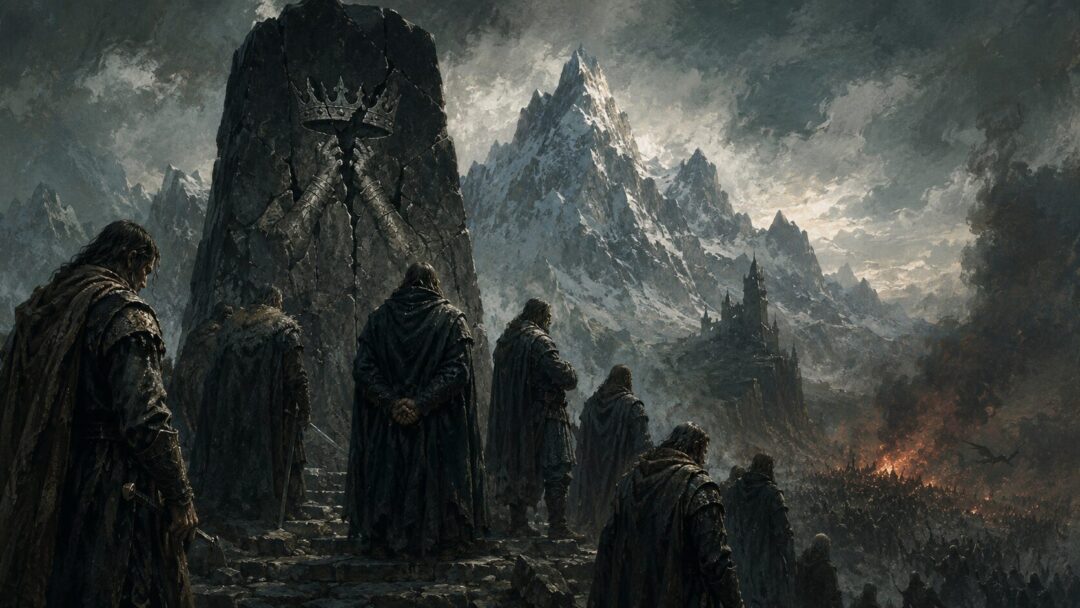
The book roots the Oathbreakers in the ancient history of Gondor. Near the end of the Second Age, the Men of the Mountains swore allegiance to Isildur at the Stone of Erech. When the war against Sauron came, they refused to fight, because they had once worshipped Sauron in the Dark Years. Isildur cursed them, declaring that they would not rest until they fulfilled their oath. This background is attached to the Stone of Erech and to the kingly authority inherited by Aragorn.
This matters because the book’s scene is not a random encounter with ghosts. Aragorn is walking into an unfinished legal and moral crisis. The Dead are not enemies in the ordinary sense. They are oathbreakers. Their condition is tied to a failure of allegiance, and only the heir of the house they betrayed can bring that failure to its end.
The scene therefore belongs to one of the deepest rules of Middle-earth: words bind. Oaths are not decorative. Promises made before powers, kings, stones, and witnesses have consequences. The Oathbreakers’ fate is terrifying precisely because their sin is not a battlefield defeat but a betrayal of pledged word.
The Paths of the Dead Are a Test of Kingship
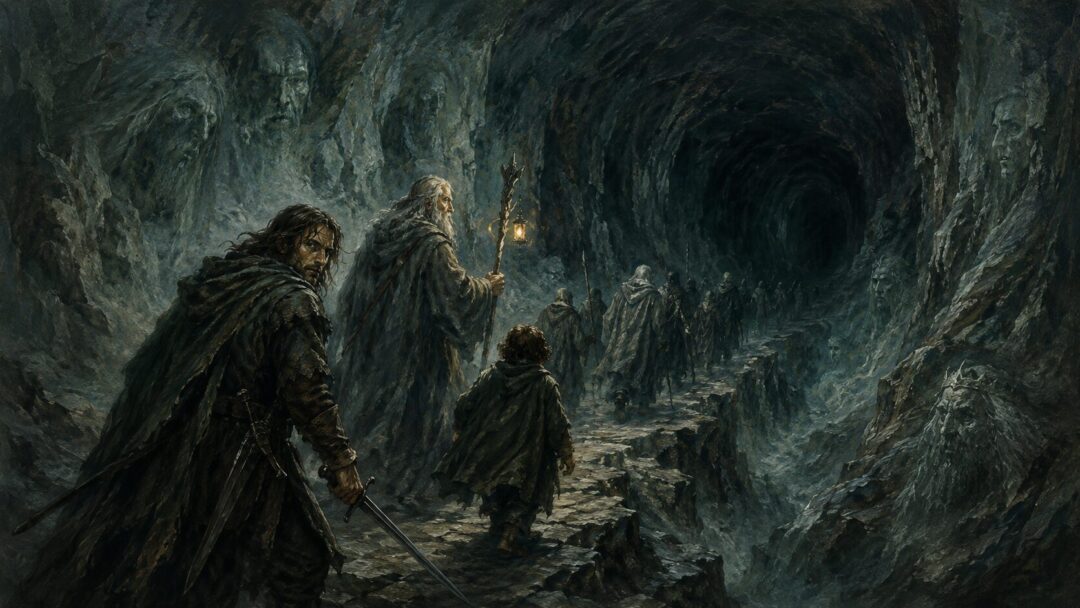
Aragorn’s decision to take the Paths of the Dead is not presented as an easy heroic shortcut. It is dreaded by almost everyone around him. The Rohirrim fear the road. The place is associated with ancient terror. Even Gimli, one of the hardiest members of the Company, experiences the passage as a near-overwhelming horror.
The point is not that Aragorn is fearless in a simple way. The book shows him choosing a road that only he can rightly take. The Paths of the Dead are tied to prophecy, inheritance, and the unresolved curse of Isildur. Aragorn does not merely possess courage; he possesses the burden of descent. As Isildur’s heir, he can make a demand that no ordinary captain could make.
This is why the scene is so important for Aragorn’s arc. He is not yet crowned, but he begins acting as king before anyone places a crown on his head. He claims responsibility before he claims honor. The Dead are part of Gondor’s unfinished past, and Aragorn’s kingship means facing that past rather than avoiding it.
The Book’s Aragorn Does Not Fight the King of the Dead
One of the most important differences from the film is that the book does not turn the encounter into a duel or a test of weapons. Aragorn does not defeat the King of the Dead in personal combat. He does not need to prove that Andúril can physically strike a ghost. His authority comes from lineage, oath, and command.
At the Stone of Erech, Aragorn unfurls his standard, declares himself heir of Isildur, and commands the Dead to follow him. The Dead obey because the old oath has come due. Reputable lore summaries preserve this sequence: Aragorn passes through the Paths, comes to Erech, summons the Dead under his banner, and leads them south toward Pelargir.
That difference changes the meaning of the entire scene. The film version makes Aragorn’s success feel like a supernatural victory won through nerve and confrontation. The book’s version makes it feel like judgment. Aragorn is not bargaining with monsters. He is enforcing a debt that has waited for an heir with the right to call it in.
The Dead Do Not Win the Battle of the Pelennor Fields
Another major difference is where the Dead fight. In the film, the ghostly host arrives at Minas Tirith and sweeps through the enemy forces on the Pelennor Fields. It is visually memorable, but it changes the structure of the war.
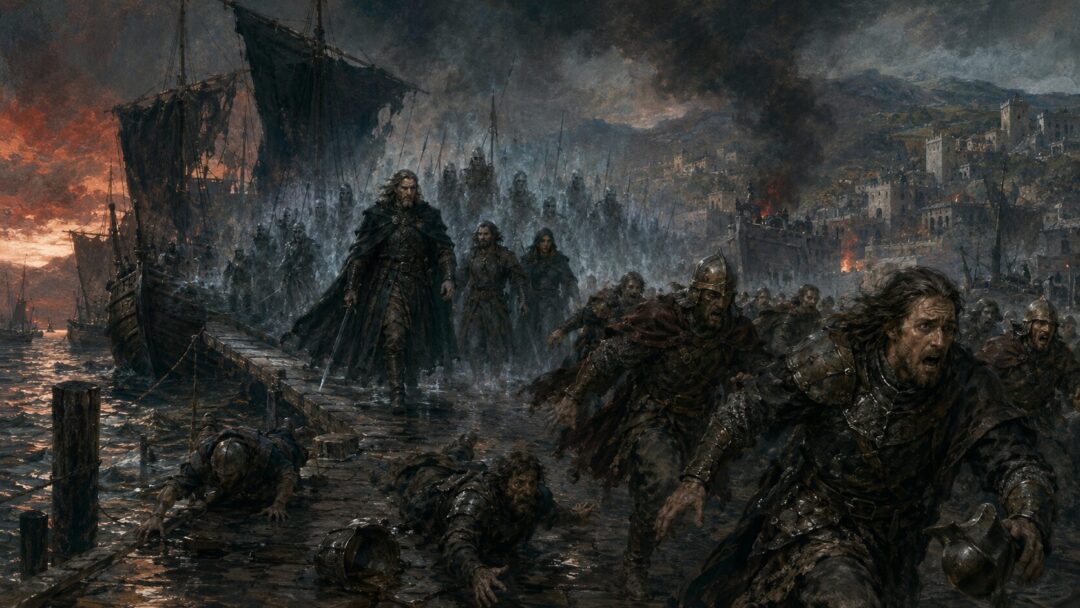
In the book, the Dead do not come to Minas Tirith. Aragorn leads them south to Pelargir, where the Corsairs of Umbar threaten Gondor from the river. Their terror drives away Sauron’s allies, allowing Aragorn and his living companions to capture the black ships. Once the Corsairs’ threat has been broken, Aragorn releases the Dead from their oath. The living men of southern Gondor then sail with him to Minas Tirith. encyclopedia-of-arda.com
This is not a small detail. In the book, the Dead are not used as a universal weapon. They do one specific thing: they fulfill the oath they broke. Their role is limited, morally precise, and then ended.
That limitation matters. If Aragorn had marched an unstoppable ghost army into the central battle, the victory might seem to belong to terror. Instead, the Dead remove one strategic threat, and the living must still fight. Théoden still rides. Éowyn and Merry still face the Witch-king. The Men of Gondor and Rohan still bleed for the city. Aragorn’s arrival matters enormously, but it does not erase the cost paid by the living.
Fear Is the Weapon, Not Slaughter
The book is careful about how the Dead function. They are terrifying, and their presence causes panic among the enemies at Pelargir. But the text does not present them as a conventional army hacking down foes in a physical battle. Their power is bound up with dread.
That makes the scene more haunting. The Dead are not glorious warriors finally redeemed through heroic violence. They are a shadow of an old wrong, and the fear surrounding them becomes the instrument by which they complete their ancient obligation. They once refused to stand against Sauron. Now, at last, their presence breaks the strength of Sauron’s allies.
This is one of the scene’s great ironies. Their cowardice in the Second Age made them dead without rest. Their final act is not described as a noble battlefield charge but as a terror that scatters those who serve the Enemy. It is enough. The oath is fulfilled.
Aragorn’s Mercy Is as Important as His Command
The most revealing part of the book’s Oathbreaker episode is not the summoning. It is the release.
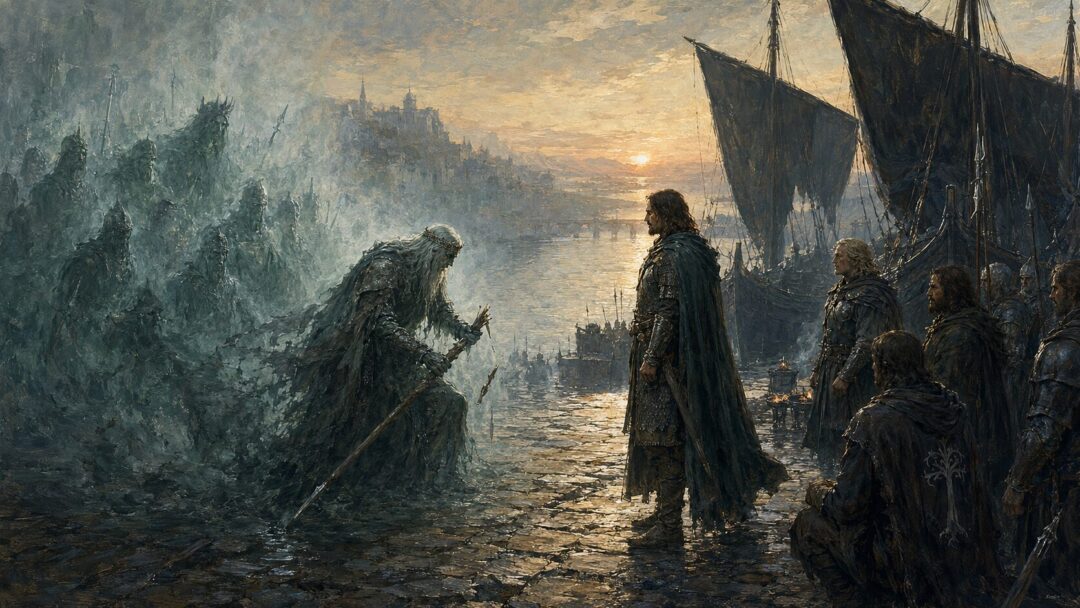
After the Dead fulfill their oath at Pelargir, Aragorn does not keep them. He does not drag them onward to win more victories. He declares their oath fulfilled and lets them depart. The King of the Dead breaks his spear and bows, and the host vanishes. The event is treated as an ending, not a recruitment.
That moment tells us as much about Aragorn as any battle. He has the authority to command, but he does not confuse authority with possession. The Dead are not his property. Their curse exists for a purpose, and once that purpose is satisfied, he releases them.
This is where the book’s scene becomes morally powerful. Aragorn’s kingship is not measured only by the enemies he defeats. It is measured by whether he can set right what has remained crooked for an age. He does not merely use the past; he heals it as far as his authority allows.
The Scene Is About the Return of Lawful Kingship
The title “Return of the King” can sound triumphant, but the Oathbreaker episode shows the burden hidden inside that return. A true king in this world is not simply a successful war-leader. He is someone who can restore broken order.
The Dead have lingered through centuries because a promise was broken and a curse remained unresolved. Gondor itself has endured long decline, ruled by Stewards while the royal line seemed lost to history. When Aragorn calls the Dead, the past recognizes him before the city formally does.
That recognition is not sentimental. It is frightening. The first subjects to answer the returning king are not cheering citizens but the restless dead. Before Aragorn can enter Minas Tirith as healer and king, he must pass through darkness, command oathbreakers, and take responsibility for a judgment made by his ancestor.
This gives the scene its deeper weight. Aragorn is not escaping history. He is stepping into it.
Why the Book Version Feels Less Like a Shortcut
Some readers who know only the film version may think the Dead make victory too easy. But in the book, their role is carefully contained. They solve the crisis of the Corsairs, not the entire war. They help Aragorn arrive at the decisive hour, but they do not replace the courage of the living.
The book also preserves suspense by separating terror from triumph. The passage through the mountain is grim. The summons at Erech is solemn. The march south is eerie. The victory at Pelargir is reported as the breaking of a threat, not as a gleeful supernatural massacre.
The result is a scene that feels less like a fantasy power-up and more like the closing of an ancient wound. The Dead are necessary, but they are not celebrated in the way living heroes are. Their best ending is disappearance.
The Oathbreakers Reveal What Power Should Not Become
The Oathbreaker scene sits near several of the story’s central temptations: power, fear, domination, and the use of terrible forces for good ends. Aragorn’s handling of the Dead is important because he refuses to become a lord of the dead.
That phrase is worth weighing carefully. Aragorn commands the Dead, but he does not build his reign on them. He uses inherited authority to bring about fulfillment, not enslavement. In a story where Sauron’s power is marked by domination and possession, Aragorn’s power is marked by rightful command followed by release.
This contrast is not accidental in effect, even if the text does not pause to explain it abstractly. The Enemy gathers servants into bondage. Aragorn frees oathbound spirits once justice has been satisfied. The difference between those two uses of power is one of the quiet moral foundations of the scene.
The True Meaning of the Scene
In the book, Aragorn’s Oathbreaker scene means far more than “the king gets a ghost army.” It means that the past is not dead until it is answered. It means that a broken oath can poison centuries. It means that rightful authority is not the same as brute force. It means that mercy may be the final proof of kingship.
The Dead Men of Dunharrow are frightening because they show how long betrayal can endure. Aragorn is compelling because he does not merely exploit that fear. He walks the road no one else can walk, calls the oath to fulfillment, saves Gondor from a southern threat, and then lets the cursed depart.
The film gives us a spectacular confrontation. The book gives us something colder, older, and more morally exact: a king standing before the dead, not to conquer them, but to finish the sentence history left unfinished.
Sources & Notes
- Tolkien Gateway, “Oathbreakers” — explains the Dead Men of Dunharrow, Isildur’s curse, and Aragorn’s summons. https://tolkiengateway.net/wiki/Oathbreakers
- Tolkien Gateway, “Paths of the Dead” — summarizes Aragorn’s journey through the mountain road and the book’s sequence of events. https://tolkiengateway.net/wiki/Paths_of_the_Dead
- Tolkien Gateway, “Aragorn” — provides context for Aragorn’s authority as Isildur’s heir and his role in fulfilling the oath. https://tolkiengateway.net/wiki/Aragorn
Sources added for the book version of Aragorn and the Oathbreakers.