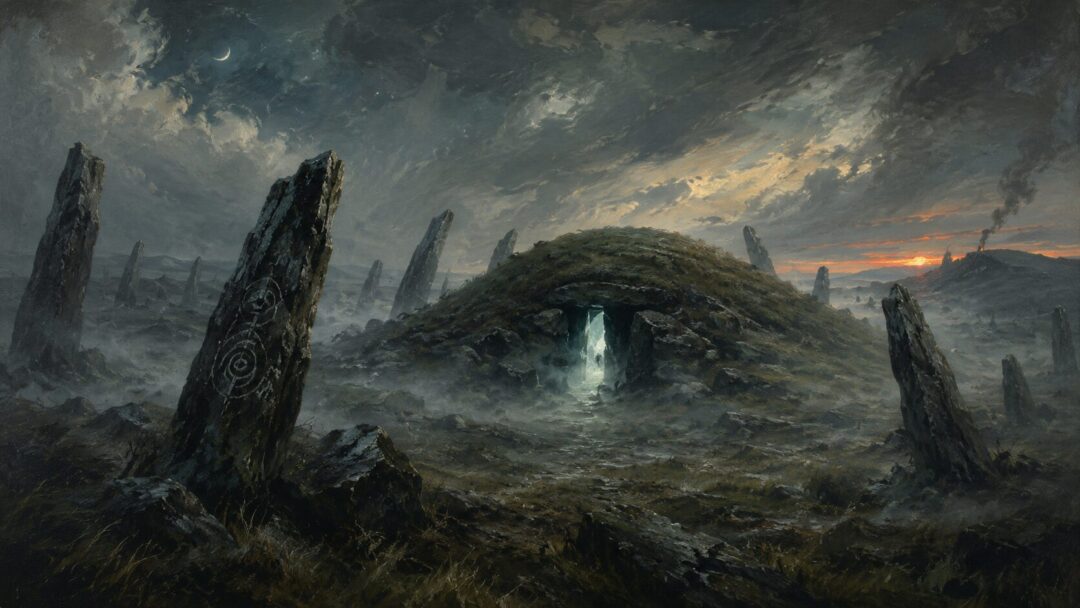
The Cold Song Beneath the Hill
Before Frodo ever stands before the Eye, before Mordor becomes more than a name on distant maps, he hears another kind of evil singing in the dark.
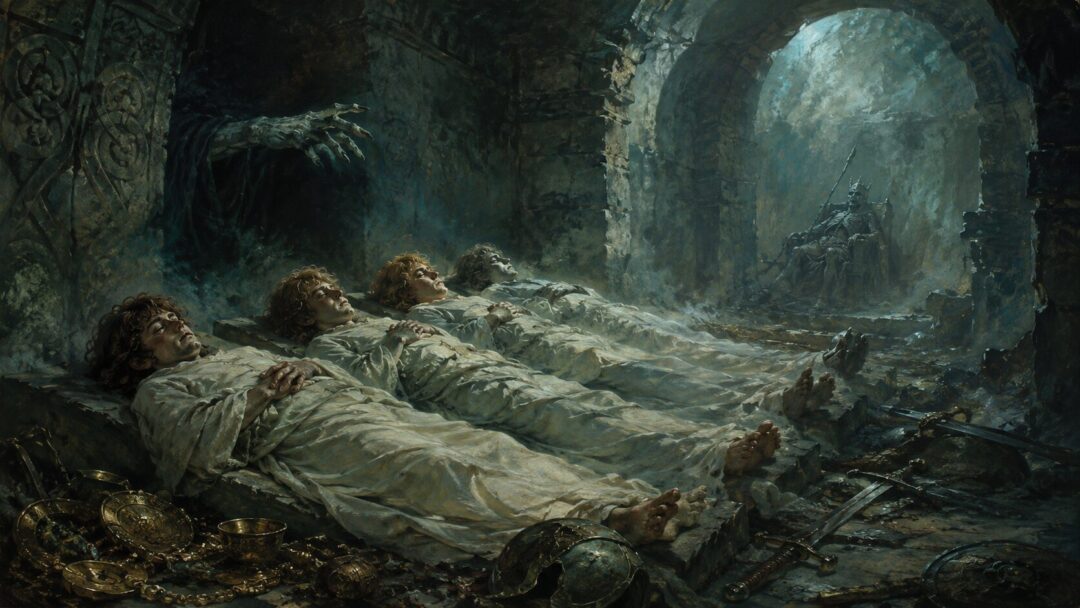
Not a command. Not a temptation. Not a voice promising power. The Barrow-wight’s song in “Fog on the Barrow-downs” is something stranger: a cold incantation over bodies laid out like the dead, under stone, beside ancient treasure that has outlived the people who made it. It feels nothing like Sauron’s evil because it is not presented as the same kind of threat, even if it belongs within the long shadowed history of Middle-earth.
Sauron’s evil is active, imperial, organizing. It seeks wills to bend, kingdoms to break, and a Ring-bearer to find. The Barrow-wight’s evil is older in mood, narrower in place, and more corpse-like in imagination. It does not ask Frodo to serve. It does not bargain. It tries to turn the living into part of a tomb.
That difference matters. The Barrow-downs are not merely a spooky episode before Bree. They are one of the first signs that Middle-earth contains more than one flavor of darkness. The Enemy has servants, allies, remnants, echoes, and consequences. But not every horror feels like Mordor.
An Evil That Does Not March
Sauron’s shadow usually moves with purpose. Even when he is not physically present, his influence is felt through pursuit, strategy, rumor, fear, and the pressure of decision. The Black Riders cross borders. Spies watch roads. Orcs gather. Men are tempted by promises of strength, order, survival, or dominion.
The Barrow-wight does almost the opposite. It waits.
Its power is bound to a place of burial: the Barrow-downs, the ancient mounds east of the Shire and beyond the Old Forest. The hobbits do not meet it because it is campaigning across Eriador. They stumble into a haunted landscape where the past has not been allowed to rest.
That is the first reason its song feels different from Sauron’s evil. Sauron’s darkness expands outward. The Barrow-wight’s darkness draws inward. It pulls Frodo into a chamber under the earth, away from road, sky, and fellowship. Its world is enclosed: stone, gold, cold flesh, dead hands, and the dreadful stillness of old graves.
Sauron wants the living world mastered. The Barrow-wight wants the living made still.
The Song Is Not a Speech of Domination
The Ring tempts by awakening desire. It works through what a person already fears or wants: escape, secrecy, pity twisted into possession, the hope of doing good by force. Sauron’s power is often tied to will. His great weapon is not only violence but domination: the reduction of other minds into extensions of his own.
The Barrow-wight’s song does not work that way. Its words are a chant of coldness, sleep, stone, cosmic darkness, and deathly suspension. It does not flatter Frodo. It does not offer him a grand destiny. It does not say, “Take power.” It says, in effect, “Lie here until all light is gone.”
That makes the horror more primitive and more intimate. The song is aimed at the body as much as the mind: hand, heart, bone, sleep, stone. Frodo is not being recruited. He is being numbed.
This is why the scene feels so alien beside the later moral drama of the Ring. Sauron’s evil is terrifying because it can make a person complicit. The Barrow-wight’s evil is terrifying because it removes agency almost entirely. It turns the heroes into objects in a burial rite.
A Tomb Full of History, Not Just Horror
The Barrow-downs are frightening because they are haunted, but they are tragic because they were not always evil. The mounds belong to the long memory of Men in Eriador. The appendices to The Lord of the Rings connect the region with ancient burial places and later with the Dúnedain of the North-kingdom, especially Cardolan.
That history gives the Barrow-wight scene its hidden sorrow. The treasure in the mound is not random loot. The blades Tom Bombadil later gives the hobbits come from the old wars of the North, made by Men of Westernesse and bound up with resistance to Angmar. Merry’s sword, drawn from this burial treasure, will later play a crucial role against the Witch-king. That is not a tidy coincidence so much as one of the deep ironies of the story: a place corrupted by the enemies of the North still preserves a weapon against them.
The Barrow-wight’s song therefore rises out of a desecrated past. Sauron’s evil often looks forward toward conquest. The Barrow-wight’s evil is a perversion of memory. It takes a tomb, a place meant to honor the dead, and turns it into a trap for the living.
The Angmar Connection Without Flattening the Mystery
It would be wrong to treat the Barrow-wight as completely unrelated to the larger war. The Barrow-downs become a place of horror in the history of the wars with Angmar. The Witch-king, Sauron’s greatest servant among the Nazgûl, is deeply connected with the ruin of the North-kingdom. The evil spirits that inhabited the mounds are associated with that same northern darkness.
So yes: the Barrow-wight belongs to the world Sauron has helped make. It is not “neutral folklore” sitting outside the moral structure of Middle-earth.
But the text does not make the Barrow-wight feel like a miniature Sauron. That distinction is important. The wight is not described as having Sauron’s political will, his vast intelligence, or his consuming desire to order all things under himself. The connection is historical and shadowy rather than psychologically identical.
One careful reading is that the Barrow-wight shows what Sauron’s wider evil leaves behind: not only armies, but poisoned places; not only tyrants, but unquiet dead; not only fear of future defeat, but the corruption of memory itself.
“The Dark Lord” in the Song
The Barrow-wight’s song refers to a “dark lord,” but the passage does not pause to define exactly how much the wight understands or intends by that phrase. In The Lord of the Rings, “the Dark Lord” most often points the reader toward Sauron. Yet the song’s imagery feels broader and more apocalyptic: the Sun failing, the Moon dead, stars dying in a black wind, dead sea and withered land.
That language reaches beyond ordinary military victory. It imagines a universe emptied of warmth and light.
This is another reason the song feels unlike Sauron’s usual mode in the story. Sauron wants rule over Middle-earth. He wants the Ring because through it he can recover mastery and bend his enemies. His evil is vast, but it is also practical: fortress, tower, road, army, messenger, siege.
The Barrow-wight’s song sounds less like policy and more like a curse. It does not envision a functioning empire. It envisions the victory of cold death over waking life.
Tolkien never needs to explain whether the wight is consciously invoking Sauron, echoing the Witch-king’s malice, or voicing a more general hope of darkness. The uncertainty is part of the dread. The song is not a manifesto. It is a burial spell.
Frodo’s First Real Test Is Not the Ring
The Barrow-downs episode is sometimes treated as a side-adventure before the “real” story begins. But Frodo’s reaction inside the barrow makes it morally central.
He wakes in darkness and sees his friends laid out in white, adorned with gold, with a sword across their necks. He feels the temptation to put on the Ring and escape. That possibility matters. The Ring is already present as a way out, already whispering the logic of self-preservation.
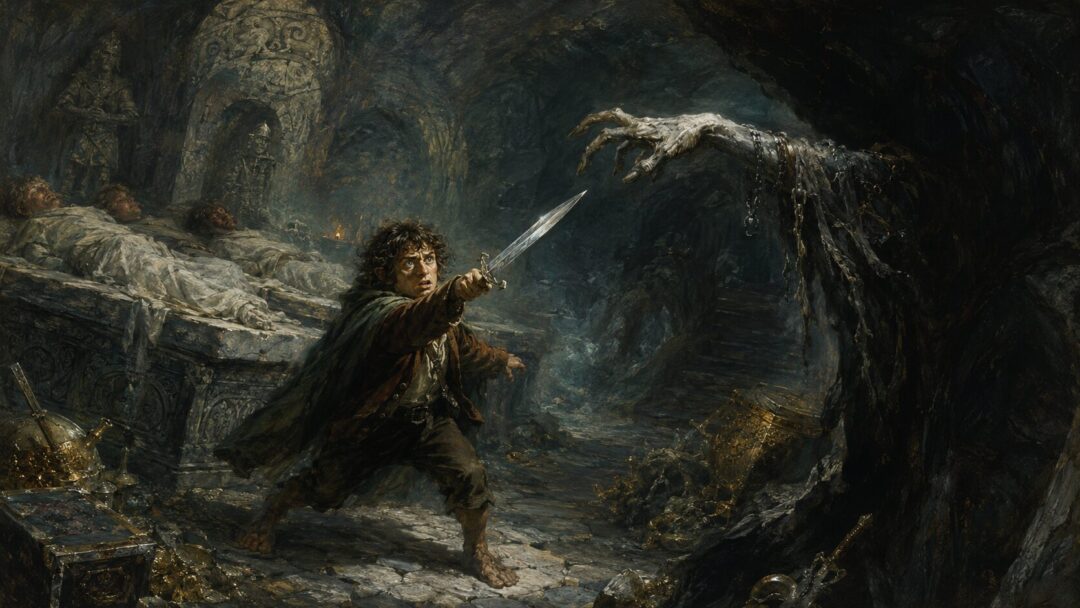
But Frodo does not abandon the others. He resists the immediate pull of escape, strikes at the wight’s arm, and calls for Tom Bombadil. This is a small but essential preview of Frodo’s character. His courage is not warrior confidence. It is the refusal, under terror, to save himself alone.
The Barrow-wight’s evil differs from Sauron’s, but the scene still prepares Frodo for Sauron’s war. It teaches that darkness can isolate, paralyze, and make escape look like the only sane choice. Frodo’s answer is imperfect but real: he remembers his companions.
Tom Bombadil’s Answer Is Also a Song
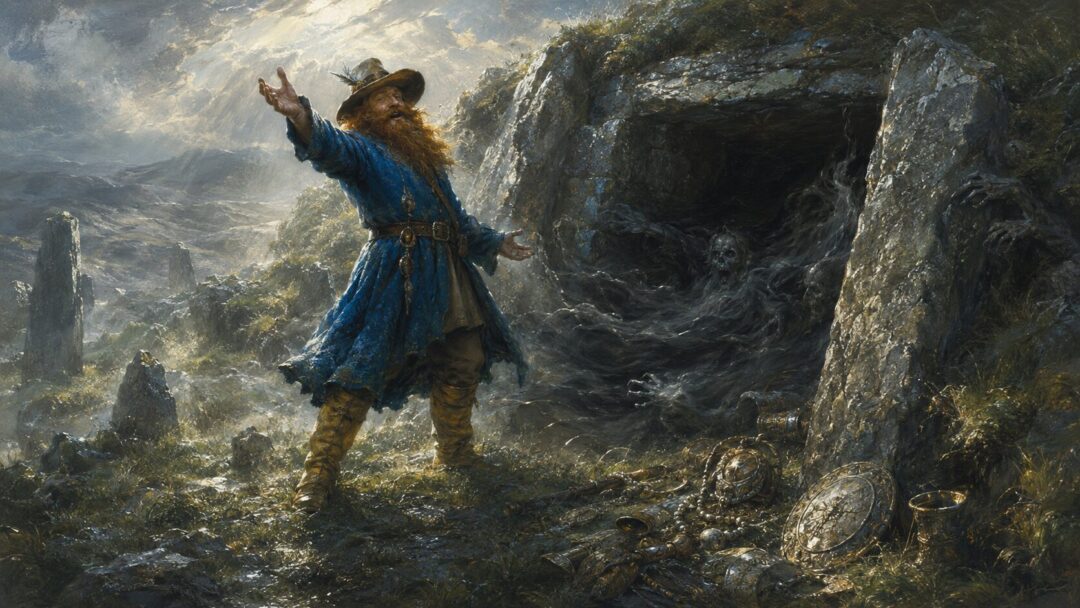
The rescue matters because it is not achieved by a duel in the ordinary heroic mode. Tom Bombadil comes singing.
That contrast is easy to miss. The Barrow-wight sings coldness, sleep, and enclosure. Tom sings opening, sunlight, and release. His words break the power of the barrow, call the sleepers awake, and send the wight away from the mound. The scene treats song as a form of authority, but not all song has the same nature. The wight’s chant binds. Tom’s song liberates.
This does not make Tom a simple “counter-Sauron.” His nature remains deliberately mysterious, and the Council of Elrond later makes clear that he is not the answer to the Ring’s crisis. But in this episode, he represents a power that the Barrow-wight cannot endure: not domination over death, but a joyous command that refuses the tomb’s claim on the living.
Sauron’s enemies often resist him by endurance, pity, humility, and sacrifice. Here, resistance takes the form of absurdly bright, ancient freedom breaking into a place of suffocation.
Why This Evil Feels Older Than Fear of Mordor
The Barrow-wight’s song frightens because it is not only about being killed. It is about being forgotten into the earth. The hobbits are dressed like the dead and surrounded by the remains of a vanished people. Time itself seems to have become hostile.
Sauron’s evil often sharpens the future into a terrible question: What will happen if he wins? The Barrow-wight’s evil collapses the future altogether. There will be no journey, no choice, no growth, no return home. There will only be cold sleep under stone.
That is why the episode belongs so strongly to the early part of The Fellowship of the Ring. Before the hobbits understand geopolitics, Rings of Power, Gondor, Rohan, or Mordor, they are made to feel the weight of a world where old griefs still have teeth. The Shire has been sheltered not because evil is simple, but because it has been held at bay by histories the hobbits scarcely know.
The Barrow-wight is one of those histories reaching up from the ground.
Not All Darkness Is the Same Darkness
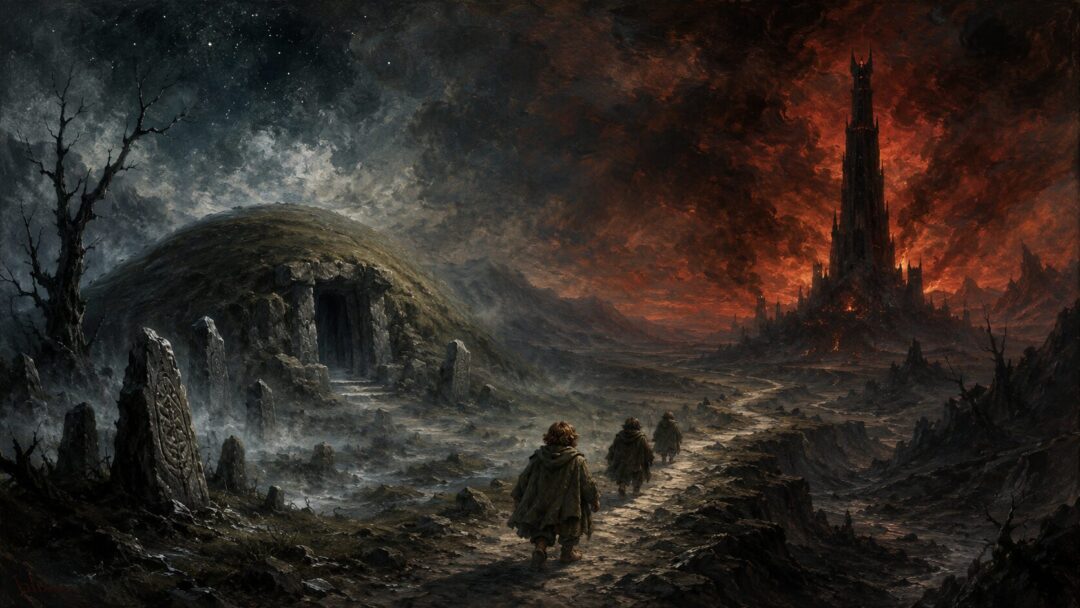
The Barrow-wight’s song feels nothing like Sauron’s evil because it reveals a different wound in Middle-earth. Sauron is the great will to dominate. The Barrow-wight is the horror of the violated dead. Sauron seeks to command history. The wight is trapped inside history’s ruin. Sauron’s shadow moves through armies and servants. The wight’s shadow gathers in a single mound.
Yet the two are not unrelated. The same long conflict that produced Angmar, ruined Cardolan, and filled the North with fear also made the Barrow-downs a place of dread. The song under the hill is not separate from the War of the Ring. It is one of the older echoes that war awakens.
And that may be the most unsettling lesson of the chapter. Frodo’s road to Mordor does not begin with a clean map of good and evil. It begins in fog, among stones, where a dead voice sings of the end of light. Middle-earth is not threatened only by the Enemy’s next move. It is haunted by every place where evil has already passed through and left something behind.
The Barrow-wight does not feel like Sauron because it is not trying to become Lord of the world.
It is trying to make the world a tomb.
Sources & Notes
- Tolkien Gateway, "Barrow-wights" — https://tolkiengateway.net/wiki/Barrow-wights
- Tolkien Gateway, "Fog on the Barrow-downs" — https://tolkiengateway.net/wiki/Fog_on_the_Barrow-downs
- Tolkien Gateway, "Tom Bombadil" — https://tolkiengateway.net/wiki/Tom_Bombadil
Sources added for article-specific Tolkien reference context.