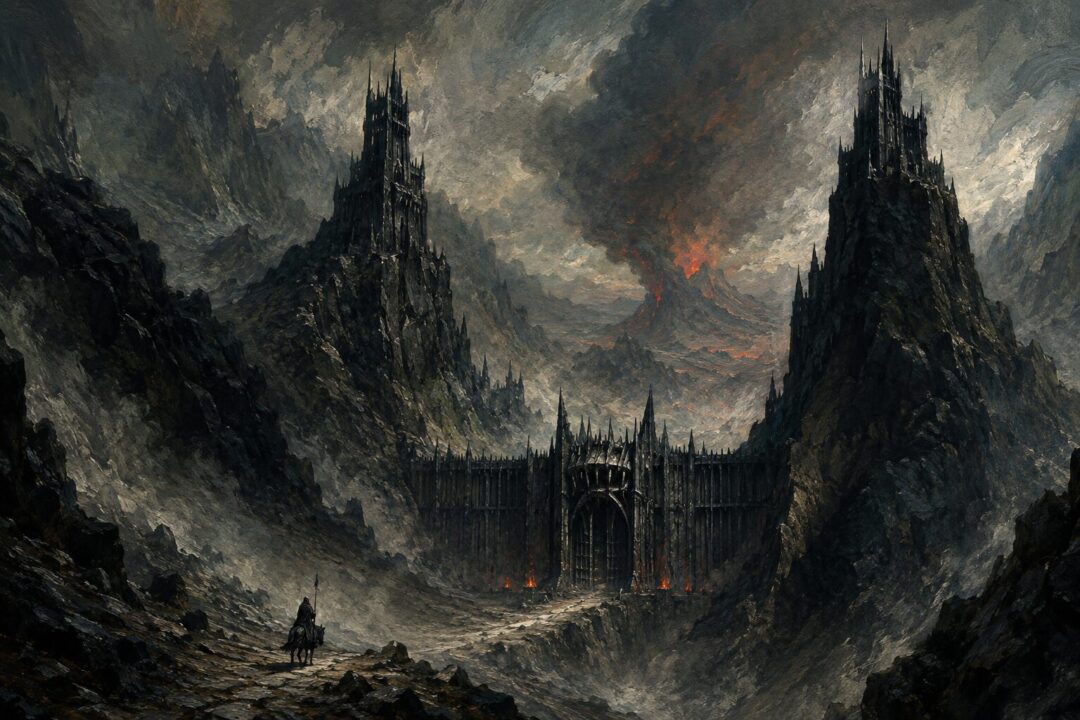
At the Black Gate of Mordor, the road did not simply end. It was judged.
That is the first thing the Towers of the Teeth reveal. They were not just sinister decorations beside Sauron’s front door, and they were not originally built as monuments to his power. They stood at Cirith Gorgor, the dreadful pass where the Mountains of Shadow and the Mountains of Ash drew together in the north-west of Mordor. Between them lay the Morannon, the Black Gate, the great iron barrier that shut the land of Mordor from the outside world.
But the deepest irony is that the towers were not made by Sauron at all.
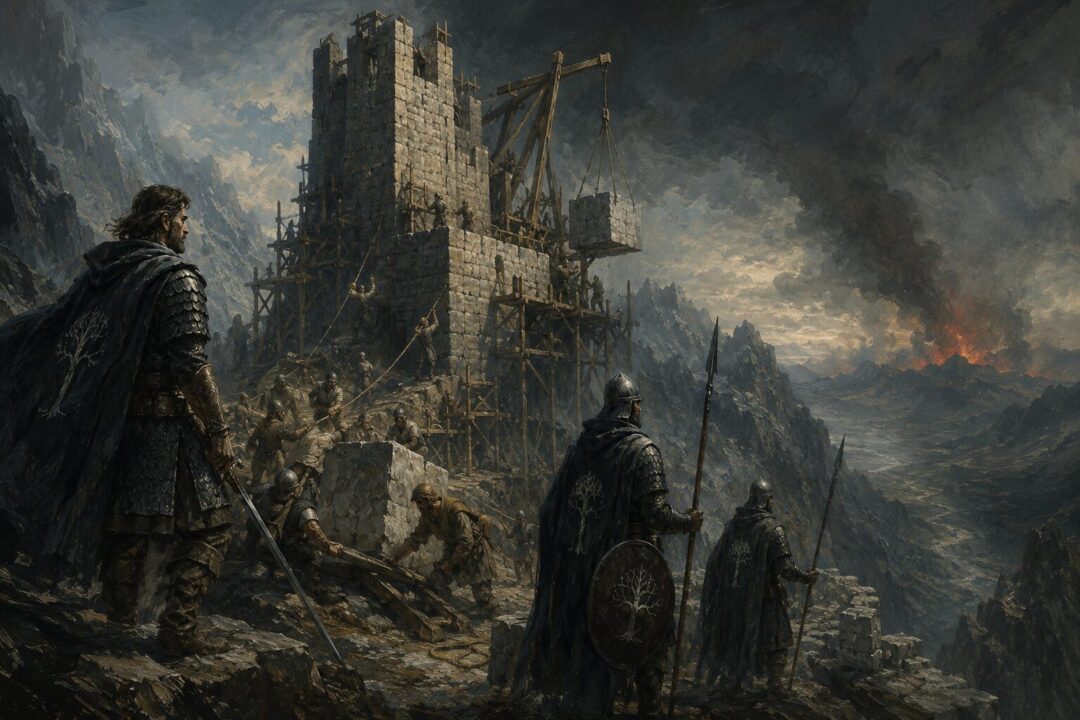
In the early Third Age, after Sauron’s defeat in the War of the Last Alliance, the Men of Gondor built fortifications to keep watch on Mordor. The Towers of the Teeth were part of that watch. They were meant to stop the Shadow from returning. By the end of the Third Age, they had become part of the Shadow’s own face.
That reversal is what makes them so haunting. They were built as a warning against evil. They became a warning that vigilance can fail.
The Gate That Looked Like a Mouth
The Towers of the Teeth stood on either side of the pass of Cirith Gorgor. Their very placement mattered. Mordor was surrounded by mountains on much of its western and northern sides, but Cirith Gorgor formed one of the great controlled approaches into the land. It was not a friendly valley or a road of trade. It was a choke point.
The Black Gate barred the pass. The towers rose on sheer hills thrust forward on either side, described in The Lord of the Rings as strong, tall, and dark, with window-holes facing outward. Their position allowed them to command the road, observe the approaches, and help turn the entrance into a killing ground.
The name “Towers of the Teeth” is not a casual image. The whole geography of the Morannon feels like a mouth: a black gate amid cliffs, flanked by two dark towers like fangs. Anyone approaching Mordor from the north-west had to come before those teeth.
That visual metaphor tells the reader what kind of border this is. It does not merely defend a kingdom. It consumes hope before battle even begins.
They Were Built to Keep Sauron Out
The most important fact about the Towers of the Teeth is easy to miss: they began as works of Gondor.
After Sauron was overthrown at the end of the Second Age, the victorious powers did not pretend Mordor had become harmless. The land remained the place where Sauron had built his power. Its mountains, roads, and inner plains still existed. Its old servants were not necessarily gone forever. So Gondor set a guard on Mordor.
The towers and related strongholds were part of that long watch. Their purpose was defensive and preventative: to watch the passes, hold the approaches, and prevent Sauron’s servants from returning to Mordor.
That gives the towers a tragic nobility at the beginning. They were not made for domination. They were built because Men remembered what Sauron had done. They were stone expressions of hard-won wisdom: evil defeated is not always evil ended.
Yet the story of Middle-earth often turns on decline. The vigilance of one age becomes the neglected duty of another. Gondor’s power weakened over time. Plague, war, civil conflict, and the long strain of guarding many borders all contributed to the shrinking of its reach. The watch on Mordor was eventually abandoned or lost. The texts do not turn the fall of these towers into one simple event with one simple cause, but the larger pattern is clear: Gondor could no longer hold what its earlier strength had built.
The fortresses remained. The purpose changed.
Sauron Did Not Need to Build Them — He Inherited Them
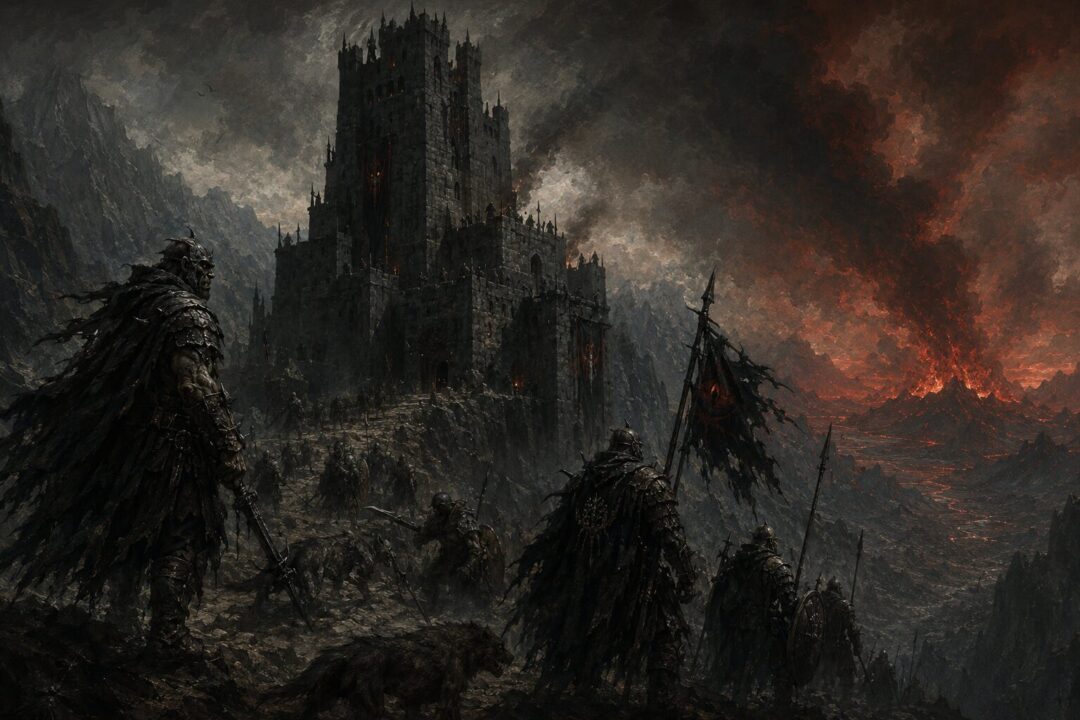
When Sauron’s power rose again, the cruel brilliance of the situation was that some of the defenses against him were already waiting.
This is one of the most unsettling patterns in Tolkien’s world: evil often corrupts existing things rather than creating everything from nothing. Minas Ithil becomes Minas Morgul. The palantíri, made for communication and wisdom, become dangerous channels of pressure and deception when one comes under Sauron’s influence. Even the Rings of Power, originally bound up with preservation and craft, become instruments of domination through the One.
The Towers of the Teeth belong to the same moral architecture. Sauron did not need to invent the idea of controlling Cirith Gorgor. Gondor had already recognized its strategic value. He simply turned that value inside out.
What had once watched Mordor now watched for Mordor.
That distinction matters. The towers were no longer guardians keeping evil contained. They became sentinels helping evil project itself outward. Their dark windows faced north, east, and west, suggesting surveillance over the lands beyond and the approaches to the gate. They were part of a system of control: gate, rampart, towers, hidden forces, tunnels, and the dreadful awareness that nothing near Mordor was unobserved.
The Towers Were a Weapon Before the Battle Began
The Towers of the Teeth were military structures, but their power was also psychological.
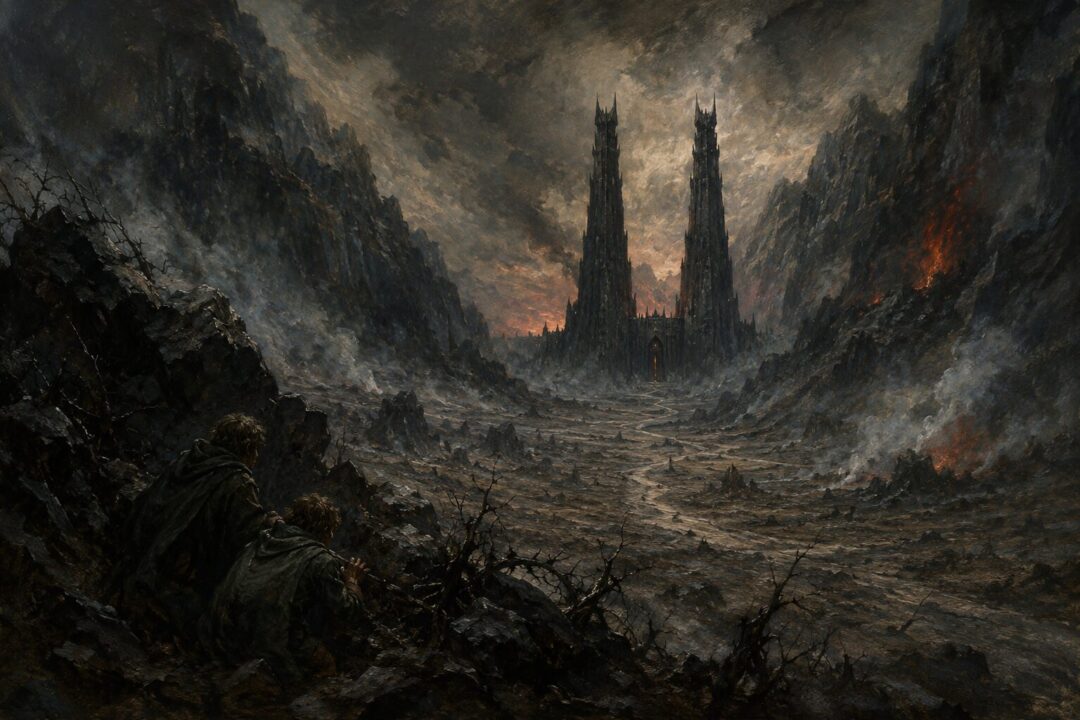
When Frodo and Sam approach the Morannon, the Black Gate does not appear as merely a practical obstacle. It is overwhelming. The mountains, the rampart, the gate, the towers, and the hidden enemies all combine to make the entrance feel impossible. The hobbits’ mission depends on entering Mordor, yet the most obvious way in is designed to crush that hope.
This is why the towers matter in the story even though no long siege of them occurs. They communicate the central problem of Mordor: the Enemy’s strength is too great to defeat by direct assault. The Morannon is not just a door. It is an argument.
It says: no small person can pass here.
That is why Frodo and Sam cannot enter by the Black Gate. They must seek another way, through danger, secrecy, and misery. The towers are part of the narrative pressure that forces the quest away from open roads and into the hidden margins of the world. They make visible the impossibility of the direct path.
For casual readers, this can feel like a simple adventure problem: the front gate is guarded, so the heroes go around. But on a deeper level, the Towers of the Teeth embody a major rule of the War of the Ring. Sauron’s power is strongest where the world meets him on his own terms: armies, gates, fortresses, fear, and domination. The Ring can only be destroyed by a path he does not fully understand.
A Border Built on Fear and Control
The towers also reveal something about how Mordor functioned as a realm.
Sauron’s land is not portrayed as chaos alone. It is organized. Roads lead through it. Armies move across it. Messengers, captains, slaves, orcs, and servants all operate within a grim hierarchy. Mordor has fortresses, passes, supply regions, guard posts, and military logic. The Towers of the Teeth belong to that structure.
They are not merely two ominous shapes. They are part of a border regime.
Anyone approaching the Morannon would be visible, exposed, and vulnerable. The gate could remain shut. The towers could watch. Troops could gather behind the defenses. The surrounding hills and rocks hid enemies. The pass beyond was associated with tunnels and teeming servants of the Enemy. The place was engineered to deny surprise.
That is why the final march of the Captains of the West to the Black Gate is so desperate. They are not attacking a weak point. They are deliberately presenting themselves before the most symbolic and fortified entrance to Sauron’s realm, hoping to draw his Eye away from Frodo and Sam.
The towers, then, become the stage for a deception. The West cannot break Mordor by force. But it can make Sauron look in the wrong direction.
Why the Final Battle Happens There
The confrontation at the Black Gate is sometimes remembered as a last stand of courage, which it is. But it is also a calculated act of misdirection.
Aragorn, Gandalf, and the Captains of the West understand that they cannot defeat Sauron’s full military power. Their march to the Morannon is not a normal campaign of conquest. It is a challenge meant to appear bold enough, and perhaps foolish enough, to fit Sauron’s expectations.
Sauron believes in power. He understands rivalry, possession, fear, and the will to dominate. The idea that his enemies might seek to destroy the Ring rather than wield it is almost beyond his imagination. So when the West comes openly to his gate, he can read it as the move of someone trying to use the Ring, or at least as a desperate military threat worth answering.
The Towers of the Teeth frame that final gamble. They are the visible fangs of the realm before which the Men of the West stand. Above them gather the Nazgûl, and around them Sauron’s forces wait. The towers help create the sense that the West has walked willingly into the mouth of Mordor.
And that is exactly what the strategy requires.
The true blow is not at the gate. It is far away, inside the land, at the Fire where the Ring was made.
The Fall of the Teeth
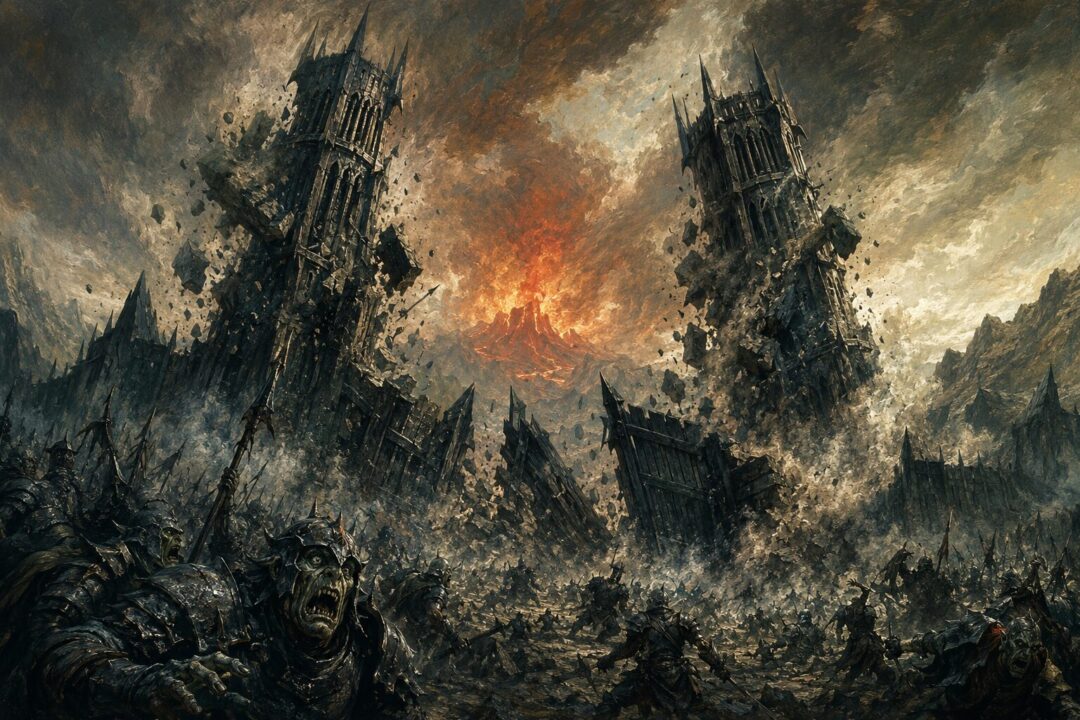
When the Ring is destroyed, the collapse of Sauron’s power is not described as a quiet political defeat. It is physical, cosmic, and architectural. Barad-dûr falls. The Black Gate is ruined. The Towers of the Teeth sway, totter, and fall.
That detail matters because the towers had become more than old military works. By the end, they are part of the visible body of Sauron’s dominion. Their fall shows that the terror they represented was dependent on the power behind them.
Stone can outlast kings, but in Middle-earth stone shaped by domination is not as permanent as it looks.
The Towers of the Teeth had survived the failure of Gondor’s watch. They had survived long enough to be absorbed into Mordor’s defenses. They had stood as proof that Sauron could turn the labor of his enemies into his own armor. Yet when the Ring is unmade, they collapse with the gate they guarded.
Their fall is not only a military image. It is moral reversal. The stolen watchtowers, corrupted into fangs, lose their bite.
What They Were Really For
So what were the Towers of the Teeth really for?
On the surface, their purpose changed across history. Gondor built them to guard Mordor and prevent the return of Sauron’s servants. Sauron later used them to guard Mordor for himself, to watch the approaches, strengthen the Morannon, and make his realm feel impossible to enter or challenge.
But their deeper narrative purpose is even sharper.
They show how fear can occupy the ruins of vigilance. They show how a fortress built for protection can become an emblem of oppression when the will behind it changes. They show why the War of the Ring cannot be won by simply matching tower with tower, army with army, or gate with gate.
The Towers of the Teeth were once a warning aimed inward at Mordor. Under Sauron, they became a warning aimed outward at the world.
That is their tragedy. They were built because Men remembered the Shadow. They fell because the smallest and least expected mercy-driven path reached the place where the Shadow’s strength truly lived.
In the end, the Teeth of Mordor did not fail because a greater army smashed them. They failed because the power that gave them terror was destroyed by someone they were never built to notice.
Sources & Notes
- Tolkien Gateway, "Towers of the Teeth" — https://tolkiengateway.net/wiki/Towers_of_the_Teeth
- Tolkien Gateway, "Morannon" — https://tolkiengateway.net/wiki/Morannon
- Tolkien Gateway, "Mordor" — https://tolkiengateway.net/wiki/Mordor
Sources added for article-specific Tolkien reference context.