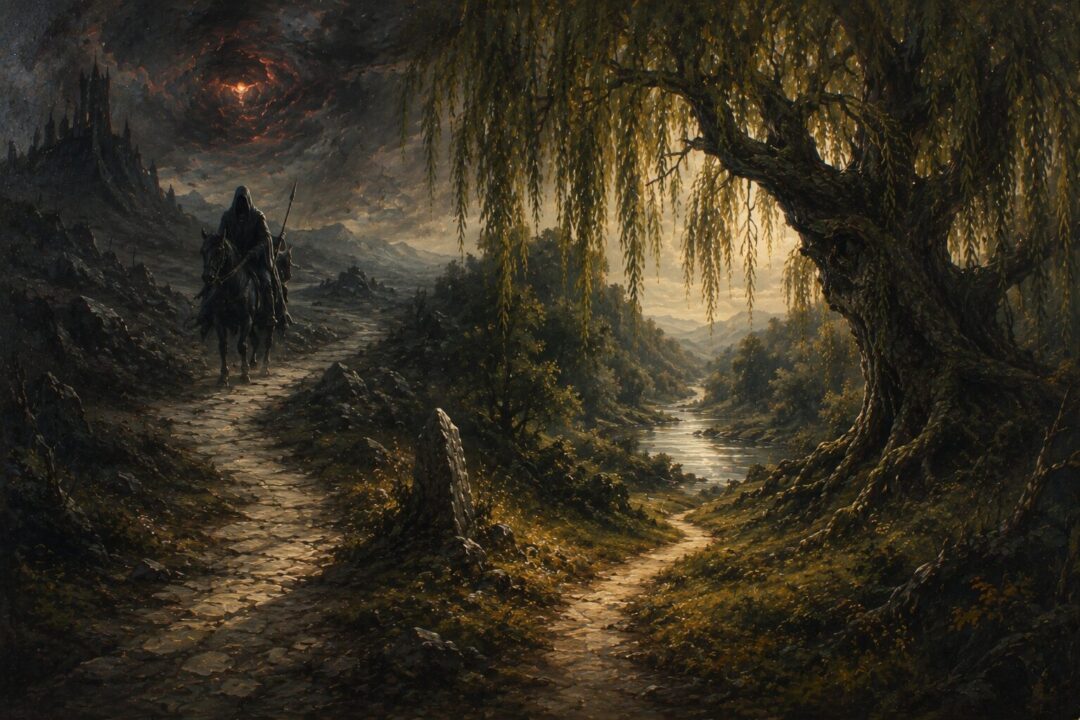
Every reader remembers the Black Riders on the road to Bree. They are visible, relentless, and unmistakably servants of the Enemy. Yet before Frodo ever reaches that familiar danger, he passes through a place that feels even more unsettling: the quiet valley of the Withywindle.
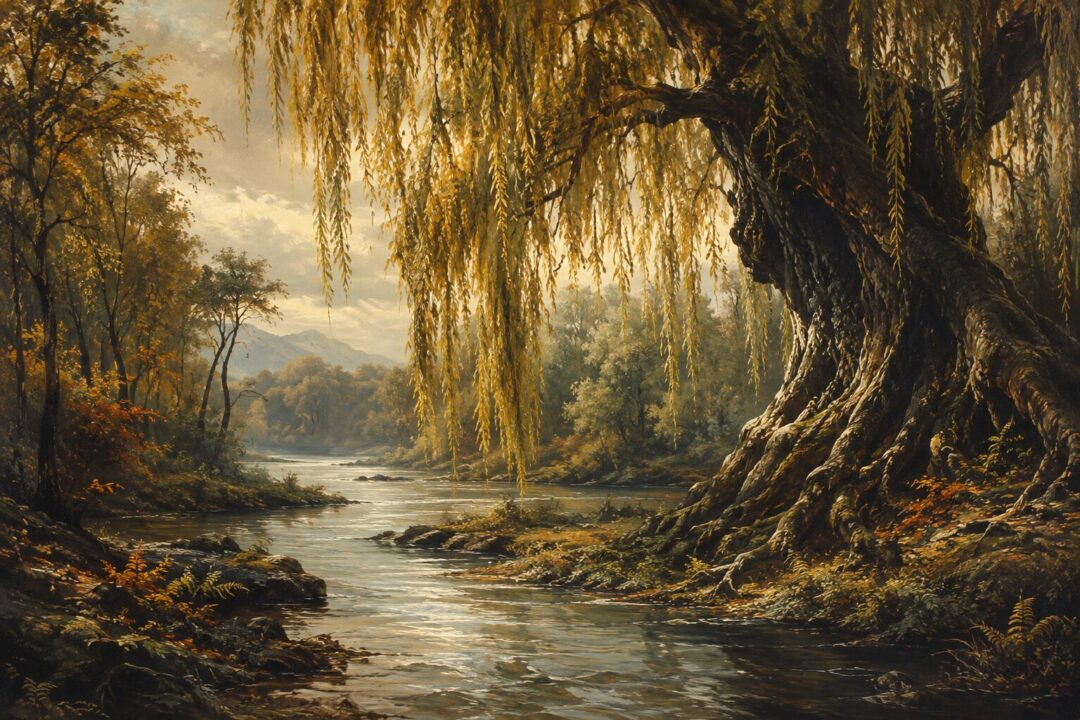
There are no armies there. No fortresses. No banners of Mordor. Instead, there is birdsong, slow-moving water, ancient willow trees, and an almost irresistible invitation to stop walking.
That is precisely what makes the Withywindle so disturbing.
Unlike the dangers that dominate the later journey, the valley attacks not through violence but through surrender. The landscape itself seems to oppose travelers. Time slows. Direction becomes unreliable. Sleep becomes almost impossible to resist. The result is one of the earliest reminders in The Lord of the Rings that evil in Middle-earth is not confined to Sauron alone. The world is older, stranger, and filled with powers that have their own histories.
The Old Forest Already Warns That Something Is Wrong
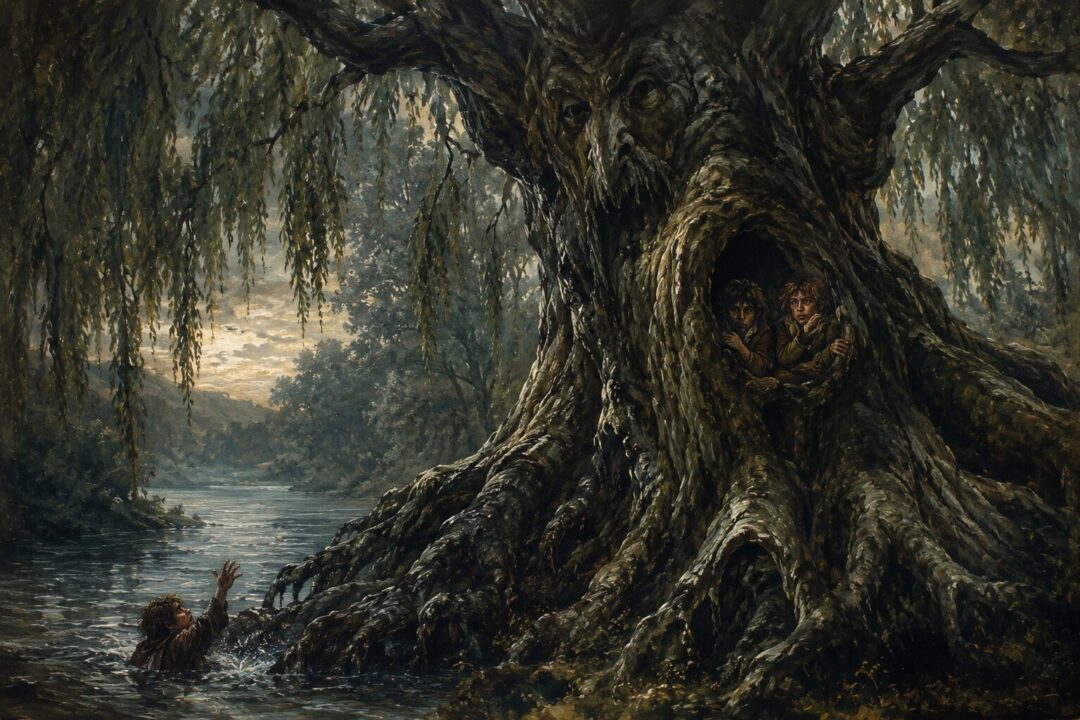
When Frodo, Sam, Merry, and Pippin enter the Old Forest, they expect a difficult shortcut. Instead, they discover that the forest behaves almost like a living intelligence.
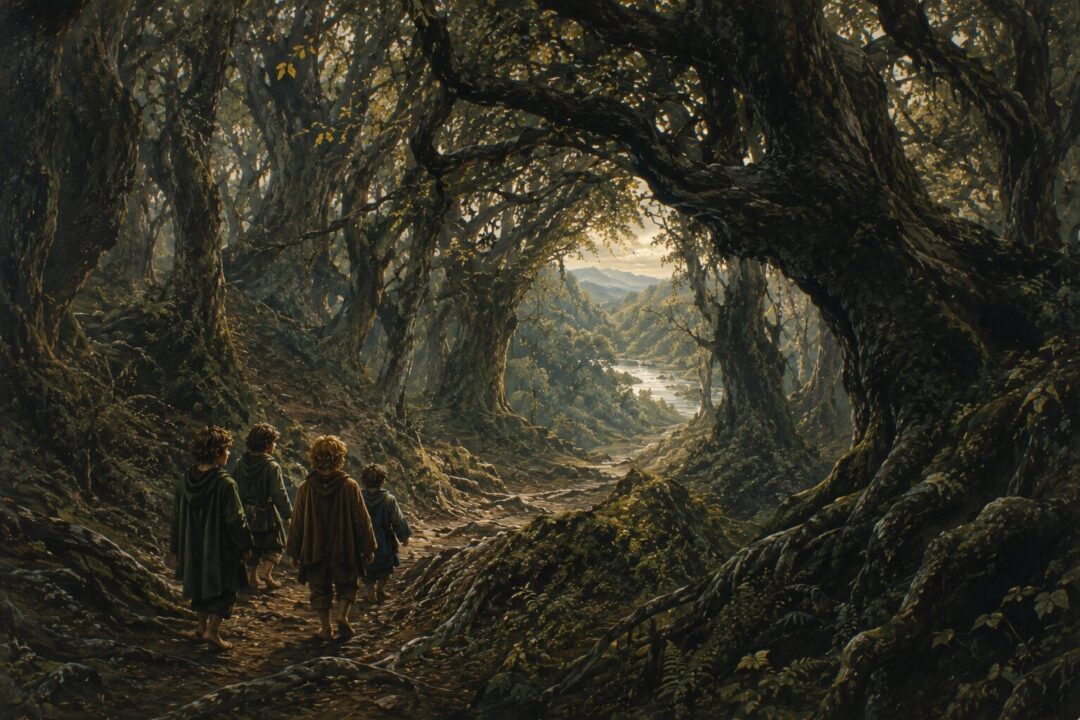
The Hobbits repeatedly notice that paths seem to shift, trees appear unfriendly, and the woods gradually drive them in a single direction. Their own choices matter less and less as the forest funnels them toward the valley of the Withywindle, described as the heart of the strange happenings within the Old Forest. The text never suggests that every tree possesses independent malice, but it strongly implies that the forest has become dominated by darker influences centered on the valley.
This loss of control creates a unique kind of fear.
On the road to Bree, the Hobbits are pursued. Inside the Old Forest, they are guided exactly where they do not wish to go.
That difference changes the emotional tone completely. Running from enemies still leaves room for decisions. Being quietly herded by the landscape itself removes that comfort.
The Valley Is Beautiful Before It Is Terrifying
One reason the Withywindle feels so dangerous is that nothing about it initially resembles a battlefield.
The river winds peacefully beneath ancient willows. The air is warm. The shade is inviting. After the exhausting struggle through tangled woodland, the valley appears almost welcoming.
Then the Hobbits begin to feel overwhelmingly sleepy.
The danger arrives through comfort rather than fear. Frodo sits beside the water. Merry and Pippin lean against the trunk of an enormous willow. Their caution fades naturally, almost effortlessly.
Readers experience the same deception. The landscape encourages relaxation just before revealing its true nature.
This reversal makes the episode memorable because it overturns ordinary expectations. Most fantasy adventures warn readers when danger is approaching. The Withywindle hides danger beneath tranquility.
Old Man Willow Is More Than a Hostile Tree
Old Man Willow is often remembered simply as an evil tree, but the text presents something more disturbing.
Tom Bombadil later explains that some trees in the Old Forest remember ages when they stood over vast lands before the coming of later peoples. Of the corrupted trees, none are more dangerous than the Great Willow. His "heart was rotten, but his strength was green," and his influence extended through much of the surrounding woods. The narrative never explains precisely what kind of being Old Man Willow is, and Tolkien leaves his exact nature deliberately undefined.
That uncertainty strengthens the horror.
Readers understand what Orcs are.
They understand what Ringwraiths serve.
Old Man Willow belongs to an older category of threat whose origins remain largely unexplained.
His weapon is neither sword nor claw.
He sings.
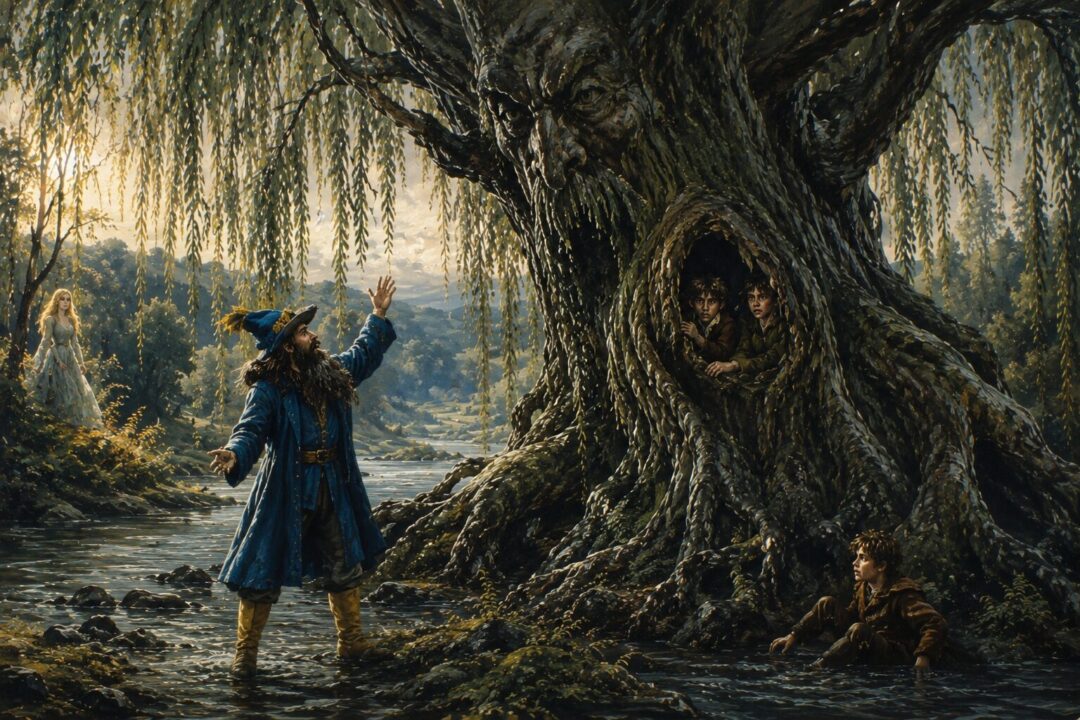
His voice fills travelers with irresistible drowsiness, allowing him to trap Merry and Pippin within his trunk while attempting to drown Frodo beneath the river.
The attack feels less like combat than predation.
The Enemy Here Is the Landscape Itself
The road to Bree contains recognizable hazards.
There are roads, inns, villages, and ordinary people trying to survive.
The Withywindle offers almost none of those reassuring structures.
Water becomes dangerous.
Trees become dangerous.
The ground itself seems determined to lead strangers toward disaster.
This transforms the environment into an active participant rather than a backdrop.
Even Sam, whose practical nature repeatedly steadies the Fellowship throughout the story, barely escapes Old Man Willow's enchantment. His suspicion and quick action save Frodo from drowning, but the rescue remains incomplete until Tom Bombadil arrives.
Without outside intervention, all four Hobbits would likely have perished before ever leaving the Old Forest.
That possibility often receives less attention than later, larger battles, yet it represents one of the closest brushes with complete failure in the early journey.
Tom Bombadil Reveals That Middle-earth Is Larger Than the War Against Sauron
Tom Bombadil's arrival dramatically changes the atmosphere.
He does not defeat Old Man Willow through superior force.
Instead, he commands him.
Bombadil's songs simply strip away the Willow's domination, forcing the ancient tree to release its captives.
The scene introduces one of the great themes of Tolkien's world: not every power belongs to the struggle between the Free Peoples and Sauron.
Bombadil exists outside many of the conflicts that define the Third Age. His mastery within his own land demonstrates that Middle-earth contains mysteries that neither the Wise nor the Enemy fully explain.
The texts never provide a complete account of Bombadil's nature, and many interpretations have been proposed over the years. The story itself deliberately preserves that mystery rather than resolving it.
For the Hobbits, however, the lesson is immediate.
Their understanding of the world has become far too small.
Why the Black Riders Feel Simpler
This may seem surprising, but the Nazgûl are easier to comprehend than the Withywindle.
The Ringwraiths are terrifying because they pursue a clear purpose.
They hunt the Ring.
They obey Sauron.
Their methods become increasingly understandable as the story progresses.
The Withywindle refuses that clarity.
Old Man Willow does not appear interested in conquest.
He is not searching for the One Ring.
He is not carrying out orders.
His hostility exists independently of the central war.
That independence makes him unpredictable.
Readers instinctively understand that negotiation is impossible because there is no larger political objective behind his actions.
The valley is dangerous simply because that is what it has become.
The Withywindle Is Surrounded by Other Ancient Shadows
The valley also sits beside another deeply unsettling region: the Barrow-downs.
After leaving Bombadil's house, the Hobbits soon encounter the Barrow-wight, another being whose origins lie within the forgotten history of Eriador rather than the immediate campaigns of Mordor.
This sequence matters.
The Hobbits do not leave the safety of the Shire and immediately enter Sauron's war.
Instead, they first cross landscapes haunted by the long memory of Middle-earth itself.
Ruined kingdoms.
Ancient forests.
Burial mounds.
Powers left behind by earlier ages.
The journey teaches both the characters and the reader that history itself remains alive.
The War of the Ring is only the latest chapter.
Fear Without Explanation Lasts Longer
Modern readers often expect every mystery to receive an answer.
The Withywindle refuses that expectation.
The text explains enough for the story to function but deliberately leaves many questions unresolved.
Why exactly is Old Man Willow as powerful as he is?
How much of the forest truly obeys him?
Why can Bombadil command him so easily?
The narrative never answers these questions directly.
Instead, uncertainty becomes part of the experience.
This reflects a broader pattern throughout The Lord of the Rings. Ancient places frequently possess histories deeper than any single character fully understands.
Rather than weakening the setting, those unanswered questions make Middle-earth feel older and more authentic.
Some mysteries survive because no one living possesses complete knowledge.
The Valley Represents a Different Kind of Evil
Perhaps the greatest reason the Withywindle feels more dangerous than the road to Bree is that it demonstrates a form of peril beyond military conflict.
Sauron seeks domination.
The Black Riders seek the Ring.
Old Man Willow simply seeks to trap.
His threat is intensely local, but no less deadly for that.
The valley embodies corruption that has seeped into the natural world without becoming part of Sauron's command. It reminds readers that Middle-earth has accumulated countless wounds across its long history, some connected to the Dark Lord and others arising from far older memories and grievances.
That distinction matters because it broadens the moral landscape of the story.
Not every danger marches beneath a black banner.
Some dangers wait beside quiet rivers beneath ancient branches.
And those may be the ones travelers least expect.
By the time Frodo finally reaches Bree, readers have already learned a crucial lesson.
The greatest threat is not always the one that chases you down the road.
Sometimes it is the beautiful place that quietly persuades you to stop walking.
Sources & Notes
- Tolkien Gateway, "Withywindle" — https://tolkiengateway.net/wiki/Withywindle
- Tolkien Gateway, "Old Forest" — https://tolkiengateway.net/wiki/Old_Forest
- Tolkien Gateway, "Tom Bombadil" — https://tolkiengateway.net/wiki/Tom_Bombadil
Sources added for article-specific Tolkien reference context.