The Quiet Horror of a Tree That Has Been Watching
In Middle-earth, a tree is rarely just scenery. A road may bend under its shadow. A forest may seem to breathe. A willow beside a river may look harmless until travelers grow sleepy, roots shift beneath them, and the trunk opens like a trap.
That is what makes Tolkien’s moving trees so unsettling. They do not become frightening because they suddenly behave like monsters. They become frightening because they reveal that the world was never as passive as Men, Hobbits, Orcs, or even Wizards liked to believe.
The terror is not merely that trees can move. It is that they have memories, grievances, loyalties, and ancient measures of time. When they finally rise, they bring the patience of centuries into a single moment of judgment.
Old Man Willow: The First Warning
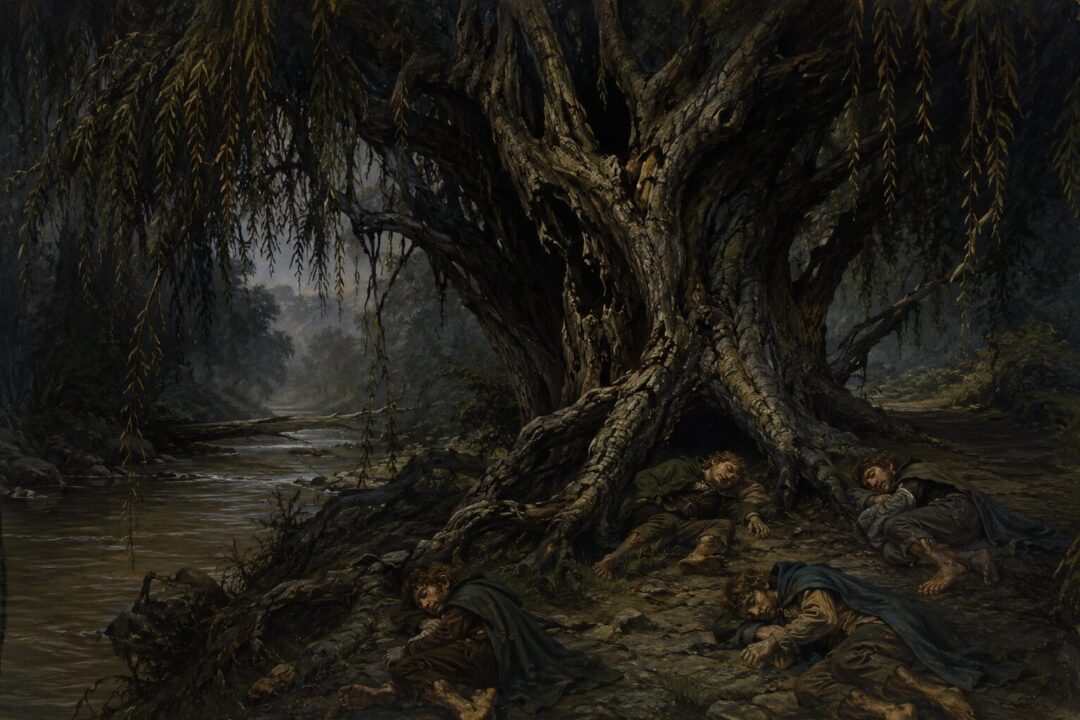
Before the Ents march on Isengard, the Hobbits encounter a darker, stranger hint of tree-will in the Old Forest. Old Man Willow is not clearly identified in the text as an Ent or a Huorn. Tolkien never explicitly confirms his exact nature. The safest reading is that he belongs to the broader mystery of awakened or half-awakened trees: ancient, aware, and hostile to “walking things.”
His danger is intimate. He does not lead an army. He does not roar across a battlefield. He bends paths, presses thought upon weary minds, and traps Merry and Pippin inside his trunk. Frodo is almost drowned. Sam resists just enough to fight back.
This matters because Old Man Willow shows tree-terror before it becomes warlike. His power is not speed but influence. He controls the mood of the forest around him. He turns shade into sleep, roots into snares, and a peaceful riverside into a place where the landscape itself becomes predatory.
The episode teaches a hidden rule: in Middle-earth, nature may seem silent, but silence is not consent.
Fangorn: A Forest Older Than Human Confidence
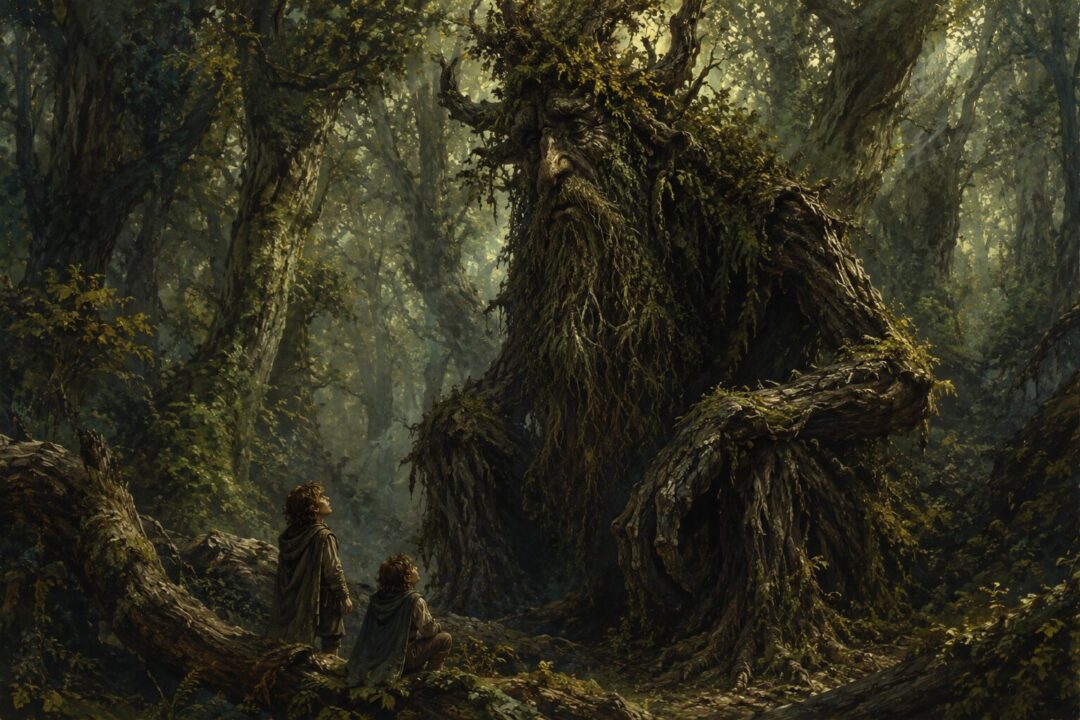
When Merry and Pippin enter Fangorn, the fear changes shape. The Old Forest feels malicious and close. Fangorn feels immeasurable. It is not simply haunted; it is ancient.
Treebeard, or Fangorn, is not a tree pretending to be a person. He is an Ent, one of the Shepherds of the Trees. His body resembles the forest, but his mind is personal, deliberate, and moral. He remembers the world in ages rather than years. He knows names that have passed out of common use. His slowness is not stupidity. It is proportion.
That proportion is terrifying to smaller creatures. Hobbits live by meals, roads, birthdays, and sudden decisions. Men live by kingdoms and wars. Ents live long enough to see forests shrink, languages fade, and powers rise and fall. When such a being finally decides that haste is necessary, the decision carries a weight no ordinary army can imitate.
The fear of Fangorn is therefore not random danger. It is the fear of being measured by something older than your excuses.
The Ents Were Made for a Moral Problem
The roots of the Ents go deeper than the War of the Ring. In the older mythology, Yavanna, who cares for growing things, fears that the Children and other makers will use and harm the living world. In response, the Shepherds of the Trees are foretold: guardians who will walk in the forests.
That origin is crucial. The Ents are not accidents. They exist because trees in Middle-earth are vulnerable to axes, fire, industry, and neglect. Their movement is defensive before it is violent. They are the answer to a moral imbalance: the strong take from the rooted, and the rooted cannot flee.
So when trees finally move, the terror is partly guilt. The axe has always assumed that the tree cannot answer. The furnace has assumed the forest is only fuel. Saruman’s pits at Isengard turn that assumption into a whole system of destruction. He cuts, burns, digs, and breeds war from ruin.
The Ents are frightening because they are the moment the victim stands up.
Huorns: When the Forest Becomes Less Knowable
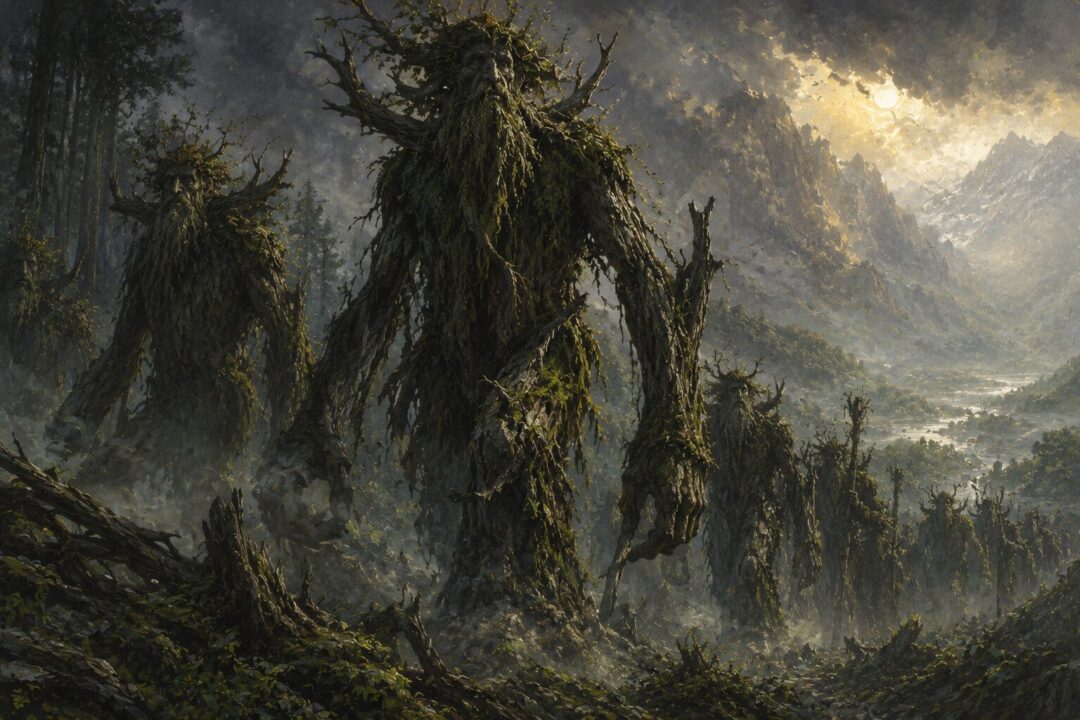
The Huorns make the terror darker. Treebeard speaks of some Ents becoming more tree-like, and some trees becoming more Ent-like; the boundary is not always simple. Huorns are associated especially with Fangorn, and they can move, though they remain mysterious. They are not given the same clear individuality as Treebeard, Quickbeam, or the named Ents.
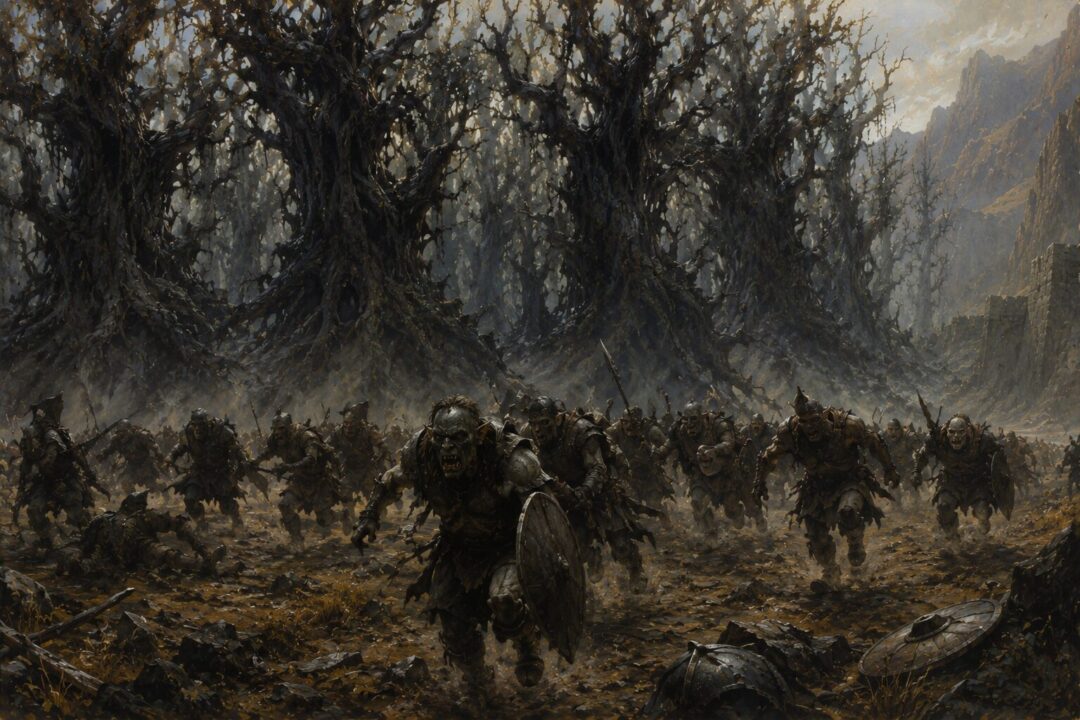
That uncertainty is precisely their power. An Ent can speak with you. A Huorn may only loom, shift, darken, and close the way. At Helm’s Deep, the sudden forest that appears behind Saruman’s fleeing Orcs is one of the most chilling images in the War of the Ring. The enemy escapes men with swords only to run into trees.
The text does not linger over the details of what happens inside that shadowed wood. That restraint makes it worse. By morning, the Orcs are gone, and the Huorns later depart. The battlefield is cleansed in a manner that feels both just and dreadful.
The Huorns are terrifying because they remove the comfort of explanation. They are not evil in the way Orcs are evil. They are not merciful in the way Hobbits understand mercy. They are the forest acting according to its own ancient anger.
Isengard: The Moment Patience Ends
The March of the Ents is powerful because it is not impulsive. Treebeard is famously reluctant to be hasty. The Entmoot takes time. The Ents deliberate in their own long manner. Yet once they understand what Saruman has done, their movement becomes unstoppable.
This is the great contradiction: the slowest people in the story produce one of its most sudden reversals.
Isengard is a fortress of calculation. Saruman has walls, gates, machinery, furnaces, and plans. He has treated the living world as material for power. But he has forgotten that Fangorn is not dead timber. He has wounded a neighbor old enough to remember when his ambitions would have seemed small.
The Ents do not defeat Isengard by out-inventing Saruman. They defeat it by being what he has ceased to respect. They break stone, tear down gates, and release the waters. The industrial circle is drowned by mountain and forest.
The terror here is not chaos. It is consequence.
Why Moving Trees Feel More Frightening Than Dragons
Dragons are openly dangerous. A dragon announces greed, fire, and domination. A moving tree is different. It corrupts the ordinary.
A tree belongs to shelter, shade, fruit, memory, and home. Hobbits especially live close to gardens, hedges, lanes, and familiar growth. When a tree becomes hostile, the safe background of life turns conscious. The reader is forced to ask: what else has been watching?
Tolkien’s trees become terrifying because they collapse the distance between landscape and character. A mountain can be crossed. A river can be forded. But a forest with will is not an obstacle. It is a society whose laws you may not know.
That is why the fear lingers. The Ents are not merely large. Old Man Willow is not merely cruel. The Huorns are not merely mysterious. They all suggest that Middle-earth contains forms of life whose patience should not be mistaken for weakness.
Mercy, Wrath, and the Limits of Control
It would be too simple to say that moving trees are always good. Old Man Willow is dangerous to innocent Hobbits. Fangorn is frightening even before it proves friendly. Huorns help destroy Saruman’s forces, but their justice is grim.
The texts imply a spectrum rather than a single category. Some trees are sleepy. Some are awake. Some Ents grow tree-like. Some trees grow Entish. Some powers of the forest are protective, some resentful, and some almost impossible for outsiders to understand.
This complexity keeps the theme from becoming a simple revenge fantasy. The forest is not pure because it is natural. It is alive, and living things in Middle-earth can be wounded, warped, angered, or ennobled.
The terror of the moving trees is therefore moral rather than merely physical. They ask what happens when long abuse finally receives an answer.
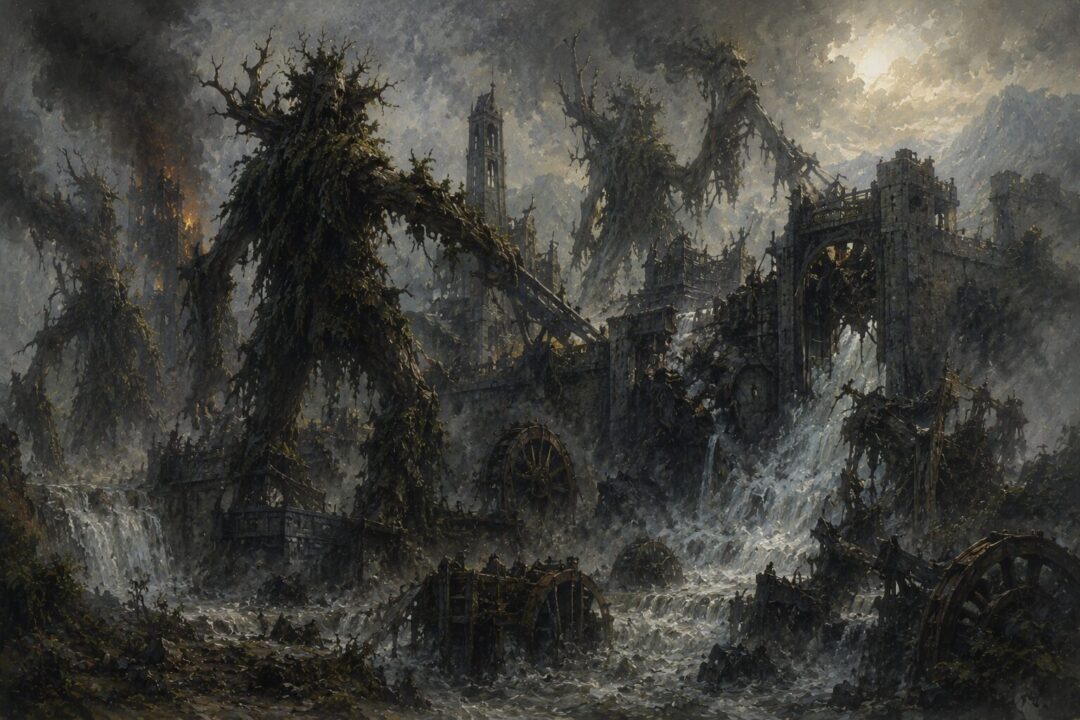
The Forest Remembers What the Powerful Forget
Saruman’s mistake is not only that he attacks trees. It is that he assumes they do not matter except as resources. The Hobbits’ early mistake in the Old Forest is smaller but related: they assume the landscape is something to pass through.
Again and again, Middle-earth corrects that assumption. Places remember. Stones remember. Trees remember most of all.
When Tolkien’s trees move, they carry the past into the present. Old wrongs stop being background. The forest steps out of myth and into history. That is why the March of the Ents feels both triumphant and frightening. It is not merely the arrival of unexpected allies. It is the arrival of a world that has endured enough.
And when roots become feet, branches become arms, and the dark wood closes behind an army, the deepest fear is not that nature has become unnatural.
It is that nature has finally become answerable.
Sources & Notes
- https://tolkiengateway.net/wiki/Old_Man_Willow — documents the hostile tree of the Old Forest, his power over the surrounding woods, and the hobbits trapped or nearly drowned by him.
- https://tolkiengateway.net/wiki/Ents — background on the Shepherds of the Trees, their origin, their slow deliberation, and their march against Isengard.
- https://tolkiengateway.net/wiki/Huorns — explains the ambiguous, dangerous trees of Fangorn that can move and become especially terrifying when roused.
- https://tolkiengateway.net/wiki/Yavanna — supports the mythic origin of tree-shepherds through Yavanna’s concern that growing things would be harmed by other makers.
Sources cover Old Man Willow, Ents, Huorns, and Yavanna’s role in the origin of tree-shepherds.