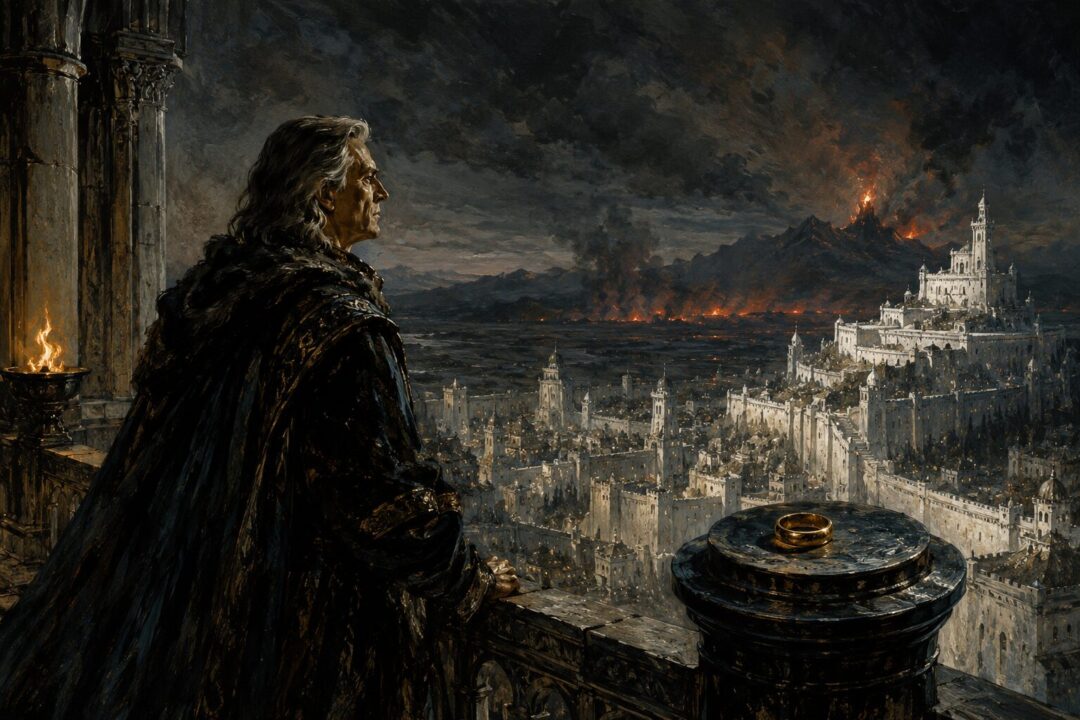
The White City endured siege after siege. Its walls stood against armies, its people carried memories of Númenor, and its Steward remained at his post long after the line of kings had failed. Yet the greatest danger to Gondor was never simply the strength of Mordor. It was the temptation to answer overwhelming power with a greater power still.
Few moments in The Lord of the Rings reveal this more clearly than Denethor’s reaction to the One Ring. Unlike Boromir, he never physically reaches for it. Unlike Gollum, he never possesses it. Yet when Gandalf speaks with him in Minas Tirith, Denethor reveals exactly how he thinks the Ring should have been used—and why Gandalf quietly recognizes that such a future would have ended in catastrophe.
The tragedy is not that Denethor desired evil for its own sake. It is that he believed he alone could master evil without becoming its servant.
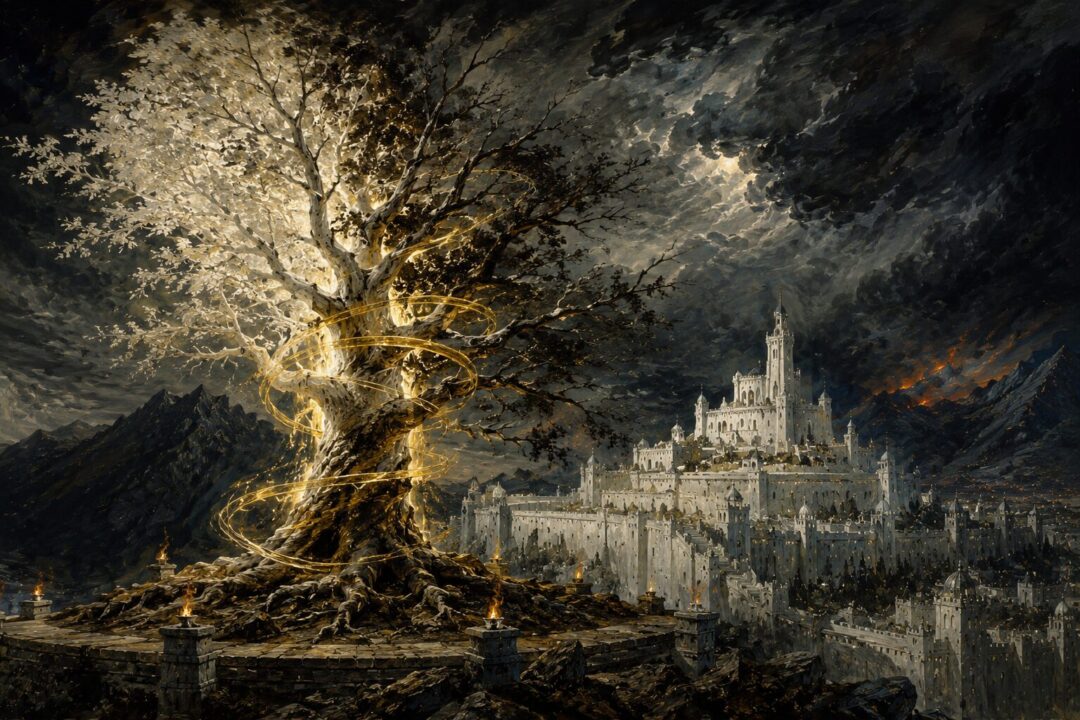
Denethor Was Stronger Than Many Readers Remember
It is easy to remember Denethor only at the end of his story, broken by despair and preparing his own funeral pyre. But the texts consistently describe him as a formidable ruler.
He was proud, intelligent, perceptive, and exceptionally strong-willed. Gandalf himself warns Pippin that Denethor is a man of great lineage and power, not merely an aging official. He successfully governed Gondor for decades while facing the growing threat of Mordor.
He also dared to use the palantír of Minas Tirith.
That decision alone reveals both his remarkable strength and his greatest weakness. Sauron never truly dominated Denethor's mind through the Seeing-stone. Instead, he overwhelmed him by showing carefully selected truths. Denethor saw the immense military strength gathering against Gondor but lacked the wider perspective to understand that hope still existed beyond what the stone revealed. The result was despair rather than direct enslavement.
This distinction matters because it shows Denethor was not a weak man. He was precisely the sort of powerful leader whom the Ring found especially dangerous.
Denethor Already Believed He Could Judge the Ring Better Than Others
One of Denethor's most revealing conversations comes after Faramir returns from Ithilien without bringing the Ring to Minas Tirith.
Denethor does not accuse Faramir of cowardice. Instead, he argues that such a weapon should have been secured.
He explains that the Ring ought to have been hidden and preserved until "the uttermost end of need," only then to be used if final victory demanded it.
Wisdom from The Lord of the Rings
At first glance, this sounds almost reasonable.
He is not proposing immediate conquest.
He is not suggesting reckless experimentation.
He even speaks of restraint.
Yet this is precisely how the Ring deceives its victims.
Its temptation rarely begins with promises of tyranny. It begins by convincing good people that they alone possess sufficient wisdom to decide when extraordinary power becomes necessary.
The crucial flaw is already present in Denethor's reasoning. He assumes there exists a future moment when using the Ring would remain under his control.
The entire history of the Ring argues the opposite.
The Ring Was Never Simply a Weapon
One of the easiest mistakes within Middle-earth is to imagine the One Ring as an especially powerful artifact that can be used wisely by sufficiently disciplined people.
The narrative consistently rejects that idea.
Even Gandalf refuses to touch it.
Galadriel rejects it despite understanding its power better than almost anyone alive.
Elrond refuses every suggestion that it be used against Sauron.
Their concern is not merely that someone might misuse the Ring.
Their concern is that the Ring changes the person who attempts to use it.
It works upon ambition, fear, duty, mercy, and justice alike. Gandalf admits that if he accepted it, his desire to do good would become the very path through which the Ring corrupted him.
The Tolkien Forum
Denethor's motives would have made him especially vulnerable.
He wanted to save Gondor.
He wanted to preserve his people.
He wanted to prevent the destruction of everything entrusted to his care.
Those are exactly the kinds of noble intentions the Ring twists into domination.
Gondor's Military Success Would Have Become Its Greatest Defeat
Suppose, for a moment, that the Ring had reached Minas Tirith.
Would Denethor immediately have become another Sauron?
The texts never explicitly describe such a sequence, so certainty is impossible.
But they strongly suggest a different, slower disaster.
Denethor would almost certainly have attempted to wield the Ring as a strategic advantage against Mordor.
His confidence in military planning, political authority, and personal judgment would have encouraged exactly that course.
Initially, Gondor might even appear stronger.
Morale could rise.
Enemies might hesitate.
The Steward himself might seem more commanding than ever.
This is one of the Ring's deepest deceptions.
Power gained through it often appears successful before its true cost becomes visible.
The longer Denethor relied upon it, the more absolute his authority would likely become. Every disagreement could be interpreted as weakness. Every delay could appear as betrayal. Every sacrifice would become justified by the promise of ultimate victory.
Victory itself would gradually cease being enough.
Security would require control.
Control would require obedience.
Obedience would require fear.
The defense of Gondor would slowly become indistinguishable from domination.
That progression follows the moral pattern repeatedly demonstrated throughout the story, even if Tolkien never describes this specific hypothetical in detail.
Sauron Would Not Have Needed to Defeat Denethor Quickly
Another common assumption is that Denethor could simply overpower Sauron using the Ring.
The texts suggest the situation would have been far more complicated.
The Ring contains much of Sauron's native power.
It remains fundamentally linked to him.
While exceptionally great individuals might eventually challenge Sauron through the Ring, the process would not leave them unchanged. Gandalf fears precisely this possibility—that victory achieved through the Ring would merely replace one Dark Lord with another.

The Tolkien Forum
Denethor stands far below Gandalf in native spiritual stature.
He is a mighty Man, but still a mortal ruler.
If even Gandalf refuses the risk, Denethor's confidence becomes all the more tragic.
Sauron would not necessarily need to seize the Ring immediately.
Time itself would become his ally.
Every decision Denethor made while relying upon the Ring would draw him further into its corruption.
The Palantír Shows Why Denethor Was Already Vulnerable
Denethor's experience with the Seeing-stone provides perhaps the clearest preview of what would happen.
He possessed genuine courage.
He possessed remarkable intelligence.
He even possessed sufficient strength to resist direct domination.
Yet he still lost the larger battle.
By seeing only selected truths, he reached disastrously false conclusions.
He abandoned hope before Gondor was truly defeated.
He mistook incomplete knowledge for complete understanding.
The Ring magnifies precisely this weakness.
Its promises reinforce the bearer's own certainty.
A ruler already convinced of his exceptional judgment would become even less willing to question himself.
The Ring would not need to invent new flaws.
It would enlarge those already present.
Faramir Reveals the Path Denethor Could Not See
One of the most painful ironies is that Denethor's own son demonstrates the wisdom his father lacks.
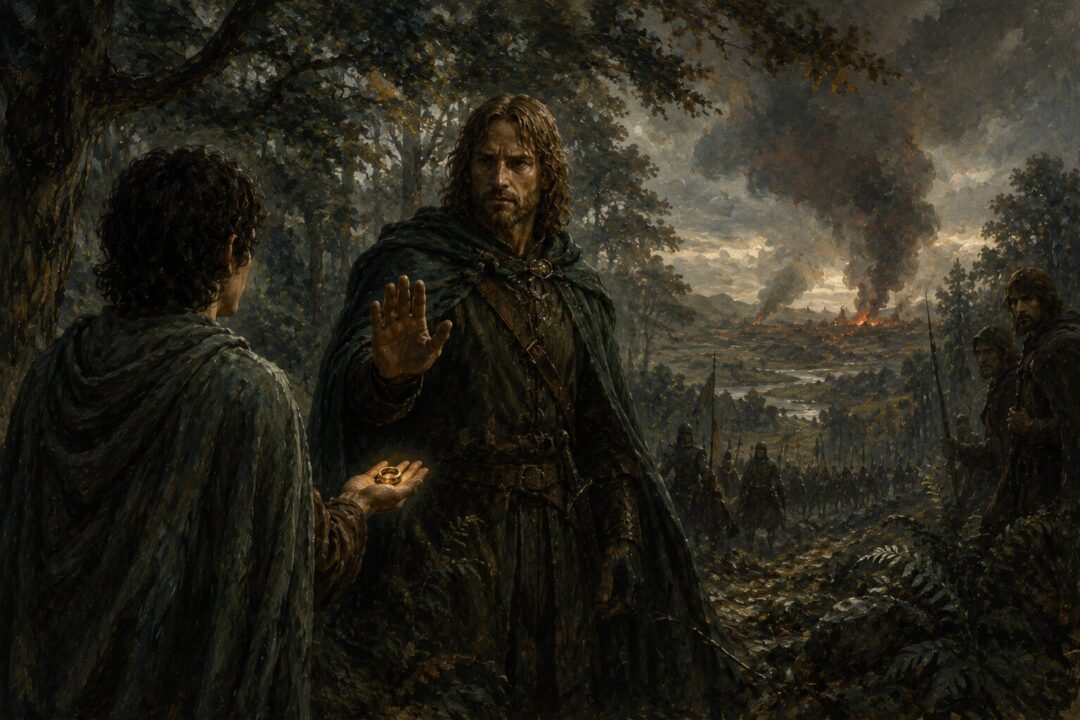
When Faramir encounters Frodo and Sam in Ithilien, he refuses even to take the Ring after learning what it truly is.
His famous declaration that he would not seize such a weapon, even if it lay beside the road, reflects more than humility.
It shows an understanding of power itself.
Faramir recognizes that some victories destroy the victor.
Denethor interprets this restraint as weakness.
In reality, the narrative consistently presents it as strength.
This contrast reaches beyond family disagreement.
It illustrates two entirely different visions of leadership.
Denethor believes survival requires greater power.
Faramir believes some powers cannot be used without destroying what they are meant to protect.
The story ultimately vindicates Faramir's judgment.
Why Gandalf Was Relieved the Ring Never Came to Minas Tirith
Gandalf never argues that Denethor lacks courage.
He never claims the Steward is unintelligent.
Instead, he recognizes something subtler.
Denethor already thinks he understands the limits of the Ring.
That confidence is itself evidence that he does not.
Those who most clearly perceive the Ring's danger consistently refuse to possess it.
Those who imagine themselves capable of mastering it have already begun to fall into its logic.
Denethor's conversation reveals that, had Boromir succeeded in bringing the Ring to Gondor, the Steward would almost certainly have regarded it as the salvation of the realm rather than its greatest peril.
From that moment onward, Gondor's fate would have been sealed—not necessarily by immediate conquest, but by slow moral collapse.
Gondor Could Have Won the War and Lost Everything
The deepest tragedy lies in what Denethor truly desired.
He did not seek endless conquest.
He wanted Minas Tirith preserved.
He wanted his people protected.
He wanted to hand Gondor intact to his heirs.
Yet the One Ring never allows its bearer to preserve the world exactly as it is.
Its power always demands more.
More authority.
More certainty.
More control.
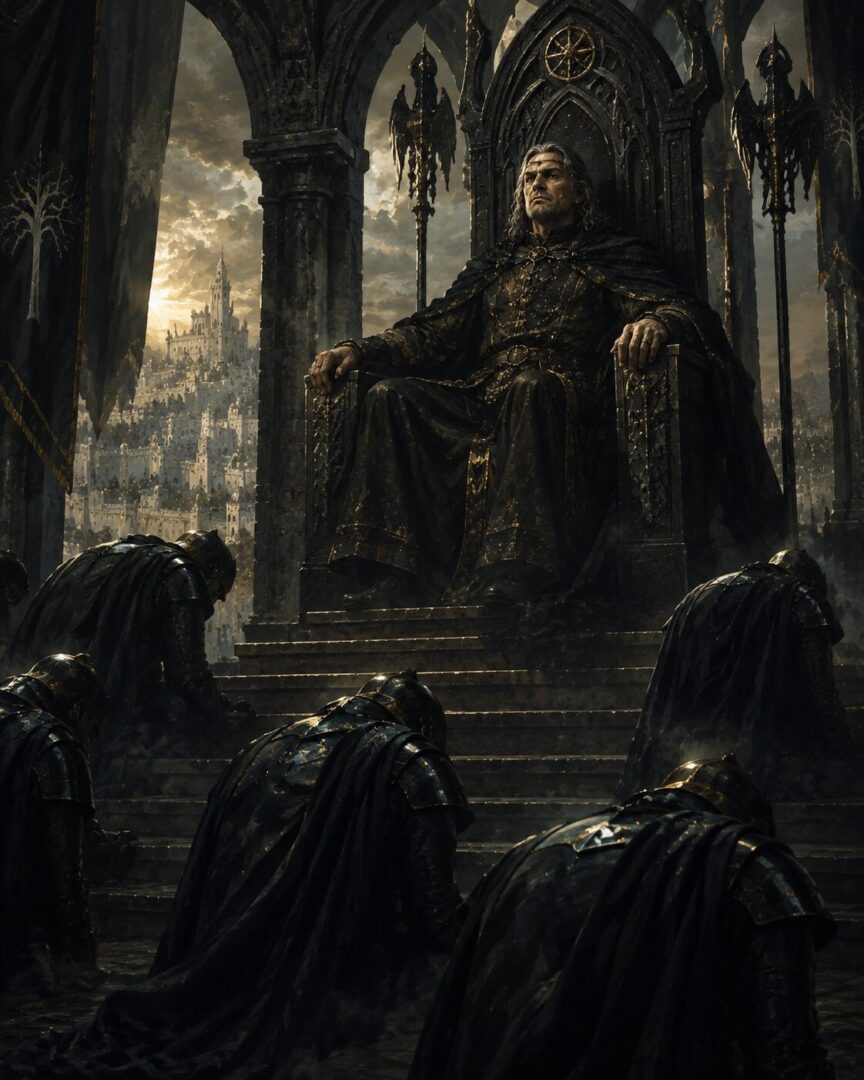
By the end, Gondor might still possess towering walls, disciplined armies, and an unchallenged ruler.
But it would no longer be the kingdom Denethor hoped to save.
The Free Peoples did not triumph because they found someone worthy enough to wield the Ring better than Sauron. They prevailed because, despite every military disadvantage, they rejected the belief that evil could be permanently defeated by mastering its own instrument.
Denethor never fully understood that lesson.
And had the One Ring reached his hands, Gondor might have survived in name—but the realm its Steward loved would almost certainly have been lost long before the last battle ended.
Sources & Notes
- Tolkien Gateway, “Denethor II” — summarizes Denethor’s rule as Steward, his pride and strength of will, his use of the Anor-stone, his despair, and his hostile response to Faramir’s refusal to bring the Ring to Minas Tirith. https://tolkiengateway.net/wiki/Denethor_II
- Tolkien Gateway, “One Ring” — outlines the Ring’s corrupting influence, its relationship to Sauron’s power, and the danger that even well-intentioned bearers could be turned by attempting to use it. https://tolkiengateway.net/wiki/One_Ring
- Tolkien Gateway, “Palantíri” — explains the Seeing-stones, Denethor’s use of the palantír of Minas Tirith, and how Sauron could manipulate what Denethor saw without simply seizing direct control. https://tolkiengateway.net/wiki/Palant%C3%ADri
- Tolkien Gateway, “The Pyre of Denethor” — summarizes the chapter in which Denethor’s despair and final rejection of hope culminate, supporting the article’s argument that the Ring in his keeping would have magnified Gondor’s crisis. https://tolkiengateway.net/wiki/The_Pyre_of_Denethor
Sources selected for Denethor’s character and Ring judgment, the Ring’s corrupting nature, the palantír’s role in his despair, and the chapter where that despair culminates.