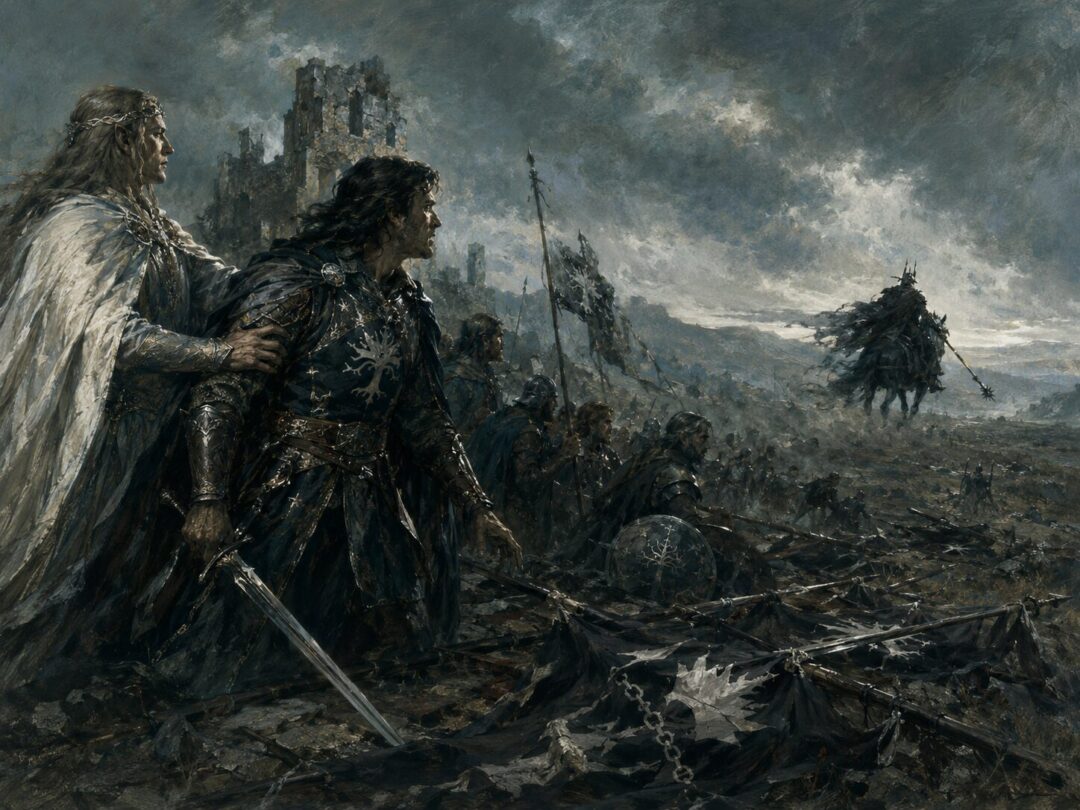
It is easy to think of the Witch-king as simply the strongest of the Nazgûl.
That is the simple version.
Nine mortal men receive Nine Rings. They fall under Sauron’s power. They become Ringwraiths. One of them becomes their leader. So the Witch-king must be the highest-ranking, most dangerous, most powerful version of the same thing.
That is true as far as it goes.
But it does not go far enough.
The Witch-king is not frightening only because he is stronger than the others. He is frightening because the story gives him a history, a function, and a weight that the other Nazgûl do not receive in the same way.
He is not merely a servant of Sauron.
He is Sauron’s long memory made active in the world.
He is the ruin of Arnor.
He is the shadow behind Minas Morgul.
He is the terror at the Gate of Minas Tirith.
And in the end, he is the enemy whose fall requires a very precise meeting of prophecy, courage, mercy, and old wounds from the North.
That is why his death matters so much.
Not because a stronger monster is finally beaten.
Because an ancient pattern of domination is finally broken.
The Nazgûl Were Not All Given the Same Story
The Nazgûl are often treated as a single group, and in many scenes that is exactly how they work.
They ride together.
They hunt together.
They spread fear together.
They are bound to the Nine Rings and through them to Sauron.
The texts tell us very little about who most of them were before they became Ringwraiths. We are told that the Nine Rings were given to mortal Men, and that those who used them became mighty in their day: kings, sorcerers, and warriors of old. But most of their names, homelands, and histories are left in darkness.
That silence is part of their horror.
They have become less like individual men and more like extensions of a will greater than their own.
But the Witch-king is different.
He also begins in that same darkness. His original name is never revealed in The Lord of the Rings. The text does not give us a personal biography of the man he once was. It does not tell us his family, his kingdom, or the exact moment of his fall.
And yet, after his fall, he receives something the others mostly do not.
A public history.
He becomes a ruler.
He becomes a war-leader.
He becomes a remembered terror in the records of the West.
The other Nazgûl are often frightening because they are nameless.
The Witch-king is frightening because he is named by the damage he leaves behind.
Angmar Was Not Just a Lair
The title “Witch-king of Angmar” is not just a dramatic nickname.
It points to one of the most important parts of his role in the Third Age.
Angmar was not merely a fortress where a wraith hid. It was a northern realm raised in opposition to the divided kingdoms of the Dúnedain. Its power grew while Arnor was already weakened by internal division. That timing matters.
The Witch-king did not simply charge at a united kingdom and overpower it in one stroke.
He exploited fracture.
The northern kingdom of Arnor had been divided into Arthedain, Cardolan, and Rhudaur. The Witch-king’s wars against them were long, patient, and destructive. Through Angmar, Sauron’s servant helped bring ruin to the North-kingdom of the Dúnedain.
This is what makes him more than a battlefield villain.
He is not just a creature of terror.
He is a political weapon.
He rules through fear. He gathers evil forces. He presses against weakened borders. He turns division into collapse.
In that sense, Angmar shows us what the Witch-king really is.
He is not merely stronger than the other Nazgûl.
He is a wraith who can be used to unmake kingdoms.
The Prophecy at Fornost
The fall of Angmar does not end the Witch-king.
After the Battle of Fornost, when the forces of the West defeat Angmar, the Witch-king flees. Eärnur of Gondor wants to pursue him, but Glorfindel stops him and speaks the famous warning: far off is his doom, and not by the hand of man will he fall.
This line is often remembered because of Éowyn.
And rightly so.
But before it becomes part of Éowyn’s victory, it tells us something else about the Witch-king’s place in the story.
His defeat in the North is not final.
Angmar is broken, but the power behind it is not. The Witch-king escapes the ruin of his own realm, and the text marks his future with a strange kind of doom. He is not simply another enemy commander who survives a battle.
He carries unfinished history with him.
That is one reason the prophecy matters. It is not a cheap riddle waiting for a clever solution. It creates a shadow over everything that follows. The Witch-king has been driven out of the North, but his end lies elsewhere, in another war, under different conditions.
The North has suffered him.
But the South will meet him too.
Minas Morgul and the War Against Gondor
After Angmar, the Witch-king’s story turns toward Gondor.
Minas Ithil, the Tower of the Moon, falls to the Nazgûl and becomes Minas Morgul. This is not just a change of ownership. It is a symbolic wound in Gondor’s eastern defense, a corruption of a place that once belonged to the realm of Isildur’s heirs.
From there, the Lord of the Nazgûl becomes tied to Gondor’s long decline.
His role in the fate of King Eärnur is especially important. Eärnur had already faced the Witch-king in the aftermath of the northern war. Later, as King of Gondor, he is challenged by the Lord of Minas Morgul. The first challenge is refused under counsel. The second is accepted. Eärnur rides to Minas Morgul and never returns.
The texts do not describe exactly what happened to him.
That restraint makes the moment worse.
There is no heroic last stand. No recovered body. No clear closure. Gondor’s last king simply disappears into the shadow of the city that the Nazgûl have taken.
After that, the Stewards rule Gondor.
This does not mean the Witch-king single-handedly “ends Gondor’s kings” in a simple mechanical sense. The history is more careful than that. But his challenge to Eärnur is directly tied to the disappearance of the last king of Gondor before Aragorn’s return.
That is not the work of an ordinary monster.
That is the work of a servant whose victories echo through centuries.
The Black Captain
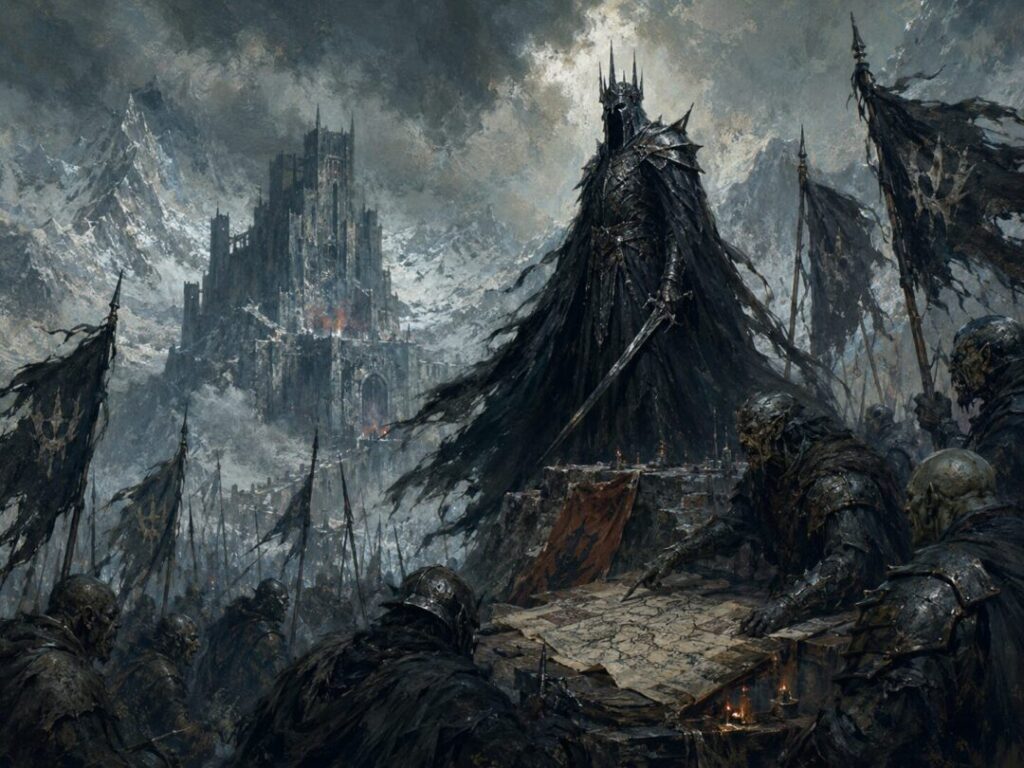
By the War of the Ring, the Witch-king appears not only as the Lord of the Nazgûl but as the Black Captain.
That title matters.
At Minas Tirith, he is not simply hunting the Ring-bearer as he did earlier in the story. He is commanding Sauron’s assault on the city. His terror is not private now. It is organized, directed, and set loose on a battlefield.
The siege of Minas Tirith shows the Witch-king at the height of his narrative power.
He leads the forces from Minas Morgul.
He breaks the will of defenders through fear.
He comes to the Great Gate after Grond has shattered it.
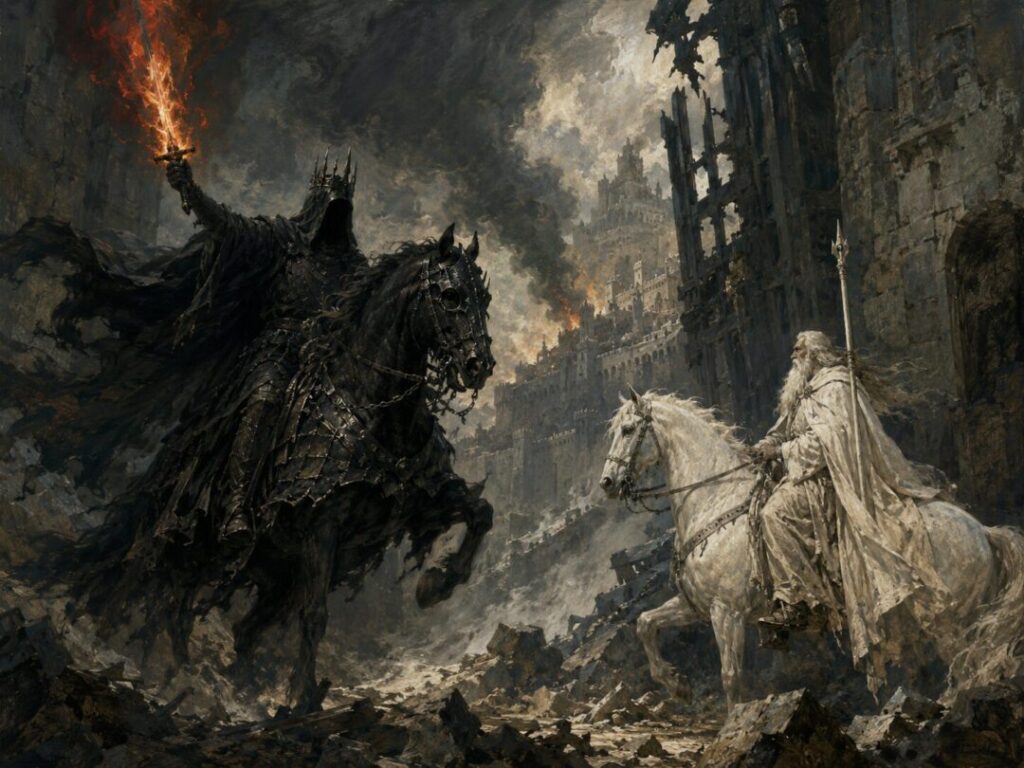
And in that moment, he confronts Gandalf.
The scene is not written like a normal duel.
It is written like the meeting of two powers at a threshold.
Gandalf forbids him to enter. The Witch-king answers with threat and terror. His sword burns with flame. The men have fled. Only Gandalf and Shadowfax remain unmoved before him.
The story never gives us a completed fight between them, because the horns of Rohan sound at that moment. The Witch-king turns away to meet the new crisis on the field.
That interruption is important.
The question is not simply “Who would win?”
The deeper point is that the Witch-king has become the living pressure of Sauron’s assault. At the Gate, he is more than himself. He has been sent, empowered, and aimed.
He is Sauron’s captain at the moment Gondor is closest to breaking.
Why Fear Is His Real Weapon
The Witch-king’s greatest weapon is not only physical strength.
It is terror.
This is true of all the Nazgûl, but it is especially concentrated in him. The Nazgûl do not simply kill bodies. They weaken courage. They cloud judgment. They make resistance feel hopeless before the sword even falls.
The Witch-king embodies this more fully than the others because his terror is historical.
For the Dúnedain, he is not a new enemy.
He is an old one returning.
He has already helped destroy the North-kingdom. He has already been bound up with the loss of Gondor’s last king. He now comes against Minas Tirith as the captain of the army that means to finish what long centuries of decline began.
This is why his presence at the Pelennor is so heavy.
He is not merely dangerous because he can kill.
He is dangerous because he makes despair seem reasonable.
That is Sauron’s deeper strategy everywhere in The Lord of the Rings. He does not need every enemy to be slain at once. He needs them to believe resistance is useless. The Witch-king is one of the clearest instruments of that strategy.
He is a commander of despair.
Éowyn, Merry, and the Breaking of the Pattern
The Witch-king’s fall is often reduced to a loophole.
“No man can kill him.”
Éowyn is a woman.
Merry is a hobbit.
Therefore, the prophecy is fulfilled.
But that is too thin.
The scene on the Pelennor is much richer than a technicality.
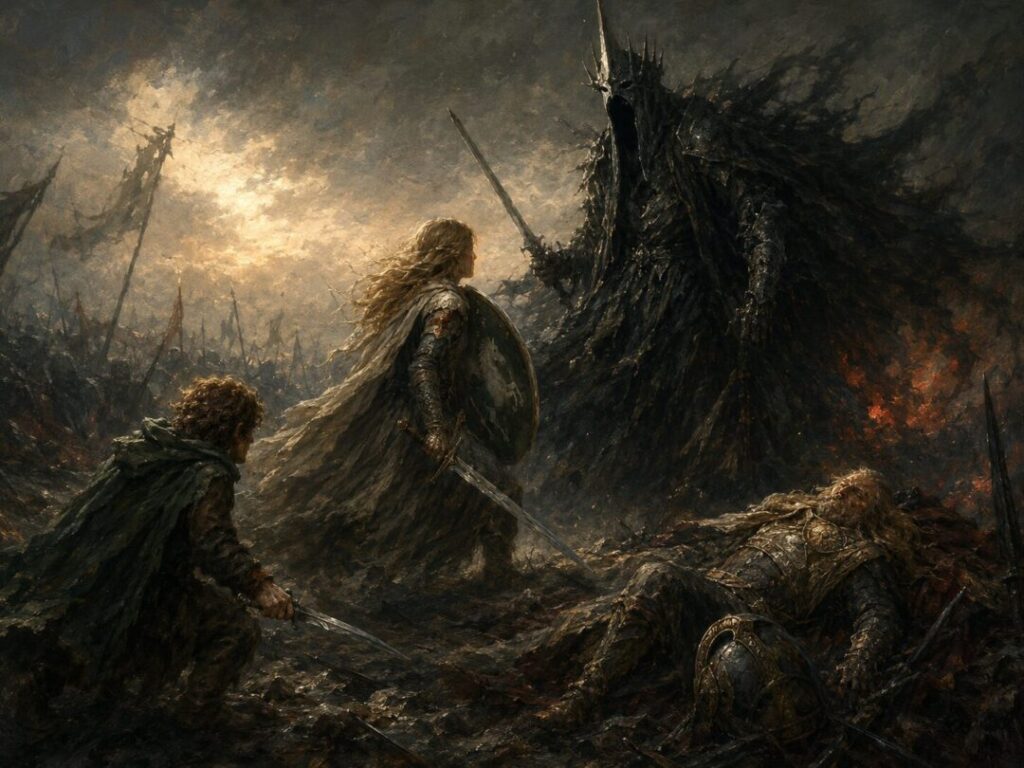
Éowyn stands against him not because she has calculated a prophecy, but because Théoden lies fallen and because she refuses to abandon him. Merry strikes not because he imagines himself a great warrior, but because pity, loyalty, and courage move him in the moment.
And Merry’s blade is not random.
It comes from the Barrow-downs, from the old wars of the North. It was made by enemies of Angmar. When Merry wounds the Witch-king, the ancient conflict that began in the North suddenly returns to the field before Minas Tirith.
That is one of the most elegant pieces of history in the whole story.
The Witch-king, destroyer of Arnor, is undone in part by a blade from the world he helped ruin.
Then Éowyn strikes the final blow.
So his death is not merely about gender. It is not merely about prophecy. It is not merely about surprise.
It is about the convergence of everything he underestimated.
A woman he dismisses.
A hobbit he barely regards.
A forgotten blade from a broken kingdom.
A moment of loyalty stronger than fear.
The Witch-king falls because the small and the disregarded stand where the proud and terrible expect only despair.
More Than a Stronger Nazgûl
So why was the Witch-king more than a stronger Nazgûl?
Because strength alone does not explain him.
His importance comes from role.
He is the chief of the Ringwraiths, but also more than their captain. He is the ruler of Angmar, the enemy of Arnor, the Lord of Minas Morgul, the Black Captain at Minas Tirith, and the figure through whom Sauron’s long war against the kingdoms of the Dúnedain becomes personal.
He is not given a private identity, but he is given a public legacy.
That legacy is ruin.
And this is why his end feels so satisfying. The Witch-king is not defeated by a greater king, or by a matching sorcerer, or by a warrior who meets him on his own terms. He is defeated by people outside the categories he trusts.
Not by the hand of man.
Not by the logic of domination.
Not by the terror he has spent centuries perfecting.
His power is real.
But it is not ultimate.
The Witch-king is more than a stronger Nazgûl because he represents Sauron’s power turned into history: kingdoms broken, courage poisoned, hope delayed until it seems almost foolish.
And his fall matters because it shows that even such a history can be answered.
Not easily.
Not without grief.
Not without death.
But answered.
On the Pelennor Fields, the old terror of Angmar meets the courage of those he never thought worth fearing.
And that is why he does not rise again.