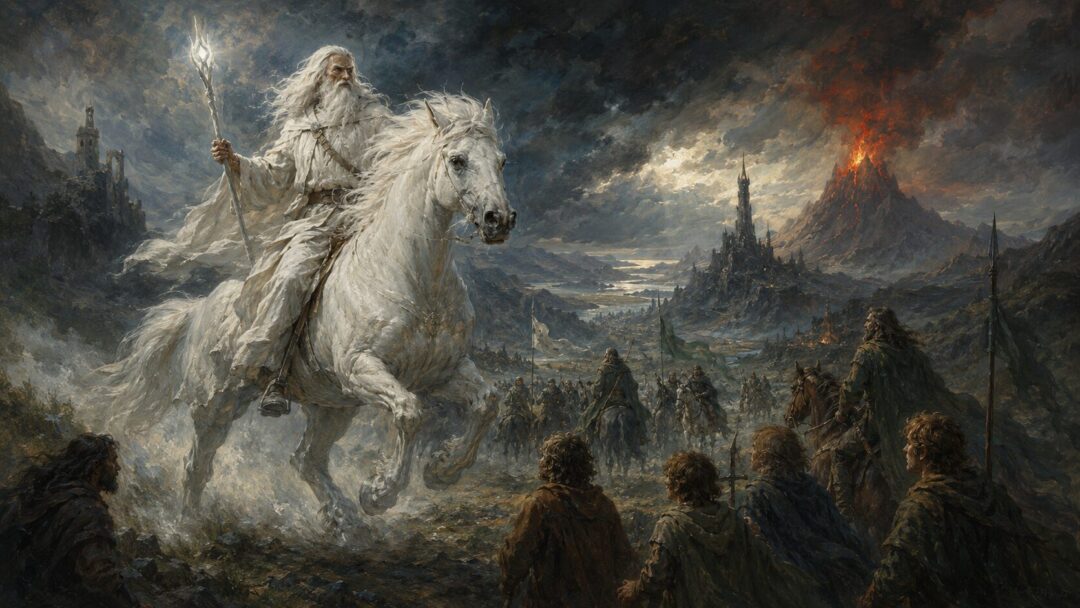
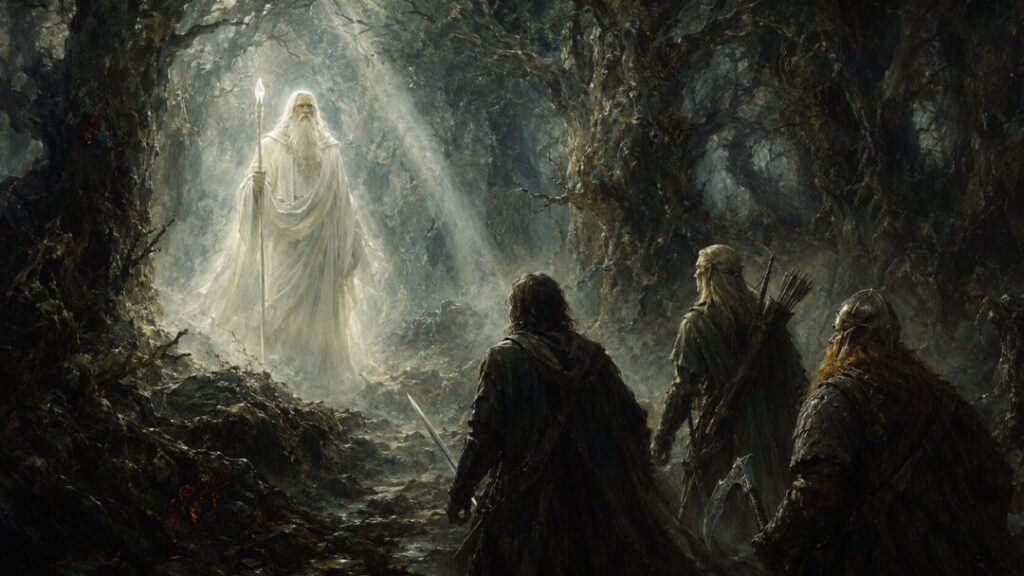
When Gandalf returns in Fangorn Forest, the moment feels almost impossible.
Aragorn, Legolas, and Gimli have followed strange signs through the trees. They expect danger. They fear Saruman. Instead, they meet a figure robed in white, shining with a power that seems to belong beyond the ordinary world.
For a moment, even his friends do not know him.
Then the truth is revealed.
Gandalf has returned.
Not as the Grey Pilgrim who fell in Moria, but as Gandalf the White.
It is one of the great transformations in The Lord of the Rings. The old wanderer is changed. His authority is greater. His presence is brighter. His words carry a force they did not carry before.
But that transformation is often misunderstood.
Gandalf the White is not simply Gandalf the Grey with stronger magic.
He is not invincible.
And the reason matters deeply to the way Middle-earth works.
The White Robes Mean Authority, Not Omnipotence
The first mistake is to read Gandalf’s whiteness as a fantasy power level.
White does signal a change. Gandalf himself says that he is Saruman as Saruman should have been. In other words, he has taken the place Saruman abandoned when he turned from wisdom to domination.
That matters.
Saruman had been the head of the Order of Wizards. He was the White. He was meant to guide resistance against Sauron. But Saruman failed because he began to desire mastery for himself. He wanted knowledge, control, machines, armies, and eventually the Ring.
So when Gandalf returns in white, the change is not just cosmetic.
It is a sign of rightful authority replacing corrupted authority.
But authority is not the same thing as unlimited power.
Gandalf does not come back with permission to rule Middle-earth. He does not become a king, a god, or a weapon to be aimed at Mordor. He is still Gandalf: a messenger, a guide, and a steward of a task larger than himself.
His robes show that his role has changed.
They do not remove the rules of that role.
The Wizards Were Never Sent to Conquer
To understand Gandalf’s limits, we have to remember what the Wizards were.
The Istari were not ordinary old men. They were beings sent into Middle-earth to oppose Sauron. Yet they were sent in humble forms, subject to weariness, fear, pain, and the slow experience of life in the world.
That is crucial.
Their mission was not to dominate Sauron by becoming a rival Dark Lord. They were meant to advise, encourage, awaken, and unite those who still had the will to resist evil.
This is why Gandalf’s greatest victories often look indirect.
He does not defeat Smaug himself. He helps set events in motion.
He does not take the Ring to Mordor. He guides the one who must bear it.
He does not crown himself ruler in Gondor. He prepares the way for the rightful king.
He does not enslave minds to obedience. He calls people back to courage.
That pattern does not disappear when he becomes the White.
If anything, it becomes sharper.
Gandalf the White has more authority because the crisis is greater. But his task remains the same: to help Middle-earth resist Sauron without becoming Sauron’s mirror.
His Power Is Real — But Still Veiled
None of this means Gandalf the White is weak.
The text makes clear that he is far more formidable after his return. In Fangorn, he is beyond the power of Aragorn, Legolas, and Gimli to harm. At Edoras, he breaks Saruman’s hold over Théoden. Later, he confronts Saruman directly and casts him from the Order, breaking his staff.
These are not small acts.
Gandalf the White is dangerous to the servants of darkness. He carries a spiritual authority that lesser powers cannot easily withstand. Even the Nazgûl are not beyond fear of him.
But the important word is veiled.
Gandalf’s power is not constantly displayed in overwhelming form. He does not walk through battle like an unstoppable flame. He still rides roads, gives counsel, makes choices, and arrives where he is needed. His greatness appears in flashes, especially when the need is urgent.
That restraint is not weakness.
It is part of his nature in Middle-earth.
He is mighty, but he is not meant to reveal himself as a being of unveiled majesty. If he did, he would cease to be what he was sent to be. He would no longer persuade the Free Peoples into courage. He would overshadow them.
And that would be a different kind of failure.
The Balrog Proves the Cost of Power
The clearest proof that Gandalf is not invincible comes before he becomes the White.
In Moria, he faces Durin’s Bane, a Balrog of Morgoth. This is not a symbolic contest. It is a real battle between ancient powers.
Gandalf wins.
But he dies.
That point should not be softened.
He does not defeat the Balrog casually. He pursues it from the depths beneath Moria to the peak of Zirakzigil. Their battle is terrible. At the end, the Balrog is thrown down, and Gandalf’s body also fails.
His victory costs him his life.
When he returns, it is not because he was secretly immortal in a way that made death meaningless. He is sent back. He says he was returned for a brief time, until his task is done.
That sentence carries the whole mystery.
Gandalf the White is not a being who has escaped all limits. He is someone restored for a purpose.
That makes his new power more solemn, not less.
He has already paid the cost of standing between the Quest and ruin. His return is not a reward for personal glory. It is a commission.
He Still Cannot Take the Ring
This may be the most important limit of all.
Gandalf the White still cannot take the One Ring.
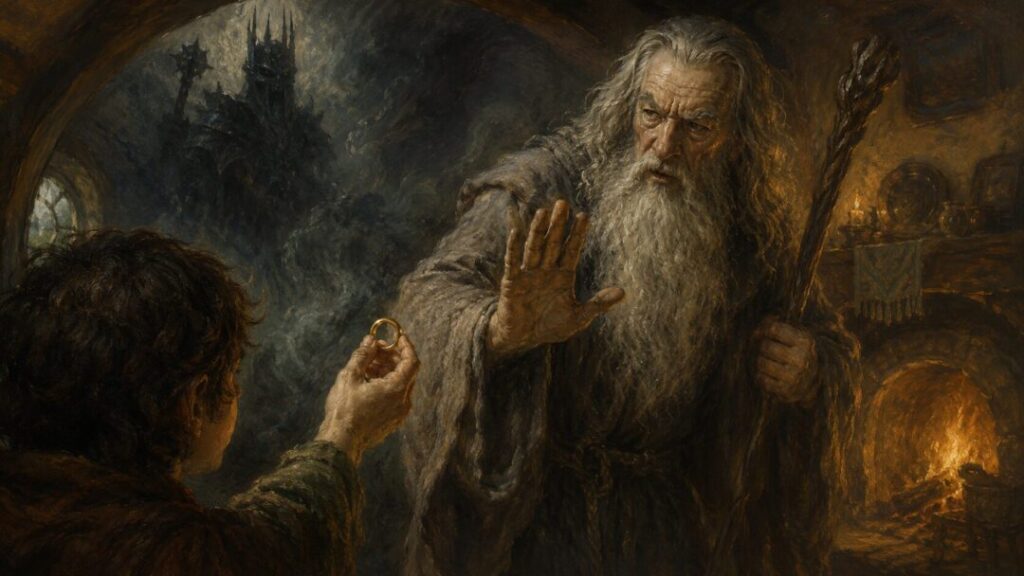
Long before his return, Gandalf refuses the Ring when Frodo offers it to him. His reason is not that he lacks the strength to use it. It is that he would be tempted to use it for good, and through him the Ring would gain a power too terrible to imagine.
That remains true after his return.
Nothing about the white robes makes Gandalf safe from the central danger of the story. The Ring corrupts through the desire to command, order, preserve, and dominate. Gandalf’s wisdom makes him more aware of that danger, not immune to it.
This is one of the most important distinctions in Middle-earth.
Goodness does not mean immunity.
Power does not mean safety.
Wisdom does not mean the absence of temptation.
Gandalf’s greatness lies partly in knowing what he must not do. He understands that if he claimed the Ring, he might begin with pity and justice, but he would end as a tyrant.
The White Rider can face many enemies.
He cannot make himself the master of the Ring and remain himself.
Why He Does Not Simply Destroy Sauron
This leads to the famous question.
If Gandalf the White is so powerful, why not go directly against Sauron?
The answer is that Sauron cannot be defeated in the necessary way by a contest of raw strength. His power is bound to the Ring. As long as the Ring endures, the central problem remains.
Even a military victory would not solve the deepest danger.
And Gandalf’s own mission forbids him from becoming the ruler of the resistance through force and fear. He is not sent to replace the choices of Elves, Men, Dwarves, and Hobbits. He is sent to strengthen them so they can make those choices themselves.
This is why the story’s hope rests on something Sauron barely understands.
Not a wizard’s duel.
Not a greater army.
Not a rival throne.
A small bearer, a faithful companion, pity shown to Gollum, and the destruction of the Ring in the place where it was made.
Gandalf’s power matters because it protects that fragile hope long enough for it to reach Mordor.
But he cannot become the hope in its place.
The Witch-king Scene Is Not a Simple Power Contest
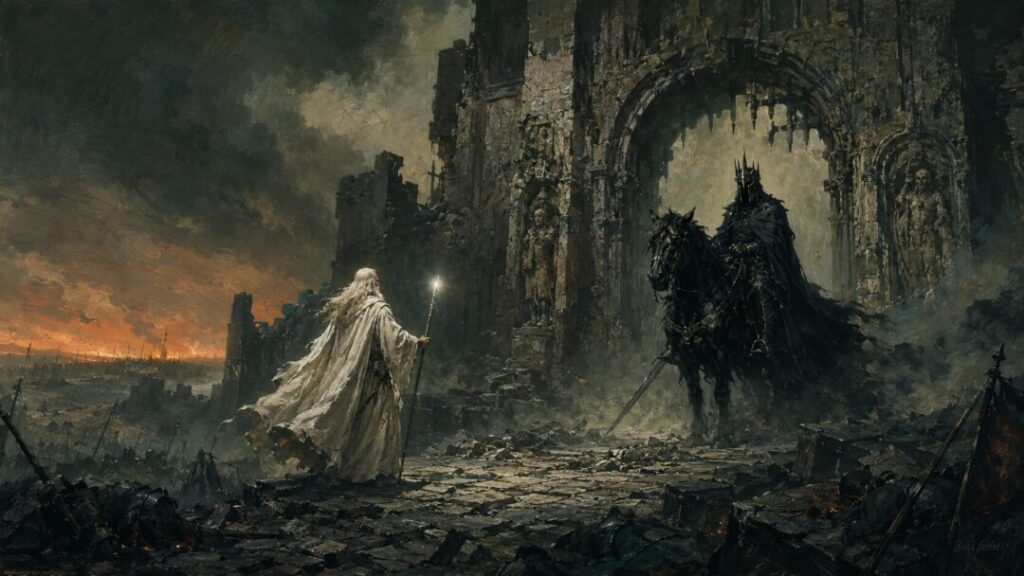
The confrontation at the Gate of Minas Tirith is often remembered as if it proves a clear ranking: Witch-king against Gandalf, darkness against white fire.
But in the book, the moment is interrupted before it becomes a settled duel.
The Lord of the Nazgûl enters the broken gate. Gandalf remains mounted, alone in the entrance. The two face one another. Then the horns of Rohan sound, and the Witch-king turns away to meet the battle on the field.
The text does not give us a clean answer to who would have won.
That silence matters.
Gandalf stands firm. He does not flee. But the scene does not turn him into an invincible champion who simply erases the enemy. The danger is real. The war is still uncertain. Other people must still act.
Théoden must ride.
Éowyn must stand.
Merry must strike.
The fall of the Witch-king does not belong to Gandalf. It belongs to a chain of courage and fate that Sauron’s servants failed to foresee.
That is exactly the kind of victory Gandalf exists to make possible.
Gandalf’s Greatness Is Restraint
The deeper point is that Gandalf’s power is most visible in what he refuses.
He refuses the Ring.
He refuses kingship.
He refuses to dominate the wills of others.
He refuses Saruman’s logic that wisdom entitles the wise to rule.
That is why his whiteness is so different from Saruman’s.
Saruman’s white becomes many-colored because he cannot bear simplicity. He wants to break light apart, possess knowledge, and bend the world to his design.
Gandalf’s white is the opposite.
It is not self-display.
It is service clarified.
He becomes greater by becoming more fully obedient to his mission. His authority increases because he does not turn it inward toward possession.
In a story obsessed with the corruption of power, that restraint is not a side detail.
It is the heart of his character.
The White Rider Is Still a Servant
This is why Gandalf’s return should feel both triumphant and heavy.
He has come back from death, but not to escape suffering.
He has greater power, but not freedom to use it however he wishes.
He has authority over Saruman, but not authority to rule Middle-earth.
He can kindle courage, but he cannot choose courage for others.
His white robes do not make him invincible because invincibility is not what Middle-earth needs.
If Gandalf had returned as an unstoppable force, the moral structure of the story would collapse. The War of the Ring would become a contest between superior powers. The small, humble, and merciful would become secondary.
But that is not the story being told.
The fate of the world turns on people who are not invincible.
A Hobbit who cannot master the Ring.
A companion who cannot carry the whole burden, but can carry his friend.
A shield-maiden who stands when prophecy seems to forbid victory.
A wizard who is powerful enough to command awe, but wise enough not to seize control.
Gandalf the White is not less impressive because he has limits.
He is greater because he remains faithful inside them.
His robes are not the sign that he can do anything.
They are the sign that he has been sent back to do one thing — and to do it without becoming the very kind of power he was sent to oppose.
Sources & Notes
- J.R.R. Tolkien, Unfinished Tales, “The Istari” — explains that the Wizards were sent to encourage and advise resistance to Sauron, not to dominate Elves and Men by force.
- J.R.R. Tolkien, The Lord of the Rings, Book I, Chapter 2, “The Shadow of the Past” — Gandalf refuses Frodo’s offer of the Ring because power used through him would become terrible and corrupting.
- J.R.R. Tolkien, The Lord of the Rings, Book II, Chapter 5, “The Bridge of Khazad-dûm” — Gandalf’s stand against the Balrog is mighty but costly, showing that his power does not make him untouchable.
- J.R.R. Tolkien, The Lord of the Rings, Book III, Chapter 5, “The White Rider” — Gandalf returns as “Saruman as he should have been,” with greater authority but only for the task appointed to him.
- J.R.R. Tolkien, The Lord of the Rings, Book V, Chapter 4, “The Siege of Gondor” — Gandalf faces the Lord of the Nazgûl at the broken gate, but the scene is interrupted by Rohan rather than resolved as a simple duel.