Everyone asks why Sauron did not guard Mount Doom more carefully.
But that question may already be thinking too much like Sauron.
It assumes the War of the Ring was finally decided by military oversight, by a gap in surveillance, by a failure to secure the one place where the Ring could be destroyed.
On the surface, that seems reasonable. The One Ring was made in the Fire of Orodruin. It could only be unmade there. Sauron knew the mountain. He knew the Ring. He knew, better than anyone in Middle-earth, how much of his own power was bound to it.
So why was the road not sealed beyond all hope?
The deeper answer is not that Sauron was foolish.
It is that he was brilliant inside a world too small.
Sauron understood power with terrifying clarity. He understood fear, domination, ambition, pride, and the hunger to rule. He understood kings. He understood wizards. He understood the temptation of the Ring because the Ring was made out of that temptation.
What he could not understand was mercy.
Not as weakness.
Not as sentiment.
But as a force that could move history.
And that blindness is one of the hidden reasons he lost.
Sauron Expected the Ring to Be Claimed
The central fact of Sauron’s strategy is simple: he expected the Ring to be used.
That does not mean he was unaware that the Ring could be destroyed. The Wise knew it had to be cast into the Fire where it was made, and Sauron was its maker. The issue is more subtle.
Sauron’s imagination was governed by domination.
The Ring existed to rule. It was not merely a treasure. It was not simply a weapon in the ordinary sense. It was the instrument by which Sauron poured out his will to master other wills, especially through the Rings of Power.
To possess such a thing and refuse mastery was almost unthinkable to him.
This is why the final strategy of the West is so strange. The Wise do not try to defeat Sauron by becoming stronger than him. They do not build a rival empire. They do not search for a champion who can wield the Ring cleanly.
They choose destruction.
And even that is not attempted by the mighty.
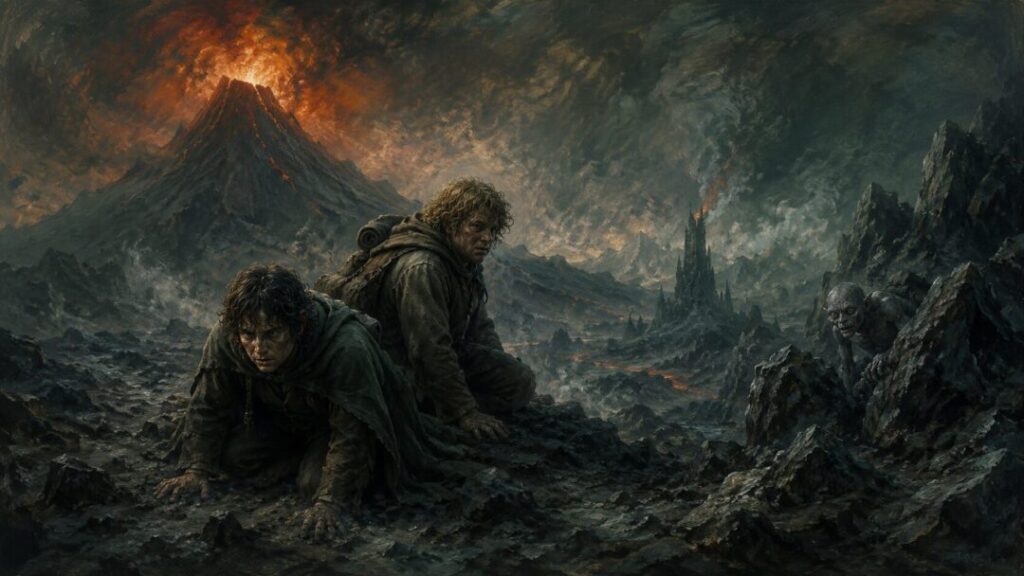
The Ring is entrusted to Frodo, a Hobbit of the Shire, accompanied not by an army but by a fellowship that gradually breaks apart. By the end, only Sam remains with him on the road into Mordor.
From Sauron’s point of view, that kind of plan barely belongs to strategy at all.
The Black Gate Was the Bait Sauron Understood
The march to the Black Gate is often remembered as a last act of courage.
It is that, but it is also a deliberate deception.
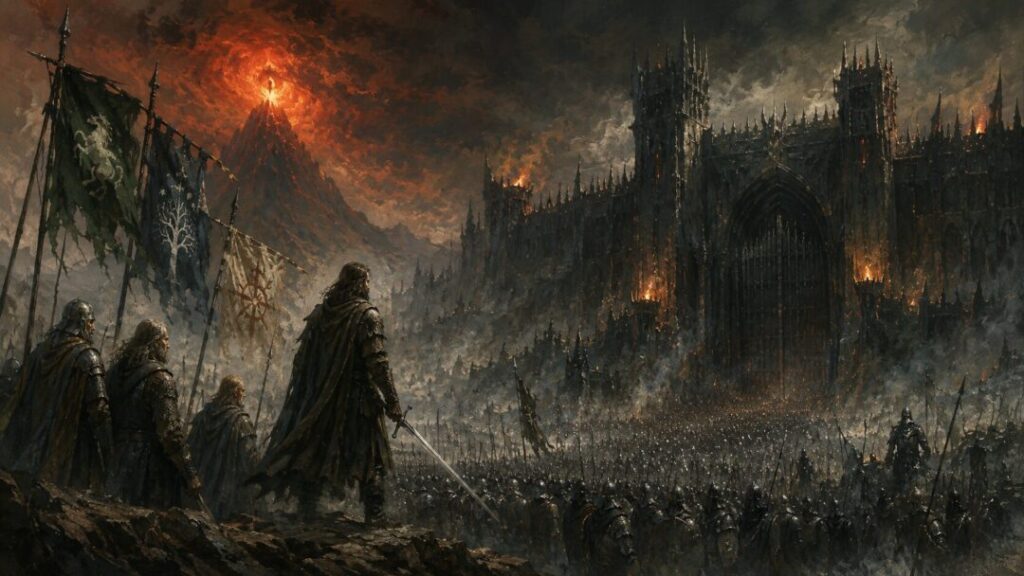
Aragorn has revealed himself through the palantír. He has drawn Sauron’s attention. The Captains of the West then march with a force far too small to conquer Mordor. Their hope is not victory in battle. Their hope is to draw the Eye away from Frodo and Sam.
The plan works because Sauron misreads it.
He sees Aragorn, heir of Isildur, moving toward open confrontation. He sees a leader of Men acting with sudden boldness. He sees the kind of story he already believes in: a rival claimant, perhaps with the Ring, rising too soon.
This is the danger Sauron can understand.
A king with the Ring.
A wizard with the Ring.
A lord of the West trying to become strong enough to challenge the Dark Lord.
That is why the feint has power. It does not make Sauron stupid. It uses his own assumptions against him.
He can imagine someone wanting to overthrow him.
He cannot imagine someone carrying the Ring all the way into his own land in order to give it up.
Mercy Looks Useless Until the End
The true counter-move to Sauron begins much earlier than Mount Doom.
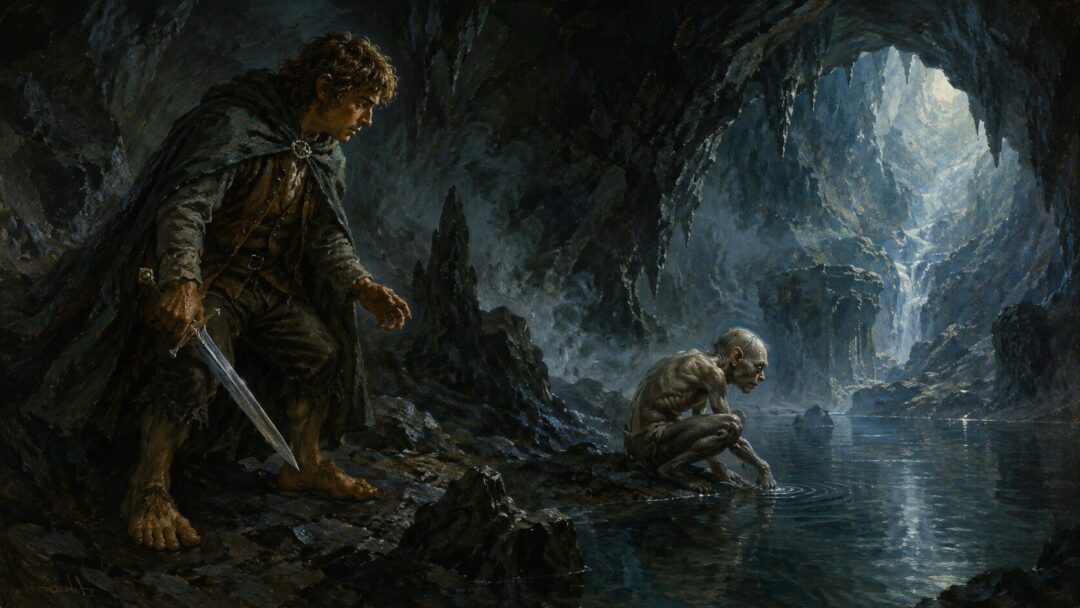
It begins in the dark under the Misty Mountains, when Bilbo has the chance to kill Gollum and does not.
Bilbo does not spare Gollum because he has seen the whole future. He does not know that the creature before him will one day be bound to the fate of the Ring. He simply sees something miserable, lonely, and ruined.
So he withholds his hand.
Later, Gandalf tells Frodo that this pity may rule the fate of many. That is one of the moral hinges of the entire story. At the time, it sounds almost impossible. How could pity for Gollum matter against Sauron?
Then Frodo meets Gollum himself.
Frodo is not naive about him. He knows Gollum is dangerous. He knows the creature is treacherous, obsessed, and bound to the Ring. But Frodo also understands, in a way few others can, what the Ring has done to him.
So Frodo pities him too.
He tames him for a time. He gives him a name again: Sméagol. He allows the possibility, however fragile, that this ruined creature is not only a monster.
That mercy does not “fix” Gollum.
It does not make him safe.
It does not erase his treachery.
It does not prevent the horror at Cirith Ungol.
But it keeps him alive.
And that is enough.
Sauron Could Use Treachery, But Not Pity
Sauron could make use of Gollum’s weakness.
He captured him. He learned from him the names “Shire” and “Baggins.” Gollum’s long possession of the Ring became part of the trail that led Sauron’s servants toward the Hobbits.
In that sense, Sauron did understand Gollum as a tool.
But only in the way he understood all tools: through fear, pain, hunger, and compulsion.
What he did not understand was that Gollum’s continued life might serve a purpose beyond Sauron’s design. He could imagine Gollum betraying. He could imagine Gollum craving. He could imagine Gollum crawling after the Ring until madness consumed him.
He could not imagine that the pity shown to Gollum would place him at the exact point where the Quest, by strength alone, would fail.
That distinction matters.
Sauron’s blindness is not merely tactical. It is moral. He sees weakness and assumes it can only be exploited. He sees pity and assumes it is softness. He sees mercy and does not recognize it as a power moving beneath the visible war.
Frodo Does Not Win by Strength
The most important part of the ending is that Frodo does not destroy the Ring by an act of pure heroic will.
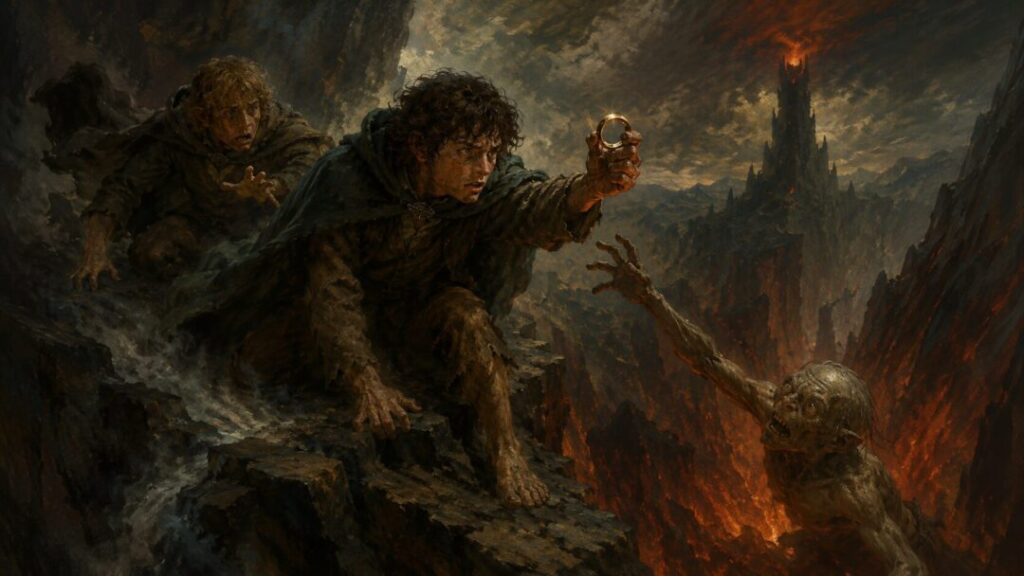
At the Crack of Doom, after hunger, terror, wounds, exhaustion, and the long pressure of the Ring, Frodo claims it.
That moment is essential.
If Frodo had simply overpowered the Ring at the end, the story would become much smaller. It would become a tale about having just enough inner strength to defeat evil.
But the text gives us something stranger and more honest.
Frodo reaches the place where the Ring can be destroyed, and there his strength fails. Not because he is wicked in any simple sense. Not because his mercy was false. Not because the Quest was meaningless.
He fails because the Ring is finally at the height of its power, in the place of its making, pressing on a bearer who has carried it farther than anyone could reasonably endure.
Then Gollum attacks.
He bites the Ring from Frodo’s hand. In his wild joy, he falls into the Fire. The Ring is destroyed.
This is not clean victory.
It is providence working through pity, suffering, broken vows, and a creature who was spared when killing him would have seemed easier.
The Weapon Sauron Could Not Recognize
Calling mercy a weapon is dangerous, because mercy does not work like a weapon.
It does not dominate.
It does not force the outcome.
It does not guarantee that the one spared will become good.
Bilbo’s pity does not make Gollum virtuous.
Frodo’s mercy does not prevent betrayal.
Sam’s restraint does not turn Gollum into a hero.
And yet without those acts, Gollum would not be there.
That is the hidden pattern Sauron cannot read.
Sauron’s power is built on control. He needs the world to be predictable through fear. He needs creatures to act from appetite, terror, pride, or ambition. The Ring itself is almost a test of that worldview: offer someone power, and eventually they will take it.
Again and again, the Ring proves nearly impossible to resist.
Boromir falls to the temptation.
Galadriel must reject it with full knowledge of what she could become.
Frodo himself cannot surrender it at the end.
So Sauron is not entirely wrong about the lure of power.
That is what makes the ending so profound.
The Ring is not defeated because someone is immune to temptation. It is defeated because earlier mercy created a path through failure.
Sauron could understand victory.
He could understand defeat.
He could understand a rival will trying to master his own.
But mercy did not fit his map of reality.
So he never saw the road that actually led to his ruin.
The Smallest Choices Moved the Greatest Power
The fall of Sauron is enormous.
Barad-dûr collapses. The Shadow is broken. The Ringwraiths pass away. The power that held Mordor together is unmade.
But the causes that lead there are often small.
A Hobbit in the dark chooses not to kill.
Another Hobbit looks at a ruined creature and sees himself.
A gardener, with every reason to hate Gollum, is still unable to become an executioner at the final turn.
None of these choices looks like a grand strategy.
They are not speeches before armies. They are not displays of ancient power. They are not the deeds Sauron fears when he looks toward Gondor or Rivendell.
And that is exactly why they matter.
The whole war turns on something Sauron has trained himself not to value.
Mercy appears weak because it refuses control. But in Middle-earth, that refusal is sometimes the only thing evil cannot predict.
Why Sauron Lost
Sauron lost because the Ring was destroyed.
But beneath that answer lies a deeper one.
He lost because he judged his enemies by himself.
He believed that anyone who possessed the Ring would eventually think as he thought: preserve it, claim it, wield it, master others through it. In the end, even Frodo could not cast it away by his own will.
But Frodo did something Sauron did not account for.
He had shown mercy before he failed.
So had Bilbo.
And that mercy brought Gollum to the Fire.
This does not make Gollum noble. It does not make the ending simple. It does not turn pity into a machine that produces happy results.
It means the moral structure of the story is larger than Sauron’s imagination.
He could build fortresses.
He could command armies.
He could bend wills toward fear.
He could pour his power into a Ring meant to rule all others.
But he could not imagine that sparing the wretched might matter more than crushing them.
That was the flaw in his vision.
Not ignorance of geography.
Not simple carelessness.
Not failure to understand that Mount Doom was dangerous.
Sauron could not imagine mercy as a weapon because mercy belonged to a world he had rejected.
And in the end, that was the world that defeated him.
Sources & Notes
- J.R.R. Tolkien, The Lord of the Rings, Book I, Chapter 2, “The Shadow of the Past” — Gandalf tells Frodo that Bilbo’s pity in sparing Gollum may rule the fate of many, setting up mercy as a decisive force against the Ring.
- J.R.R. Tolkien, The Lord of the Rings, Book IV, Chapter 1, “The Taming of Sméagol” — Frodo’s pity and recognition of Sméagol’s name keep Gollum in the Quest instead of treating him only as an enemy to be killed.
- J.R.R. Tolkien, The Lord of the Rings, Book V, Chapter 9, “The Last Debate” — the Captains of the West deliberately march on the Black Gate as a feint, banking on Sauron’s belief that a rival power would try to wield the Ring.
- J.R.R. Tolkien, The Lord of the Rings, Book VI, Chapter 3, “Mount Doom” — Frodo claims the Ring at the brink, and its destruction comes through Gollum’s attack and fall rather than through a simple triumph of will.
- J.R.R. Tolkien, The Letters of J.R.R. Tolkien, Letter 246 — Tolkien’s own reflection on Frodo’s failure, pity, and providential mercy supports reading the ending as morally larger than Sauron’s logic of domination.