Most readers eventually ask the same question.
Why does Gandalf not simply do more?
He is clearly more than an old man with a staff. He knows things others do not know. He speaks with a weight that unsettles kings. He withstands terrors that would break ordinary warriors. At moments, something far older and greater seems to shine through him.
And yet, for most of the story, he does not rule armies by command. He does not seize thrones. He does not take the Ring. He does not march alone into Mordor and challenge Sauron in a contest of raw power.
At first glance, this can look like a limitation placed on him from outside the story.
But within the lore, Gandalf’s restraint is not a weakness.
It is the key to understanding what the Wizards were.
The Wizards Were Not Sent to Conquer
The Istari were not ordinary magicians.
They were emissaries from the West, sent into Middle-earth when Sauron’s shadow began to rise again. Their purpose was to resist him, to encourage those who still had the will to oppose him, and to help unite the free peoples against domination.
But their mission came with a crucial boundary.
They were not sent to match Sauron’s power with power. They were not permitted to dominate Elves or Men by force and fear. They came in humble, aged bodies, not in unveiled majesty.
That detail matters more than almost anything else.
The Wizards were powerful beings, but they were sent under restraint. Their task was not to overwhelm Middle-earth into goodness. It was to awaken resistance within Middle-earth itself.
They were meant to advise, persuade, strengthen, and guide.
Not possess.
Not rule.
Not replace the choices of others with their own will.
Why That Limit Matters
Sauron’s evil is not only that he is cruel.
It is that he seeks mastery.
He does not merely want victory over his enemies. He wants ordered control. He wants wills bent into obedience. The One Ring itself is the perfect expression of that desire: power concentrated into an instrument of domination.
So the answer to Sauron could not simply be another great power taking his place.
That is the trap.
If the Wizards had come openly in glory, commanding kings and peoples by awe, they might have resisted Sauron’s armies while repeating something dangerously close to Sauron’s method. The world might have been saved from one master only to be trained to obey another.
That is why Gandalf’s limits are so important.
He is not prevented from doing good because he is weak. He is prevented from doing good in the wrong way.
The entire mission of the Istari depends on that distinction.
Gandalf’s Refusal of the Ring
This is why Gandalf’s refusal of the Ring is one of the clearest windows into his nature.
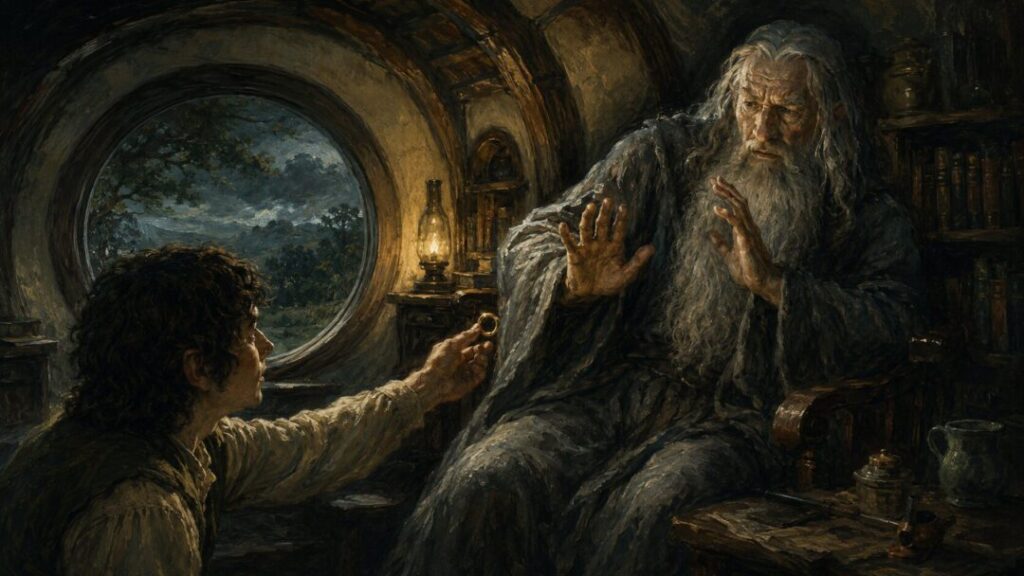
When Frodo offers it to him, Gandalf does not pretend he would use it for selfish reasons. His fear is more subtle than that. He knows he would desire to use it for good.
That is exactly what makes it terrifying.
Gandalf’s danger is not that he would immediately become petty or wicked. The danger is that his wisdom, pity, and strength would give the Ring a greater and more terrible field to work through.
He would try to heal the world by command.
He would try to make good irresistible.
And in doing so, he would become precisely the kind of ruler the Wizards were forbidden to become.
This is not a minor temptation. It goes to the heart of the Istari’s mission. Gandalf can only remain faithful if he refuses the shortcut that would let him force the world into the shape he believes is right.
That is why his “no” matters.
It is not only humility.
It is obedience to the deepest logic of his task.
Saruman Shows the Failure
Saruman reveals what happens when a Wizard crosses the line.
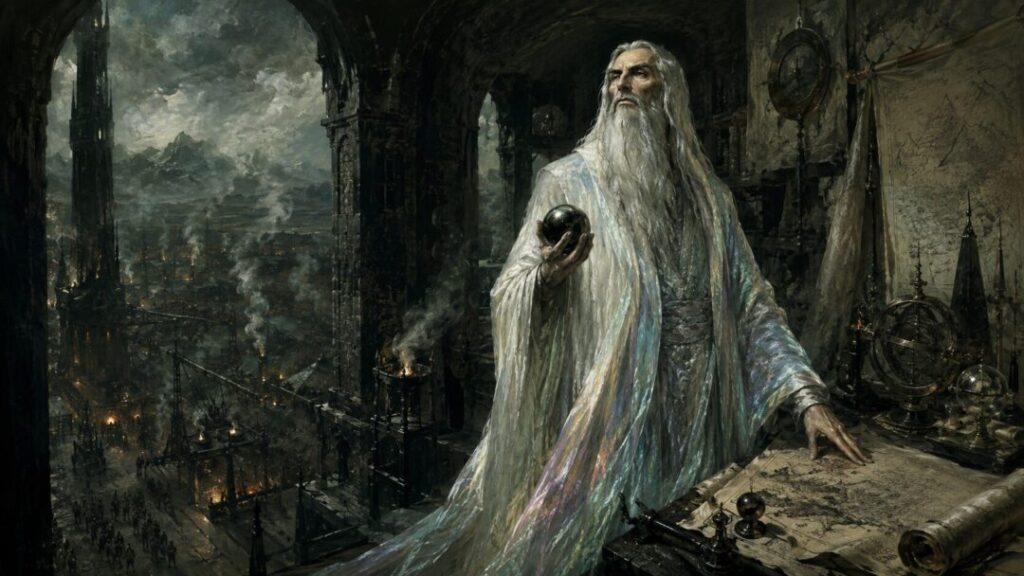
He begins as the chief of the order, wise, learned, and powerful. He studies the devices of the Enemy. He becomes deeply concerned with Ring-lore. He understands Sauron’s methods better than most.
But that knowledge does not preserve him.
It bends him.
Saruman’s fall is not simply that he joins the wrong side. It is that he accepts the wrong idea of power. He comes to believe that wisdom gives him the right to rule. He speaks of order, knowledge, and necessity. He persuades himself that domination can be justified if the dominator is wise enough.
That is where he ceases to be a true guide.
He becomes a rival master.
His voice itself becomes a weapon. Isengard becomes an imitation of tyranny. He does not merely advise Men; he manipulates, commands, breeds war, and tries to make himself a power in his own right.
In that sense, Saruman is not just Gandalf’s enemy.
He is Gandalf’s warning.
He shows what a Wizard becomes when guidance turns into control.
Gandalf’s Power Is Real
None of this means Gandalf is powerless.
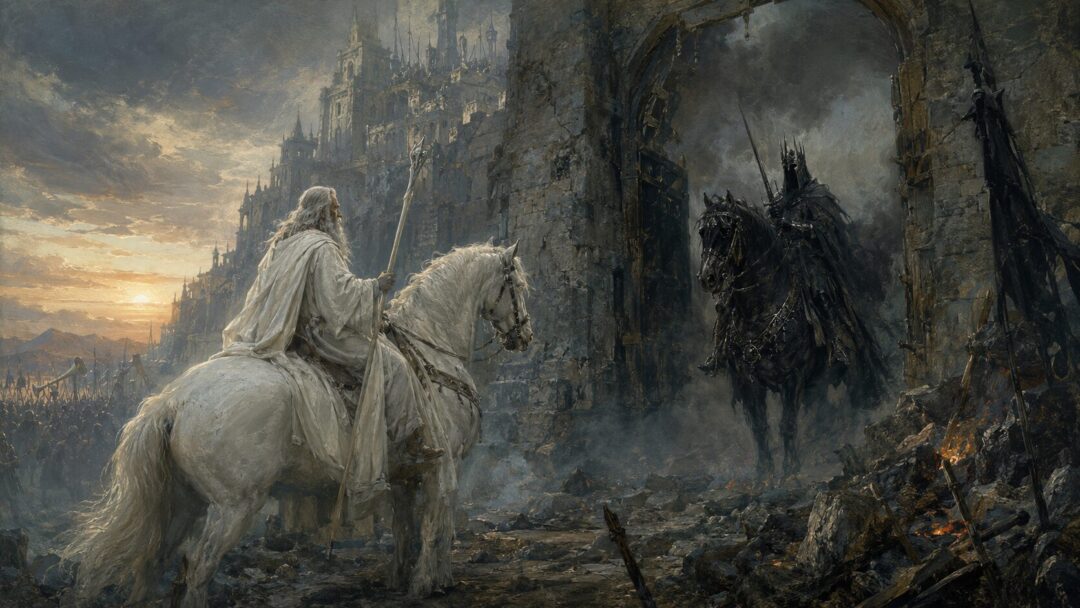
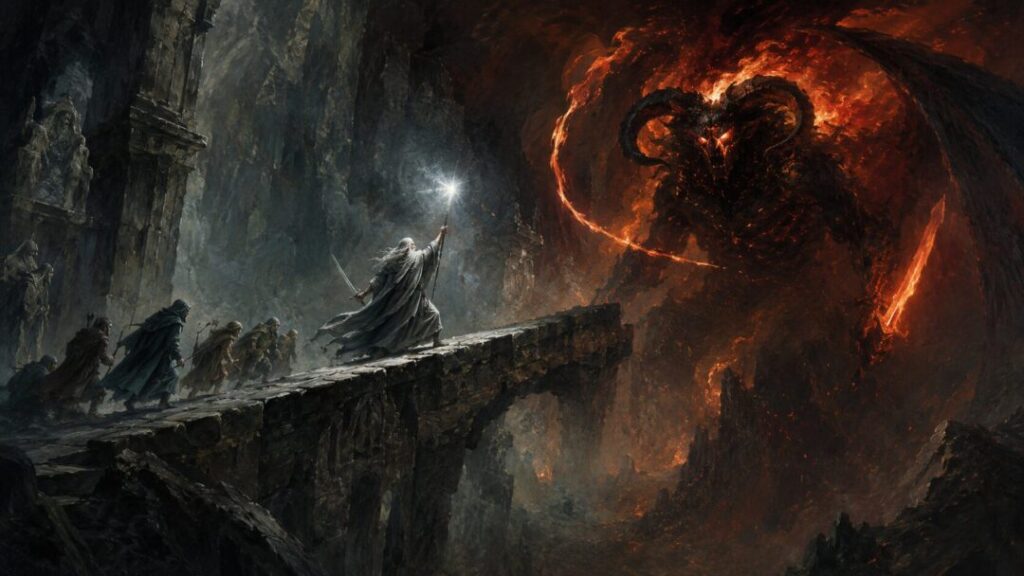
The story never presents him as merely symbolic. He uses power when he must. He battles the Balrog in Moria. He breaks through fear and darkness. He confronts Saruman. He drives back the Nazgûl. He stands before the Lord of the Nazgûl at the ruined gate of Minas Tirith.
But notice the pattern.
Gandalf’s power is usually defensive, liberating, or strengthening. He acts to preserve the possibility of free resistance. He does not take the place of that resistance.
At the Bridge of Khazad-dûm, he stands so the Fellowship can escape.
In Rohan, he helps release Théoden from the decay and manipulation that have weakened him. But Théoden must still ride. Théoden must still choose. Théoden must still become king again in deed, not merely by Gandalf’s command.
At Minas Tirith, Gandalf stands against despair, but the great turn of the battle comes through others: the Riders of Rohan, Aragorn’s arrival, the courage of mortal hands, and the small, overlooked actions that Sauron never truly understands.
Gandalf kindles.
He does not consume.
Gandalf the White Is Not a New Tyrant
After his battle with the Balrog, Gandalf returns changed.
He is no longer Gandalf the Grey. He is Gandalf the White. His authority is greater, and he speaks with a force that others cannot easily ignore.
This could easily have become a dangerous turning point.
If greater power meant permission to dominate, Gandalf’s return would have contradicted the whole mission of the Istari. But that is not what happens.
Even as the White Rider, Gandalf does not crown himself, seize command of the West, or compel the free peoples into obedience. He becomes more direct, more urgent, and more terrible to the servants of evil, but he still works through the courage and choices of others.
He helps Aragorn come into his kingship.
He strengthens Rohan and Gondor.
He guides the desperate strategy of marching to the Black Gate, not because the Captains of the West can defeat Sauron by arms, but because their courage may give Frodo and Sam the last chance to finish the true task.
Even at his height, Gandalf does not become the answer by himself.
He makes room for the answer to come through others.
The Balrog Does Not Break the Rule
One common objection is the Balrog.
If Gandalf was forbidden to match power with power, why could he fight Durin’s Bane?
The safest answer is that the restriction was not a ban on all use of power in every situation. Gandalf does use power at moments of dire need. The deeper issue is the purpose and direction of that power.
He was forbidden to dominate the peoples of Middle-earth or overthrow Sauron by becoming a rival lord of force and fear. Fighting the Balrog is different. The Balrog is an ancient terror, a destructive evil that threatens the Fellowship directly. Gandalf’s stand is sacrificial and protective, not imperial.
He does not fight the Balrog to gain followers.
He fights so others may continue.
That distinction is essential.
The same is true throughout his story. Gandalf’s power is most faithful when it opens a path for others rather than closing the world around his own will.
The Secret of Narya
Gandalf’s possession of Narya, the Ring of Fire, also fits this pattern.
Círdan gives it to him because he perceives something about Gandalf’s mission. Narya is associated not with conquest, but with endurance, courage, and the rekindling of hearts in a world growing cold.
That is exactly the kind of power Gandalf is permitted to bear.
Not the power to dominate wills.
The power to strengthen them.
This is why Gandalf often seems less like a battlefield weapon and more like a hidden flame moving through the story. He does not always remove danger. He does not always explain himself. He does not spare others from having to choose.
But he keeps hope alive long enough for free people to act.
That may be his greatest work.
Why the Wizards Had to Be Limited
The limits of the Wizards reveal a major moral pattern in Middle-earth.
Evil seeks control.
Good refuses to become control, even for good reasons.
That is much harder than it sounds.
Because the temptation to rule wisely can look noble. The desire to prevent suffering can become the desire to remove freedom. The wish to defeat evil can become the excuse to use evil’s tools.
Saruman falls into that trap.
Gandalf does not.
His greatness is not that he has unlimited power. His greatness is that he knows where power must stop.
The Real Victory of Gandalf
By the end of the War of the Ring, Sauron is defeated without Gandalf taking his place.
That is the victory.
Not merely that the Dark Lord falls, but that he falls through the courage, pity, endurance, and choices of those he dismissed. Hobbits carry the Ring. Men ride against terror. A shield-maiden and a halfling bring down the Lord of the Nazgûl. Aragorn claims kingship not as a tyrant, but as a healer and rightful ruler.
Gandalf stands behind much of this.
But he does not own it.
He prepares, guides, warns, and kindles. Then he lets others act.
That is why his limits matter so much.
They are not an inconvenience in the story. They are the shape of his faithfulness.
The Wizards were sent to oppose Sauron without becoming Sauron’s mirror. Their success depended not only on strength, but on restraint.
And Gandalf’s deepest power was never that he could force Middle-earth to be saved.
It was that he helped Middle-earth find the courage to stand freely against the Shadow.
Sources & Notes
- J.R.R. Tolkien, Unfinished Tales, “The Istari” — the Wizards are sent from the West in humble form to counsel and encourage resistance to Sauron, not to reveal themselves in majesty or rule Elves and Men by force.
- J.R.R. Tolkien, The Lord of the Rings, Book I, Chapter 2, “The Shadow of the Past” — Gandalf refuses Frodo’s offer of the Ring because he would try to use it for good and be mastered into a more terrible form of rule.
- J.R.R. Tolkien, The Lord of the Rings, Book II, Chapter 5, “The Bridge of Khazad-dûm” — Gandalf’s confrontation with the Balrog is a sacrificial defense of the Fellowship rather than a bid to command Middle-earth.
- J.R.R. Tolkien, The Lord of the Rings, Book III, Chapter 10, “The Voice of Saruman” — Saruman’s persuasive voice and self-justifying designs show the Wizardly calling corrupted into manipulation and mastery.
- J.R.R. Tolkien, The Lord of the Rings, Appendix B, “The Tale of Years” — Círdan gives Narya to Mithrandir, fitting Gandalf’s role as a hidden kindler of courage and endurance rather than a conquering lord.