The easy answer is that the One Ring wanted to survive.
That is true, but it is not enough.
The Ring was not just a dangerous object. It was made by Sauron, filled with much of his own power, and bound to his will. Its purpose was domination: to rule the other Rings, to control, to gather, to possess. It did not tempt people randomly. It worked through what was already present in them—fear, ambition, pity twisted into control, love bent into possession.
That is why its failures are so revealing.
The Ring could corrupt strength.
It could inflame desire.
It could turn good intentions toward mastery.
But again and again, the story suggests that there was one thing the Ring could not truly account for: the willing refusal of power.
Not weakness.
Not ignorance.
Not lack of imagination.
Self-sacrifice.
And that blind spot runs all the way to Mount Doom.
The Ring Was Made for Mastery
The One Ring was forged for rule.
Its inscription says exactly what it is for: to rule, find, bring, and bind. That is not poetic decoration. It is the Ring’s nature.
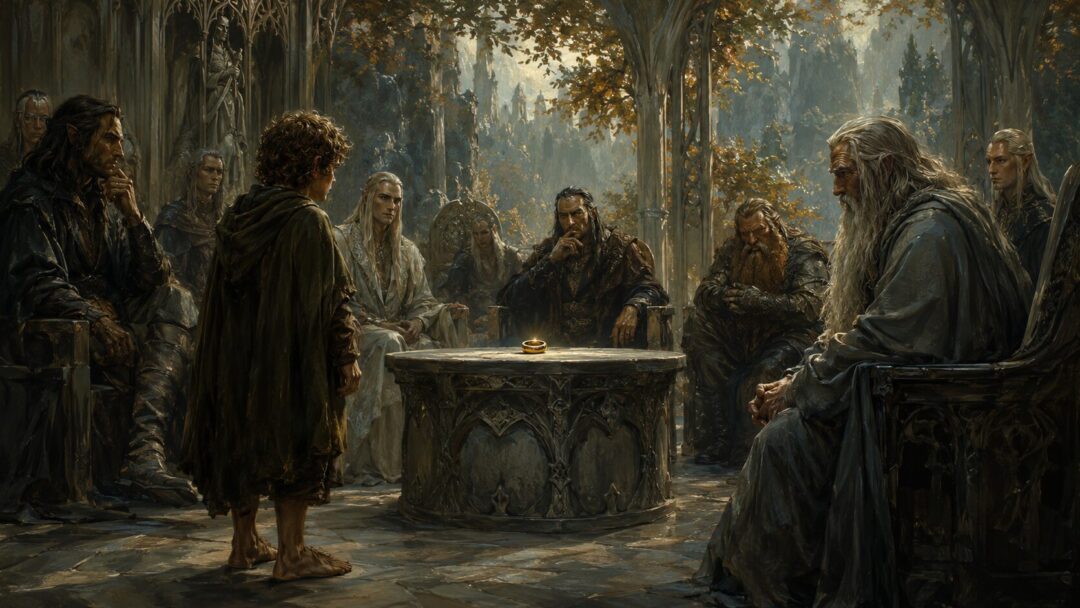
At the Council of Elrond, the Wise do not treat the Ring as a neutral weapon that happens to be dangerous. Elrond says it cannot be used by them, because it is altogether evil and belongs to the Dark Lord who made it. Gandalf’s answer goes even further: Sauron measures others by desire for power, and therefore does not imagine that anyone who has the Ring would seek to destroy it.
That is one of the most important ideas in the entire War of the Ring.
Sauron is not merely unaware of the plan. He is morally unable to understand it. He can imagine conquest. He can imagine rivals. He can imagine someone seizing the Ring and trying to overthrow him.
But he cannot imagine someone carrying absolute power across the world in order to give it up.
The Ring shares that same logic because the Ring is an extension of Sauron’s power and will. The texts do not present it as a little person with a mind exactly like Sauron’s. That would be too simple. But its action follows his nature: it awakens the desire to possess and use.
It knows how to say: take me.
It does not know how to answer: no.
The Ring Tempts Through What People Want
The Ring’s danger is not that it offers the same temptation to everyone.
It is more subtle than that.
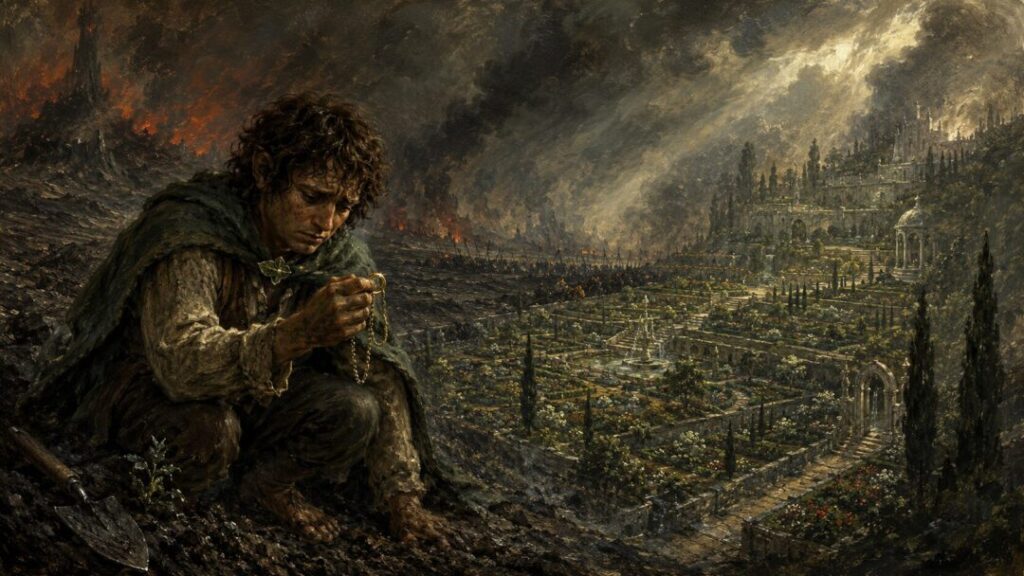
Boromir does not desire evil for its own sake. He wants Gondor saved. He wants strength against Mordor. His tragedy is that the Ring can turn that noble desire into a demand for possession. He begins with defense and ends by trying to take the Ring from Frodo.
That is how the Ring works.
It does not need to invent desire from nothing. It finds the place where love, fear, pride, or duty can be twisted into control.
Galadriel understands this immediately. When Frodo offers her the Ring, she sees the possibility of becoming a queen: beautiful, terrible, worshipped, and despairing. Her temptation is not petty greed. It is the temptation to use power for a world she longs to preserve.
Gandalf refuses the Ring for the same reason. He knows that his desire to do good would make him especially dangerous if he took it. The Ring would not make him less righteous at first. It would make his righteousness coercive.
That is the pattern.
The Ring does not only tempt the wicked.
It tempts the good by offering them a way to force goodness upon the world.
Sam’s Vision Shows the Ring’s Method
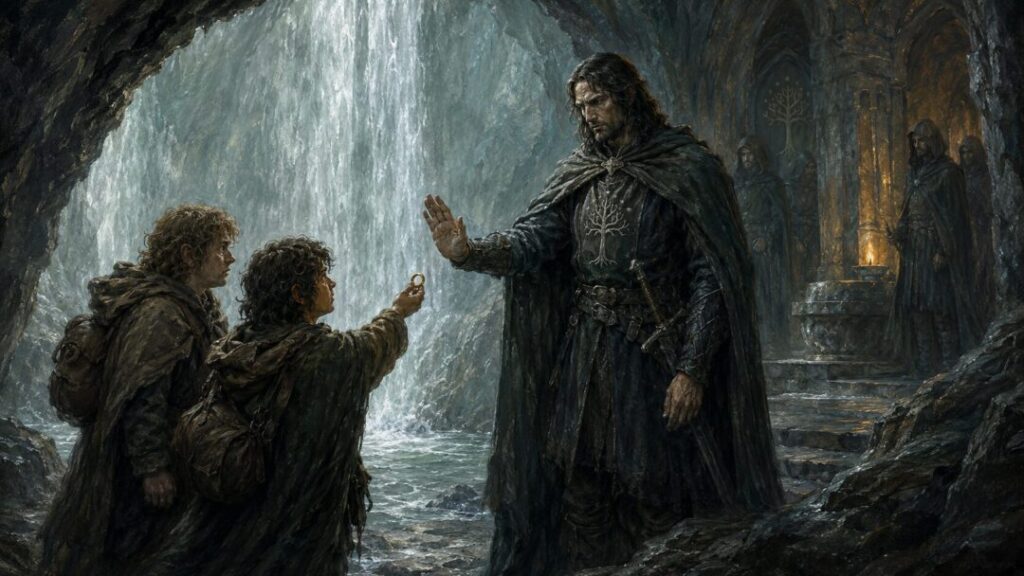
Sam’s brief possession of the Ring in Mordor is one of the clearest examples of this.
Sam is not a lord, a warrior, or a wizard. He does not dream naturally of thrones or armies. Yet when the Ring works on him, it enlarges even his humble desires into something vast and commanding.
He imagines himself as a great hero, overthrowing Barad-dûr, and turning the land of Gorgoroth into a garden. The dream is almost innocent on the surface. Sam loves gardens. He loves growing things. He hates the waste and ugliness of Mordor.
But the Ring reshapes even gardening into dominion.
It does not simply offer Sam flowers.
It offers him command.
And Sam rejects it because, at heart, he knows the size of his own proper world. He wants one small garden, not a realm remade by his will. That humility matters. The Ring tries to inflate him, and he survives by becoming small again.
This is not because Sam is immune. He is not.
It is because his deepest love is not conquest.
Faramir Refuses Before He Is Tested
Faramir’s refusal is another vital clue.
When he learns what Frodo carries, he does not seize it. More than that, he says he would not take it even if it lay by the highway. Faramir’s words are not the same as being tested at the Crack of Doom, where the Ring’s pressure would be greatest. But they still reveal something the Ring cannot easily use.
Faramir does not define victory as possession.
That separates him from Boromir.
Boromir sees the Ring as a weapon that should be brought to Minas Tirith. Faramir sees that some weapons cannot be used without becoming the very evil they oppose.
This is why Faramir’s wisdom is not simply “strength of character.” It is a different understanding of power.
He does not merely resist taking the Ring.
He rejects the entire premise that taking it would save anything.
That is exactly the kind of refusal Sauron cannot imagine.
Frodo’s Quest Is Built on Refusal
Frodo’s mission is strange from the beginning.
He is not sent to master the Ring.
He is not trained to wield it.
He is not chosen because he can defeat Sauron in a contest of strength.
He is sent because the Ring must be unmade, and because someone small enough, humble enough, and merciful enough must carry it there without trying to become its lord.
This is why the Quest of the Ring is so unlike a normal heroic mission.
Most heroic stories move toward acquisition. The hero gains the sword, claims the throne, receives the power, wins the crown.
Frodo’s journey moves in the opposite direction.
He carries the most dangerous power in Middle-earth, not to claim it, but to lose it.
The Ring can work on his exhaustion. It can work on his fear. It can become heavier as he approaches Mordor. It can press on him until every step becomes almost impossible. But the original shape of the quest is already outside the Ring’s moral vocabulary.
The Ring says: possess.
The Quest says: surrender.
Mercy Is the Crack in the Ring’s Logic
The Ring’s destruction depends on mercy long before anyone reaches Mount Doom.
Bilbo spares Gollum under the Misty Mountains. Frodo later chooses not to kill Gollum in the Emyn Muil. Sam, on the slopes of Orodruin, also chooses not to strike him down when he has the chance.
None of these acts look strategically safe.
Gollum is treacherous. He is dangerous. He has already been twisted by long possession of the Ring. From a purely practical point of view, mercy toward him seems almost foolish.
And yet that mercy becomes essential.
Letters discussing Frodo’s “failure” at the end emphasize that the quest is saved through pity and forgiveness, and that Frodo’s endurance and mercy matter even though he cannot finally cast the Ring away by his own strength.
This is not an accident in the story’s moral design.
The Ring can understand Gollum’s craving. It can use his hunger, his jealousy, his possessiveness. But it cannot understand why Bilbo would spare him. It cannot understand why Frodo would pity him. It cannot understand why Sam, in that last terrible stretch, would hold back.
Mercy creates a path the Ring does not know how to close.
Not because mercy is soft.
Because mercy refuses to treat the world as a contest of possession.
Mount Doom Is Not a Simple Failure
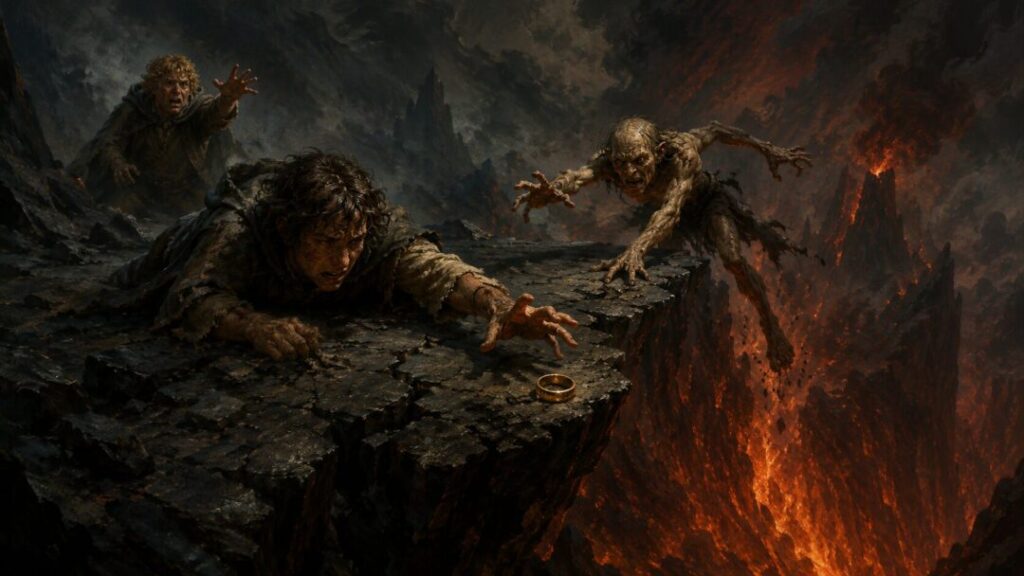
At the Crack of Doom, Frodo claims the Ring.
That has to be said plainly.
He does not throw it into the Fire. He says the Ring is his, and he puts it on. The chapter summary in Tolkien Gateway reflects the text clearly: Frodo refuses to destroy the Ring at Sammath Naur, and Gollum then seizes it by biting off Frodo’s finger before falling into the fire.
But this moment should not be flattened into “Frodo was weak.”
That misses the entire point.
The pressure of the Ring is at its maximum, in the place of its making, after months of torment, hunger, fear, and spiritual burden. The story does not present this as an ordinary moral test under ordinary conditions. Frodo has carried the Ring farther than anyone had any right to expect.
He reaches the place where self-sacrifice is demanded.
And there, finally, he cannot complete it by will alone.
That is not a cheap ending. It is a deeply honest one.
No one simply out-muscles the Ring at its strongest.
The victory comes because Frodo’s earlier mercy has allowed Gollum to be there at all.
The Ring Destroys Itself Through Possession
Here is the strange reversal.
The Ring cannot understand self-sacrifice, but it understands possession perfectly.
So at the final moment, it draws possessiveness to itself one last time.
Frodo claims it.
Gollum attacks him for it.
Gollum seizes it.
And in the madness of getting back his Precious, he falls.
The Ring is destroyed not because someone becomes strong enough to wield it rightly, but because its own world of craving collapses in on itself.
That is why the ending is so powerful.
The Ring’s logic succeeds completely for one terrible instant. Everyone near it is drawn into possession. Frodo claims. Gollum takes. The struggle becomes exactly what the Ring was made to produce.
And then that very possessiveness carries it into the Fire.
Its victory becomes its undoing.
The Ring can defeat the will to cast it away.
But it cannot escape the consequences of the mercy it never understood.
Sauron Makes the Same Mistake
Sauron’s defeat mirrors the Ring’s defeat.
He watches for a rival. He expects someone powerful to reveal themselves. He fears Aragorn because Aragorn appears to be exactly the kind of enemy Sauron understands: a king, a claimant, a wielder of strength.
That is why the march to the Black Gate works as a diversion.
It looks like a challenge of power.
But the real threat is not there.
The real threat is two exhausted Hobbits crawling through Mordor, carrying the Ring not toward a throne, but toward annihilation.
Sauron’s imagination fails because he sees others through himself. He believes the desire for power is the basic truth of every heart. Gandalf says as much: the thought that someone would refuse the Ring and seek its destruction does not enter Sauron’s heart.
That blindness is not tactical only.
It is spiritual.
Sauron cannot guard properly against self-renunciation because he cannot believe in it.
Why Self-Sacrifice Matters
Self-sacrifice in The Lord of the Rings is not dramatic self-destruction for its own sake.
It is the willingness to give up claim.
Bilbo gives up the Ring, though not without struggle.
Frodo gives up the Shire’s peace to carry it.
Sam gives up his own safety again and again for Frodo.
Faramir gives up the chance to take a weapon that could have made him mighty in the eyes of others.
Aragorn risks the West’s remaining strength at the Black Gate to give Frodo a chance.
These acts do not all destroy the Ring directly.
But they create the only world in which the Ring can be destroyed.
The Ring thrives wherever someone says, “This should be mine.”
It weakens wherever someone says, “I will not take what I have no right to possess.”
That is why the smallest acts matter so much.
The Ring can work with ambition.
It can work with fear.
It can work with pride.
It can even work with noble desire when that desire becomes controlling.
But it cannot truly comprehend love that does not seek ownership.
The Final Irony
The Ring is destroyed by the one thing it most consistently misjudges.
Not innocence alone. Frodo is not untouched by the end.
Not strength alone. The strong are often in greater danger.
Not wisdom alone. The Wise refuse the Ring because they know they would fall.
The Ring is defeated through a chain of renunciations, mercies, and burdens carried without hope of reward.
Bilbo does not kill Gollum.
Frodo accepts the burden.
Sam remains faithful.
Faramir refuses a prize.
Aragorn turns Sauron’s gaze away.
Gollum, in the end, acts from possessiveness—but only because mercy allowed him to survive long enough to be there.
That is the terrible beauty of the ending.
The Ring understands desire.
It does not understand grace.
And so, at the very edge of victory, it falls through the one opening its maker never believed could matter.
Not a greater Ring.
Not a stronger Dark Lord.
Not a hero claiming power for good.
Only pity, endurance, friendship, and the refusal to possess.
That is why the Ring could not understand self-sacrifice.
Because self-sacrifice is the opposite of everything it was made to rule.
Sources & Notes
- J.R.R. Tolkien, The Lord of the Rings, Book I, Chapter 2, “The Shadow of the Past” — Gandalf explains the Ring as Sauron’s ruling instrument and frames Bilbo’s pity toward Gollum as a mercy with consequences beyond immediate strategy.
- J.R.R. Tolkien, The Lord of the Rings, Book II, Chapter 2, “The Council of Elrond” — Elrond and Gandalf reject using the Ring and stress that Sauron does not imagine its bearers would try to destroy it.
- J.R.R. Tolkien, The Lord of the Rings, Book II, Chapter 10, “The Breaking of the Fellowship” — Boromir’s attempt to seize the Ring shows how a desire to defend Gondor can be twisted into mastery and possession.
- J.R.R. Tolkien, The Lord of the Rings, Book IV, Chapter 5, “The Window on the West” — Faramir’s refusal to take the Ring, even if it lay by the highway, directly supports the article’s contrast between victory and possession.
- J.R.R. Tolkien, The Lord of the Rings, Book VI, Chapters 1–3, “The Tower of Cirith Ungol,” “The Land of Shadow,” and “Mount Doom” — Sam’s Ring-vision, his mercy toward Gollum, and Frodo’s final claim at the Fire trace the last stages of temptation, endurance, pity, and destruction.
- J.R.R. Tolkien, The Letters of J.R.R. Tolkien, Letter 246 — Tolkien’s discussion of Frodo’s failure at the Sammath Naur and the role of pity and forgiveness is useful background for reading the ending as more than a simple collapse of will.