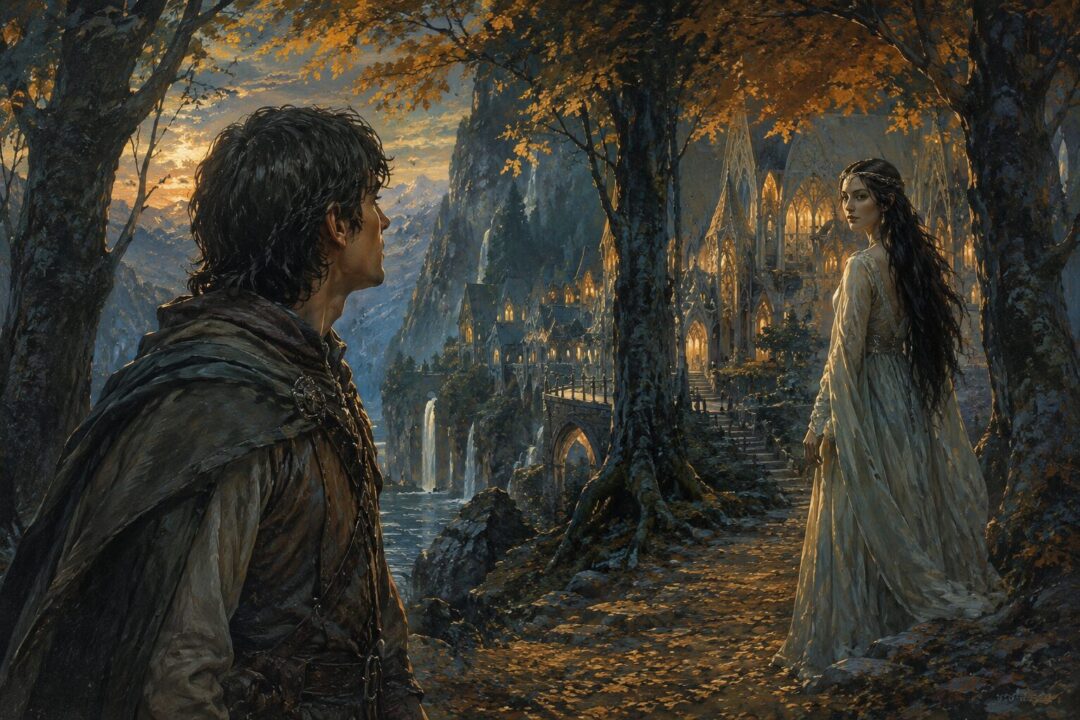
When Aragorn stands beneath the trees of Rivendell and first sees Arwen, the moment feels intensely personal. A Ranger falls in love with an Elf-maiden. Yet beneath that quiet encounter lies one of the oldest stories in Middle-earth. Every glance Aragorn gives Arwen carries the weight of a tale that began thousands of years earlier with another mortal man and another immortal woman.
Without Beren and Lúthien, Aragorn and Arwen would still have loved each other—but the meaning of that love would be profoundly different. Their relationship is not simply a repetition of an ancient romance. It is a deliberate echo that reminds readers how history, sacrifice, and hope survive across the Ages.
Aragorn Knows He Is Walking an Ancient Road
When Aragorn first meets Arwen in Rivendell, he mistakes her for Lúthien herself. The comparison is not merely about beauty. It immediately places Aragorn inside one of the greatest legends ever remembered among Elves and Men.
This reaction reveals how deeply the story of Beren and Lúthien shaped the imagination of Middle-earth. Their names were not forgotten myths but living memories, preserved especially by the Eldar. Aragorn recognizes not only Arwen's appearance but also the impossible situation before him.
A mortal man has fallen in love with an immortal Elf.
He already knows how such stories usually end.
Unlike ordinary romances, this one comes with the burden of history. Every hope is measured against an example that almost no one could ever equal.
The First Union of Elf and Man Changed History
Before Beren and Lúthien, the Children of Ilúvatar lived largely apart. The Elves were immortal within the life of Arda, while Men possessed the mysterious Gift of mortality.
Their union became the first marriage between Elf and Man. It was extraordinary not because affection between the races was unimaginable, but because the differences between their destinies appeared almost impossible to overcome.
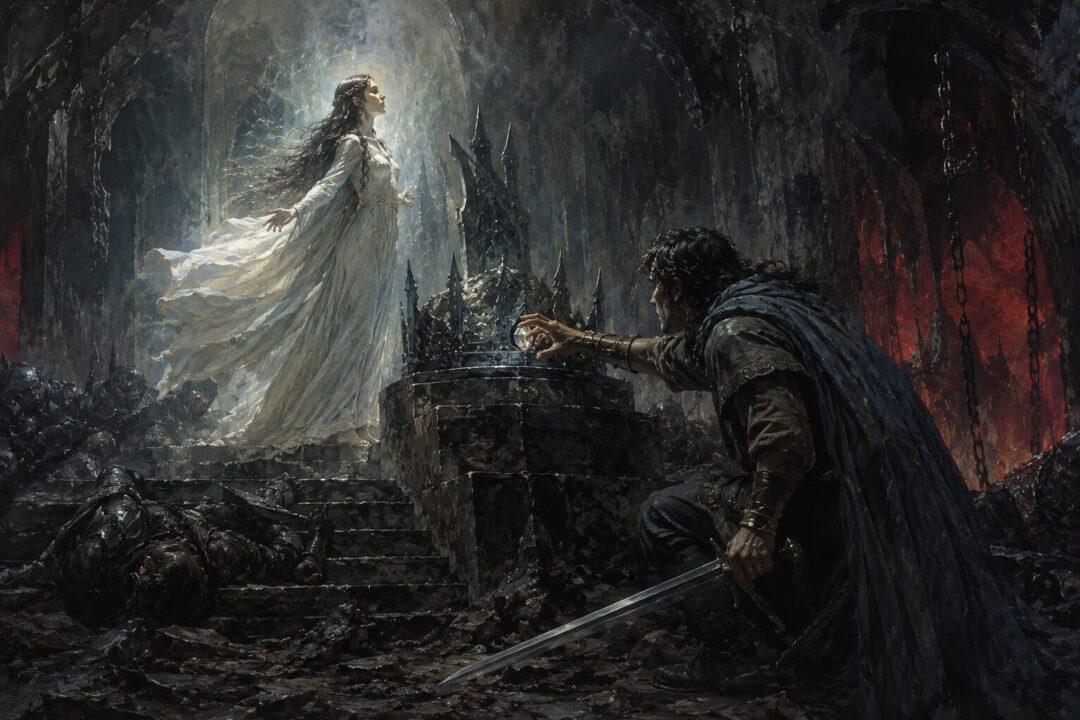
King Thingol demanded that Beren recover a Silmaril from Morgoth's Iron Crown before he could marry Lúthien. The task was intended to be impossible.
Instead, Beren and Lúthien accomplished what armies could not. Through courage, endurance, and Lúthien's extraordinary power, they entered Angband itself and wrested a Silmaril from the Dark Lord's crown.
The price was immense. Beren died. Lúthien chose to surrender her own immortality so they could share the same fate.
Their marriage therefore established far more than a family line. It proved that love in Middle-earth often requires sacrifice rather than triumph alone.
Their Choice Reshaped the Bloodlines of the West
The importance of Beren and Lúthien extends beyond romance because nearly every major royal house of the West descends from them.
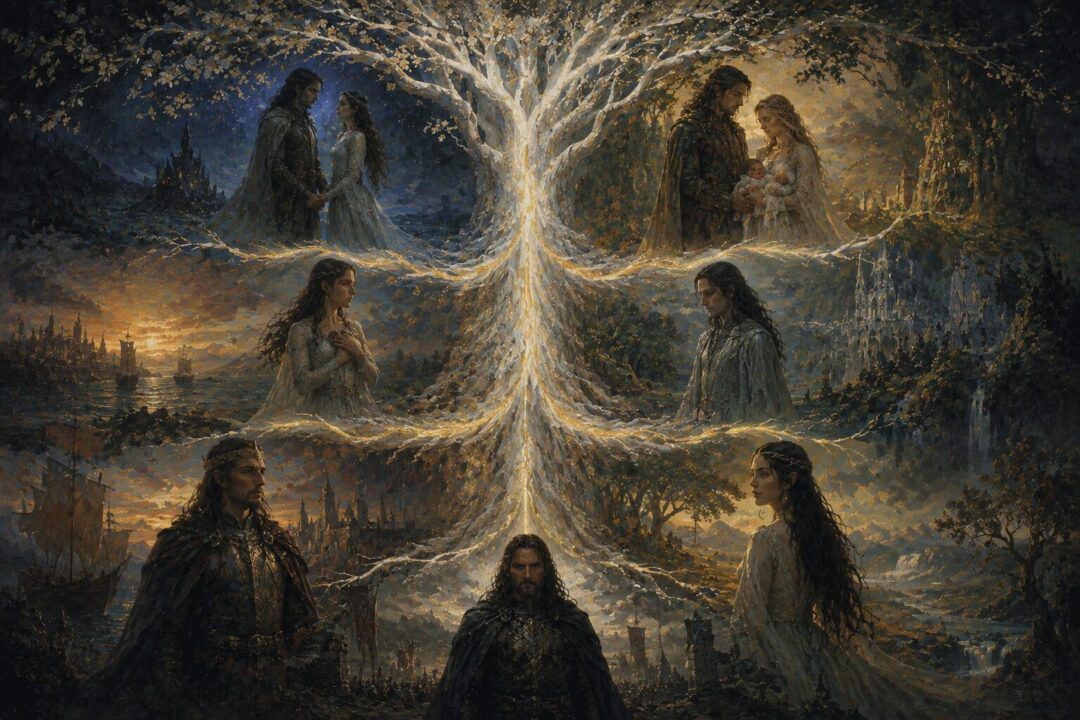
Their son Dior inherited both mortal and Elvish ancestry. Through Dior came Elwing. Through Elwing came Elrond and Elros.
Here the story divides in remarkable fashion.
Elros chose the fate of Men and became the first King of Númenor. Elrond chose the fate of the Elves and remained among the Eldar.
Thousands of years later these two branches meet again.
Aragorn descends from Elros through the long line of Númenórean kings and the Chieftains of the Dúnedain.
Arwen is Elrond's daughter.
Their marriage therefore reunites the two choices first separated in the generation after Beren and Lúthien.
This is one reason their relationship feels less like coincidence than fulfillment. The ancient family story has come full circle.
Arwen Faces the Same Choice—But Not the Same Circumstances
It is tempting to think Arwen simply repeats Lúthien's decision.
The similarities are obvious.
Both love mortal men.
Both must choose between immortal life among the Elves or a mortal future beside the one they love.
Both ultimately accept mortality.
Yet Tolkien's texts also show important differences.
Lúthien's mortality comes through an exceptional act after death itself. Her return with Beren is unique within the legendarium.
Arwen's choice belongs to the descendants of Eärendil, whose family received the special privilege of choosing whether to belong to Elves or Men. Because she descends from Elrond, that choice eventually rests before her as well.
The parallel therefore exists, but it is not identical. History echoes without simply repeating itself.
Elrond Understands Better Than Anyone
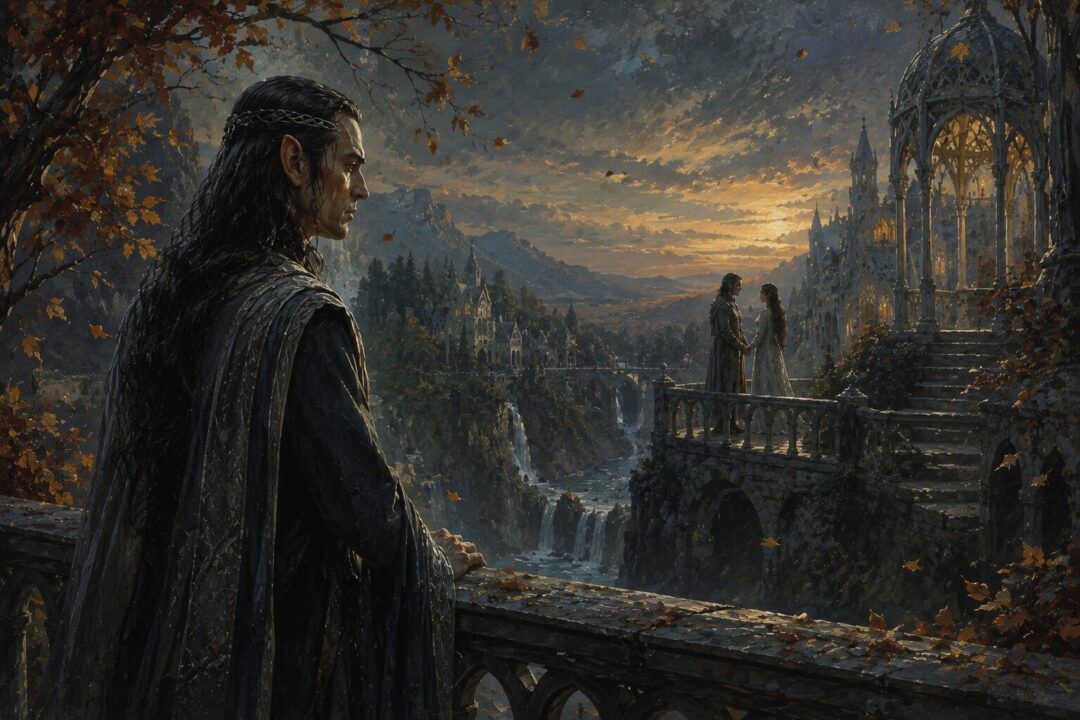
Few characters appreciate the cost of Aragorn and Arwen's love more deeply than Elrond.
His own family history exists because Beren and Lúthien succeeded.
His brother chose mortality.
He himself chose immortality.
His wife, Celebrían, departed across the Sea after suffering grievous torment, leaving Elrond separated from her while he remained in Middle-earth.
Now his daughter wishes to embrace mortality.
Elrond's reluctance is therefore understandable. He does not oppose love itself. Rather, he fully understands what such a decision means.
When he tells Aragorn that Arwen will not marry him unless he becomes both King of Gondor and Arnor, the condition is not merely political.
Aragorn must become worthy of a sacrifice that cannot be reversed.
Aragorn Carries More Than His Own Hope
Throughout The Lord of the Rings, Aragorn repeatedly displays confidence that appears larger than personal ambition.
Part of this confidence comes from his lineage.
He carries the shards of Narsil.
He inherits the legacy of Númenor.
He bears the hopes of the Dúnedain.
Yet he also belongs to the family line that began with Beren.
This ancestry does not guarantee success. Tolkien never suggests that blood alone determines destiny.
Instead, it provides an example.
Beren confronted impossible odds against Morgoth himself.
Compared with that legendary quest, Aragorn's struggle against Sauron belongs to the same moral tradition: victory depends not merely upon strength but upon courage, endurance, humility, and faithfulness.
Remembering Beren reminds both Aragorn and the reader that greatness has always required impossible choices.
Love Never Escapes the Cost of Mortality
The greatest connection between the two romances is not genealogy.
It is mortality.
Middle-earth consistently presents death as one of its deepest mysteries.
The Elves are bound to the life of Arda until its end.
Men leave the world after death for a destiny not fully revealed within the texts.
No romance between Elf and Man can avoid confronting this divide.
Beren accepts death because he has no alternative.
Lúthien willingly shares that destiny.
Aragorn eventually accepts the Gift of Men freely when his time comes, laying himself down in peace rather than clinging to life.
Arwen remains behind, grieving until she too dies in the now-empty land of Lórien.
The emotional shape of both stories therefore reaches beyond romance. They ask whether love is diminished by mortality or made more meaningful because time is limited.
The texts consistently point toward the latter.
Their Stories Frame the Beginning and End of an Age
The tale of Beren and Lúthien belongs to the First Age, when Morgoth ruled from Angband and the Silmarils still determined the fate of kingdoms.
Aragorn and Arwen belong to the closing years of the Third Age, when Sauron is the final great shadow.
These stories function almost like literary bookends.
The first establishes hope during Middle-earth's darkest ancient struggles.
The second accompanies the passing of the Elves and the beginning of the Dominion of Men.
By connecting these couples through ancestry, theme, and choice, Tolkien allows the oldest hope of the First Age to survive into the world's changing future.
Why the Story Matters Every Time Aragorn Looks at Arwen
It is easy to read Aragorn and Arwen as simply another tragic romance.
Yet the deeper context transforms every meeting between them.
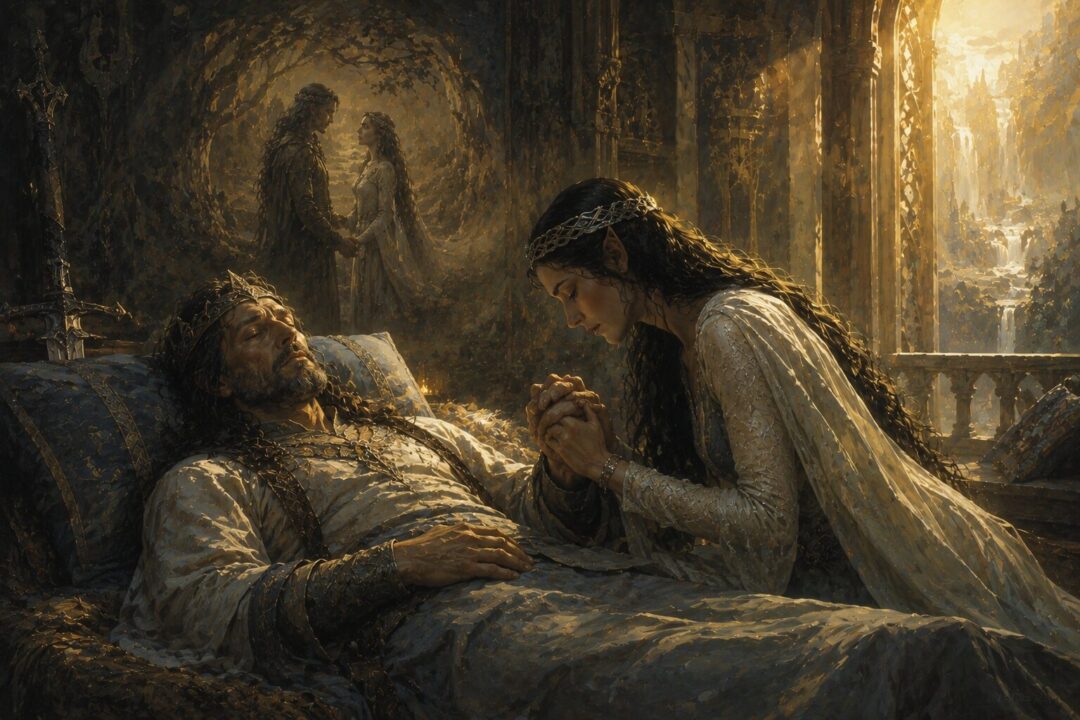
When Aragorn sees Arwen, he also sees the memory of Lúthien.
When Elrond looks upon Aragorn, he sees the descendant of Elros—and behind him the courage of Beren.
When Arwen chooses mortality, readers remember that another Elf-maiden once surrendered everything for love.
None of these echoes remove the individuality of Aragorn and Arwen. Instead, they enrich it. Their love succeeds not because history repeats itself exactly, but because each generation must make its own choices despite knowing the cost.
That is ultimately why Beren and Lúthien matter every time Aragorn looks at Arwen.
The ancient tale reminds us that the greatest victories in Middle-earth are rarely won by power alone. They are won when courage accepts sacrifice, when hope survives despair, and when love proves strong enough to cross even the boundaries that seem woven into the nature of the world itself.
Sources & Notes
- https://tolkiengateway.net/wiki/Beren_and_L%C3%BAthien — Background on the first union of Elf and Man, the quest for the Silmaril from Morgoth, and Lúthien's choice of mortality with Beren.
- https://tolkiengateway.net/wiki/The_Tale_of_Aragorn_and_Arwen — Summary of Tolkien's appendix tale connecting Aragorn and Arwen's love to the older Beren and Lúthien pattern.
- https://tolkiengateway.net/wiki/Arwen — Context for Arwen's descent from Elrond, her resemblance to Lúthien, and her decision to accept the fate of Men.
- https://tolkiengateway.net/wiki/Half-elven — Explanation of the Half-elven line and the choice of kindred that frames Elrond, Elros, and Arwen's family history.
Sources selected for Tolkien background on Beren and Lúthien, Aragorn and Arwen, Arwen's choice, and the Half-elven lineage.