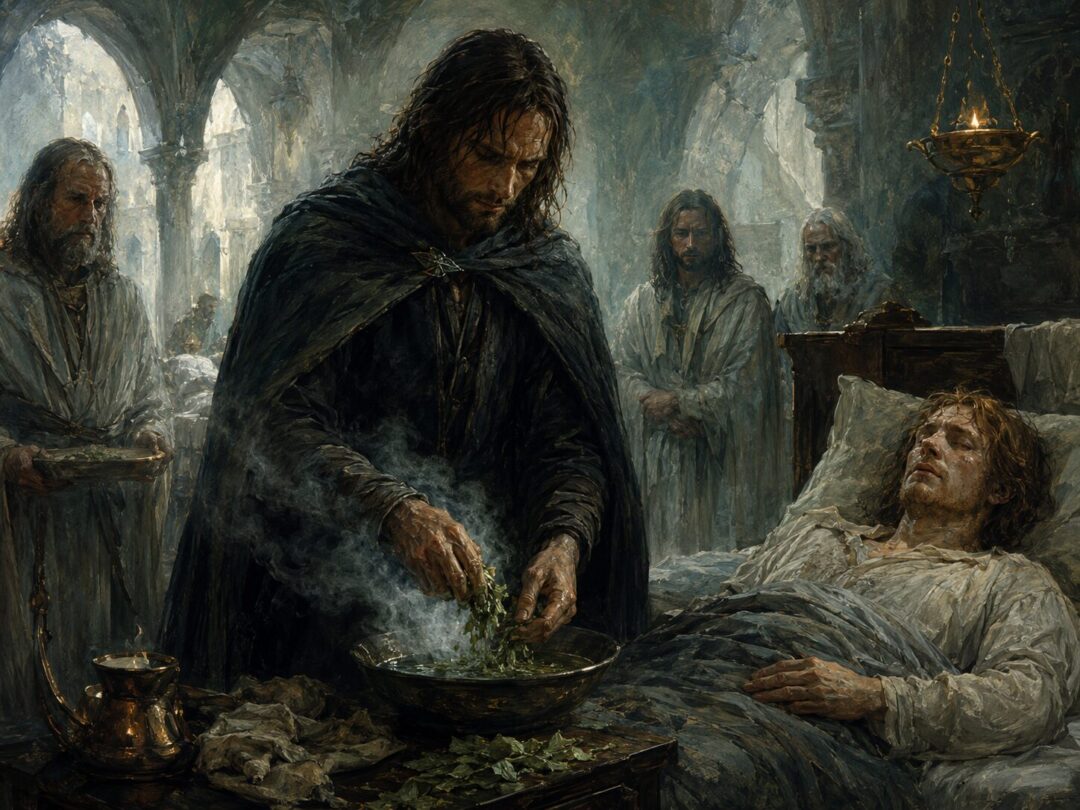
Kingsfoil is easy to overlook. In Gondor it had become little more than an old herb with a pleasant scent, something remembered by name but not by power. Yet in the Houses of Healing, after the ruin of the Pelennor Fields, that small green leaf becomes one of the most important signs of Aragorn’s kingship.
Not his sword. Not his banner. Not even the line of Elendil by itself.
Aragorn’s bloodline matters deeply in the story. He is the heir of ancient kings, and his claim is not invented at the gates of Minas Tirith. But the moment that reaches the people of the City is not a legal argument about ancestry. It is the sight of a weary man entering the houses of the wounded, calling the lost back from shadow, and spending the night tending those who have suffered. The old saying remembered by Ioreth is simple: “The hands of the king are the hands of a healer.” The deeper point is sharper. Aragorn proves not only who he descends from, but what kind of king he is.
The King Who Refused to Seize the City
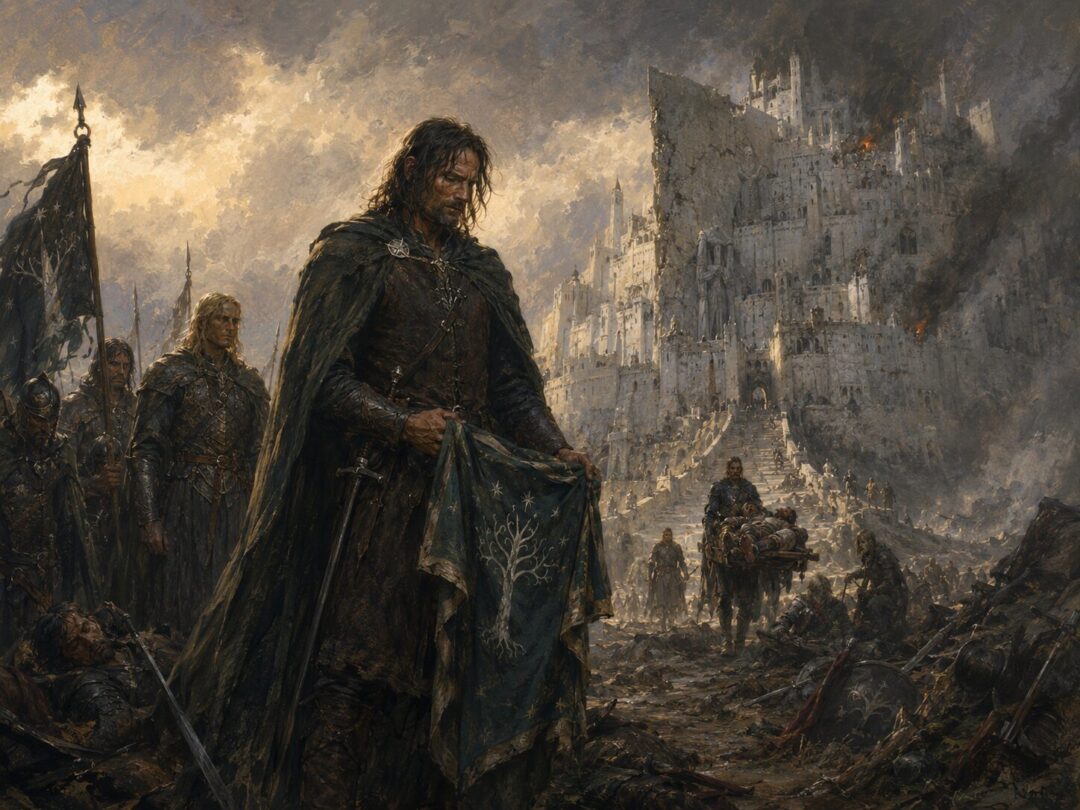
After the Battle of the Pelennor Fields, Aragorn has every visible sign a returning monarch could want. He has come up from the river with the ships from Pelargir. The Standard of Elendil has been revealed. Mordor’s assault on Minas Tirith has been broken by the combined force of Gondor, Rohan, and Aragorn’s own company. Yet the texts are careful: Aragorn does not simply march into the City and demand the throne. He furls his banner and leaves the immediate ordering of the City to Prince Imrahil, according to the need of the hour.
That restraint is important. A lesser claimant might have treated victory as permission to rule at once. Aragorn does the opposite. He understands that Gondor is exhausted, divided by grief, and not yet ready for a political shock. Denethor is dead. Faramir lies near death. The City has survived, but it is not whole.
So Aragorn’s first true entrance is not as a conqueror. He comes because the wounded need him.
This changes the meaning of kingship. He does not begin by taking the seat of power. He begins by serving the broken body of the realm.
The Old Lore Gondor Almost Forgot
The Houses of Healing are not a symbolic invention floating outside the world. They are a real place in Minas Tirith: an infirmary set near the Citadel-gate and the southward wall in the sixth circle, surrounded by lawns and trees. Into that place are brought Faramir, Éowyn, Merry, and others suffering under the Black Shadow after the siege and battle.
The irony is that Gondor still has healers, order, knowledge, and institutions. The Warden is no fool. The herb-master knows the names of plants. But the crucial old knowledge has faded. The City remembers kings as history, but not fully as living power. Ioreth, with her half-dismissed old saying, becomes the unlikely keeper of a truth the learned have almost lost.
That does not make her a prophet in some formal sense. The text presents her as talkative and comic as well as useful. But her memory matters. In a City that has gone long without a king, a piece of “old wives’ lore” turns out to carry a forgotten standard of recognition.
The rightful king will not merely command. He will heal.
Athelas Was Not Enough Without the Healer
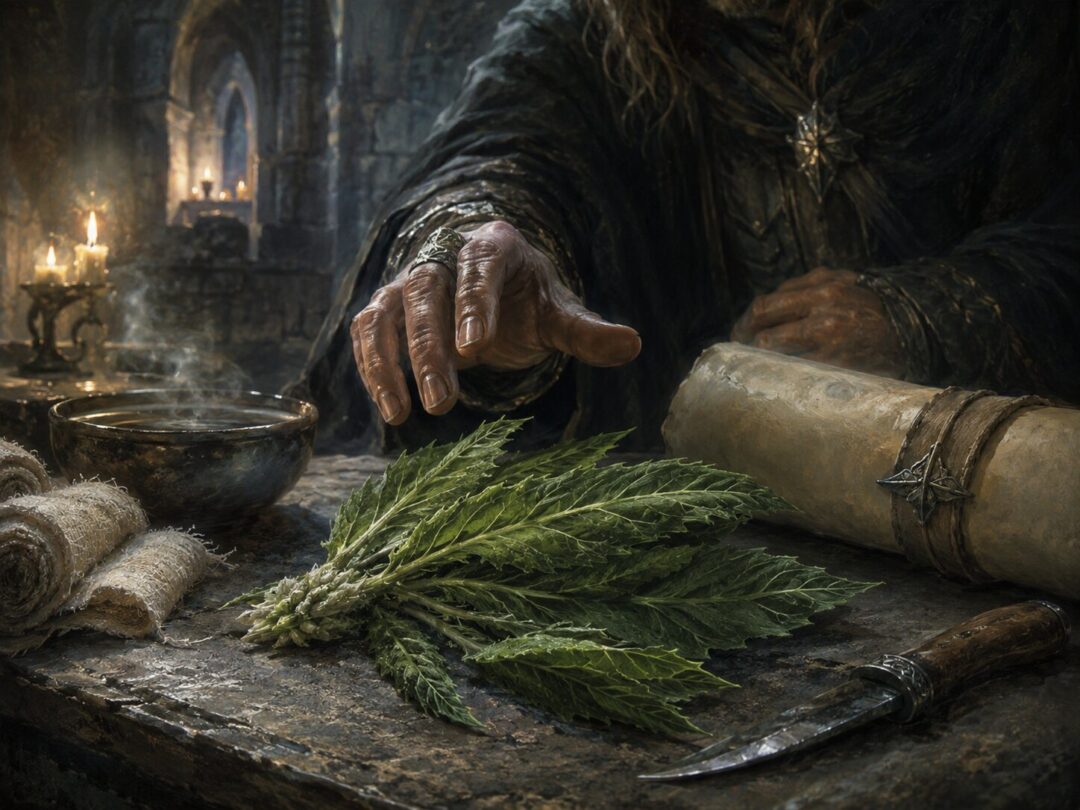
Athelas, or kingsfoil, is not an ordinary garnish in the story. It is associated with healing wounds, poison, and evil influence, especially the Black Breath. It was brought to Middle-earth by the Númenóreans, grew in places connected with the Dúnedain, and by the end of the Third Age its deeper uses were largely remembered by the Rangers of the North rather than the people of Gondor. In Gondor itself, the herb’s healing virtues had mostly been forgotten; it was valued chiefly for freshness or headaches.
That detail is essential. Aragorn is not simply lucky enough to possess a magic plant. The plant is present, but its meaning has been lost. The herb-master can name it, but he cannot wield its full virtue. The old lore survives as a rhyme; the actual practice survives in Aragorn.
His healing therefore proves several things at once.
It proves his connection to the ancient line. It proves his learning as one of the Dúnedain. It proves his long experience outside the safety of courts. He has already used athelas before: for Frodo after the Morgul wound, and for Frodo and Sam after Moria. By the time he reaches Minas Tirith, healing is not a sudden royal trick. It is part of the hidden work he has been doing all along.
The bloodline matters, but bloodline without wisdom would not have saved anyone.
The Wounds Were More Than Physical
Faramir, Éowyn, and Merry are not all wounded in the same way, but all are touched by a darkness beyond ordinary injury. Faramir falls under the shadow during the fighting before the siege, while Éowyn and Merry are exposed to the horror of the Witch-king on the Pelennor Fields. The Black Breath or Black Shadow is treated in the text as something the ordinary healers cannot remedy, and Aragorn recognizes what is at work.
This is why the scene matters so much. Aragorn is not simply binding cuts or lowering fever. He is confronting the spiritual and psychological aftermath of Sauron’s war. Mordor’s power does not only kill bodies. It freezes hope, drains will, and leaves the living almost unreachable.
That is especially clear in Faramir. Denethor’s son has been wounded in battle, nearly burned alive by his own father’s despair, and carried into the Houses as the Stewardship itself seems to be collapsing. When Aragorn calls him back, Faramir’s awakening is not only medical recovery. It is the first personal recognition of the king by the man who should have inherited rule as Steward. The political order of Gondor is healed in miniature at the bedside.
Aragorn does not force that recognition. Faramir gives it freely when he wakes.

Éowyn Shows the Limit of Aragorn’s Gift
Éowyn’s case is even more revealing because it prevents us from reducing Aragorn’s healing to a simple cure-all. He can call her back from the Black Shadow. He can help restore her body after her encounter with the Witch-king. But the deeper wound in Éowyn is not only the shadow of the Nazgûl. It is despair, loneliness, and a hunger for death disguised as glory.
The following chapter makes this clear by continuing her healing after Aragorn has gone to war again. In the Houses, while the Army of the West marches toward the Black Gate, Éowyn remains restless and sorrowful. Her recovery unfolds through waiting, conversation with Faramir, and the breaking of the Shadow. Only then does she choose a different future, saying that she will be a healer and love growing things rather than seeking renown only through battle.
That does not diminish Aragorn. It makes the healing theme richer. Aragorn can open the door back to life, but he does not possess another person’s will. He can recall Éowyn from deathly shadow, but he cannot simply command her heart into peace.
True healing in Middle-earth is not domination in gentle clothing. It restores freedom.
Mercy as a Royal Sign
This is why the hands matter more than ancestry alone. A bloodline can identify a claimant. A sword can win a battle. A banner can rally soldiers. But hands reveal what power will do when no glory is available.
In the Houses of Healing, Aragorn is tired. He has come through war, danger, the Paths of the Dead, the struggle at Pelargir, and the terrible day on the Pelennor. Yet after tending Faramir, Éowyn, and Merry, he continues through the night healing others in the City. The rumor that spreads through Minas Tirith is not merely that the heir has arrived, but that the king has returned with healing in his hands.
That rumor is powerful because it answers Gondor’s deepest need. The City does not only need victory. It needs restoration. It needs someone who can repair what fear, pride, and despair have broken.
Denethor had authority, knowledge, and noble blood of his own. But at the end, his rule collapses inward into hopelessness. Aragorn’s authority moves outward. He spends himself for others. His kingship is therefore not proven by superiority alone, but by life-giving service.
The Crown Comes After the Healing
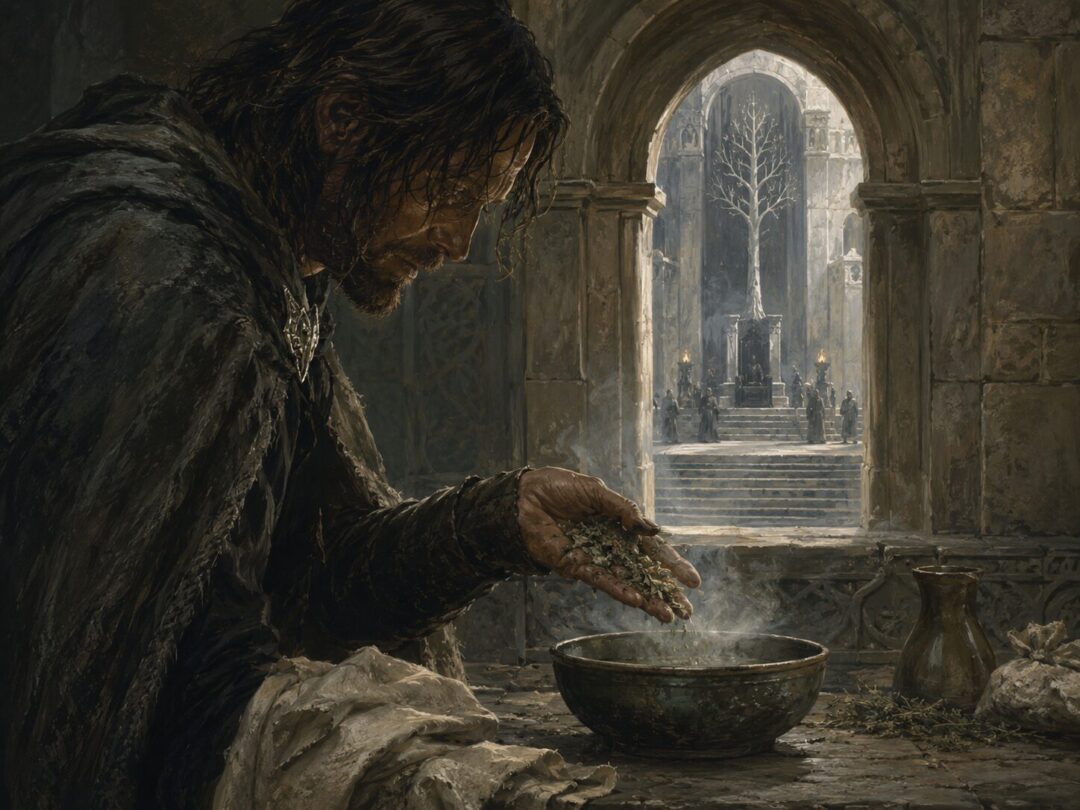
Aragorn is crowned later, outside Minas Tirith, after the victory at the Morannon and the fall of Sauron. Only then does he enter the City as King Elessar. The order is not accidental. First he comes hidden and cloaked to heal. Later he comes openly to reign.
That sequence tells us how the story wants us to understand him. Aragorn’s lineage gives him the right to return, but his mercy makes that return believable. His healing hands do not replace his bloodline; they reveal its proper fruit. He is not merely the descendant of kings. He is the renewal of what kingship was supposed to mean.
The hands of the king are not only a test of identity. They are a test of character.
And Aragorn passes it in the quietest possible way: not on a throne, not before cheering armies, but beside the beds of the wounded, with crushed leaves of athelas in warm water, calling the lost back from the dark.
Sources & Notes
- https://tolkiengateway.net/wiki/Houses_of_Healing — Tolkien Gateway, Houses of Healing: setting and events surrounding Aragorn’s treatment of Faramir, Éowyn, Merry, and others after the Pelennor Fields.
- https://tolkiengateway.net/wiki/Athelas — Tolkien Gateway, Athelas: kingsfoil’s Númenórean/Dúnedain associations and its use against the Black Breath and other evil wounds.
- https://tolkiengateway.net/wiki/Aragorn — Tolkien Gateway, Aragorn: biography and Return of the King context for his claim, restraint, and healing role in Minas Tirith.
- https://tolkiengateway.net/wiki/Black_Breath — Tolkien Gateway, Black Breath: background on the Nazgûl-induced sickness healed in the Houses of Healing narrative.
Sources selected for Tolkien lore context on Aragorn, athelas/kingsfoil, the Houses of Healing, and the Black Breath.