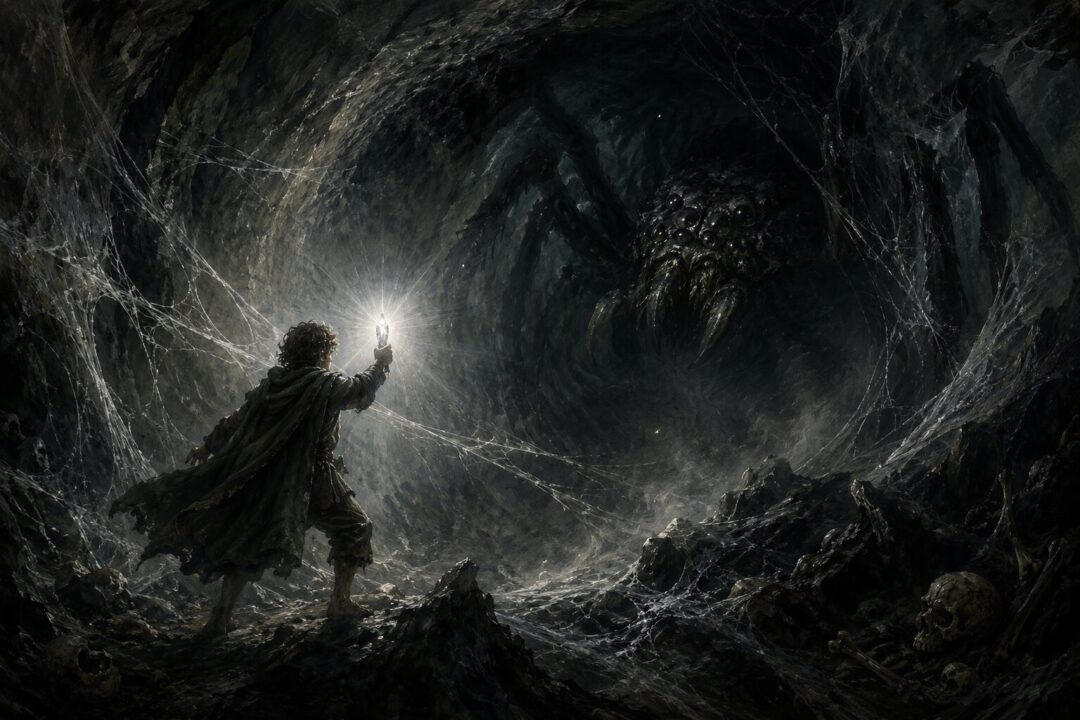
A torch would have made sense in Shelob’s tunnel. Fire is practical. It throws light on stone, burns through cobwebs, and gives frightened travellers something ordinary to trust. But when Frodo and Sam entered the pass above Minas Morgul, ordinary light was not the weapon that mattered.
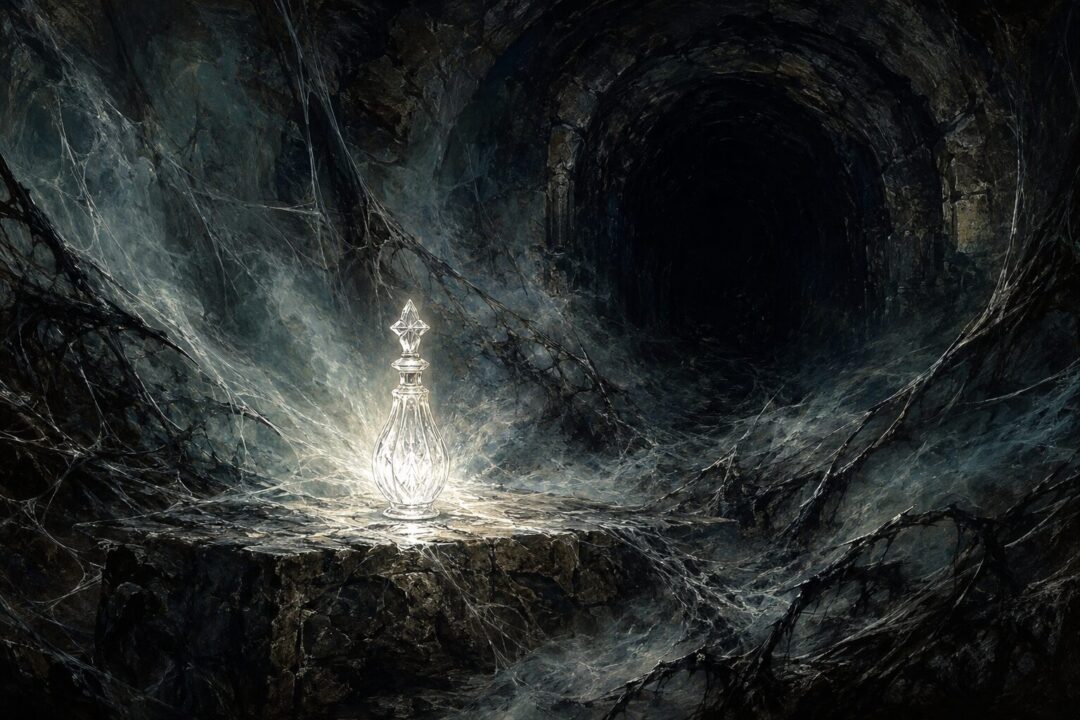
The object that changed the encounter was small enough to hang near Frodo’s breast: Galadriel’s Phial, filled with water from her fountain and holding the light of Eärendil’s star. Against Shelob, it did not behave like a brighter lantern. It became something far older and more dreadful to her than flame.
That is the key to the scene. Shelob was not merely afraid of being seen. She was confronted by a kind of light bound to the deepest history of Middle-earth: the light of the Silmaril, the light preserved from the Two Trees, the light raised into the heavens as a sign against the powers of the ancient darkness. A torch could expose Shelob. The Phial touched the wound at the root of what she was.
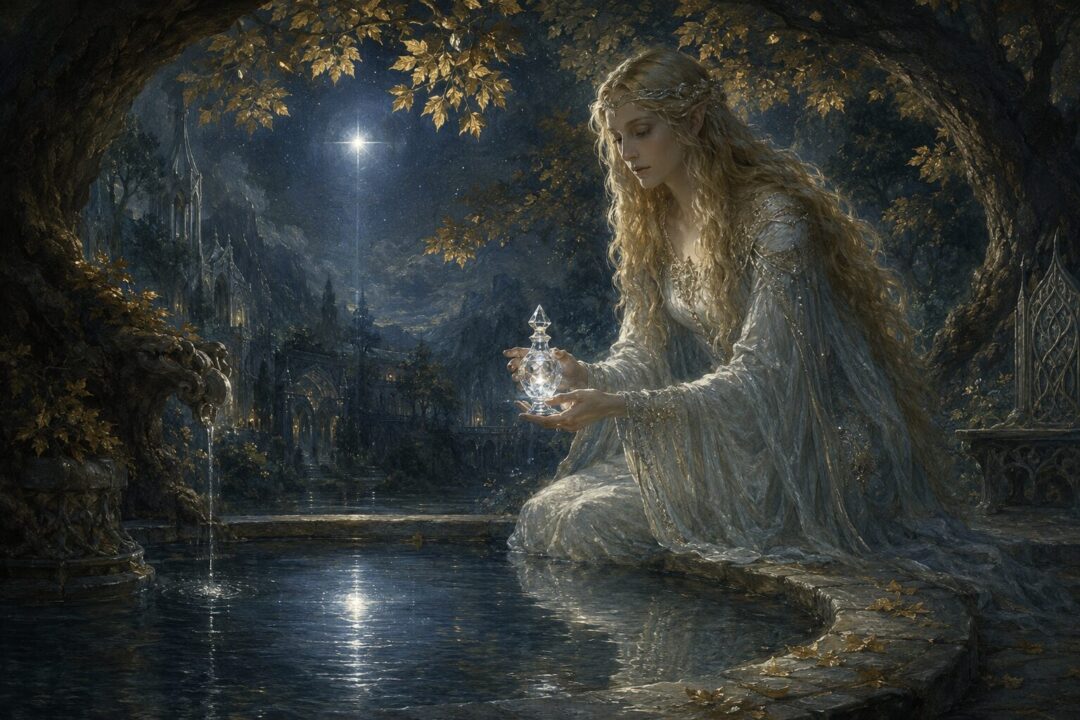
The Phial Was Not Ordinary Light
Galadriel gives the Phial to Frodo in Lothlórien with a very specific explanation. It contains the light of Eärendil’s star, caught in the waters of her fountain. She tells him it will shine brighter when night is around him, and that it is meant to be a light in dark places when other lights go out.
That wording matters. The gift is not described as Elvish technology, nor as a convenient lamp. Its power is tied to memory, endurance, and the survival of light through ages of loss.
Eärendil’s star is not merely a distant point in the sky. In the larger legendarium, Eärendil bears a Silmaril, one of the jewels in which the light of the Two Trees of Valinor was preserved before their destruction. That means the Phial’s radiance is several steps removed from the original light, but still linked to it: Trees to Silmaril, Silmaril to star, star to reflected light in Galadriel’s water, water to the Phial.
That chain is important because Tolkien’s world treats certain kinds of light as morally and spiritually charged. Not every light is equal. Fire can warm, destroy, or signal. Sunlight and moonlight belong to the created order. But the light of the Two Trees, preserved in a Silmaril and set in the sky with Eärendil, carries the weight of ancient holiness, defiance, and providential hope.
So when Frodo raises the Phial in Shelob’s Lair, he is not simply holding up a bright object. He is carrying a remnant of a light that once existed before the Sun and Moon, a light that the servants and descendants of darkness could not easily endure.
Shelob Was More Than a Giant Spider
Shelob’s terror lies partly in her physicality: the stench, the webs, the many eyes, the hunger, the long patient malice in the dark pass. But the text gives her a deeper ancestry. She is the last child of Ungoliant to trouble the unhappy world.
Ungoliant is one of the most dreadful figures in the older stories. She is associated with a devouring darkness so terrible that she helped destroy the Two Trees themselves. Her darkness was not merely absence of light. It was an active, consuming power. She drank light, hated it, and used darkness as a weapon.
Shelob is not Ungoliant, and the texts do not make them identical. Shelob is a diminished descendant in the Third Age, living in her tunnels above Mordor, feeding on Elves, Men, Orcs, and whatever else comes into her lair. Yet her nature still echoes that older horror. She is described through appetite, shadow, venom, webs, and self-serving malice. She serves neither Sauron nor anyone else in loyalty, though Sauron knows of her and allows her to remain as a useful terror near his borders.
This makes her encounter with the Phial more than a monster scene. Shelob is a creature of ancient darkness meeting a fragment of the very light her ancestral darkness opposed.
Why a Torch Would Not Have Been Enough
A torch is useful against many natural fears. It can push back darkness, threaten beasts, and give travellers courage. But Shelob’s darkness is not only practical darkness. It is part of her atmosphere, her hunting method, and her symbolic nature.
Her lair is filled with webs, foul air, and choking blackness. Frodo and Sam are not simply walking in a cave at night; they are entering a space shaped by predation and despair. Shelob’s power depends on confusion, isolation, and the crushing sense that all ways forward have been swallowed.
A torch could have given some visibility. It might even have been dangerous to webs. But the story does not frame Shelob as a creature who can be defeated simply by camping gear. Her horror is older and more inward. She is not just hidden in the dark; she belongs to it.
The Phial is different because it does not merely illuminate the tunnel. It challenges the darkness. When Frodo remembers Galadriel’s gift and raises it, the light grows. The scene links the Phial with words of invocation: Frodo cries out in Elvish, calling on Eärendil. The light becomes unbearable to Shelob’s eyes. It is described as a star-like radiance in the heart of her blackness.
That is why the Phial hurts her more than a torch could. A torch says, “I can see you.” The Phial says, “The ancient light still survives.”
The Pain Was in the Eyes — and in the Meaning
The immediate effect is visual and physical. Shelob’s many eyes, accustomed to darkness and predation, are struck by the Phial’s radiance. The text presents her recoil as pain and terror, not mere inconvenience. This is not the reaction of a beast surprised by a lantern.
But the scene also works on a deeper level. Shelob’s eyes are central to the horror of the encounter. Frodo and Sam first perceive her through those clusters of eyes in the dark. They are predatory, watchful, and alien. Her gaze belongs to the tunnel’s power over its victims: she sees while they do not.
The Phial reverses that relationship. Suddenly Shelob is the one exposed. The hidden hunter is forced into the light. Her eyes, which made her terrifying, become the vulnerable point.
This reversal is one of the most satisfying details in the scene. Shelob’s power is not overcome by greater physical strength. Frodo and Sam do not become mighty warriors. Instead, the darkness that made her dominant is broken by a light she cannot master. The small thing Galadriel gave in Lothlórien becomes a weapon precisely because Shelob’s world has no answer to it.
Galadriel and Shelob Are Opposites Without Ever Meeting
Galadriel and Shelob never confront each other directly, yet the Phial makes their opposition unmistakable.
Galadriel is associated with memory, preservation, beauty, water, and light. Her realm of Lothlórien is itself a kind of resistance against time and decay, though not without sorrow. Her gift to Frodo is not a weapon in the conventional sense. It is a vessel of light given freely, without domination.
Shelob is associated with appetite, darkness, isolation, and consumption. She does not build a realm of beauty. She makes a lair. She does not preserve. She devours. She does not give. She feeds.
The Phial carries Galadriel’s presence into a place where Galadriel herself cannot go. That matters because Frodo and Sam’s journey often depends on gifts that seem small until the exact moment they are needed. The Elven-cloak, the lembas, Sting, the rope, and the Phial all show that mercy, foresight, and friendship can become practical forms of survival.
Against Shelob, Galadriel’s gift becomes the answer to Shelob’s nature. Not a queen facing a monster, but a freely given light entering the lair of a creature who has lived by taking.
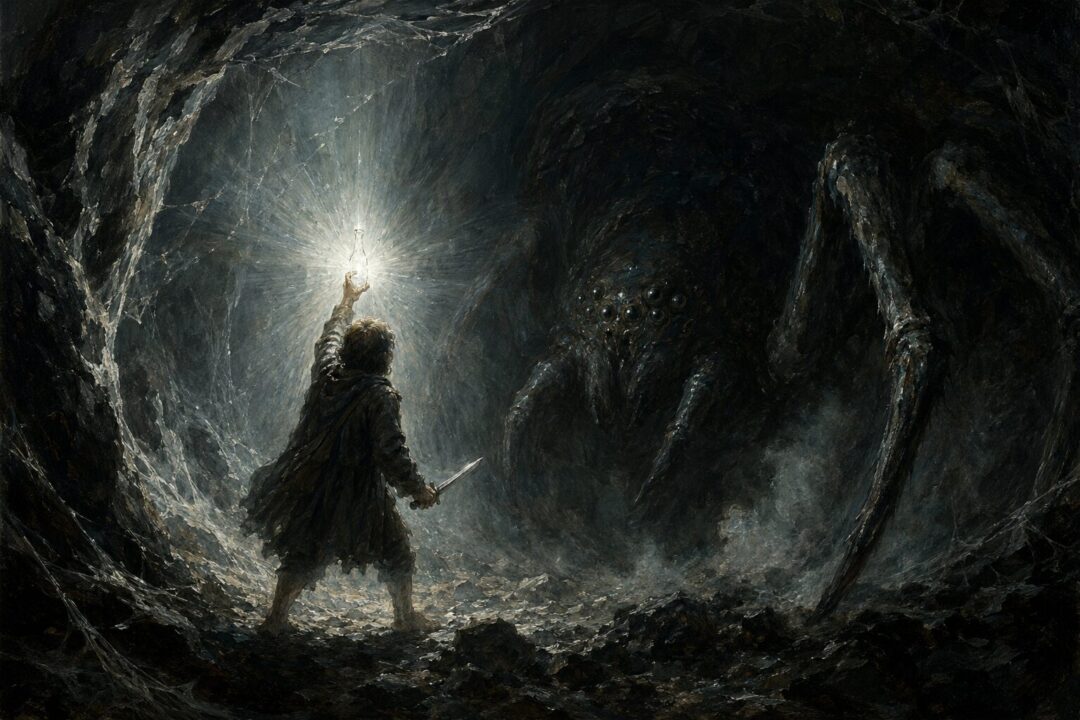
The Phial Did Not Defeat Shelob Alone
It is important not to overstate the case. The Phial hurts and terrifies Shelob, but it is not the only thing that saves the hobbits.
Frodo first drives her back with the Phial and Sting. Later, after Frodo is stung and Sam believes him dead, Sam wounds Shelob with Sting while she is trying to crush him. The text makes the wound crucial. Shelob’s own weight and force drive her onto the blade, and the pain is terrible. Sam then raises the Phial again, and its light helps break her will to continue.
So the Phial is not a simple magical spider-killer. It does not erase danger. It does not make Frodo invulnerable. It does not prevent Shelob from striking him. Its power works together with courage, resistance, and the unlikely heroism of Sam.
That is part of the scene’s greatness. The ancient light is necessary, but so is the gardener who refuses to give up. The Phial brings the light of Eärendil into Shelob’s darkness, but Sam must still stand, speak, strike, and endure.
The Deeper Pattern: Light Preserved Against Devouring Darkness
Shelob’s confrontation with the Phial echoes a much older pattern in Middle-earth: light is made, lost, preserved, stolen, recovered, and passed on. The Two Trees are destroyed, but their light survives in the Silmarils. One Silmaril is carried into the heavens by Eärendil. Galadriel catches that star-light in water. Frodo carries it into Mordor’s shadow. Sam lifts it in the tunnel when hope seems gone.
This chain of survival is one of the quiet miracles of the story. The light does not remain in a palace, a treasury, or a safe country. It travels into the hands of the small and frightened. It goes where power would not think to look.
Shelob, by contrast, is the endpoint of devouring. She gathers things into darkness. Her web catches, binds, and drains. Her tunnel is a place where stories should end.
The Phial refuses that ending. It brings into her lair the memory of a light that darkness once tried and failed to consume completely.
Why It Hurt More Than Fire
So the answer is not simply that the Phial was brighter than a torch. Brightness is only part of it.
It hurt Shelob more because its light belonged to a sacred and ancient lineage opposed to the kind of darkness she embodied. It hurt because Shelob’s power depended on hiddenness, fear, and the suffocating rule of her own black tunnel. It hurt because her many eyes, instruments of predation, were forced to receive a light connected to the Silmaril of Eärendil. It hurt because Galadriel’s gift was not just illumination, but remembrance made visible.
A torch could have burned in Shelob’s lair.
The Phial brought into it a star.
Sources & Notes
- https://tolkiengateway.net/wiki/Phial_of_Galadriel — Tolkien Gateway, ‘Phial of Galadriel’: explains the Phial as water from Galadriel’s fountain containing the light of Eärendil’s star and its use by Frodo and Sam.
- https://tolkiengateway.net/wiki/Shelob — Tolkien Gateway, ‘Shelob’: background on Shelob as a monstrous spider, descendant of Ungoliant, and her encounter with Frodo and Sam in Cirith Ungol.
- https://tolkiengateway.net/wiki/E%C3%A4rendil — Tolkien Gateway, ‘Eärendil’: covers Eärendil’s voyage and the Silmaril set in the sky, grounding the Phial’s link to ancient holy light.
- https://tolkiengateway.net/wiki/Ungoliant — Tolkien Gateway, ‘Ungoliant’: explains the primordial spider-like darkness associated with devouring light and destroying the Two Trees, relevant to Shelob’s ancestry.
Sources selected for Galadriel’s Phial, Eärendil’s Silmaril-light, Shelob’s ancestry from Ungoliant, and the confrontation in Shelob’s Lair.