When Frodo stands at the Crack of Doom, exhausted beyond measure, many readers remember the Ring, Gollum, and the fire beneath the mountain. Fewer notice that the Quest ends not only with the destruction of evil's greatest weapon, but with a permanent wound. Frodo does not leave Mount Doom whole. He loses the very finger on which the One Ring rests.
It is one of the most haunting endings in Middle-earth because victory arrives through loss.
Yet this is not the first time the greatest quest of an Age ends with a hero returning physically diminished. Long before Frodo, Beren emerged from his impossible mission missing a hand after it had been bitten away by Carcharoth while holding a Silmaril. The parallel is too striking to ignore, but it is also more subtle than a simple repetition. The two injuries happen under remarkably similar circumstances, yet they reveal profoundly different truths about heroism, temptation, and the price of carrying holy or terrible power.
Rather than suggesting direct prophecy within the story itself, Beren's wound establishes a narrative pattern that reaches its fullest expression in Frodo's final trial.
Two Impossible Quests
Beren and Frodo begin from very different worlds.
Beren is a mortal Man in the First Age, driven by love and an oath that sends him into Morgoth's own fortress to seize a Silmaril from the Iron Crown. Frodo is a humble hobbit whose task is the opposite: not to obtain a great treasure, but to destroy one.
Despite these opposite goals, both quests share remarkable similarities.
Each hero carries an object that shapes the fate of the world.
Each enters the stronghold of the Dark Lord.
Each succeeds in reaching the object when all hope should have failed.
And neither leaves unscarred.
This repeated pattern suggests that the greatest victories in Middle-earth are rarely clean triumphs. They demand sacrifices that remain visible long after the battle ends.
Beren's Hand and the Silmaril
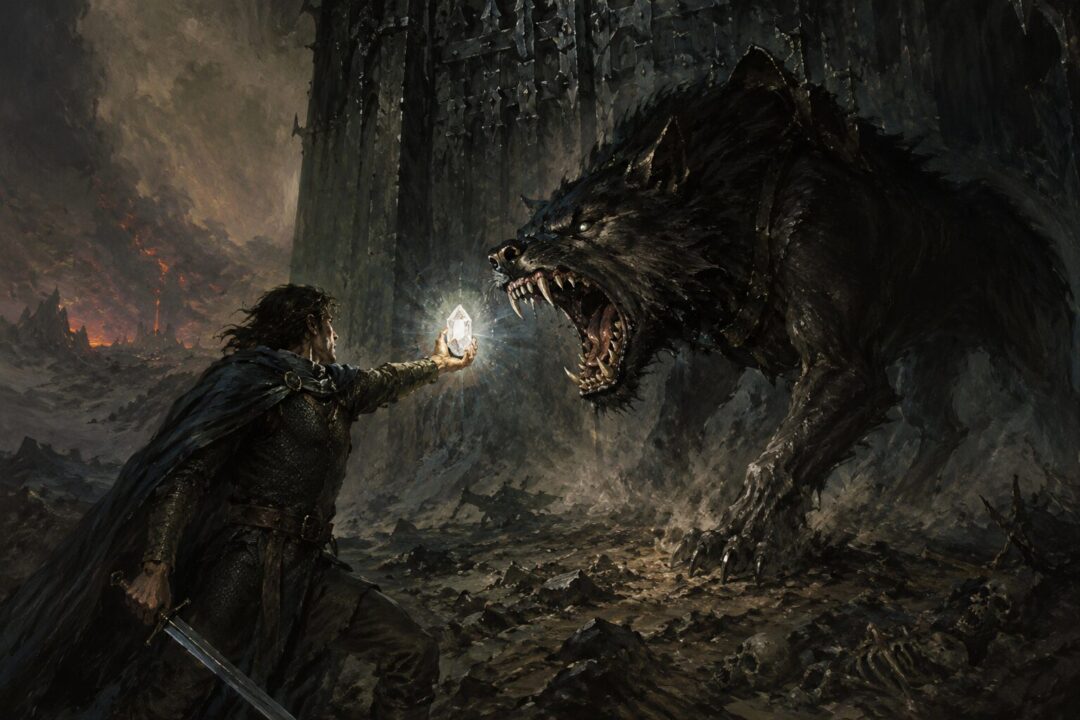
After Lúthien cast Morgoth and his court into enchanted sleep, Beren cut a Silmaril from the Iron Crown with the knife Angrist. As he and Lúthien escaped Angband, they encountered Carcharoth, the monstrous wolf bred by Morgoth to guard the gates.
Beren attempted to ward the beast away by holding out the Silmaril.
Instead, Carcharoth bit off Beren's hand at the wrist, swallowing both hand and jewel.
This moment carries several layers of meaning already present in the text.
The Silmarils had been hallowed by Varda so that no evil flesh could touch them without torment. Once Carcharoth swallowed the jewel, unbearable pain drove him into madness. The wolf became a living disaster, rampaging through Beleriand until he was finally hunted down.
Beren's injury therefore does not mark failure.
The Silmaril continues its work even after leaving his body.
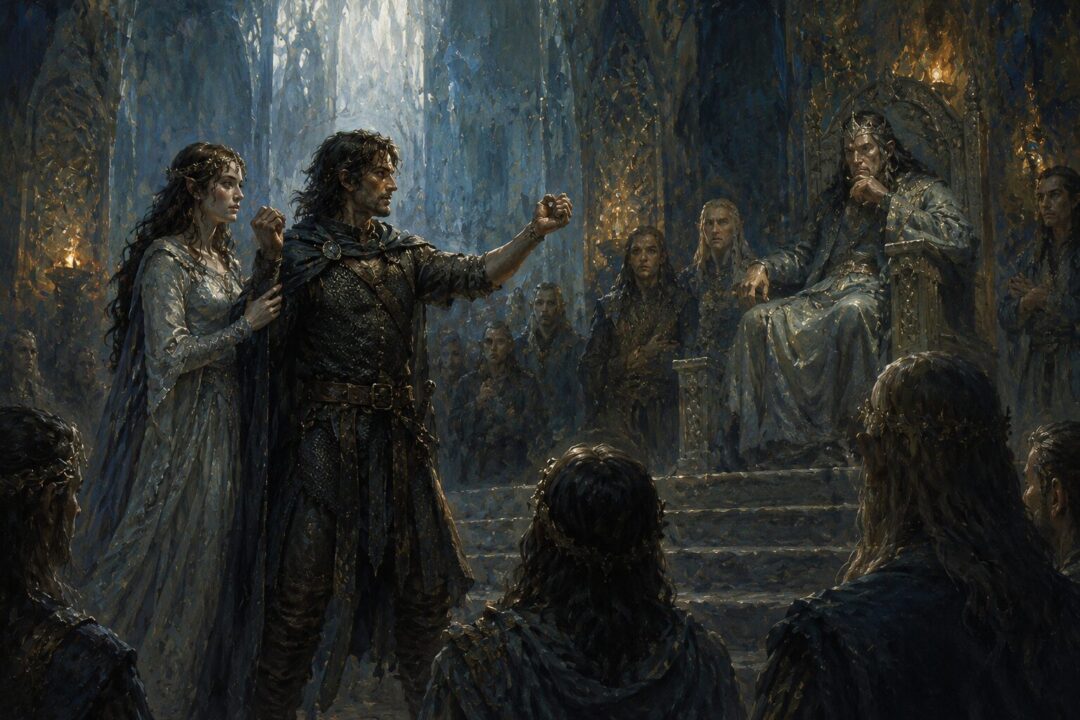
Indeed, when Beren later stands before Thingol, he can honestly answer the king's demand for proof.
"I have a Silmaril in my hand," he declares.
Then he raises his empty arm.
The irony is unforgettable. The hand is gone, yet the quest has truly been fulfilled.
Thingol, seeing both the sacrifice and the truth behind Beren's words, finally relents and permits the marriage of Beren and Lúthien.
The missing hand becomes visible testimony that the impossible task was accomplished.
Frodo's Finger at Mount Doom
Frodo's final wound follows an eerily similar structure.
Standing over the Fire, he reaches the end of every strength available to him.
Instead of casting away the Ring, he claims it.
This is one of the most important moments in The Lord of the Rings because the text never portrays Frodo as morally weak in comparison with other characters. Rather, it demonstrates the overwhelming power of the Ring itself. Earlier in the story, Gandalf had warned that no one could safely wield it, and the narrative consistently shows its corruption growing stronger the nearer it comes to its source.
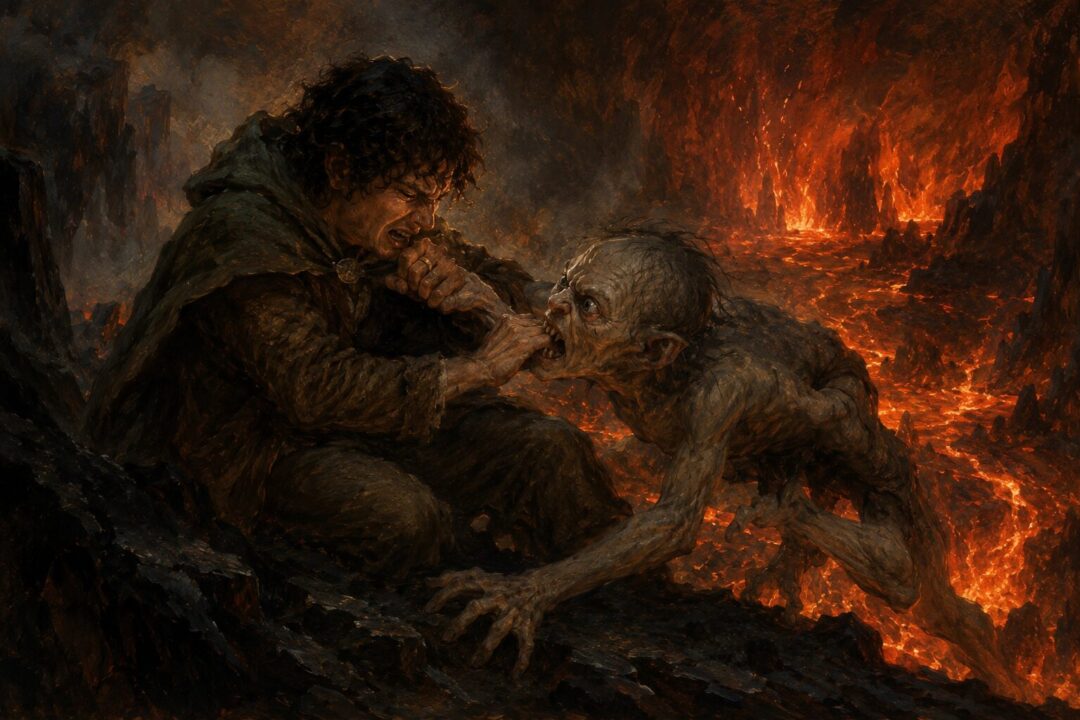
At the last instant, Gollum attacks.
Unable to see Frodo while he wears the Ring, he nevertheless grapples with him, bites off the Ring-bearing finger, and takes back his "Precious." Moments later, Gollum falls into the Fire, bringing about the Ring's destruction.
Like Beren's injury, Frodo's mutilation occurs at the precise instant the quest reaches its climax.
The hero achieves victory.
But not without permanent loss.
Similar Wounds, Different Meanings
Although the physical parallels are unmistakable, the symbolism differs.
Beren loses the hand that bears a holy jewel.
Frodo loses the finger that bears an object of absolute corruption.
The contrast matters.
The Silmaril remains pure throughout its history. Countless beings commit terrible deeds because they desire it, but the jewel itself never corrupts its possessor in the way the One Ring does. The evil lies in pride, possessiveness, and oath-breaking, not in the Silmaril itself.
The Ring is fundamentally different.
It actively dominates the will of those who bear it.
Thus Beren's wound follows an act of extraordinary courage.
Frodo's wound follows the moment he finally yields to temptation.
Yet neither ending reduces the hero's achievement.
Beren still succeeds.
Frodo still saves Middle-earth.
The texts hold both truths together without contradiction.
Victory Through Mercy Rather Than Strength
Another shared feature often goes unnoticed.
Neither hero ultimately completes the quest through personal strength alone.
Beren does not defeat Morgoth by force.
His success depends upon Lúthien's courage, Huan's loyalty, the providential aid of the Eagles, and finally the Hunting of the Wolf that recovers the Silmaril from Carcharoth.
Likewise, Frodo does not destroy the Ring by an act of iron will.
Instead, Gollum's intervention becomes decisive.
This ending has often surprised readers expecting a conventional heroic climax. Yet Gandalf had long before suggested that Gollum still had a role to play, and the story repeatedly emphasizes mercy shown toward him by Bilbo and Frodo.
The destruction of the Ring therefore arises from a chain of mercy extending across decades.
The pattern resembles Beren's story in one important respect.
In both tales, the hero's personal courage remains indispensable.
Yet courage alone is not enough.
The final victory comes through circumstances greater than any single individual controls.
Wounds That Cannot Be Healed
Middle-earth rarely pretends that evil leaves no scars.
Beren survives the loss of his hand, but later dies from the wounds inflicted during the Hunting of Carcharoth before Lúthien's choice allows them both to return briefly to mortal life.
Frodo survives Mount Doom.
Yet survival is not the same as restoration.
His missing finger becomes only one visible reminder among many deeper wounds.
The pain from Weathertop returns.
Shelob's poison lingers.
The burden of the Ring never entirely leaves him.
His departure over Sea acknowledges a difficult truth found throughout the legendarium: some injuries cannot be fully healed within Middle-earth itself.
Beren and Frodo both become living witnesses that great victories often require irreversible sacrifice.
The Empty Hand as a Sign of Completion
One of the most remarkable literary echoes lies in what remains after the object is gone.
When Beren returns to Thingol, the missing hand proves that he truly reached Morgoth's crown.
The absence becomes evidence.
Likewise, Frodo's missing finger silently declares that he reached the very heart of Sauron's realm.
Neither hero returns displaying the prize.
One has lost the Silmaril.
The other has lost the Ring.
Instead, each bears only the wound.
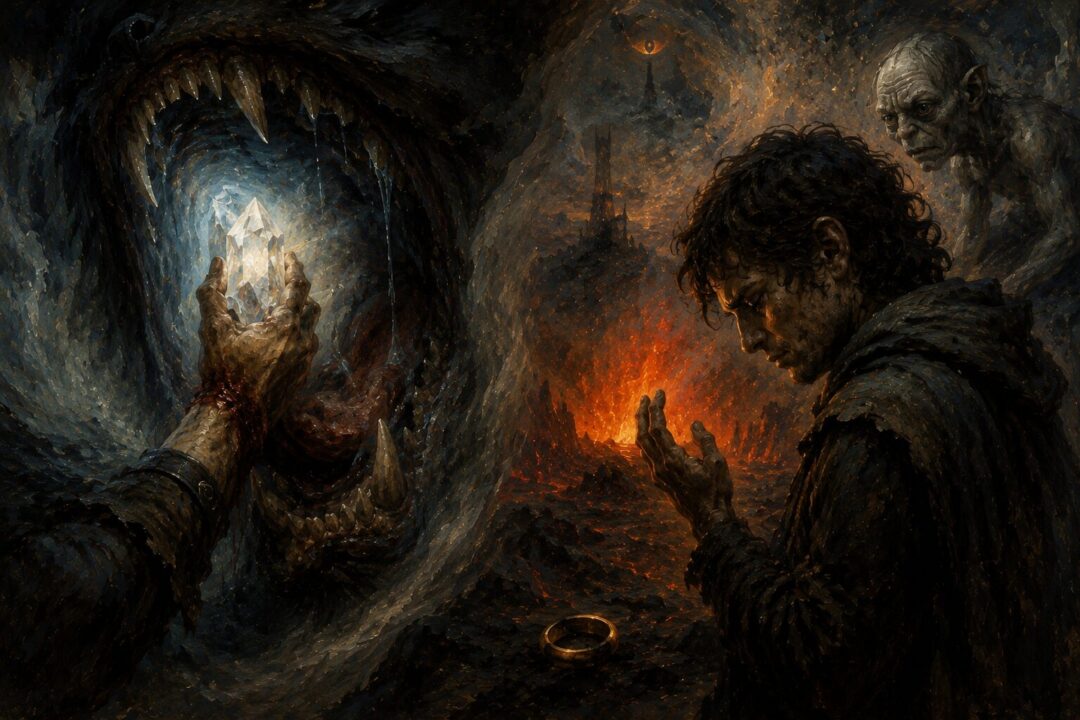
In both cases, the body itself becomes the record of the quest.
This is not merely physical injury.
It is visible testimony that the impossible road was actually walked.
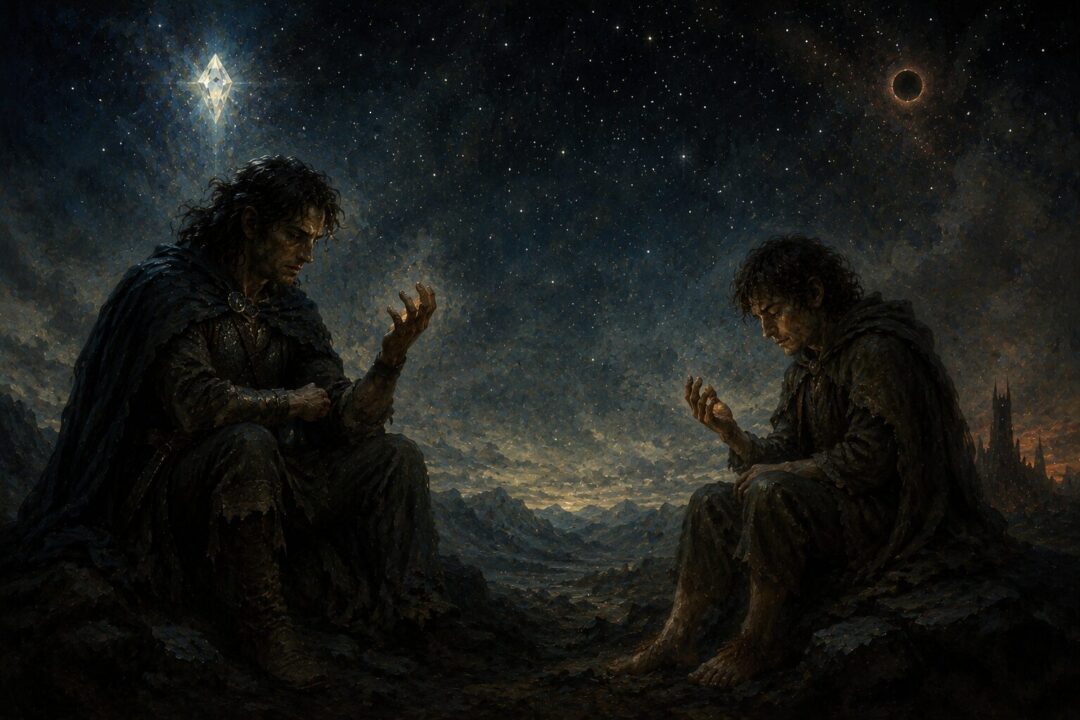
Why the Echo Matters
The connection between Beren's hand and Frodo's finger should not be understood as a prophecy inside Middle-earth's history. The texts never state that Frodo consciously repeats Beren's fate, nor that one event predicts the other.
Instead, the resemblance belongs to the deeper structure of the legendarium.
The greatest heroes repeatedly discover that confronting ultimate evil demands more than bravery.
It demands surrender.
Sometimes that surrender is chosen.
Sometimes it is forced.
Sometimes it comes at the very instant success seems within reach.
Beren loses the hand carrying the light of a Silmaril.
Frodo loses the finger carrying the darkness of the Ring.
One bears away a sacred jewel only briefly before it passes beyond him.
The other cannot relinquish a cursed treasure until it is violently torn away.
Both return marked forever.
That lasting mark explains why these stories continue to resonate. Their greatest victories never erase suffering or pretend that evil leaves no trace. Instead, they acknowledge a harder truth: the deepest wounds may become the clearest evidence that hope endured to the very end.
Sources & Notes
- https://tolkiengateway.net/wiki/Beren — Tolkien Gateway, ‘Beren’: recounts Beren’s quest for the Silmaril and the loss of his hand to Carcharoth while holding the jewel.
- https://tolkiengateway.net/wiki/Silmarils — Tolkien Gateway, ‘Silmarils’: explains the hallowed jewels and why evil flesh, such as Carcharoth’s, could not endure touching or swallowing one.
- https://tolkiengateway.net/wiki/Mount_Doom — Tolkien Gateway, ‘Mount Doom’: covers Frodo’s final failure to cast away the Ring, Gollum biting off the Ring-bearing finger, and the Ring’s destruction.
- https://tolkiengateway.net/wiki/One_Ring — Tolkien Gateway, ‘One Ring’: background on the Ring’s corrupting power and its hold over bearers, relevant to Frodo’s final wound.
Sources selected for Beren’s hand and the Silmaril, Frodo’s finger at Mount Doom, the Ring’s corrupting power, and the Beren/Frodo mythic parallel.