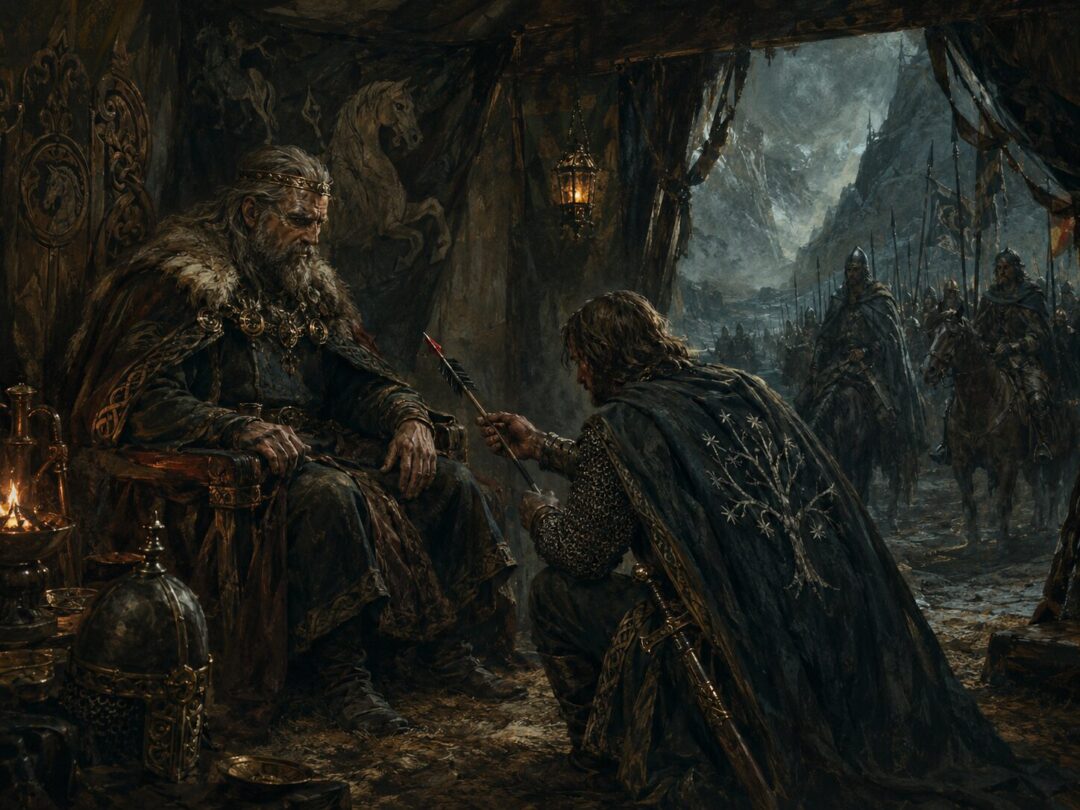
The Red Arrow is one of the smallest objects in The Lord of the Rings, yet when Théoden receives it at Dunharrow, it carries the weight of two kingdoms. It is not a weapon meant to be fired. It is a summons. Gondor is calling for aid, and Rohan must answer. The arrow has black feathers, steel barbs, and a red-painted point, and it had not been seen in the Mark during Théoden’s lifetime before Hirgon brought it to him in March 3019.
That is the obvious reason Théoden rides: Gondor needs help. But the deeper reason is more painful. Théoden has only just been restored from weakness, deception, and political paralysis. He has lost time. His son Théodred is dead. His land has been burned by Saruman’s war. His own house has been poisoned by Gríma’s counsel. When the call from Minas Tirith comes, Théoden is not merely deciding whether to send soldiers. He is deciding what kind of king he will be at the end.
Tolkien never states that Théoden has prophetic knowledge of his own death. He does not ride because he has seen his fate. He rides because every fact before him points toward mortal danger, and because refusing that danger would be a worse death for Rohan’s honor.
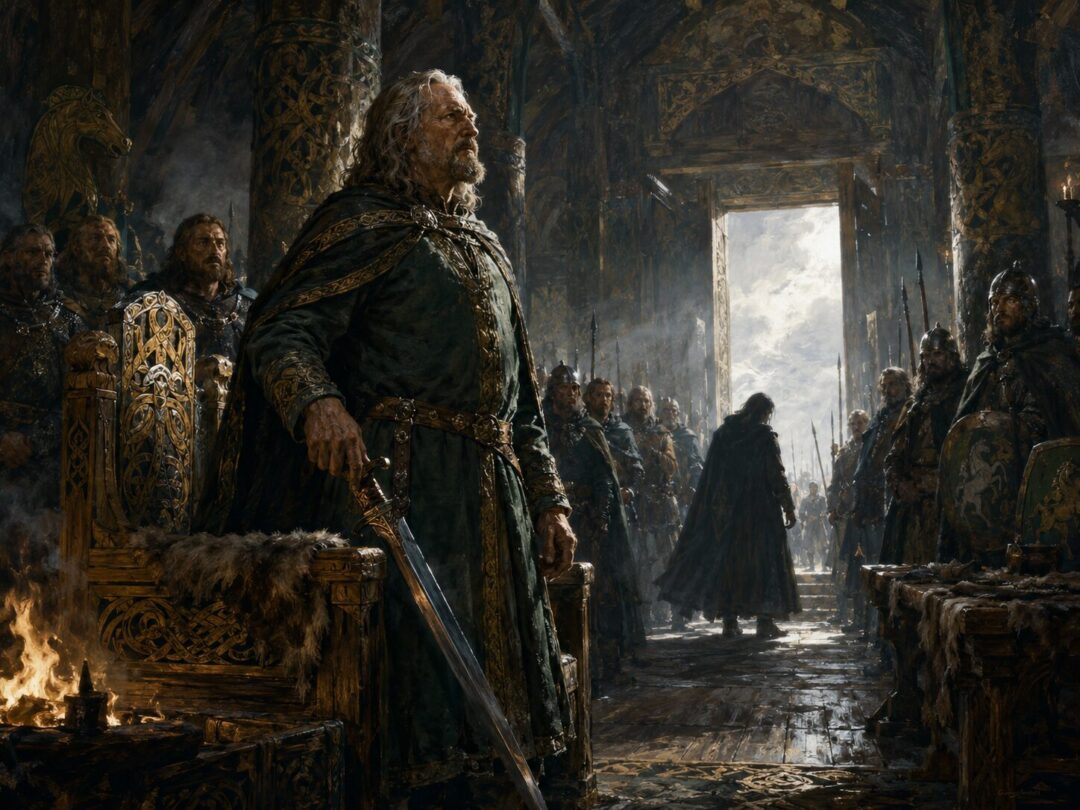
Théoden’s Ride Was Not Recklessness
It is easy to remember Théoden only as the king who charges. But the books do not present him as foolishly hungry for death. At the Hornburg, he waits until dawn. At Dunharrow, he musters what strength he can. On the road to Gondor, he accepts the guidance of Ghân-buri-Ghân and the Drúedain, who show the Rohirrim hidden paths through the forest when the main road is watched.
That matters. Théoden does not throw his people away. He takes counsel, moves with urgency, and uses the best chance available. But once the choice has narrowed to action or collapse, he chooses action.
At Helm’s Deep, the pattern is already visible. The fortress is surrounded. Saruman’s forces have broken the Deeping Wall. The defenders are being pressed back. Théoden’s decision to ride out with Aragorn at dawn looks almost suicidal from inside the keep. Yet it is also the only remaining way to turn fear into movement. The sortie led by Théoden and Aragorn breaks out from the Hornburg, and only then do the defenders discover that the Huorns have blocked the enemy’s escape and that Gandalf and Erkenbrand are arriving with help from the Westfold.
Théoden did not know rescue was about to come in that exact form. His choice was made before the victory was visible.
The King Who Had Been Kept Still
Théoden’s tragedy begins before the battlefield. In Edoras, he has become a king made old before his time, isolated by Gríma Wormtongue and weakened by despair. The recovery brought by Gandalf is not just physical. It restores Théoden’s capacity to choose.
That is why his later riding matters so much. Théoden is not a young conqueror seeking fame. He is an aged king reclaiming agency. His great temptation is not ambition, but passivity. He could remain behind, argue prudence, send others, and preserve his life. Many rulers in Middle-earth do exactly that kind of calculation, sometimes wisely and sometimes not.
But Théoden’s kingship is personal. Rohan is a horse-lord culture where the bond between king and riders is not abstract bureaucracy. The men of the Mark follow a lord who rides with them. This does not mean every king of Rohan must always be in the front rank, but in Théoden’s final crisis, the text strongly presents his presence as the thing that turns duty into courage.
At the Pelennor, his voice and example transform the army. Tolkien describes a sudden renewal: darkness breaks, the wind changes, and Théoden’s cry rises with a power beyond ordinary expectation. The Rohirrim do not merely arrive as reinforcements. They arrive as a people whose king has chosen to stand at their head.
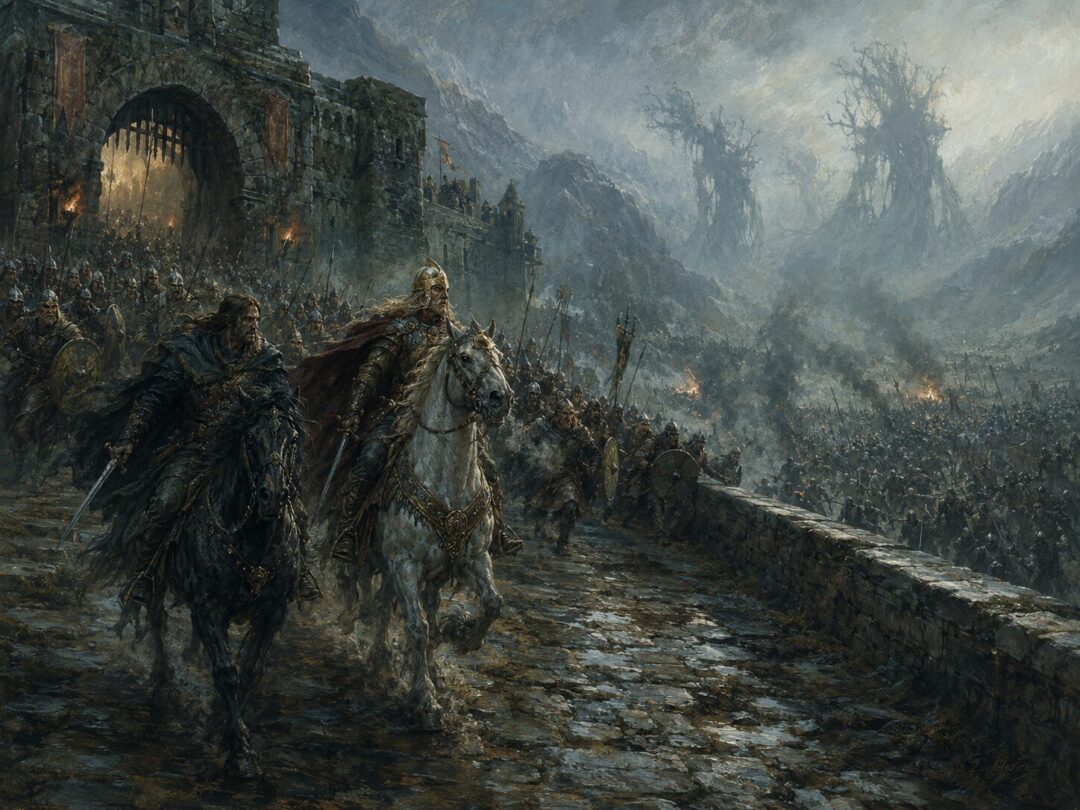
The Oath Was Bigger Than Strategy
Rohan’s ride to Gondor is not only a military calculation. It is bound to the ancient alliance between the two realms, remembered as the Oath of Eorl. During the War of the Ring, the Red Arrow is the visible sign of that old bond, and Théoden answers it by promising to ride with six thousand Riders toward Minas Tirith.
This is why Théoden cannot treat Gondor’s request as optional. If the oath fails when it is most costly, then it was never truly an oath. Rohan’s honor would survive no better than Gondor’s walls.
The grimness of the summons is emphasized by Hirgon’s fate. The messenger who brings the Red Arrow does not successfully return to reassure Minas Tirith that aid is coming. The Rohirrim later find dead errand-riders near the Rammas Echor, and the sign suggests that Gondor does not know Rohan is near.
That detail sharpens Théoden’s burden. He is riding toward a city that may already believe itself abandoned. If he comes too late, he may find only ruin. But even then, as he tells Hirgon in essence, Rohan would still come to avenge it. That is not empty bravado. It is the oath stripped down to its hardest form: aid if possible, vengeance if not, but never silence.
Why He Had to Go Himself
Could Théoden have sent Éomer and remained behind? In practical terms, perhaps. The texts do not give us a law saying the king must personally lead every host. But in narrative and moral terms, Théoden has to ride.
First, he has already lost Théodred. If he holds back while younger men pay the price of his realm’s survival, his restoration at Edoras remains incomplete. Second, Éomer has only recently been imprisoned under Gríma’s influence. Théoden’s public return to command repairs the damage done to the kingdom’s trust. Third, the crisis is not merely Rohan’s defense but the survival of the West. A deputy can command troops, but only the king can embody the full answer of Rohan to Gondor.
This is one of the great contrasts in The Return of the King. Denethor remains within Minas Tirith and is consumed by despair. Théoden rides outward and is killed, but his death occurs within an act of renewal. That contrast should not be simplified into “Denethor cowardly, Théoden brave.” Denethor is a complex ruler under terrible pressure. Still, the structure of the story is clear: despair turns inward, while hope accepts the road even when the road may end in death.
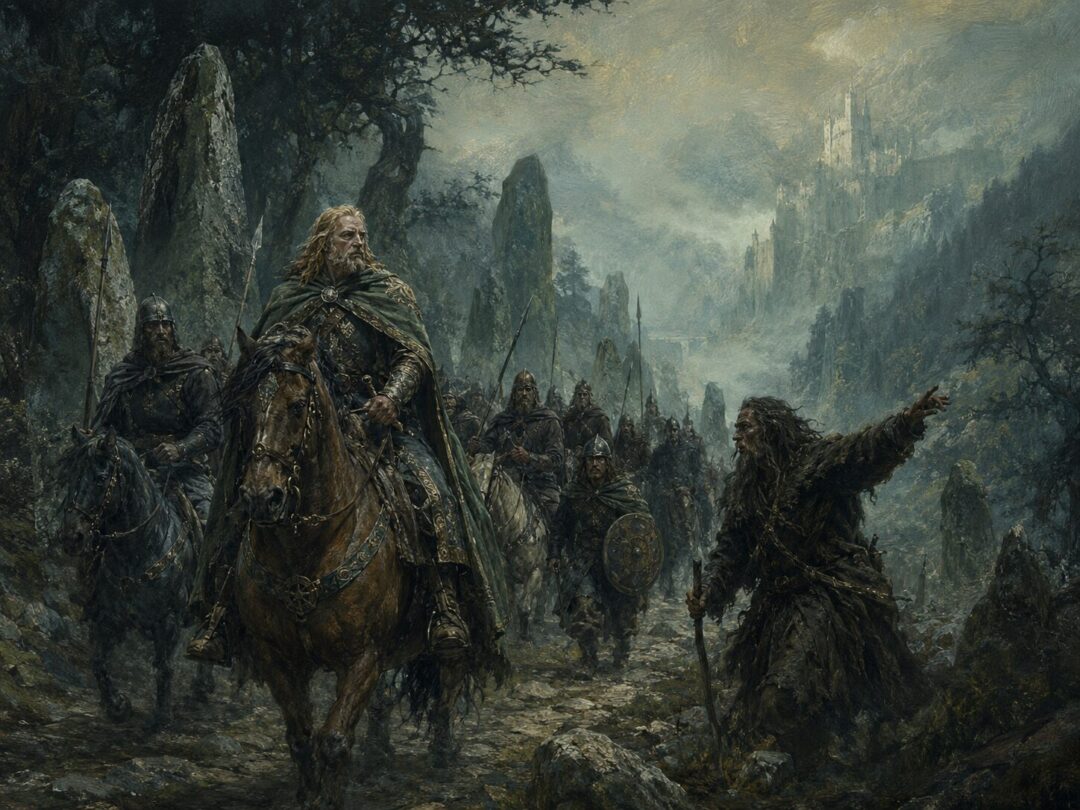
Théoden Did Not Ride Because Victory Was Certain
At the Pelennor Fields, the Rohirrim are not entering a fair fight. Mordor’s forces have already breached the outer defenses of Minas Tirith. The Witch-king has broken the Great Gate with Grond. The armies of the Enemy include Orcs, Haradrim, Easterlings, forces from Khand, and other strength gathered under Sauron. Tolkien Gateway summarizes the battle as the greatest battle of the War of the Ring, and the Rohirrim relief force is given as six thousand Riders against an enemy of vast superiority.
Théoden’s charge is therefore not confidence in easy success. It is courage without guarantee. This is a recurring moral rule in The Lord of the Rings: the right deed is often required before its outcome can be known. Frodo enters Mordor without knowing he can destroy the Ring. Aragorn takes the Paths of the Dead without knowing whether the Dead will answer. Théoden rides to Minas Tirith without knowing whether Gondor still stands.
The difference is that Théoden’s decision is public. His courage must become contagious. If he falters, thousands falter. If he rides, thousands ride.
The Beauty of a Chosen End
Théoden’s death is not meaningless because it is not the point of the ride. He does not seek death. He seeks to spend the life left to him in the right place.
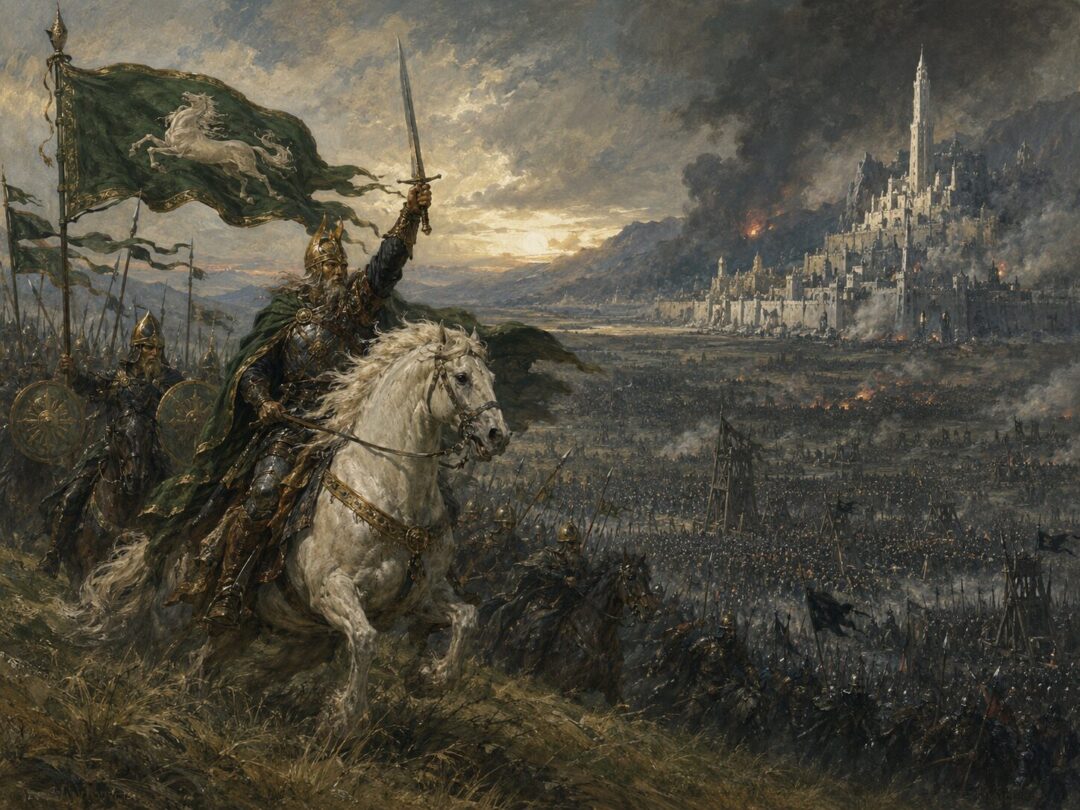
On the field, he achieves more than symbolic glory. His charge helps break Mordor’s assault, drives into the enemy’s northern forces, and throws down the chieftain of the Haradrim and the black serpent standard before the Witch-king turns upon him.
Then comes the bitter turn: Snowmane is struck down, and the horse falls upon Théoden. He dies not as an untouched hero standing above war, but as a mortal king crushed inside the cost of it. That is part of why the scene endures. Théoden’s glory is not invulnerability. It is obedience to duty after fear has had every chance to speak.
Even his last place in the story is not isolated. Éowyn, whom he tried to leave behind in safety, has ridden in disguise. Merry, whom he also ordered to remain behind, has come with her. The old king’s mercy toward Merry and his concern for those under his care are not side details. They show that Théoden’s courage is not the love of battle for its own sake. He wants the vulnerable protected. He wants his people preserved. But he also knows that some things can only be preserved by risking everything.
The King Rohan Needed at the End
The title question has a simple answer and a deeper one. Théoden had to ride because Gondor called. He had to ride because Rohan’s oath demanded it. He had to ride because Minas Tirith’s fall would leave the West nearer to ruin. He had to ride because his riders needed their king before them.
But most of all, he had to ride because he had been given back himself.
The restored Théoden is not granted a long peaceful reign. He is granted one final chance to be fully what he is: king of the Mark, keeper of an oath, father of a wounded house, and leader of a people whose courage must be awakened before dawn. His death is tragic, but it is not defeat. He dies in the very act that proves Gríma did not have the last word over him, Saruman did not break him, and fear did not master him.
Théoden rides out because the alternative would be survival without kingship. And for him, at that hour, that would have been the lesser life.
Sources & Notes
- Wikipedia overview of Théoden and his leadership of Rohan — https://en.wikipedia.org/wiki/Th%C3%A9oden
- Wikipedia overview of Rohan as the kingdom Théoden rides for — https://en.wikipedia.org/wiki/Rohan,_Middle-earth
- Wikipedia overview of The Return of the King and Théoden at the Pelennor Fields — https://en.wikipedia.org/wiki/The_Return_of_the_King
Sources selected for Tolkien-lore context and reader verification.