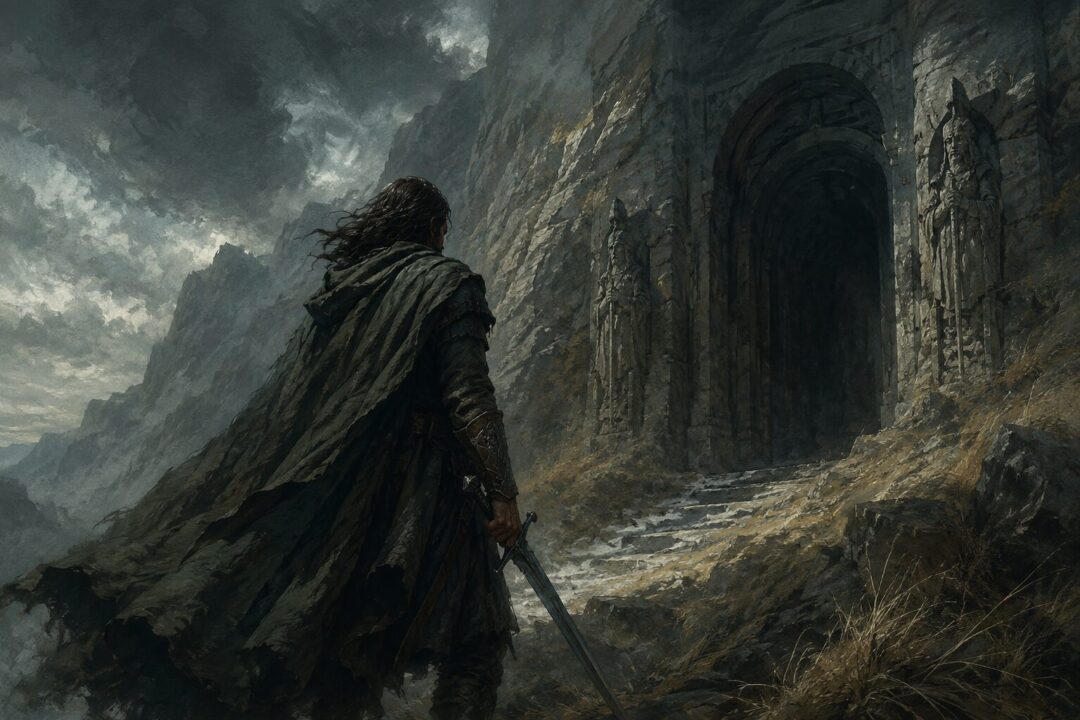
The crown of Gondor was not waiting in a bright hall. It was waiting in a mountain road where no living man wished to pass.
Before Aragorn came to Minas Tirith as king, before the banner of Elendil broke upon the wind from the black ships, he had to enter the Paths of the Dead. That journey was not merely a shortcut through the White Mountains. It was the point where Aragorn’s claim stopped being ancestry and became judgment.
He was not tested by whether he could kill. He was tested by whether he could command the unresolved past.
The Door No King Had Opened
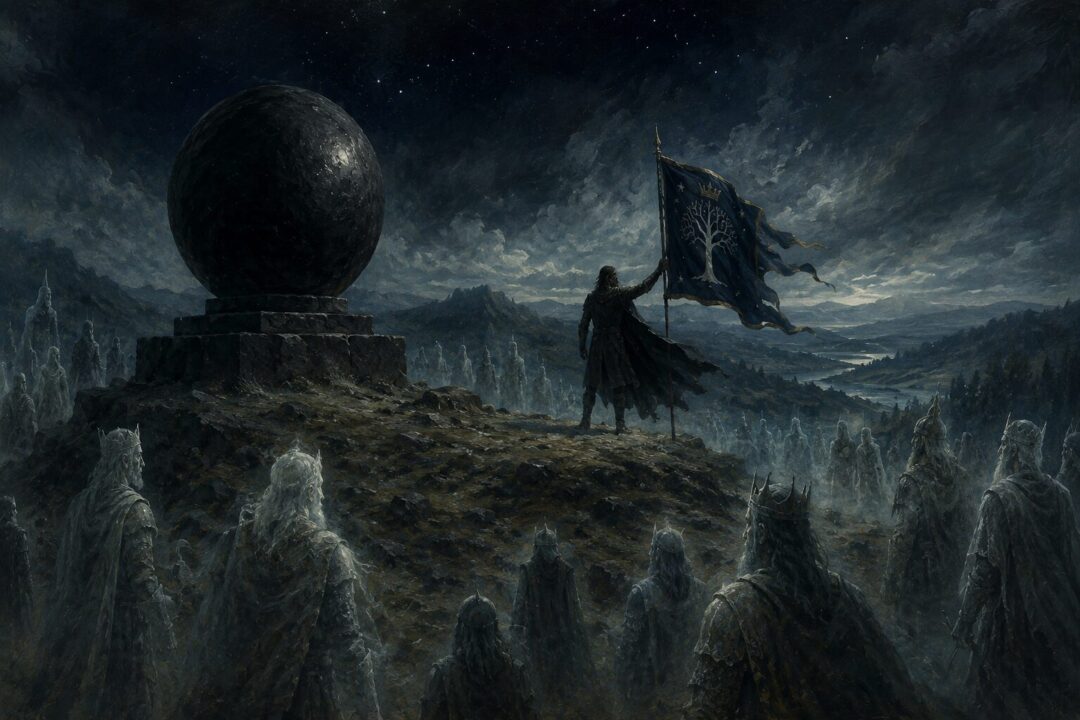
The Paths of the Dead were feared by the Rohirrim and remembered in old words. At Dunharrow, the Dark Door stood beneath the mountain, and the living avoided it. The dread was not vague superstition. The Dead Men of Dunharrow were bound there because of an oath broken in the Second Age.
They had sworn allegiance to Isildur at the Stone of Erech. When Isildur called them to fight against Sauron, they refused. The reason given in the lore is stark: they had worshipped Sauron in the Dark Years. Isildur cursed them, declaring that they would find no rest until their oath was fulfilled.
That matters because Aragorn did not enter the mountain as a wandering hero seeking a magical army. He entered as Isildur’s heir, facing a debt that began with his own house.
Aragorn’s Claim Had to Face Isildur’s Shadow
Aragorn’s kingship is often imagined as a restoration of glory: the sword reforged, the White Tree renewed, the throne reclaimed. But the Paths of the Dead reveal a darker truth. To inherit Isildur’s line was also to inherit Isildur’s unfinished consequences.
The Dead did not owe service to “Aragorn the brave.” They owed service to the heir of the man whose curse held them. That made the journey a legal, moral, and spiritual test. Could Aragorn speak with the authority of Isildur without becoming merely another lord of fear?
The texts show him acting with command, not cruelty. He summons the Dead, demands passage, and later calls them to the Stone of Erech. Yet his purpose is limited: fulfill the oath, defeat the threat from the south, and be released. He does not keep them as a permanent weapon.
That restraint is crucial. A lesser claimant might have seen the Dead as power to possess. Aragorn treats them as a burden to resolve.
The Prophecy Was About Need, Not Glory
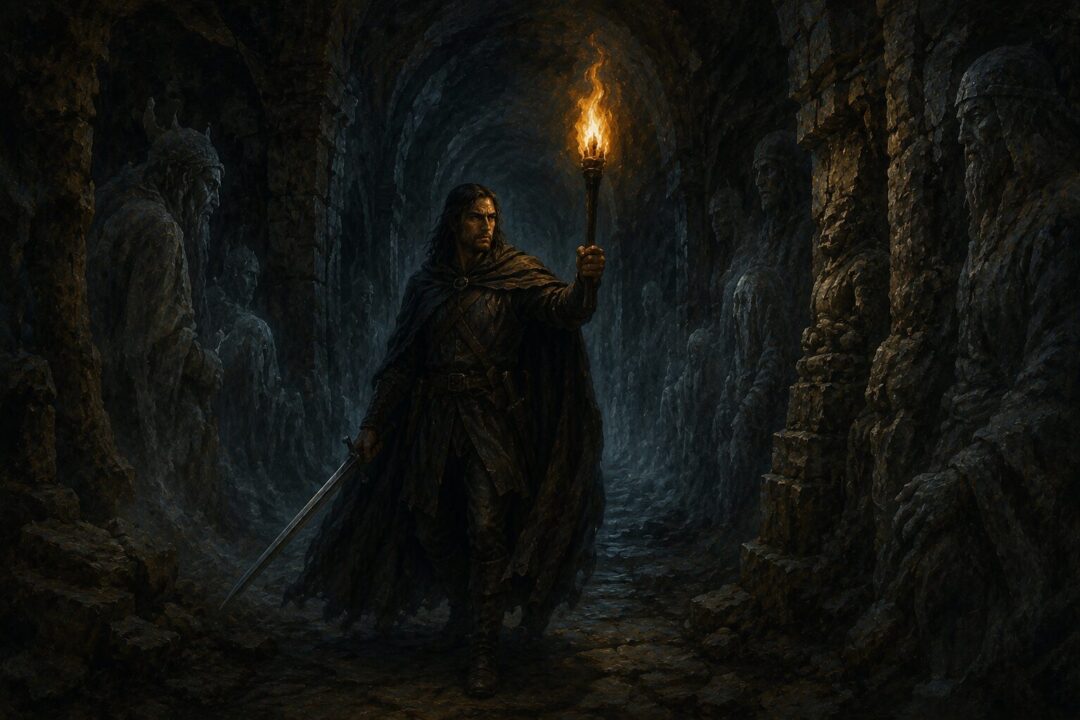
Malbeth the Seer had foretold that the heir of Isildur would take the road under the mountain when need and haste drove him. That detail changes the meaning of the episode. Aragorn does not choose the Paths because they are glorious. He chooses them because time has run out.
After looking into the palantír, Aragorn understands that danger is coming from the south: the Corsairs of Umbar threaten Gondor’s coastal lands and the Anduin. If those ships reach the war at the wrong moment, Minas Tirith may fall before help can matter.
The Paths of the Dead therefore become the kingly road because they are the road no one else can take. Théoden rides openly to war. Denethor holds the city in despair. Aragorn must vanish into a place of dread, trusting prophecy, lineage, and nerve.
This is not escapism from battle. It is a descent into the oldest unpaid debt of Gondor.
The Dead Test the Meaning of Authority
The Dead obey Aragorn because he is who he says he is. But the deeper test is whether his authority heals or merely dominates.
In Middle-earth, rightful rule is never just force. Sauron commands through terror, possession, and the reduction of others into instruments. Aragorn’s command of the Dead is different. He uses fear, yes, and the coming of the Dead spreads terror among his enemies. But he does not enslave them beyond the oath’s terms.
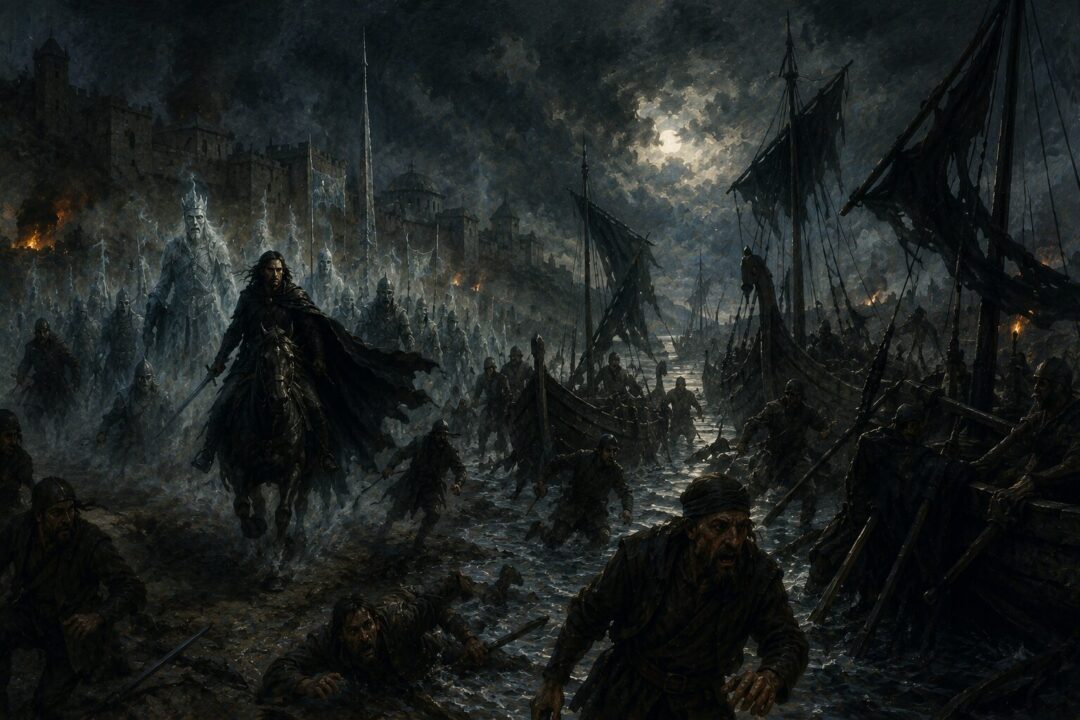
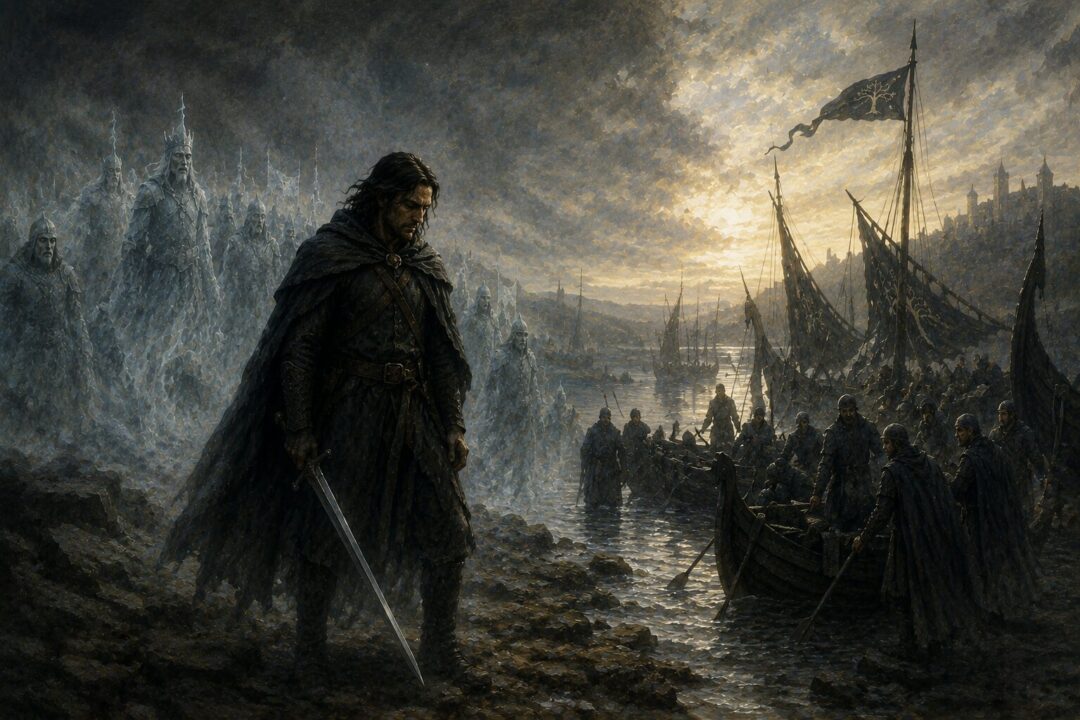
At Pelargir, the Corsairs are overthrown largely through dread. The text emphasizes the terror of the Dead and the flight of the enemy. Aragorn then releases the Oathbreakers when their task is done. They vanish, and the living continue the war.
That is the hinge of the whole episode. Aragorn proves he can wield an ancient, fearful power without being corrupted by it.
Before the Crown, He Must Save What Gondor Forgot
The Paths also test Aragorn because they force him to act outside the visible center of power. Minas Tirith does not crown him first and then send him south. He saves Gondor before Gondor formally receives him.
This is one of the quiet ironies of his return. The king comes not by demanding recognition, but by taking responsibility. He goes first to the forgotten road, the haunted oath, the southern danger, and the people threatened far from the city’s walls.
When he finally arrives at the Pelennor, he does not come empty-handed. He comes in the captured ships, bearing the standard made for him, bringing men from the southern fiefs who can now join the battle. His kingship has already become service before it becomes ceremony.
The Oathbreakers Mirror the Fall of Men
The Dead Men are not simply spooky remnants. They are a warning about fear. They had sworn loyalty, but when the hour came, fear of Sauron and old allegiance to darkness overcame their word. Their punishment is fitting in a grim way: because they would not stand among the living in the war against Sauron, they are denied the peace of the dead.
Aragorn’s test is the opposite. He must go where fear is strongest and keep his word to the living and the dead alike.
This makes the Paths one of the great moral inversions in The Lord of the Rings. The Oathbreakers once failed because they would not answer Isildur’s summons. Aragorn succeeds because he answers a summons older than himself: the need of Gondor, the prophecy of Malbeth, the claim of his bloodline, and the mercy owed even to the cursed.
Why This Had to Happen Before the Crown
Aragorn could not simply arrive in Minas Tirith and announce himself. The throne of Gondor had been empty for long ages. His claim needed more than descent. It needed proof that he could do what no Steward, captain, or lord could do.
The Paths of the Dead gave that proof in three ways.
First, they confirmed his identity. Only Isildur’s heir could rightly summon the Oathbreakers.
Second, they revealed his courage. He did not merely face enemies in battle; he entered a place where ordinary courage failed.
Third, they displayed his mercy and restraint. He did not cling to the Dead after their oath was fulfilled.
That last point may be the most important. Aragorn’s kingship is not founded on domination. It is founded on restoration: broken swords reforged, broken realms reunited, broken oaths finally answered.
The King Who Releases
The most revealing thing Aragorn does on the road to the crown is not summoning the Dead. It is releasing them.
In that moment, he becomes more than the heir of Isildur’s curse. He becomes the one who ends it. He does not deny the justice of the old oath, but neither does he prolong the punishment once its purpose is complete.
That is why the Paths of the Dead are his true threshold. A throne can be inherited. A battle can be won. But a king worthy of Gondor must know when power has done its rightful work and must be laid down.
Aragorn enters the mountain as a claimant. He leaves it as a ruler who has faced the dead, mastered fear, redeemed an ancient oath, and chosen mercy over possession.
Only then is he ready for the crown.
Sources & Notes
- Wikipedia overview of the Paths of the Dead and Aragorn’s summons of the Oathbreakers — https://en.wikipedia.org/wiki/Paths_of_the_Dead
- Wikipedia overview of Aragorn and the return of the king theme — https://en.wikipedia.org/wiki/Aragorn
- Wikipedia overview of The Return of the King for the broader Gondor and kingship context — https://en.wikipedia.org/wiki/The_Return_of_the_King
Sources selected for Tolkien-lore context and reader verification.