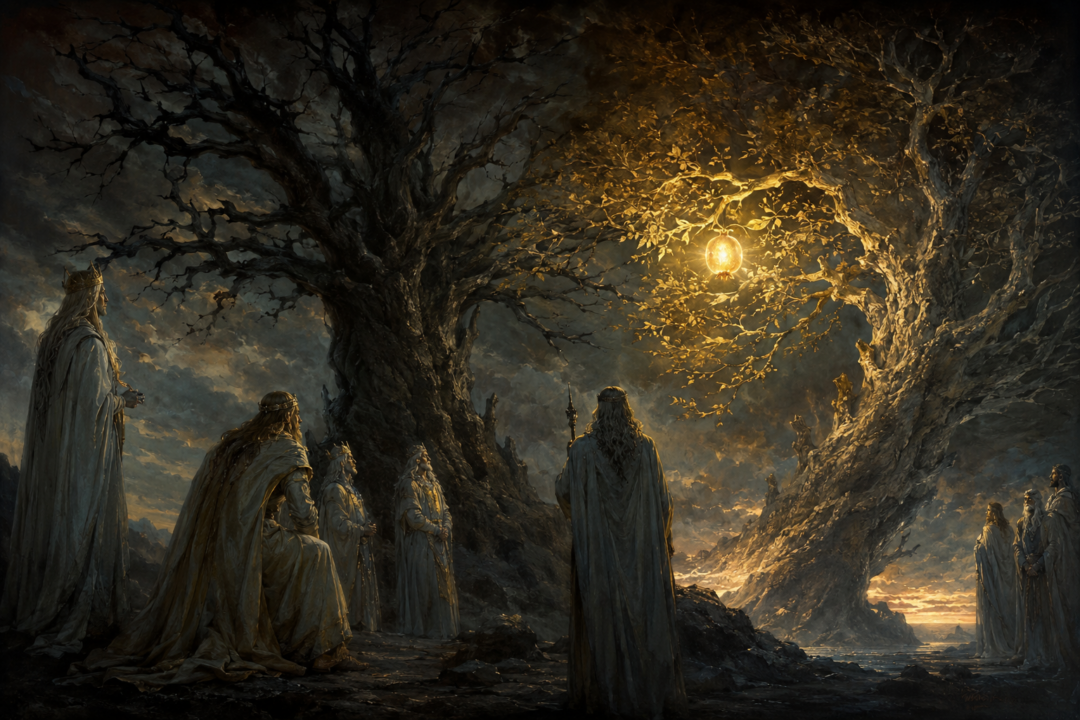
Few images in the mythology of Middle-earth are more memorable than the first sunrise.
In the familiar account, the Two Trees of Valinor are dead. Morgoth and Ungoliant have destroyed their light, and even the Valar cannot restore what was lost. Yet Telperion gives one final silver flower and Laurelin one final golden fruit. These last lights are preserved, raised into the heavens, and become the Moon and Sun.
It is a beautiful solution born from catastrophe: the Sun exists because something greater has died.
But in some much later writings, the relationship is almost reversed.
The Sun was not born from Laurelin at all. It already existed before the Two Trees. Indeed, in these unfinished cosmological revisions, the Trees themselves preserved a more ancient light associated with the Sun.
That sounds like a technical change to the astronomy of Arda. It is much more than that.
It changes what the Sun means, what the Two Trees represent, and even the nature of Morgoth’s war against light.
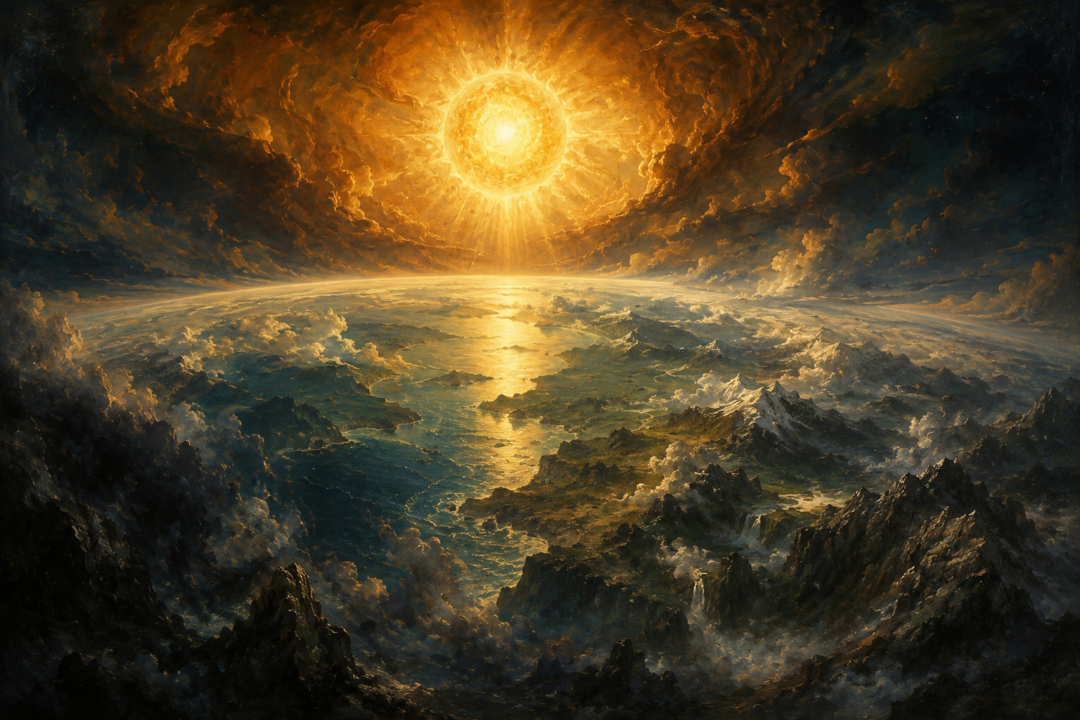
The Familiar Story: The Sun Is the Last Fruit of Laurelin
The published Silmarillion gives the clearest version of the traditional account.
For much of the Years of the Trees, Middle-earth does not possess ordinary daylight. Valinor is illuminated by Telperion and Laurelin, while the lands beyond Aman lie beneath the stars.
Then comes the Darkening of Valinor.
Morgoth and Ungoliant attack the Trees. Their light fails, the Silmarils become the great surviving repositories of their blended radiance, and the Valar attempt unsuccessfully to heal what has been destroyed.
There is, however, one final gift.
Telperion produces a last silver flower. Laurelin produces a last golden fruit. These are placed in vessels and set in the heavens. Tilion guides the Moon, while Arien, a powerful spirit associated with fire, guides the Sun.
The sequence is therefore straightforward:
First come the Two Trees.
Then the Trees are destroyed.
Then their final flower and fruit become the Moon and Sun.
This chronology makes the first sunrise one of the great turning points in the history of Arda. It also coincides with the awakening of Men in the East, binding the coming of humanity to a world newly illuminated by the Sun.
Within this version of the mythology, daylight itself is something surprisingly late.
The later writings challenge that premise at its foundation.
A Radical Alternative: The Sun Was Already There
In the texts collected under the title Myths Transformed in Morgoth’s Ring, a substantially different cosmology was explored.
These writings were never developed into a completed replacement for the older mythology, which is crucial. They should not simply be treated as a final revised edition of The Silmarillion. They are unfinished and sometimes offer competing possibilities.
Yet the direction of the experiment is unmistakable.
Arda was being reconceived as a world that had always been round rather than originally flat. More importantly for the Sun, the heavenly bodies could no longer simply appear extremely late in the physical history of the world.
Under this conception, the Sun existed from the beginning of Arda’s history.
That reverses one of the most famous relationships in the older mythology.
The Sun is no longer descended from Laurelin.
Instead, the light preserved in the Two Trees is connected to an earlier, primordial light.
The cosmic family tree has been turned upside down.
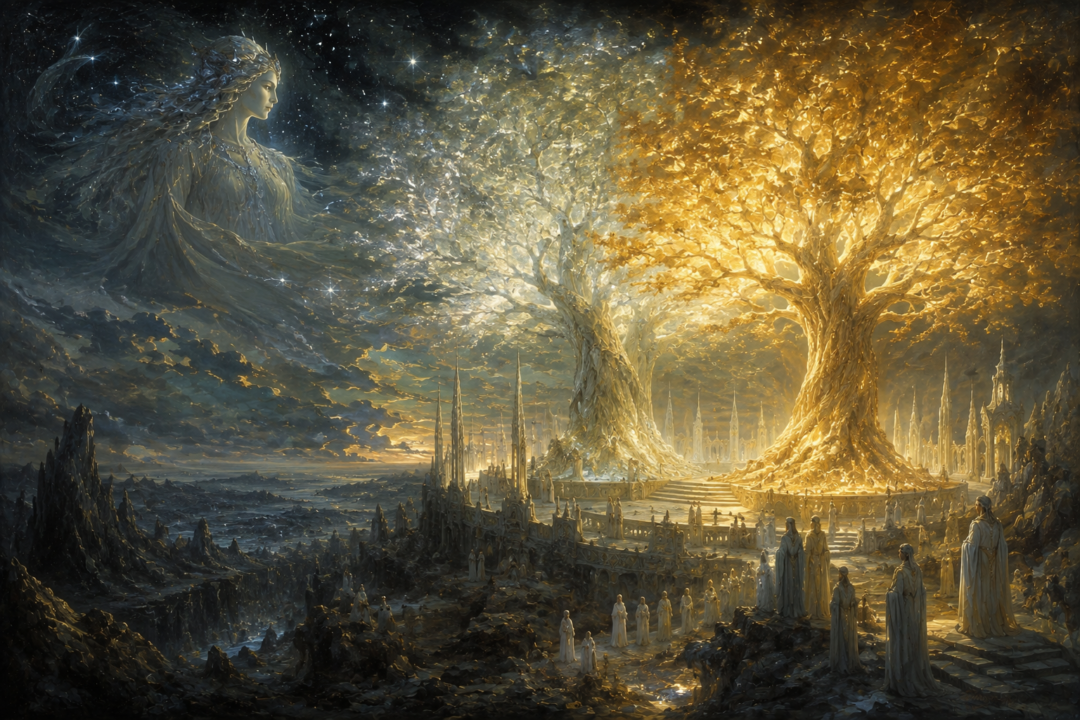
The Two Trees Become More Important, Not Less
At first this revision seems to diminish the Two Trees.
If Laurelin did not literally produce the Sun, has something magnificent been taken away from it?
The later conception points toward almost the opposite answer.
The Trees cease to be the ancestors of ordinary sunlight and become preservers of something extraordinarily precious: light that existed before Morgoth’s corruption had fully touched the world.
In these late writings, Varda is associated with a holy light originating beyond the created world and unsullied by Melkor. Different notes explore how this primordial light relates to the Sun, Arien, and ultimately the Two Trees.
The details are not entirely uniform across the surviving drafts, so it would be misleading to reduce them to one perfectly settled chronology.
But the central idea is clear enough.
The light of the Trees is valuable not because it eventually becomes sunlight, but because it preserves an older and purer light.
That gives the Trees a different symbolic role.
They are no longer merely the greatest lamps ever made within the world.
They become a refuge.
The Sun Is No Longer the Recovery After Morgoth’s Victory
This also changes the meaning of Morgoth’s assault on Valinor.
In the familiar narrative, the destruction of the Trees produces darkness, but the Valar salvage their last remnants and create the Sun and Moon. The new lights are therefore a kind of recovery after disaster.
Morgoth destroys one form of light, but light returns in another.
The later cosmology imagines a darker possibility.
Morgoth’s conflict with light begins far earlier.
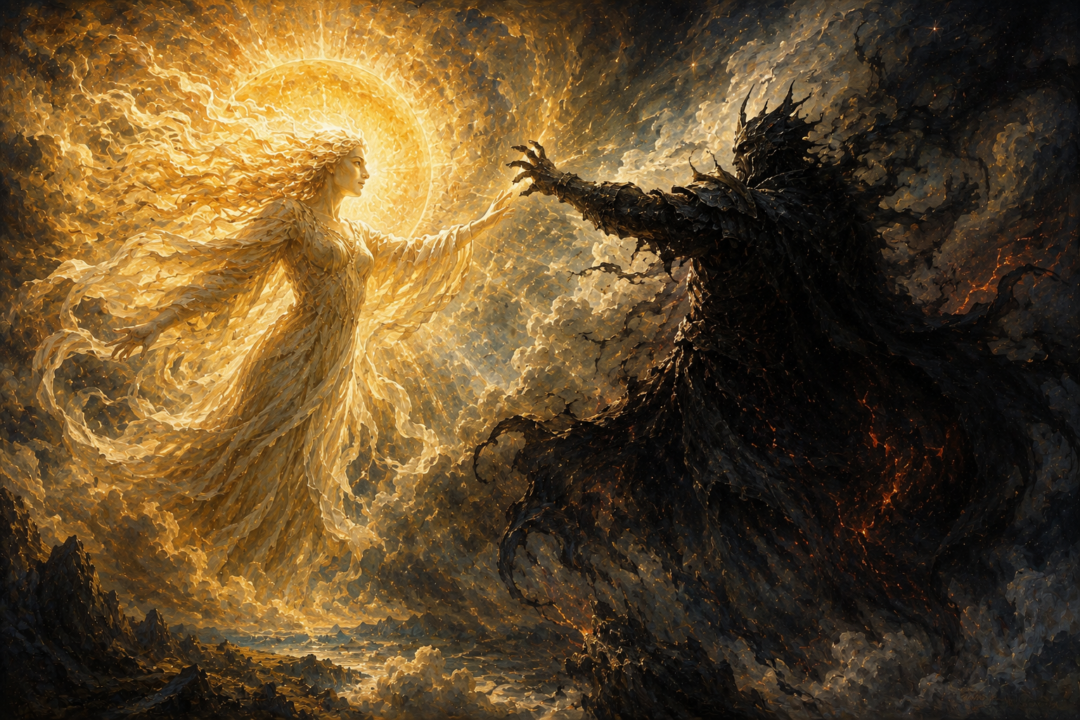
Some of the late texts connect Arien directly with the primordial Sun. In one version, Melkor desires Arien and seeks to possess her; when she rejects him, his assault has catastrophic consequences. These writings are fragmentary and contain variations, so their precise details should not be treated as a single finished narrative.
What matters is the larger transformation.
The Sun itself now belongs to the ancient struggle between uncorrupted creation and Morgoth’s desire to possess, dominate, or defile what he cannot rightfully create.
The Trees therefore do not precede that struggle.
They preserve something from it.
Arien Changes With the Sun
Arien’s role becomes correspondingly more significant.
In the published Silmarillion, she is chosen to guide the vessel containing Laurelin’s last fruit. She is particularly suited to it because she is a spirit of fire and is not harmed by its radiance.
She is important, but she enters the story of the Sun after Laurelin dies.
The later material experiments with something much older.
Arien—sometimes appearing as Ari or Arie in these drafts—is associated with the Sun before the making of the Trees. Her conflict with Melkor therefore becomes part of the earliest history of light in Arda rather than an episode following the Darkening of Valinor.
This also helps explain a striking characteristic of Morgoth.
Light becomes painful and hateful to him.
The theme already fits his broader character: Morgoth repeatedly desires things that originate in the creative work of others, yet his desire tends toward possession and destruction rather than genuine creation.
The later Sun mythology makes that pattern cosmic.
He reaches for light itself and cannot master it without corrupting both himself and what he touches.
What Happens to the First Sunrise?
This creates an obvious problem.
If the Sun already existed, what becomes of the famous first sunrise over Middle-earth?
The later cosmological notes explore a world in which the Sun could have been obscured rather than nonexistent.
Melkor’s darkness could prevent the inhabitants of Earth from seeing the heavens. The revelation of stars and changes in the world’s illumination could therefore still carry enormous mythic significance without requiring the stars or Sun literally to have been created at that moment.
This is an important distinction.
The older mythology frequently makes cosmic events and historical events the same thing: a new heavenly light is physically created, and the world enters a new age.
The later conception sometimes moves toward another model.
The light was already there.
What changes is the world’s access to it.
That is a subtler mythology, but also a haunting one. Darkness becomes not simply the absence of light, but something imposed between living creatures and a light that already exists.
The Silmarils Become Part of an Even Older Chain
The change also deepens the strange history of the Silmarils.
In the familiar story, Fëanor captures the blended light of the Two Trees within the three jewels. After the Trees are destroyed, their light survives in the Silmarils.
The later conception potentially pushes that chain backward.
If the Trees themselves preserved primordial, untainted light, then the Silmarils preserve light that was already ancient before Laurelin and Telperion existed.
Conceptually, the sequence becomes something like this:
primordial holy light, preserved in the blessed light associated with the early Sun; that light preserved in the Two Trees; the light of the Trees captured in the Silmarils.
Because the late cosmological texts were never brought into one final system, the exact mechanics should not be overstated.
But the thematic effect is extraordinary.
Fëanor has not merely trapped the light of two miraculous trees inside his jewels.
He has captured an echo of the world’s uncorrupted beginning.
That helps explain why possession of the Silmarils becomes so much larger than possession of beautiful objects. Their light belongs to a history that no craft can simply reproduce once it has been lost.
Two Versions That Should Not Be Forced Into One
It is tempting to ask which account is the “real” one.
That question has no perfectly clean answer.
The published Silmarillion presents the great myth in which the Sun is Laurelin’s final fruit and the Moon Telperion’s final flower. That is the coherent narrative most readers encounter.
The later writings show a serious attempt to reconstruct the cosmology around a world that was always round and possessed a primordial Sun. But that reconstruction remained incomplete. Some individual notes contradict or revise other possibilities.
The safest reading is therefore not that the familiar story was cleanly erased.
Rather, we possess different stages of an evolving mythology.
And comparing them reveals something fascinating.
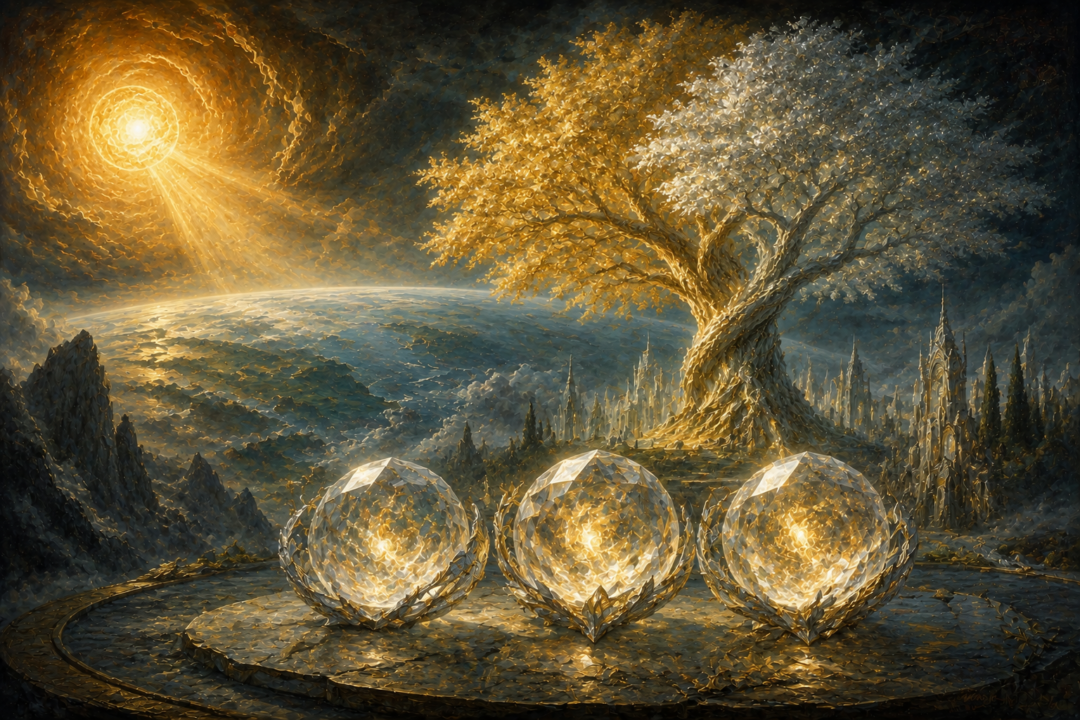
The Meaning of the Sun Changes More Than Its Date of Birth
In the familiar version, the Sun is hope after destruction.
Morgoth kills the Trees, but he cannot permanently extinguish their light. Laurelin’s last fruit rises above Middle-earth, and a new age begins beneath it.
In the later conception, the tragedy runs deeper.
The Sun belongs to the world from far earlier, while the Two Trees preserve a light connected with a state of creation less touched by Morgoth’s corruption.
The direction of inheritance changes.
The Sun does not receive the light of Laurelin.
Laurelin receives and preserves an older light.
That turns the Trees from the source of the ordinary Sun into guardians of something the ordinary world has partly lost.
And perhaps that is the most powerful consequence of the revision.
The older story asks what can survive when perfect light is destroyed.
The later one asks something even sadder: what fragments of the original light can still be preserved once darkness has entered the world?
Both lead to the same recurring truth of Middle-earth.
The greatest victories rarely restore what was lost exactly as it was.
Light survives—but increasingly as memory, inheritance, and something guarded against the Shadow.
Sources & Notes
- The Encyclopedia of Arda — Sun: reference account of the published legend in which Laurelin’s last golden fruit becomes the Sun and Arien guides it through Ilmen — https://www.glyphweb.com/arda/s/sun.php
- The Encyclopedia of Arda — Two Trees: chronology of Telperion and Laurelin, their destruction in the Darkening of Valinor, and their relationship to the first rising of the Sun and Moon — https://www.glyphweb.com/arda/t/twotrees.php
- The Encyclopedia of Arda — Arien: reference on the fire-spirit chosen to steer the Sun and her earlier service tending Laurelin’s light — https://www.glyphweb.com/arda/a/arien.php
- Morgoth’s Ring — bibliographic overview of volume ten of The History of Middle-earth and its ‘Myths Transformed’ section, where Tolkien’s late cosmological revisions are presented — https://en.wikipedia.org/wiki/Morgoth%27s_Ring
Sources distinguish the familiar published Sun-from-Laurelin account from the late, unfinished cosmological reconsiderations preserved in ‘Myths Transformed’ in Morgoth’s Ring.