
Among the treasures of the First Age, Nimphelos is easy to overlook. It is not a Silmaril. No oath is sworn over it, no dragon sleeps upon it, and no kingdom is destroyed merely to possess it.
Yet this enormous pearl becomes part of one of the most revealing exchanges between Elves and Dwarves in early Beleriand.
Nimphelos came from the sea. The Falathrim found beautiful pearls in the shallow waters around the Isle of Balar, and Círdan gave many of them to Thingol. Among them was one extraordinary pearl, Nimphelos, described in The Silmarillion as being as large as a dove’s egg and possessing a sheen like starlight upon sea-foam.
Thingol eventually gave it to the Dwarves of Belegost after they helped create Menegroth.
The remarkable part is not simply that Thingol paid craftsmen with treasure. The Dwarves always expected payment for their work.
It is that Thingol possessed something the Dwarves valued beyond the kind of wealth their own mountains could provide.
Nimphelos therefore reveals an important principle of power in Middle-earth: the most effective diplomatic gift is not necessarily the treasure with the greatest abstract value. Sometimes it is the treasure the other side cannot obtain for itself.

Before Menegroth, Thingol Needed Dwarven Skill
Thingol was already a formidable ruler before Menegroth existed.
He was Elwë, one of the original ambassadors of the Elves who had journeyed to Valinor and seen the light of the Two Trees. After returning to Middle-earth and becoming united with Melian, he ruled the Sindar of Beleriand.
But kingship did not mean self-sufficiency.
When disturbing reports began to reach Beleriand concerning dangerous creatures east of the Blue Mountains, Melian warned Thingol that the peace of Middle-earth would not last forever. Thingol therefore sought a dwelling that could be strongly defended.
This brought the Sindar into deeper cooperation with the Dwarves.
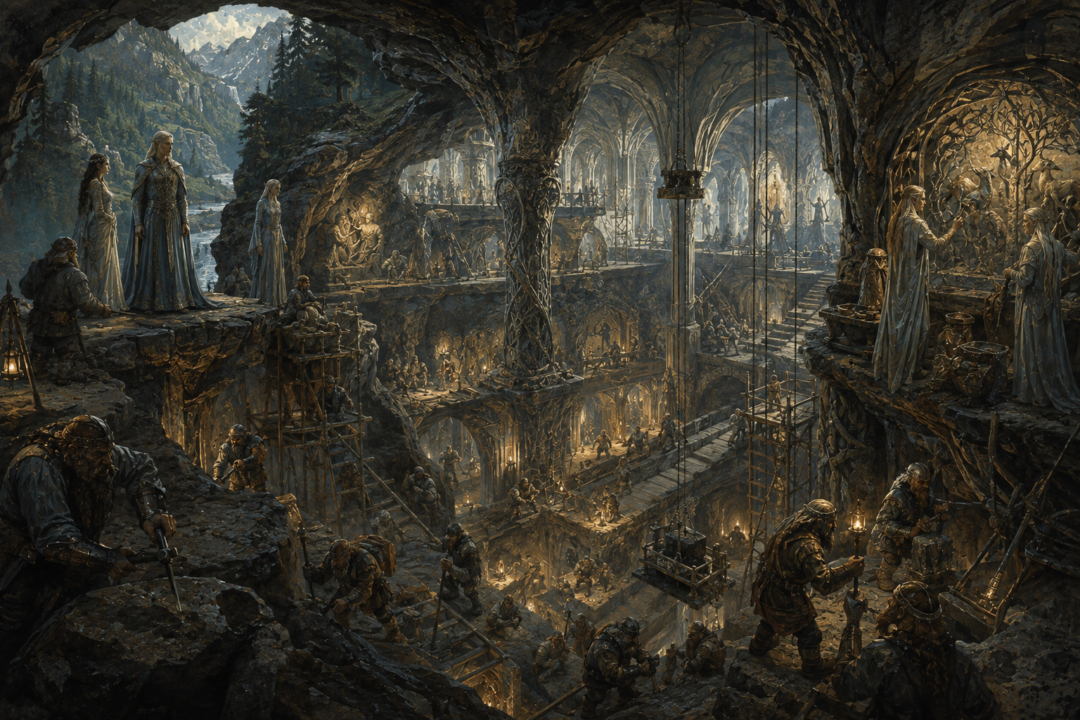
The Dwarves of Belegost aided Thingol in the construction of Menegroth, the Thousand Caves. Beneath the wooded hills beside the Esgalduin, they helped excavate and shape the underground halls that became the center of Doriath.
The project was not simply Dwarven construction carried out for an Elven employer. The Silmarillion presents a genuine combination of traditions. Dwarven skill and Melian’s knowledge worked together, while Elves contributed their own arts.
Menegroth consequently became something neither people would necessarily have made alone.
That makes the payment significant.
Thingol was not rewarding ordinary labor. He was compensating specialists whose knowledge materially strengthened his kingdom.
The Dwarves Expected a Price
The relationship should not be romanticized.
The friendship between the Sindar and the Dwarves is described as cool, even though both peoples profited greatly from it. They were useful to one another without becoming culturally indistinguishable allies.
The Dwarves also did not simply work for Thingol out of affection.
The text explicitly notes that they demanded payment for their labor.
Thingol therefore faced a problem familiar to rulers everywhere: how does a king obtain strategically important expertise from an independent people whose cooperation cannot simply be commanded?
His answer included pearls.
The Dwarves had apparently not seen their like before and valued them highly. Among the pearls Thingol gave them was Nimphelos.
Its effect was extraordinary.
The chieftain of the Dwarves of Belegost prized Nimphelos above a mountain of wealth.
That statement tells us something crucial about the transaction.
Why Would Dwarves Value a Pearl So Highly?
Dwarves are strongly associated with mining, metalworking, masonry, jewels, and treasures drawn from beneath the earth.
Nimphelos came from somewhere entirely different.
The pearl originated in the waters around Balar and passed from the maritime world of Círdan and the Falathrim into Thingol’s possession. It was therefore a treasure produced not by mines, smithies, or mountain halls, but by the sea.
The text does not explicitly say that Thingol calculated its diplomatic value on those grounds, so we should not turn the episode into a detailed economic strategy Tolkien never described.
But the exchange itself strongly illustrates the principle.
Thingol possessed access to treasures that were unfamiliar to the Dwarves. The Dwarves possessed architectural and craft knowledge that Thingol wanted.
Each side could provide something the other lacked.
That is far more interesting than a simple exchange of gold.
Giving a master smith another quantity of ordinary precious metal may increase his wealth. Giving him something rare outside his entire sphere of experience can create a different kind of value.
Nimphelos was not merely expensive.
To the Dwarves of Belegost, it was exceptional.
Thingol’s Real Wealth Was His Network
There is another layer to the pearl’s journey.
Thingol did not find Nimphelos himself.
Círdan gave it to him.
That means the pearl moved through at least three cultural worlds: from the Falathrim and the sea, to Thingol’s court in Doriath, and finally to the Dwarves of Belegost.
That chain matters.
Thingol’s power was not simply stored in vaults. It existed in relationships.
Círdan was his friend and ally. The Falathrim controlled coastal settlements and possessed knowledge and resources associated with the sea. The Dwarves brought expertise from the Blue Mountains. Melian brought wisdom beyond that of the ordinary inhabitants of Middle-earth.
Thingol stood at the center of these connections.
Nimphelos becomes a small but vivid demonstration of how such networks could be converted into political strength. A treasure obtained through friendship with the Falathrim becomes part of the compensation that secures Dwarven craftsmanship, and that craftsmanship helps create the fortified heart of Doriath.
The pearl effectively travels from sea to forest to mountain culture.
At every stage, its meaning changes.
Menegroth Was Built Through Exchange, Not Isolation
This is particularly striking because Doriath later becomes famous for separation.
After Morgoth’s return and the First Battle of Beleriand, Melian surrounds the kingdom with the Girdle of Melian. Doriath becomes a protected realm into which outsiders cannot simply wander.
It is tempting, therefore, to imagine Thingol’s kingdom primarily as an isolated Elven sanctuary.
But Menegroth itself is evidence against taking that image too far.
The capital at the heart of the protected kingdom was created with substantial Dwarven assistance.
Before Doriath became one of the great refuges of Beleriand, Thingol had already recognized the value of cooperation beyond his own people.
The Dwarves gained rewards and knowledge. Thingol gained their skill. Both sides profited.
Nimphelos belongs to that earlier and more constructive relationship.
It represents a moment when cultural difference generates exchange rather than conflict.
That makes the later history of Doriath much darker.

The Pearl and the Necklace
There is an unavoidable irony surrounding Thingol and Dwarven treasure.
Early in the history of his kingdom, his dealings with the Dwarves help produce Menegroth. He compensates them with treasures they value, including Nimphelos, and the relationship is mutually profitable despite its coolness.
Much later, another transaction involving Dwarven craftsmen and a great jewel ends catastrophically.
After the ruin of Nargothrond, the Nauglamír—the Necklace of the Dwarves—eventually comes into Thingol’s possession through Húrin. Thingol decides to have the Silmaril won by Beren and Lúthien set within it, and Dwarven craftsmen from Nogrod perform the work.
The resulting dispute ends with Thingol’s death.
The circumstances are different, and Nimphelos should not be treated as a direct foreshadowing deliberately recognized by the characters. Yet the contrast is powerful.
In the building of Menegroth, Thingol understands that Dwarven work has a price and gives treasure in return.
At the end of his life, treasure itself has become the center of the dispute.
The earlier exchange creates.
The later quarrel destroys.
Nimphelos Shows Thingol at His Most Effective
Thingol can be remembered chiefly through his proudest or most disastrous decisions: his impossible demand that Beren obtain a Silmaril, his hostility toward the sons of Fëanor, or the fatal confrontation surrounding the Nauglamír.
Nimphelos reveals another side of his kingship.
Here Thingol is operating successfully within a world of independent peoples.
He cannot order the Dwarves of Belegost to build Menegroth. Instead, he welcomes their cooperation and rewards their work. More importantly, the payment includes something uniquely desirable to them.
There is no need to invent a formal treaty or elaborate diplomatic ceremony. None is described.
The simple exchange is enough.
The Dwarves possess something Doriath needs: their extraordinary craftsmanship.
Thingol possesses something they prize: rare pearls from the western sea.
Both sides understand value differently, and cooperation becomes possible precisely because of that difference.

A Treasure Can Be Worth More Far From Home
Nimphelos never becomes one of the great engines of the legendarium.
Its later fate is not recorded.
But perhaps that is why the pearl is so useful for understanding everyday power in the First Age. It shows diplomacy functioning before catastrophe takes over the story.
A treasure gathered near Balar passes from Círdan to Thingol. Thingol then gives it to the Dwarves whose labor helps turn a natural system of caves into one of the greatest halls of Beleriand.
The Dwarven chieftain values that single pearl above enormous material wealth.
Not because the Dwarves were poor.
Quite the opposite.
They knew the riches beneath mountains better than almost anyone.
Nimphelos represented something their mountains did not readily give them.
And Thingol, whether by deliberate diplomatic calculation or simply through an appropriate and generous payment, turned that difference in resources into cooperation.
Long before the jewels of the First Age became causes of obsession, oath, murder, and ruin, one remarkable jewel served a quieter purpose.
It helped pay for the making of a kingdom.
Sources & Notes
- https://www.encyclopedia-of-arda.com/n/nimphelos.php — The Encyclopedia of Arda: Nimphelos (provenance, size, and gift to the Lord of Belegost)
- https://www.encyclopedia-of-arda.com/m/menegroth.php — The Encyclopedia of Arda: Menegroth (Thingol’s stronghold and its construction by the Dwarves of Belegost)
- https://www.encyclopedia-of-arda.com/d/dwarvesofbelegost.php — The Encyclopedia of Arda: Dwarves of Belegost (their craft, relations with the Elves, and role in building Menegroth)
- https://thainsbook.minastirith.cz/doriath.html — The Thain’s Book: Doriath and Menegroth (construction of Menegroth and Thingol’s payment in Balar pearls, including Nimphelos)
The primary narrative is The Silmarillion, ‘Of the Sindar.’ These reference entries corroborate the pearl’s provenance, the Belegost craftsmen’s role in Menegroth, and the exchange of Nimphelos; the article’s diplomatic interpretation is identified as analysis rather than a direct statement by Tolkien.