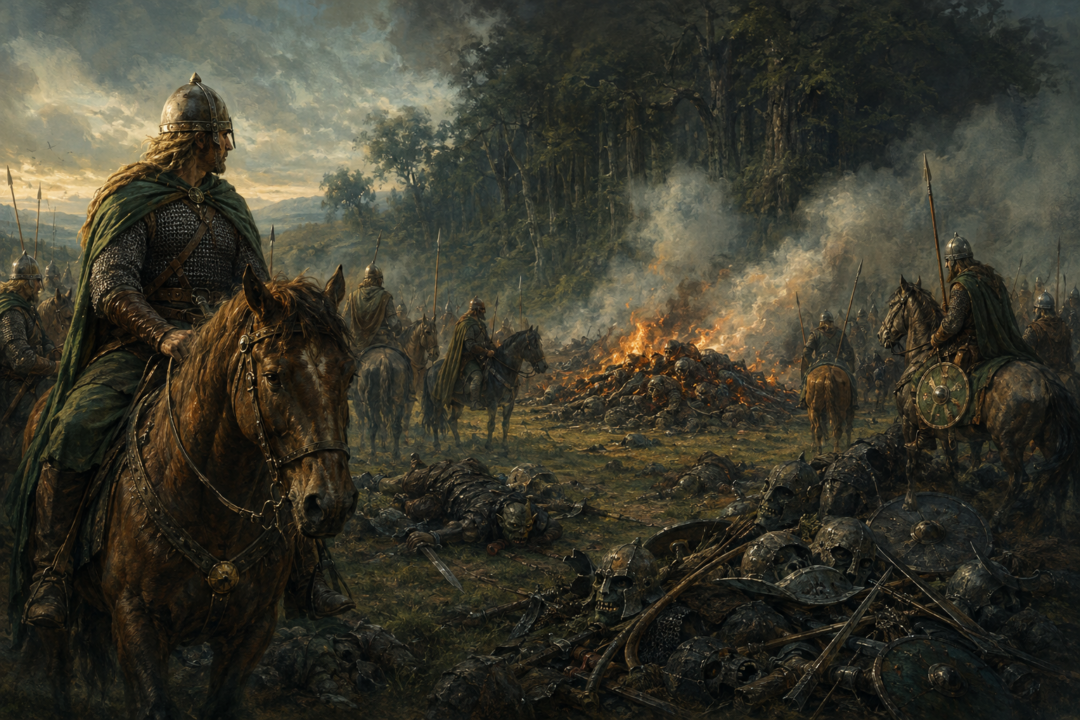
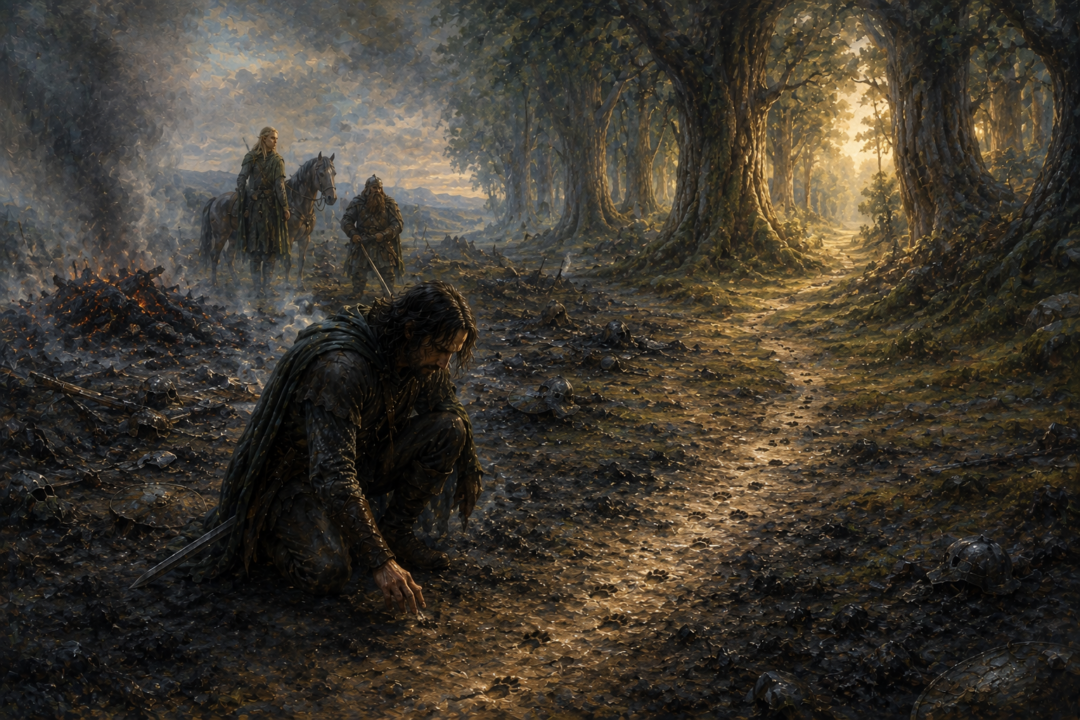
When Aragorn, Legolas, and Gimli finally reach the edge of Fangorn, the Orc-band they have pursued across Rohan is already gone in the most literal sense. The Rohirrim have killed it, searched the battlefield, stripped the enemy dead, piled the bodies together, and burned them.
Only hot ashes remain.
For Aragorn, this is almost disastrous. Merry and Pippin had been prisoners among those Orcs. If the Riders accidentally killed them—or merely failed to notice their bodies—then the evidence Aragorn desperately needs may have vanished into the same fire.
It can therefore seem strange that Éomer did not leave the battlefield untouched.
But the book gives a remarkably direct answer, while also revealing something deeper about Rohan. Éomer does not burn the Orcs because he knows Aragorn is coming, because he wants to conceal evidence, or because Orc corpses carry some supernatural danger. He tells Aragorn that the Riders counted the enemy dead, despoiled them, piled the carcasses, and burned them “as is our custom.”
That small phrase changes the entire scene.
Éomer Was Not Expecting Aragorn
The first thing to remove is a misleading assumption created by hindsight.
Éomer has no reason to preserve the battlefield for Aragorn.
When the Rohirrim attack the Orcs near Fangorn, they do not know that three members of the Fellowship are running across Rohan behind them. Aragorn, Legolas, and Gimli are strangers whose arrival Éomer could not reasonably have anticipated.
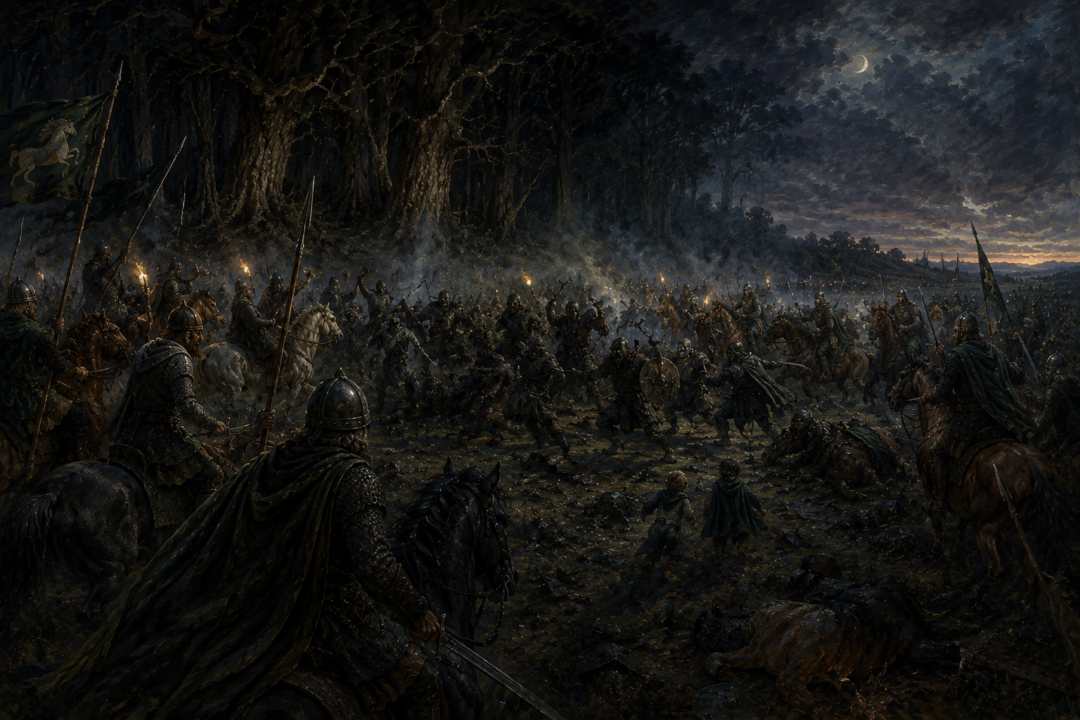
Éomer's company has its own urgent military problem. The Orc-band has crossed Rohan carrying captives and includes Orcs connected with different powers. Éomer tells Aragorn that Orcs had joined the company from the East and that great Orcs bearing the White Hand had also come from the forest. The Riders surround them at the eaves of Fangorn and attack at dawn.
It is a costly victory. Éomer reports the loss of fifteen men and twelve horses.
Afterward, the Riders cannot simply remain indefinitely beside the battlefield. Éomer says they have already been away too long and are needed in the south and west. Rohan is sliding toward open war with Isengard.
So the sequence is straightforward: fight the enemy, account for the dead, deal with the battlefield according to Rohirric custom, bury their own fallen, and move on.
Aragorn arrives afterward because he is following the same Orcs from far behind.
The Most Important Words Are “As Is Our Custom”
In The Two Towers, Aragorn specifically asks whether Éomer's men searched the slain and whether there were any bodies other than Orcs.
Éomer's answer is more careful than readers sometimes remember.
The Riders found no dwarves or children. More importantly, Éomer says they counted all the slain and despoiled them before burning the bodies.
Only then does he explain that the Orc carcasses were piled and burned according to their custom.
That means the fire was not a hurried attempt to erase the battlefield. The Rohirrim first examined and counted the dead.
The text never provides a detailed explanation of why this is their custom. It does not say that Orc bodies are poisonous, that they must be burned to prevent resurrection, or that Rohan follows some religious command requiring cremation of Orcs. Those explanations go beyond what the text establishes.
The safest conclusion is simply the one explicitly provided: burning defeated Orcs was an established practice among the Rohirrim.
And the battlefield itself shows that they did not treat every corpse alike.
The Rohirrim Do Not Burn Their Own Men With the Orcs
This is the detail that makes the scene much more revealing.
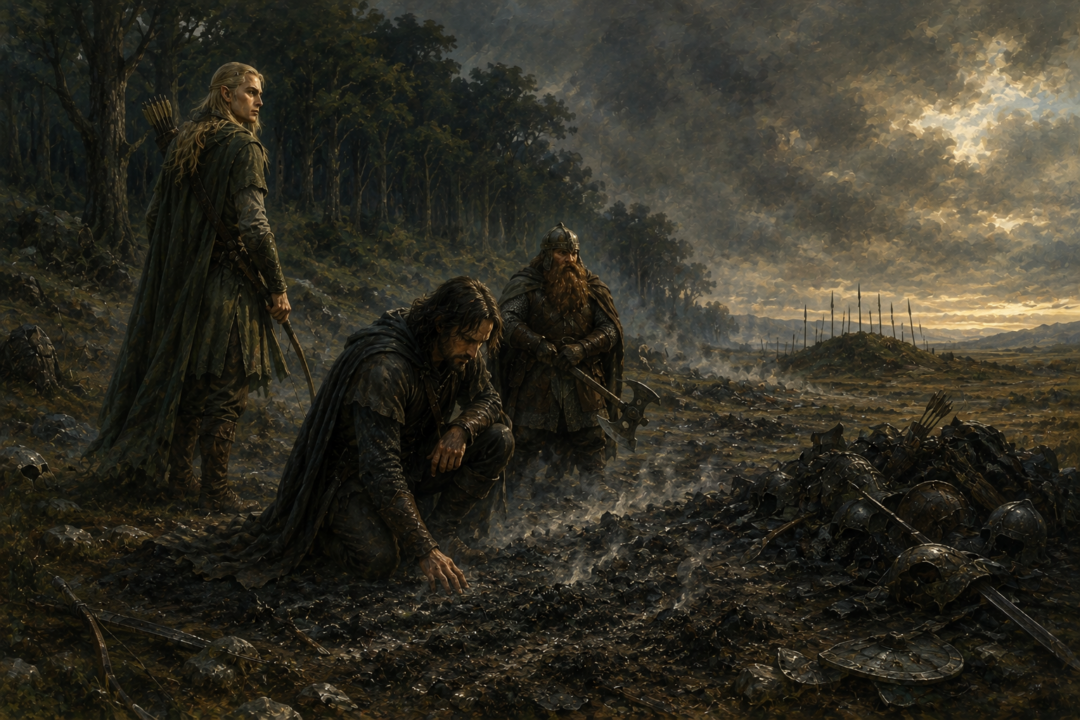
When Aragorn, Legolas, and Gimli eventually reach the battlefield, they find the great burning near Fangorn. The ashes remain hot and smoking. Nearby lies a pile of captured or discarded war-gear: helms, mail, broken shields, swords, bows, and darts.
But farther away stands something entirely different.
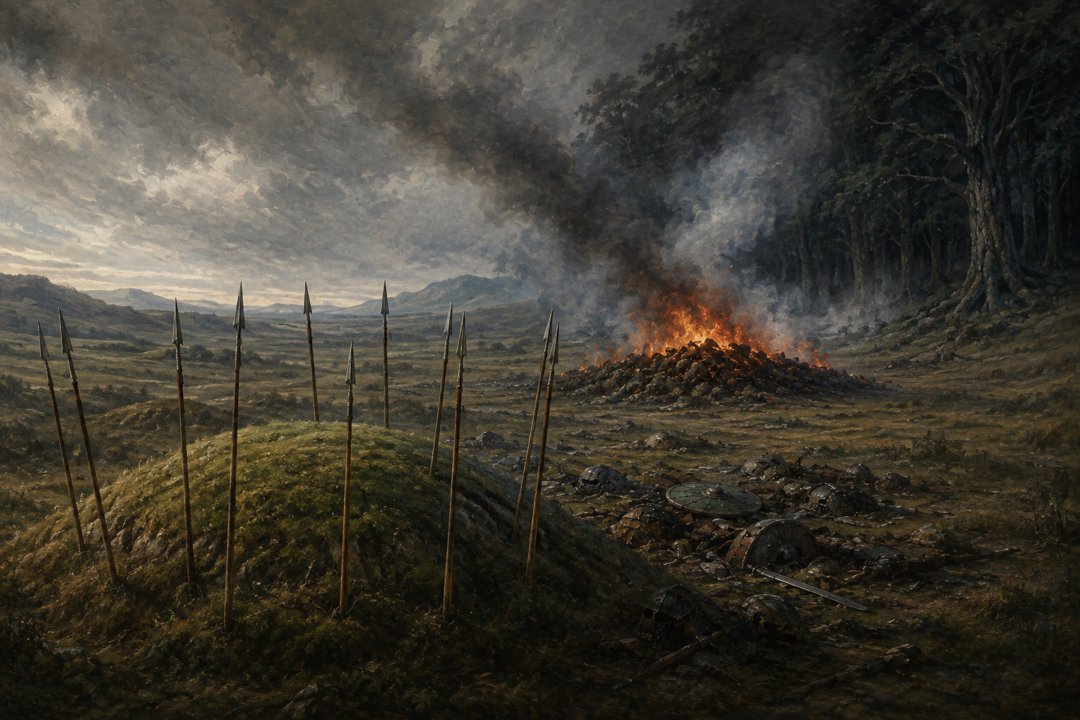
There is a newly raised burial mound covered with fresh turf, surrounded by fifteen spears.
Those fifteen spears correspond to the fifteen Riders Éomer says were killed in the battle.
The contrast could hardly be clearer.
The Orc dead are burned together. The fallen Rohirrim receive a mound.
This distinction fits the wider culture of the Mark. Burial mounds are deeply associated with Rohan. The royal dead lie beneath the barrows near Edoras, and Théoden himself is eventually laid beneath a mound after the War of the Ring.
The battlefield at Fangorn therefore contains two treatments of death side by side: one for the defenders of the Mark and another for their enemies.
Whatever additional practical reasons may have existed for burning a large number of Orc corpses, the text does not specify them. What it does show is that the Rohirrim regard the two groups very differently.
Why Not Leave the Orcs Where They Fell?
Here interpretation has to remain cautious.
It is tempting to supply practical motives. A large battlefield full of dead Orcs would be unpleasant and potentially hazardous, and an army might understandably want to dispose of enemy corpses rather than leave them scattered across its territory.
Those considerations are plausible, but they are not Éomer's stated explanation.
His explanation is custom.
That matters because the Riders spend real effort carrying it out. Aragorn later observes that they felled trees for the burning, and the ashes are still hot when the Three Hunters arrive. This was not merely a few torches thrown onto fallen enemies during a hurried retreat. The Rohirrim deliberately completed the work after the battle.
They also separated equipment from bodies. The great pile of Orc gear remains beside the ashes.
The scene therefore has the appearance of an ordered battlefield aftermath: the enemy accounted for and burned, usable or significant material removed from the bodies, and the Rohirric dead buried separately.
Éomer's company is behaving like a military force following an established practice, not like men trying to hide what happened.
The Cruel Irony: Merry and Pippin Were There
The tragedy of the scene is that Éomer is almost completely correct.
His Riders destroyed the Orc-company.
They found no obvious non-Orc bodies among the dead.
No Orc escaped their encirclement once the Riders had sighted the company, Éomer confidently tells Aragorn.
Yet Merry and Pippin survive.
During the confusion surrounding the battle, the hobbits escape toward Fangorn. Their survival exposes a tiny gap between what the Rohirrim believe they have accounted for and what actually happened.
Aragorn seizes on that possibility.
He has already found evidence during the pursuit that at least one hobbit was alive after the Orcs crossed into Rohan. He therefore refuses to accept Éomer's conclusion that hope is gone. Perhaps, Aragorn suggests, the captives were carried toward the forest before the battle or somehow escaped the ring.
Éomer admits that these are strange days and that certainty is becoming difficult.
That uncertainty becomes crucial.
The Fire Almost Destroys Aragorn's Hope
When the hunters finally stand beside the smoking ashes, Gimli reaches the bleakest conclusion.
Perhaps Merry and Pippin's burned bones are mixed among the Orcs.
That possibility cannot immediately be disproved.
The battlefield has already been processed by another group of people who had no idea what Aragorn would later need to discover. Evidence has been trampled by horses, bodies have been burned, equipment has been moved into piles, and darkness is approaching.
For one of Middle-earth's greatest trackers, this is almost the worst possible scene.
Yet Aragorn refuses to leave.
That refusal matters more than the forensic problem itself. He does not possess proof that the hobbits survived. What he possesses is an unresolved contradiction.
Éomer's men found no hobbit bodies.
Aragorn found no trail showing the captives leaving the Orcs earlier.
The Riders believe nothing escaped.
And yet Aragorn cannot make all the signs fit.
So he waits for daylight.
The Rohirrim Actually Preserve More Evidence Than It First Appears
Ironically, their orderly treatment of the battlefield helps establish what happened.
The Riders counted the slain before burning them. They separated the Orc equipment. They raised a distinct mound for their own fifteen dead. They can describe how the encirclement worked and where other Orcs joined the band.
Éomer can also testify that his men found no children or dwarves—the categories into which Aragorn's description of the hobbits might initially fall.
This does not solve the mystery, but it narrows it.
Merry and Pippin are not simply two unidentified bodies that nobody noticed lying far from the fighting. If they died there, their bodies would somehow have had to escape the attention of men who deliberately counted and stripped the slain.
That leaves open the possibility Aragorn needs.
The burned battlefield seems at first to announce death. Instead, the absence of the hobbits among the identified dead becomes part of the reason the search can continue.
Éomer's Decision Reveals the Larger Crisis in Rohan
There is another layer to the episode.
Éomer is not operating in peaceful territory under ordinary conditions.
Saruman's influence is spreading. Théoden's authority has been weakened from within. Orcs bearing the White Hand are moving through the Mark. Éomer has ridden out against orders and knows that his decisions may place him in danger when he returns.
His company therefore cannot become custodians of an Orc battlefield while waiting for unknown travelers who may never appear.
They defeat an enemy force, perform their customary aftermath, honor their own dead, and ride because Rohan needs them elsewhere.
That is why the burning occurs “before Aragorn arrives”: not because Éomer chooses to act before Aragorn can inspect the bodies, but because their stories have not yet intersected.
Éomer is fighting Rohan's war.
Aragorn is trying to save two friends.
For a brief moment at Fangorn, those purposes collide.
The Ashes Are Not the End of the Trail
The burning of the Orcs works so well as a narrative moment because it transforms apparent certainty into uncertainty.
Éomer believes the Orcs are destroyed and the captives lost.
Gimli fears the worst when he sees the ashes.
But Aragorn continues looking.
The truth is already only a short distance away, beneath the ancient trees of Fangorn: Merry and Pippin have survived and entered a world stranger than either the Rohirrim or their pursuers yet understand.
So Éomer's fire is not evidence of cruelty toward the hobbits, carelessness, or an attempt to conceal what his Riders did. The text gives us something simpler and more culturally revealing.
The Rohirrim counted the enemy dead, stripped them, and burned their bodies because that was their custom. Their own fallen received a burial mound and fifteen spears. Then the Riders departed for a country moving rapidly toward war.
Aragorn simply came too late to see the battlefield untouched.
And yet, in one of the quiet patterns that runs throughout the story, arriving too late does not mean that hope is lost.
Sources & Notes
- The Encyclopedia of Arda — Éomer Éadig: biographical reference on the Marshal who led the attack on the Orc-band — https://www.glyphweb.com/arda/e/eomer.html
- The Encyclopedia of Arda — Uglúk: reference on the Uruk-hai captain and the Orc company destroyed by Éomer’s riders — https://www.glyphweb.com/arda/u/ugluk.html
- The Encyclopedia of Arda — Fangorn Forest: geographical context for the battlefield and the fugitives’ escape — https://www.glyphweb.com/arda/f/fangornforest.html
- The Encyclopedia of Arda — Rohirrim: overview of the mounted people whose burial and battlefield practices frame the episode — https://www.glyphweb.com/arda/r/rohirrim.html
Sources document the key people, places, institutions, and chronology used in this interpretation.