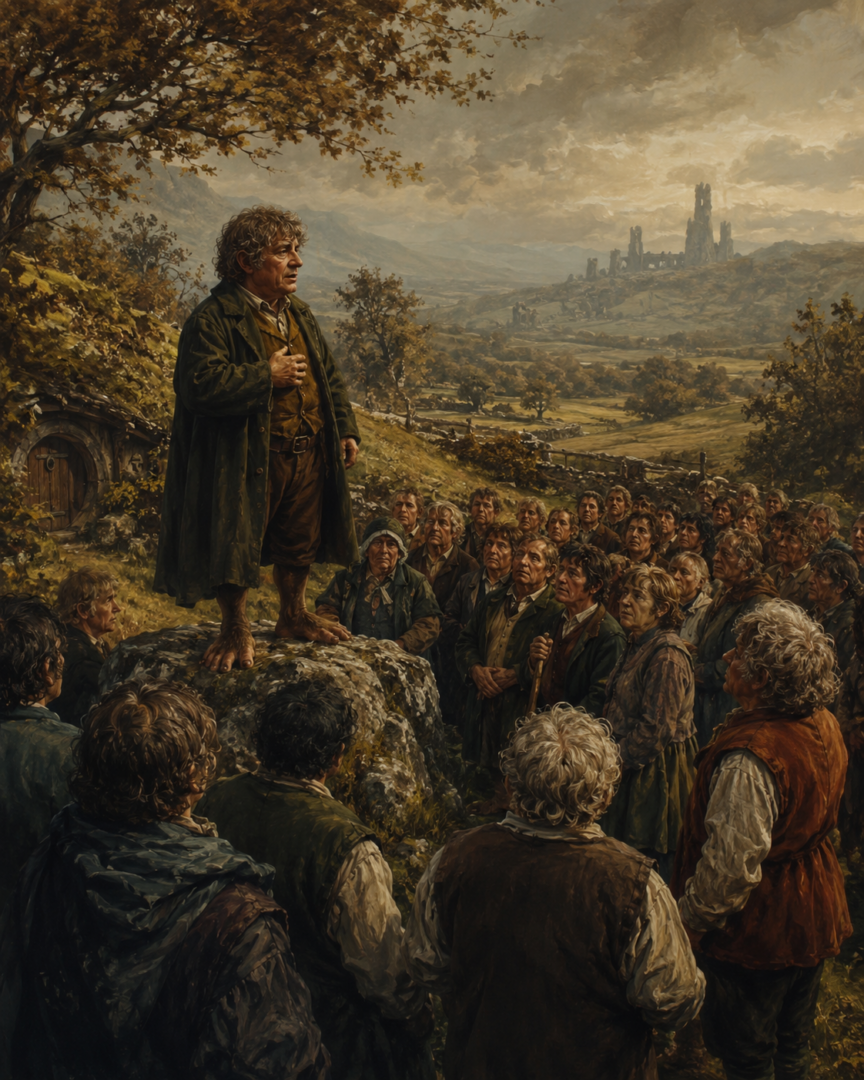
The Shire’s Thain: How Hobbits Preserved a King’s Authority Without a King
The Shire seems like the last place in Middle-earth that should contain the remains of a monarchy.
Its Hobbits dislike interference, manage most affairs through families and local custom, and have almost no government worthy of the name. By the end of the Third Age, the Mayor of Michel Delving is effectively the Shire’s only significant working public official. Kings belong to old stories, while the ruins of the northern royal city have lain grass-covered for generations.
Yet sitting quietly inside this remarkably self-governing society is an office created precisely because there is no longer a king: the Thain.
The Thain can summon the Shire in an emergency. He presides over its moot. He is captain of its muster and of the “Hobbitry-in-arms.” And according to the historical tradition preserved in the appendices, the first Thain was chosen after the disappearance of the North-kingdom.
The apparent contradiction is revealing. The Shire is not actually anti-royal in the sense of rejecting kingship. It is better understood as a society that has almost forgotten what being ruled feels like while continuing to preserve the legitimacy of the vanished King.
The Thain is the clearest surviving trace of that strange arrangement.
The Shire Was Founded Under a King
Hobbit independence did not begin as a rebellion.
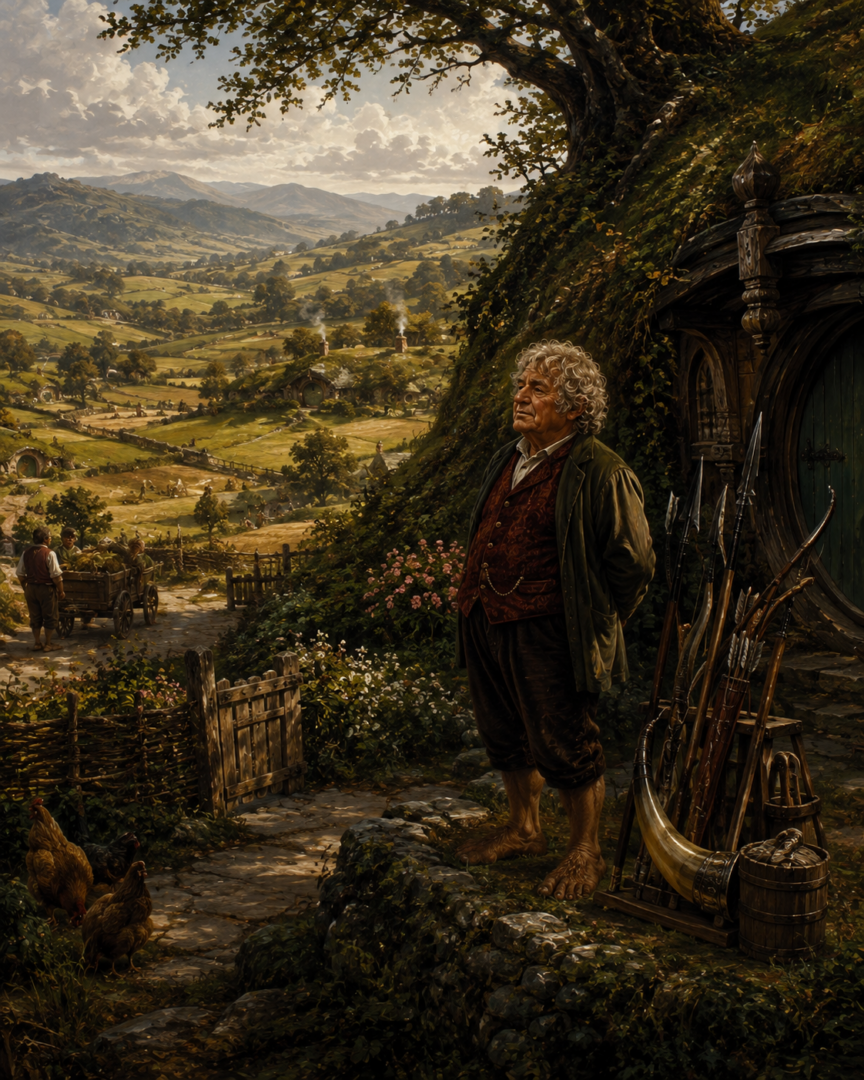
In Third Age 1601, Marcho and Blanco led Hobbits westward from Bree and crossed the Baranduin into the territory that became the Shire. Appendix B records that this settlement occurred with the permission of King Argeleb II of Arthedain.
The Prologue to The Fellowship of the Ring adds the traditional conditions attached to their settlement. The Hobbits were to acknowledge the King, maintain the great bridge and other roads, and speed the King’s messengers.
That origin matters.
The Shire was not founded by Hobbits throwing off royal authority. Their extraordinarily independent society developed inside a territory whose political legitimacy originally came from the northern Dúnedain monarchy.
Then that monarchy disappeared.
Arthedain fell to Angmar in Third Age 1974, and its last king, Arvedui, was lost the following year. According to Appendix A, the Hobbits chose a Thain in 1979, with Bucca of the Marish becoming the first holder of the office.
The timing makes the purpose difficult to miss: the Thainship arose from the disappearance of functioning kingship.
But the Hobbits did something subtler than simply appointing a replacement king.
They did not crown Bucca.
They created a Thain.
The Thain Replaced a Function, Not the King
Appendix A describes the Hobbits as choosing a Thain “to hold the authority of the king” after the ending of the North-kingdom.
That wording is crucial.
The office does not establish a new Hobbit monarchy. Instead, it preserves authority that ultimately belongs to an absent royal order.
By the late Third Age, the Thain has three explicitly described responsibilities: he is master of the Shire-moot, captain of the Shire-muster, and captain of the Hobbitry-in-arms.
All three become important primarily when ordinary Hobbit life stops working.
A moot implies collective deliberation. A muster means calling the population to organized defence. The Hobbitry-in-arms is the Shire's fighting body.
The Thain therefore sits at the point where peaceful decentralization gives way to emergency coordination.
During normal years, families can manage themselves.
When the Shire faces a crisis, someone must be able to gather it.
That someone is the Thain.
Calling this “emergency kingship” is useful as an interpretation, provided the distinction is maintained: the Thain is never himself presented as King of the Shire. He preserves certain functions associated with royal authority without claiming the crown from which that authority historically descended.
A Government Designed Almost Never to Govern
The most remarkable feature of the Thainship is how little it normally does.
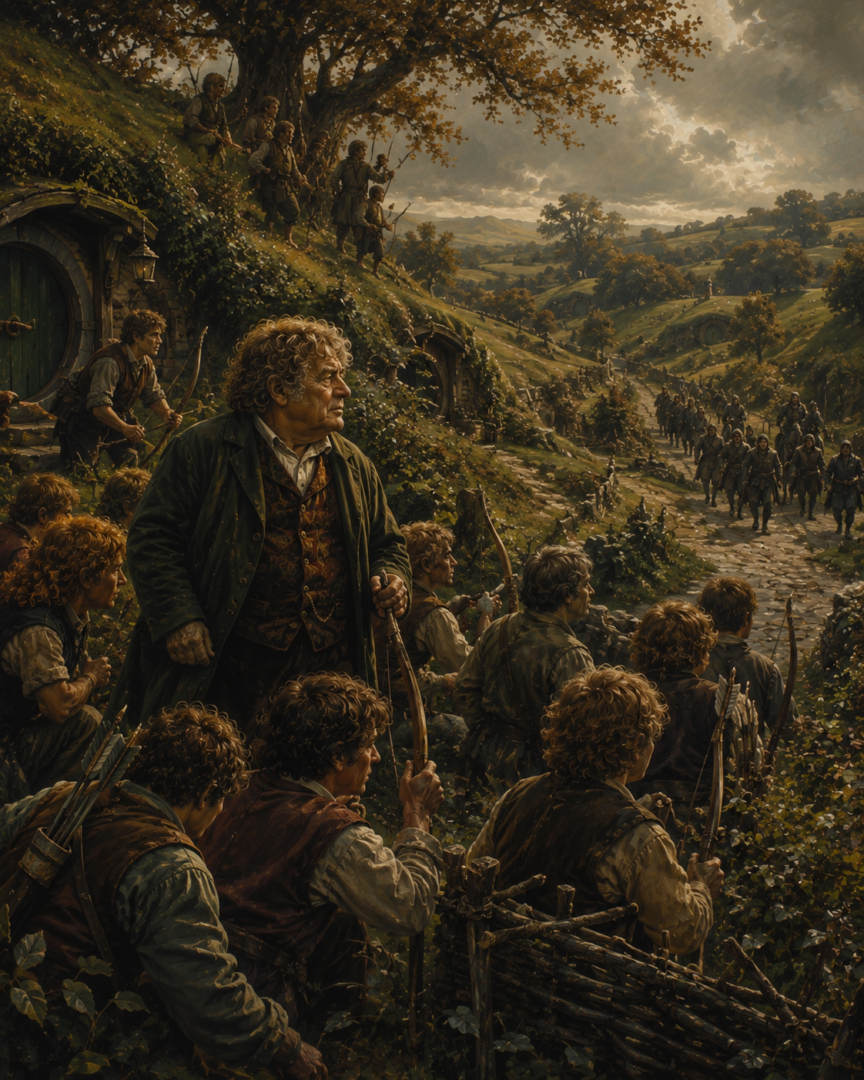
The Prologue says that the Shire had “hardly any ‘government.’” Families generally conducted their own affairs. The ancient laws remained, but Hobbits usually obeyed them voluntarily because they regarded them as old and just.
By Frodo’s lifetime, even the Thainship had become largely ceremonial.
The reason is almost comic: the Shire-moot and Shire-muster were associated with emergencies, and emergencies had become so rare that these institutions were barely used.
This produces one of the Shire’s deepest political paradoxes.
The Thain possesses significance precisely because he usually does nothing.
His office does not administer Hobbiton, supervise farms, dictate trade, or regulate daily domestic life. Its authority waits in reserve.
The Hobbits have therefore preserved an institution for the moment when their ordinary preference for local independence might no longer be sufficient.
For centuries, that moment hardly comes.
Then Saruman’s Men enter the Shire.
Paladin Took Shows What the Office Was For
During the occupation described in “The Scouring of the Shire,” normal Hobbit society is deliberately disrupted.
Lotho Sackville-Baggins has accumulated power, Men enforce new rules, goods are seized, traditional life is restricted, and eventually Saruman himself stands behind the regime.
Yet one part of the Shire has not been completely subdued.
Tookland resists.
Farmer Cotton explains that the Tooks have not accepted the new order. They remain inside their country, and the ruffians have been unable to force them into submission. Some intruding Men have even been shot.
This is not merely a random family feud.
The head of the Tooks at this point is Paladin Took II, Pippin’s father — and Paladin is the Thain.
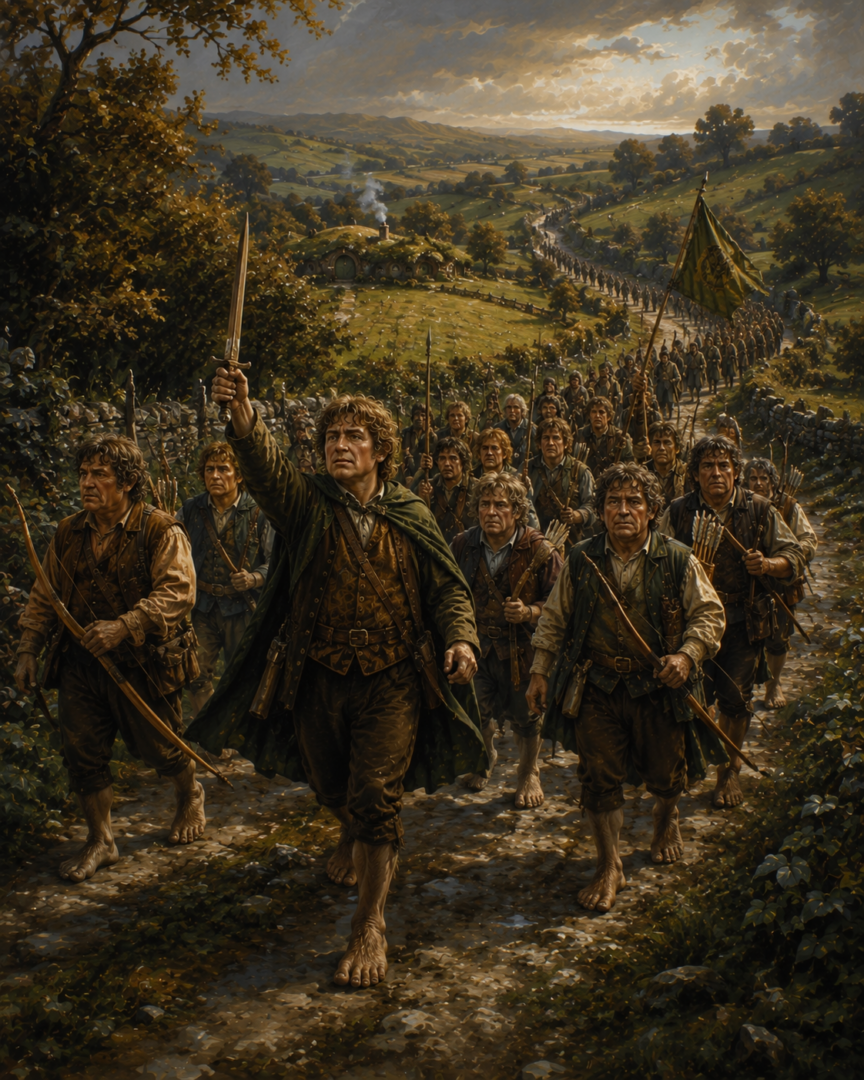
When Pippin rides to Tookland during the uprising, he is able to return with a substantial body of armed Tooks. A hundred arrive to strengthen the resistance before the Battle of Bywater, while others are employed against the remaining ruffians elsewhere.
For once, the ancient office has encountered exactly the kind of emergency for which it existed.
The Shire has been invaded and its normal customs have failed to protect it.
The Thain’s people muster.
An institution that had become almost nominal suddenly makes practical sense again.
The Hobbits Never Truly Rejected the King
This is why describing the Shire simply as anti-royal goes too far.
Hobbits have little interest in being governed, but the Prologue makes clear that they retain a cultural memory of legitimate kingship.
They attribute their fundamental laws to the old King. Even after nearly a thousand years without one, they still preserve a proverb about wicked creatures who have “not heard of the king.”
The joke contains political memory.
A troll does not recognize civilized restraint because, proverbially, it has never heard of royal law.
More importantly, the Hobbits do not respond to the disappearance of the monarchy by declaring its authority illegitimate. Their customs continue to assume that the old laws remain valid.
Their political world has therefore separated authority from administration.
The King can be absent.
His laws can remain.
The government can almost disappear.
The people can continue governing themselves.
And the Thain can preserve emergency authority without becoming a monarch.
That combination helps explain why the Shire can simultaneously feel almost anarchic in daily practice and surprisingly traditional in its understanding of legitimacy.
The Return of the King Does Not Destroy Hobbit Freedom
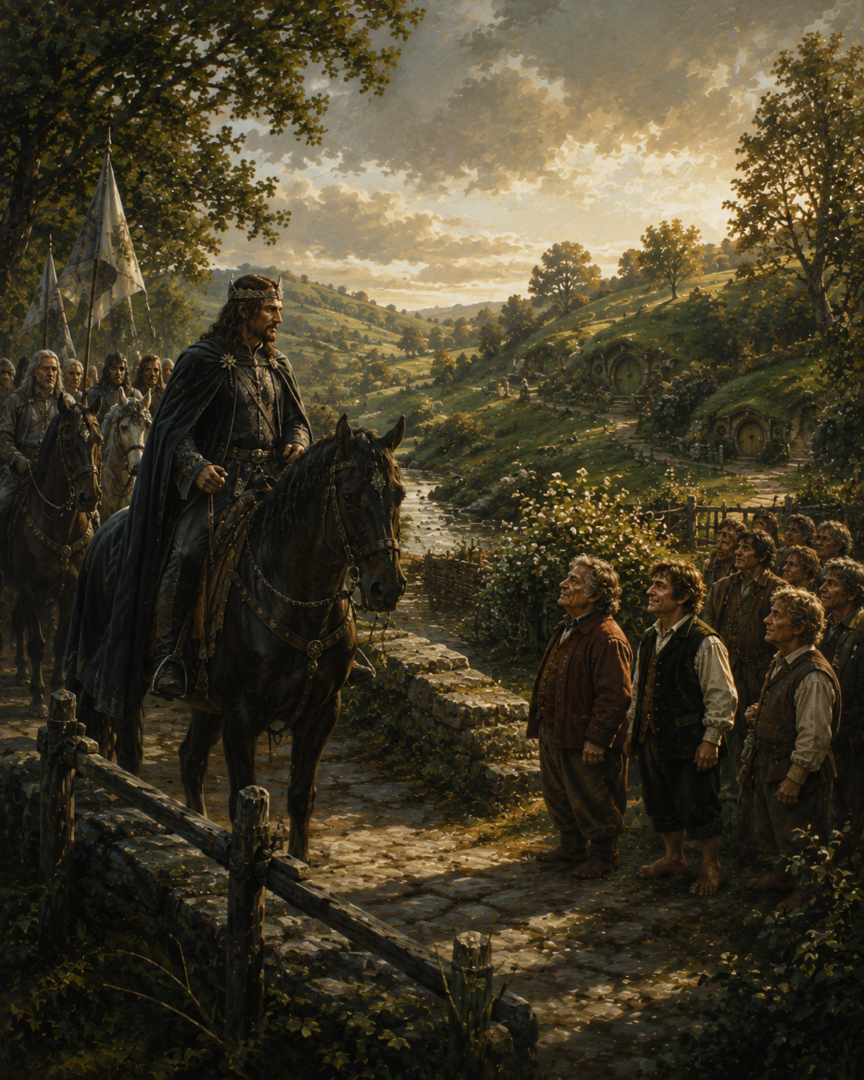
The final proof comes after Aragorn becomes King Elessar.
If Hobbit independence depended upon rejecting monarchy, the restoration of the northern kingship should create a constitutional crisis.
Instead, restoration and Hobbit autonomy coexist.
King Elessar issues an edict forbidding Men from entering the Shire and makes it a Free Land under the protection of the Northern Sceptre. He himself respects the boundary when he later comes north.
Even more strikingly, in Fourth Age 13, the Thain, the Master of Buckland, and the Mayor of the Shire are made Counsellors of the North-kingdom.
The restored monarchy does not erase the institutions that developed during its long absence.
It incorporates them.
Peregrin Took, once the reckless young Hobbit who left the Shire with Frodo, eventually succeeds his father as Thain. The office created because the King was gone survives after the King returns.
Its meaning has changed again.
What had been a substitute for absent authority becomes a link between the self-governing Shire and the restored realm.
The Shire Preserved More Than It Realized
There is a beautiful irony in the political history of the Hobbits.
For centuries, they live as though kings are irrelevant. Their communities function through family, custom, local reputation, elected office, and an extraordinary degree of voluntary order. The Thain becomes so inactive that his dignity appears almost antiquarian.
But they never abolish him.
And when genuine tyranny finally reaches the Shire, the forgotten structure of emergency leadership proves useful.
The Thainship reveals that Hobbit freedom is not built upon the belief that all authority is evil. The texts present something more complicated: authority can be legitimate without constantly interfering, law can survive without an enormous machinery of enforcement, and ancient institutions can remain dormant until circumstances require them.
Most importantly, the Shire never appoints its own king.
It waits.
For nearly a thousand years, the King becomes a memory, then a proverb, then almost a fairy tale. Grass covers the ruins of the old northern kingdom. Generations of Hobbits are born and buried without seeing a royal banner.
Yet somewhere in the Green Hills, the Thain remains.
Not a replacement king.
Not quite a ruler.
Rather, the keeper of an authority whose true holder has vanished beyond living Hobbit memory.
And when the King finally returns, the strangest thing is that the Shire does not need to surrender its freedom to receive him.
Its freedom had been living beside the memory of his kingship all along.
Sources & Notes
- The Encyclopedia of Arda — Thain of the Shire: overview of the office, its delegated royal authority, and its role in emergencies — https://www.glyphweb.com/arda/t/thain.html
- The Encyclopedia of Arda — The Shire: political and cultural context for the hobbit society that retained the Thainship after the northern kingdom fell — https://www.glyphweb.com/arda/s/shire.html
- The Encyclopedia of Arda — Tookland: reference for the territory and family most closely associated with the hereditary Thainship — https://www.glyphweb.com/arda/t/tookland.html
- The Encyclopedia of Arda — Aragorn Elessar: background on the restored northern king under whom the Shire’s old relationship to kingship was renewed — https://www.glyphweb.com/arda/a/aragorn.html
Sources document the key people, places, institutions, and chronology used in this interpretation.