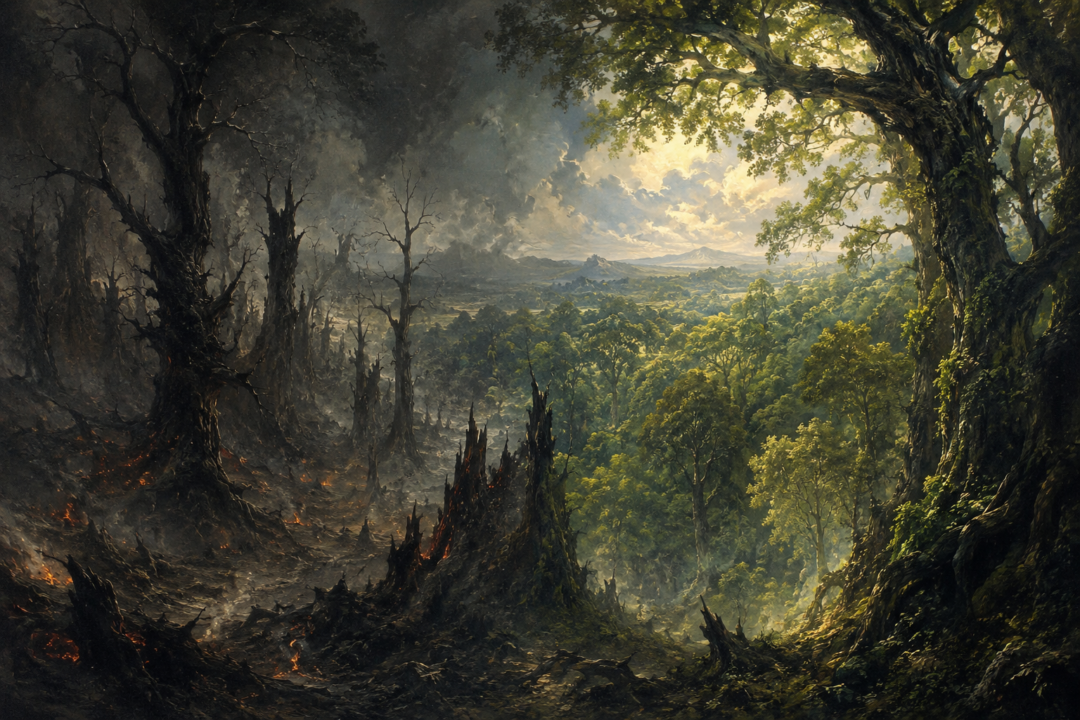
Mirkwood is one of the most memorable names in Middle-earth because it tells you what has happened before you ever enter the forest. This is no ordinary woodland. It is a place under shadow: tangled, dangerous, inhabited by hostile creatures, and for centuries poisoned by the presence of Sauron at Dol Guldur.
But “Mirkwood” was not its first name.
Before the Shadow settled there, the great forest east of the Anduin was known as Greenwood the Great, or Eryn Galen. And after Sauron’s final defeat, it received another name: Eryn Lasgalen, the Wood of Greenleaves.
That can sound like a simple restoration. Darkness is defeated, the forest becomes green again, and its hopeful new name reflects the change.
Yet Appendix B of The Lord of the Rings places the renaming beside something more concrete. Celeborn and Thranduil do not merely give the forest a new name. At the same meeting, they divide its territories among different peoples.
The change from Mirkwood to Eryn Lasgalen is therefore ecological, but it is also political. The map is being rewritten at the same moment as the name.
Mirkwood Was a Name Created by the Shadow
The forest did not begin as Mirkwood.
In the earlier Third Age it was Greenwood the Great. According to the chronology in Appendix B, around Third Age 1050 a shadow fell upon the forest, and people began calling it Mirkwood. Around this same period the Wise became aware that an evil power had established itself at Dol Guldur.
That power was eventually revealed to be Sauron.
The transformation was therefore more than linguistic. The name reflected a real historical catastrophe. A vast region that had once been Greenwood became associated with fear, darkness, dangerous creatures, and the Enemy's growing influence.
The Hobbit shows what that altered forest means at ground level. Bilbo and the Dwarves enter a place where the road is perilous, light is scarce beneath the canopy, enormous spiders hunt travellers, and leaving the path can have disastrous consequences.
Even after Sauron withdrew temporarily from Dol Guldur in 2941, the forest did not instantly become what it had once been. The long domination of the Shadow had consequences.
“Mirkwood,” then, functions almost like a historical scar. Its very name remembers the corruption of a landscape.
That makes what happens in 3019 especially significant.
The Forest Has to Be Won Back
The fall of Barad-dûr does not mean that every servant of Sauron simply disappears.
While the great war is being fought in Gondor, the northern lands are also attacked. Appendix B records assaults on Lórien and an invasion of Thranduil's realm. There is prolonged fighting beneath the trees, accompanied by destructive fire, before Thranduil wins.
Lórien itself is attacked three times from Dol Guldur.
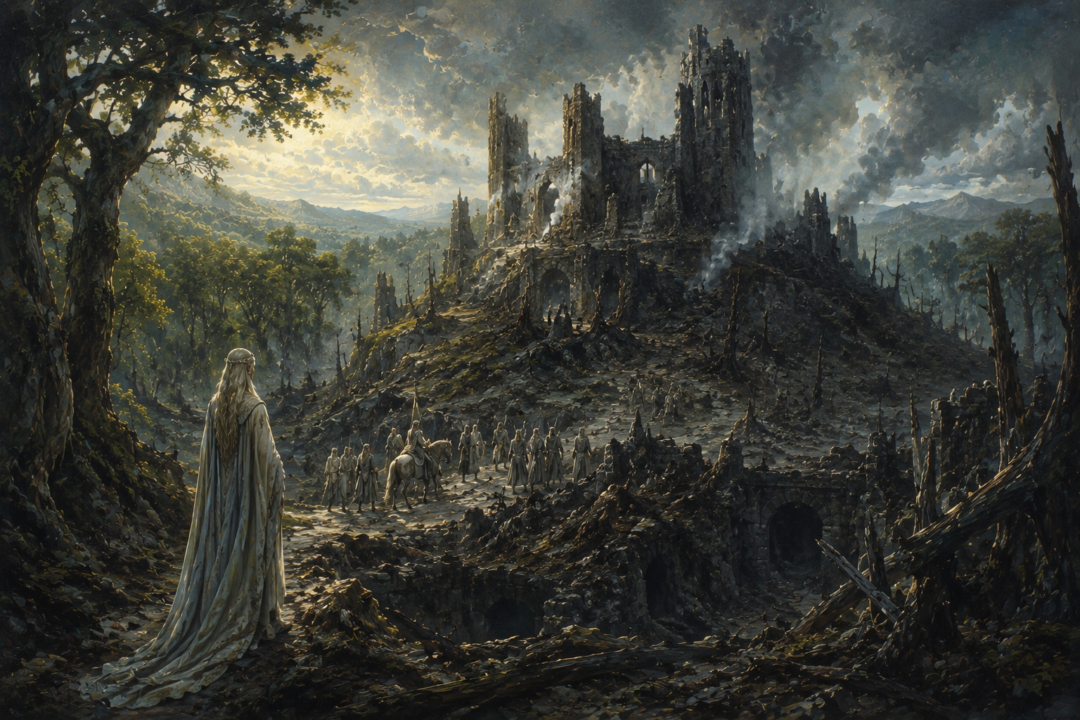
After Sauron's fall, Celeborn leads forces across the Anduin and takes Dol Guldur. Galadriel throws down its walls and lays bare its pits, and the forest is cleansed.
Only after these events comes the renaming.
That sequence matters.
Eryn Lasgalen is not simply a poetic announcement that trees are growing again. It follows military victory, the destruction of the Enemy's fortress, and the removal of the power that had made southern Mirkwood one of Sauron's principal strongholds.
The name therefore marks liberation.
But liberation creates another question: who now governs the liberated land?
Celeborn and Thranduil Do More Than Rename It
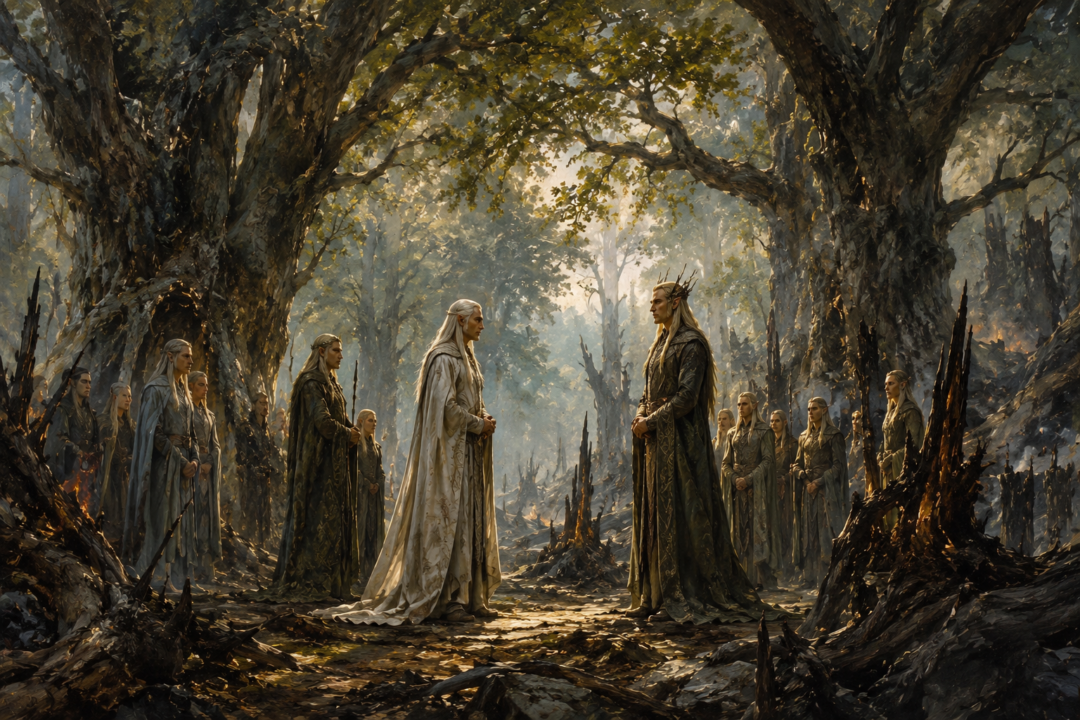
On the Elven New Year, Celeborn and Thranduil meet in the middle of the forest.
There they rename Mirkwood Eryn Lasgalen, the Wood of Greenleaves.
Then they divide it.
Thranduil takes the northern region as far as the mountains within the forest. Celeborn takes the southern woodland below the Narrows and calls it East Lórien. The broad region between these territories is given to the Beornings and the Woodmen.
This is why treating the episode merely as environmental symbolism misses half of what is happening.
The new name and the territorial settlement occur together.
A forest previously defined by Sauron's intrusion is being reordered after his defeat. Boundaries are identified. Realms are established or reaffirmed. Human inhabitants are assigned a large central region. The southern territory that had contained Dol Guldur becomes part of a new political landscape.
The text does not provide a constitutional explanation for this settlement, nor does it describe negotiations among all the peoples concerned. It would therefore go too far to invent a detailed diplomatic process.
But the political result is explicit.
Mirkwood disappears not only as the name of a corrupted forest, but as the name of a region belonging to the old geography of the Shadow.
Eryn Lasgalen Looks Backward as Well as Forward
The new name is especially revealing because it resembles the forest's ancient identity.
Before Mirkwood there was Eryn Galen, Greenwood. After Mirkwood comes Eryn Lasgalen, the Wood of Greenleaves.
The linguistic relationship makes the renaming feel less like the invention of an entirely new identity than a recovery of something older.
Yet it is not simply a return to the past.
The forest after the War of the Ring is politically different from the Greenwood that existed before Sauron's long occupation. Thranduil retains his northern realm, but Celeborn now claims the southern wood as East Lórien, while the Beornings and Woodmen receive the extensive territory between the Elven realms.
So the restored name points backward toward the unshadowed Greenwood, while the territorial settlement points forward toward a new age.
That tension is important.
Restoration in Middle-earth rarely means turning history backward until everything is exactly as it was. Damage leaves consequences. Peoples move. Kingdoms rise and fall. Even victory cannot restore every vanished thing.
Eryn Lasgalen is green again, but it is not simply yesterday's Greenwood resurrected unchanged.
The Human Lands in the Middle Matter
The most easily overlooked detail may be the land assigned to the Beornings and Woodmen.
Celeborn and Thranduil could have divided the entire forest between two Elven rulers. They do not.
The wide woodland between their territories goes to Men already associated with the region.
The Woodmen had long lived around the forest and the Vales of Anduin, while the Beornings had become an important people in the lands west of Mirkwood after the events of The Hobbit. By the time of the War of the Ring, the Beornings controlled important approaches between the Misty Mountains and the forest.
The postwar settlement therefore does not present the cleansed forest as exclusively Elvish.
That becomes significant when viewed against the larger transition taking place throughout Middle-earth. The Third Age is ending. Aragorn's kingship begins a restored political order among Men, while the great Elven powers are already moving toward departure and decline.
Eryn Lasgalen briefly embodies both realities.
Elven rulers participate in its liberation and division, but Men receive a substantial part of its future.
The forest has escaped Sauron, yet its new arrangement already belongs to a world moving beyond the age in which Elves were its dominant historical powers.
The Ecological Recovery Is Real — but Should Not Be Exaggerated
It is tempting to imagine the renaming as if every corrupted tree instantly burst into healthy leaf.
The texts do not require that picture.
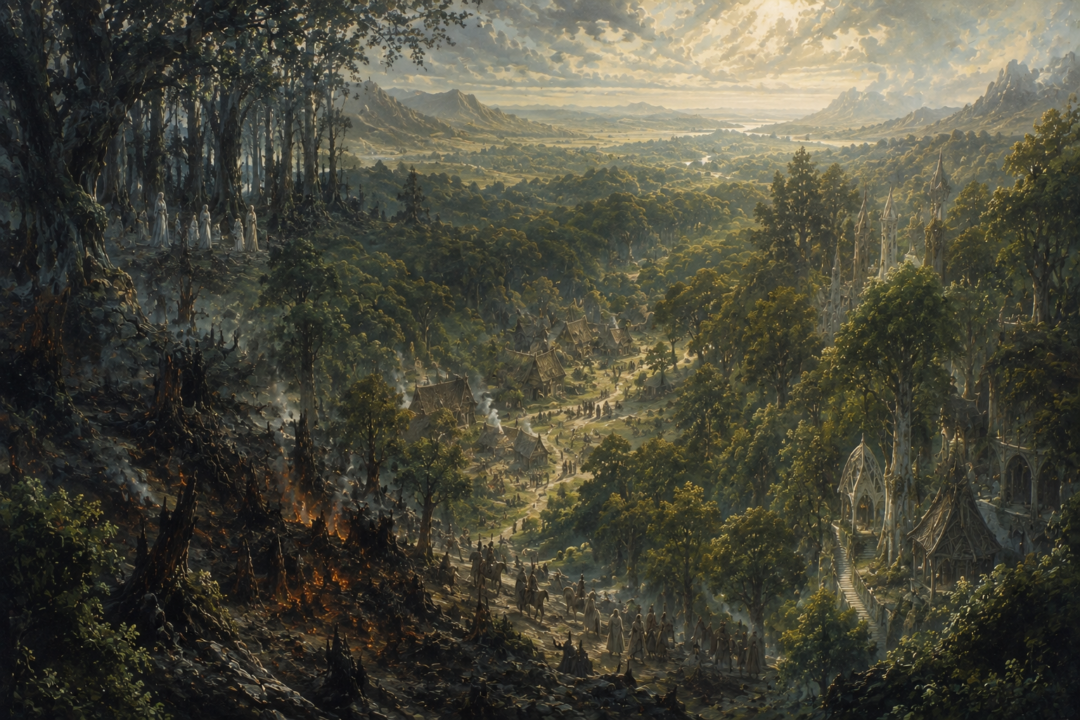
What they do tell us is that Dol Guldur is overthrown and the forest is cleansed. The new name, Wood of Greenleaves, plainly signals the removal of the Shadow and a restored identity for the woodland.
But Tolkien does not give us a botanical report describing precisely how quickly every part of Mirkwood recovered.
That distinction matters because the deeper transformation is not merely physical.
Sauron's presence had imposed an entire meaning upon the landscape. Places became feared because his power inhabited them. Creatures multiplied under the Shadow. Roads became dangerous. Names themselves changed.
When that power is removed, the forest can once again be understood as something other than a domain of dread.
The ecological reading and the political reading therefore reinforce one another.
The land is freed from corruption, and it is freed from the political geography created by the Enemy's occupation.
Naming Is a Form of Historical Memory
Middle-earth is filled with names that preserve history.
Places retain traces of vanished kingdoms, forgotten peoples, ancient disasters, and old victories. A name can survive long after the event that produced it.
“Mirkwood” belongs to that tradition.
It preserves the memory of the forest under darkness.
Renaming it does not erase the fact that the darkness happened. Instead, Eryn Lasgalen declares that the Shadow no longer has the final right to define the place.
That is why the identity of those doing the naming matters.
Celeborn and Thranduil are not distant observers. Their peoples have lived with the threat of Dol Guldur. Thranduil's realm has just endured invasion and ruin by fire. Lórien has repeatedly been assaulted. Celeborn's host has crossed the river after Sauron's fall, and Galadriel has destroyed Dol Guldur itself.
Their naming comes after resistance and victory.
It is consequently reasonable to read the act as a declaration of recovered authority, provided we do not pretend the text explicitly gives it that modern political terminology.
The Shadow named an age of the forest.
Its survivors name what comes afterward.
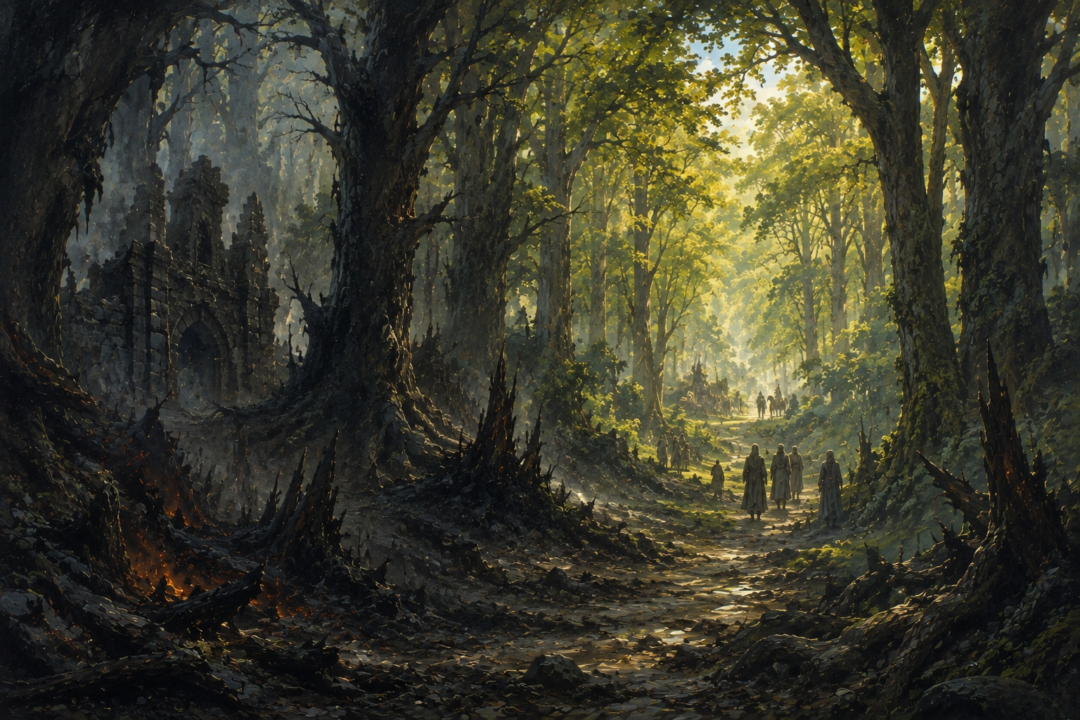
A Small Scene That Contains the End of an Age
The meeting in the forest occupies very little space in the vast history of the War of the Ring.
Yet it contains the pattern of the ending remarkably well.
Sauron's fortress is destroyed. A corrupted landscape is cleansed. An old name associated with darkness is discarded. Two Elven rulers establish new territories. Men receive a broad portion of the restored woodland.
And the forest becomes the Wood of Greenleaves.
That is not merely nature healing after evil.
It is the creation of a postwar order.
The irony is that this restoration comes just as the wider dominion of the Elves in Middle-earth is fading. Galadriel will depart. Celeborn will eventually leave Lórien for Rivendell. The Three Rings have lost their power with the destruction of the One. The Age of Men is beginning.
Eryn Lasgalen therefore stands at a threshold.
Its new name reaches backward toward Greenwood the Great, rejecting the identity imposed by centuries of Shadow. Its new borders point toward the political world that will follow Sauron's defeat.
The forest has been reclaimed, but history has not been reversed.
That may be the deepest meaning hidden in its renaming.
Mirkwood does not simply become green again.
It becomes a place whose inhabitants can decide what the forest will be called, where its realms will lie, and who will inherit the land after the Shadow is gone.
Sources & Notes
- https://www.encyclopedia-of-arda.com/m/mirkwood.php — The Encyclopedia of Arda: Mirkwood (the forest’s earlier Greenwood identity, corruption under Sauron’s shadow, and later recovery).
- https://www.encyclopedia-of-arda.com/e/erynlasgalen.php — The Encyclopedia of Arda: Eryn Lasgalen (the postwar name Wood of Greenleaves and the territorial settlement made by Celeborn and Thranduil).
- https://www.encyclopedia-of-arda.com/d/dolguldur.php — The Encyclopedia of Arda: Dol Guldur (Sauron’s forest stronghold, its wartime role, destruction, and cleansing).
- https://www.encyclopedia-of-arda.com/t/thranduil.php — The Encyclopedia of Arda: Thranduil (his realm, defense of the forest, and part in its Fourth Age division and renaming).
Sources checked for relevance and availability.