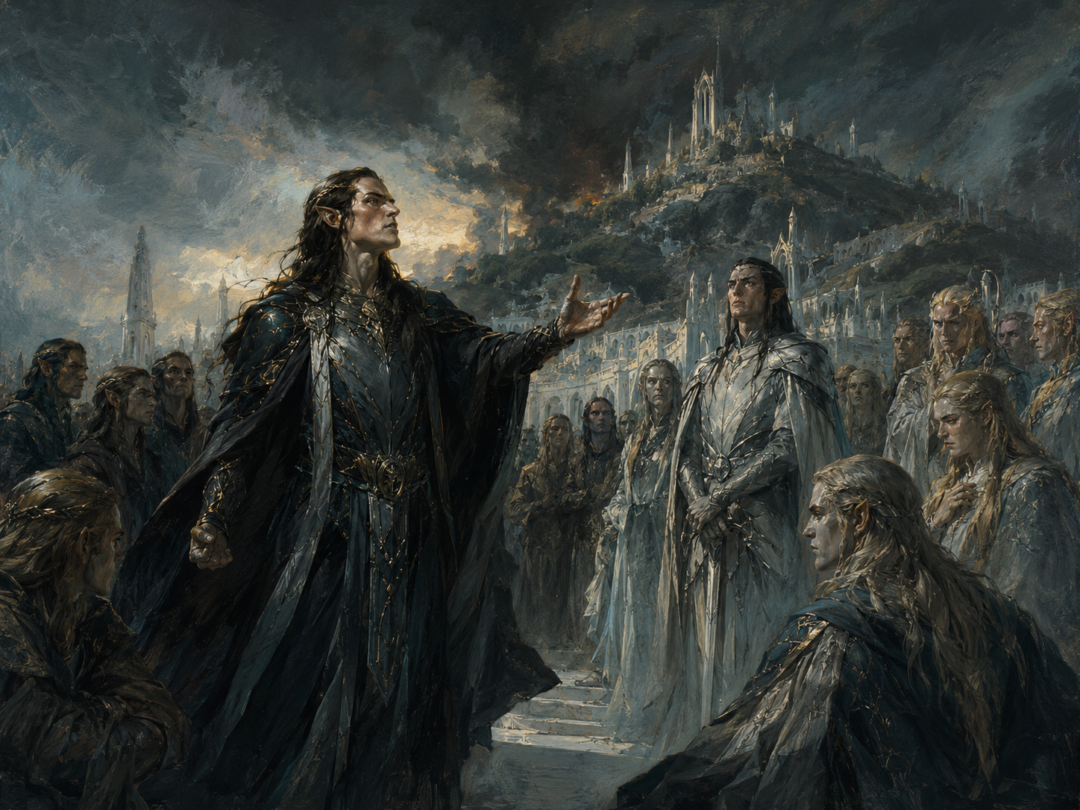
When Finwë was slain at Formenos, the obvious heir seemed to be Fëanor. He was Finwë’s eldest son, the greatest of his children, and already the dominant political force among the Noldor. Yet the history that follows is one of the clearest warnings against treating Noldorin High Kingship as though it operated by a simple rule of “eldest son inherits, then eldest son after him.”
That pattern appears at several points. But it repeatedly bends under the weight of divided peoples, renounced claims, rival houses, catastrophe, and the practical question of who can actually command the allegiance of the Noldor.
The result is something more complicated than straightforward primogeniture. Blood matters enormously. Male-line descent from Finwë clearly matters. Yet descent alone does not explain why Fingolfin becomes High King, why the House of Fëanor never recovers the title, why Turgon succeeds Fingon, or why Gil-galad ultimately emerges as the last High King in Middle-earth.
The kingship after Finwë is hereditary—but it is not automatic.
Finwë Leaves Behind More Than One Possible Political Order
Before Finwë’s death, the Noldor already possess a dangerous fracture.
Fëanor is Finwë’s eldest son by Míriel. Fingolfin and Finarfin are Finwë’s sons by Indis. The hostility between Fëanor and his half-brothers becomes part of the wider unrest stirred by Melkor in Valinor, eventually culminating in Fëanor drawing his sword against Fingolfin.
Finwë then goes with Fëanor into exile at Formenos.
This matters because when Morgoth murders Finwë, there is no calm transfer of power inside a united kingdom. The Noldor are already politically divided.
Fëanor claims the kingship and becomes the driving force behind the rebellion and flight from Aman. But even then, his personal supremacy is incomplete. The Silmarillion makes clear that many of the Noldor preferred Fingolfin, although Fëanor’s words and the desire to leave Aman drew most of the people into the great march.
So Fëanor’s status cannot be reduced to a ceremonial inheritance. He is Finwë’s eldest son, certainly, but he must also persuade people to follow him.
That distinction becomes decisive almost immediately.
Finarfin Shows That One Kingship Has Already Become Two
At the Doom pronounced upon the Noldor, Finarfin turns back.
He and those who follow him return to Valinor, where Finarfin receives pardon and rules the Noldor who remain in Aman. The Silmarillion describes him as being made king over that remnant.
Meanwhile Fëanor and Fingolfin continue toward Middle-earth.
From this point onward, talking about a single uninterrupted “crown of Finwë” becomes misleading. The Noldor have divided geographically and politically. Finarfin can rule the Noldor of Aman while another royal authority develops among the Exiles in Middle-earth.
That alone tells us that Noldorin kingship is attached not merely to genealogical seniority but also to a particular people and political community.
Finarfin has not somehow ceased to be Finwë’s son because his elder brothers crossed the Sea. Instead, the division of the Noldor produces different royal realities.
Maedhros Is the Great Exception That Changes Everything
Fëanor dies soon after reaching Middle-earth, mortally wounded after pursuing Morgoth’s forces too aggressively.
If inheritance operated mechanically, his eldest son Maedhros would simply take his place.
And initially, Maedhros does possess the senior claim of the House of Fëanor.
But by then Fëanor has committed the act that poisons relations between the two great branches of the Exiles. After seizing the ships of the Teleri, he abandons Fingolfin’s host and burns the vessels at Losgar, forcing Fingolfin’s people through the deadly Helcaraxë.
Then Maedhros is captured by Morgoth.
His rescue comes not from his brothers but from Fingon, eldest son of Fingolfin, who ventures toward Thangorodrim and saves him.
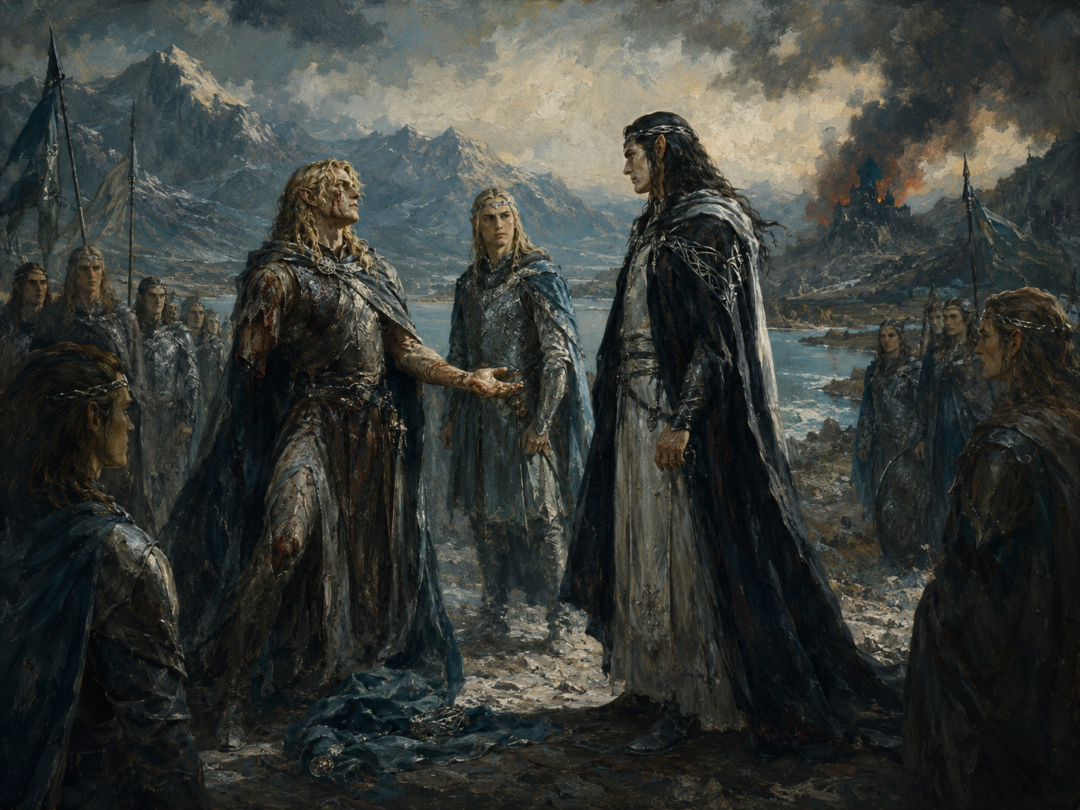
Afterward comes the pivotal political act in the history of Noldorin kingship: Maedhros relinquishes his claim to Fingolfin.
His reasoning is especially revealing. He declares that the kingship should come to Fingolfin as the eldest present member of the House of Finwë and praises his wisdom. The transfer also helps heal the breach created by Fëanor’s betrayal, although several of Maedhros’s brothers resent what he has done.
This is not automatic primogeniture.
Under strict descent through the eldest son, Maedhros should outrank his uncle. Instead, the senior heir voluntarily abandons the claim of Fëanor’s house and recognizes Fingolfin.
The political consequences last far beyond Maedhros himself.
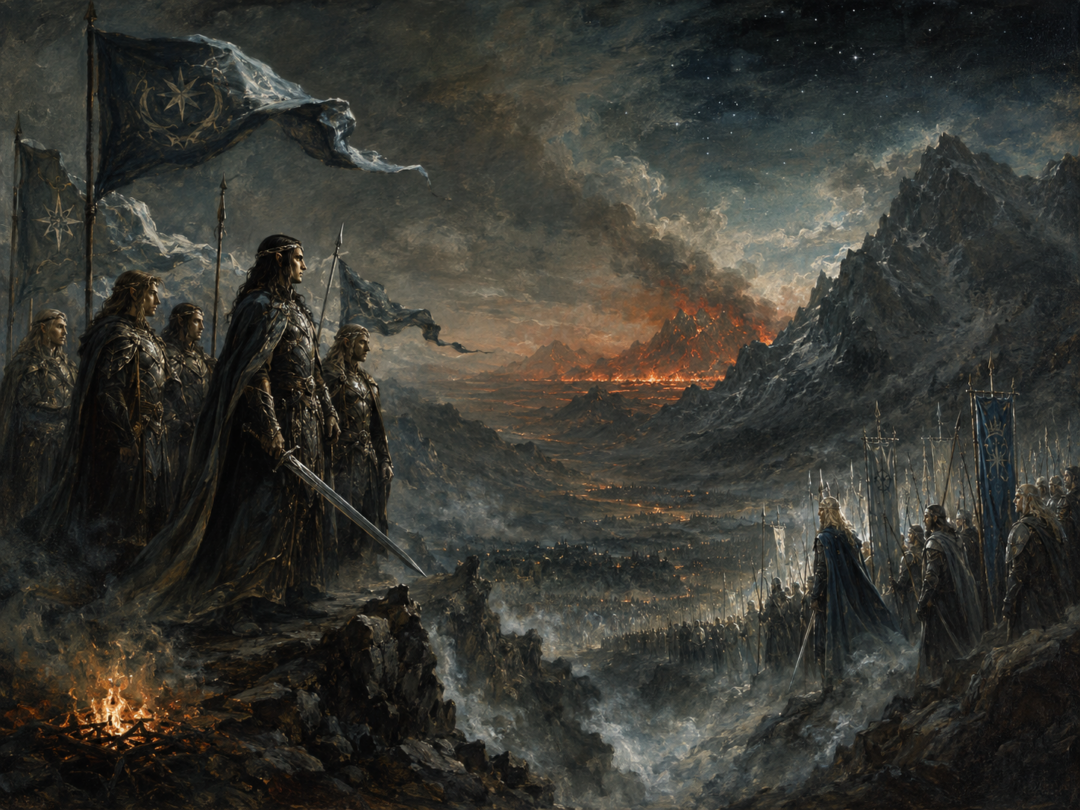
The House of Fëanor Becomes the Dispossessed
Maedhros’s decision does more than surrender a title for one lifetime.
The kingship passes away from the House of Fëanor.
That is why the sons of Fëanor are associated with the terrible fulfillment of the Doom: they become the Dispossessed. Although they remain immensely powerful princes with territories, armies, followers, and an independent political identity, none later reclaims the High Kingship.
This is crucial because members of Fëanor’s line continue to exist after later High Kings fall.
If senior descent from Finwë automatically determined the crown, the death of rulers from Fingolfin’s branch should repeatedly reopen the Fëanorian claim.
It does not.
Maedhros remains one of the greatest Noldorin leaders of the First Age and eventually organizes the vast alliance later called the Union of Maedhros. Yet he does so without taking back the High Kingship. Even the practical authority of the High King should not be imagined as absolute: the sons of Fëanor frequently pursued their own purposes despite acknowledging the wider kingship. Glyphweb
The crown has therefore acquired a political history that genealogy alone cannot erase.
Fingon Inherits—but Turgon Reveals the Limit of the Pattern
When Fingolfin dies after his desperate challenge to Morgoth, his eldest son Fingon succeeds him.
Here succession looks much more like ordinary primogeniture.
But Fingon’s death in the Nirnaeth Arnoediad produces another revealing transition. The High Kingship passes to his brother Turgon, King of Gondolin.
That succession is particularly interesting because the published Silmarillion identifies Gil-galad as Fingon’s son. Taken literally, that would mean the kingship passes from a dead king not to his son but to his younger brother.
There is, however, an important textual complication. Gil-galad’s parentage changed during the development of the legendarium. The published Silmarillion presents him as Fingon’s son, while later genealogical work instead makes him a descendant of Finarfin through Orodreth. Christopher Tolkien subsequently acknowledged that presenting Gil-galad straightforwardly as Fingon’s son had been an editorial mistake and believed his parentage would better have been left uncertain.
Therefore, Gil-galad should not be used as proof of a precise constitutional rule about inheritance.
But the stable narrative fact remains: after Fingon, Turgon is High King.
The kingship follows the surviving royal structure of the Exiles, not a clearly stated statute of eldest-son succession.
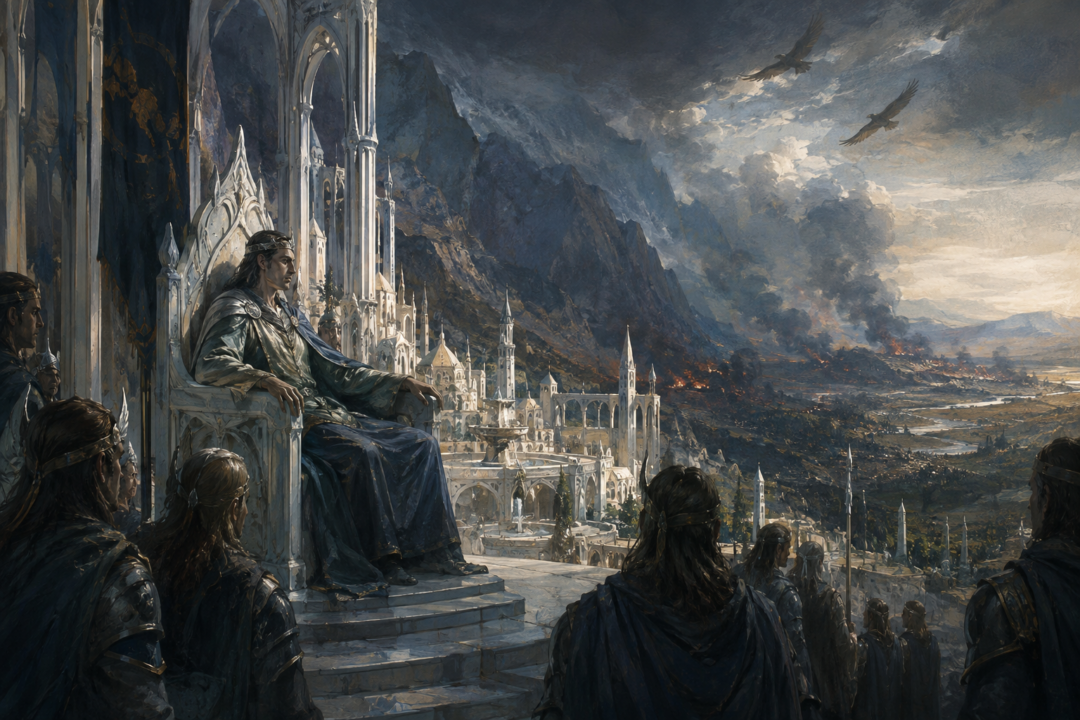
Turgon Is High King Even While Hidden
There is another paradox in Turgon’s reign.
He is High King of the Noldor, yet his realm is Gondolin—the Hidden City, deliberately concealed from Morgoth and largely separated from the outside world.
That makes the title very different from the rule of a centralized monarch controlling every Noldorin settlement.
By this point Beleriand is already shattered. Fingolfin’s old political world has been devastated. Nargothrond follows its own king. The sons of Fëanor retain their own forces. Gondolin is hidden. Other survivors gather around the Falas and later Balar.
High Kingship is consequently as much a statement of dynastic pre-eminence and recognized senior authority as a description of everyday government.
Turgon does not need to administer every Noldo directly to possess it.
And after Gondolin falls and Turgon dies, the title moves again.
Gil-galad’s Accession Shows Survival Matters as Much as Seniority
Gil-galad ultimately becomes High King among the survivors and remains so throughout the Second Age, ruling in Lindon until his death in the War of the Last Alliance.
Precisely where he belongs in Finwë’s family tree is one of the legendarium’s famous textual problems. The published Silmarillion calls him Fingon’s son; later material places him in the House of Finarfin through Orodreth. What should not be done is quietly choose whichever genealogy produces the neatest succession law and pretend the evidence is uniform.
What is secure is more useful.
Gil-galad belongs to the royal Noldorin tradition, becomes the recognized High King after the destruction of the older realms, and possesses the authority to lead the surviving Noldor into a new age.
By then the question is hardly “Who is Finwë’s eldest living descendant?”
The sons of Fëanor are still part of the story for a time. Galadriel also survives, as does the line of Turgon through Idril and Eärendil. Yet the High Kingship does not simply bounce between whichever descendant can construct the strongest genealogical claim.
It remains with Gil-galad until his death.
Why Elrond Does Not Simply Become the Next High King
Gil-galad dies without an heir at the end of the Second Age.
Elrond survives him. Elrond is descended from Turgon through Idril, and therefore from Finwë, but through the female line. Galadriel, herself a granddaughter of Finwë through Finarfin, also remains in Middle-earth.
Neither becomes High King of the Noldor.
The office simply disappears.
That ending may be the strongest evidence that the kingship is not an abstract hereditary possession compelled to find the next available descendant.
The texts never present a succession crisis in which Elrond, Galadriel, or some other descendant is calculated to be the genealogically nearest heir. Gil-galad is remembered as the last High King of the Noldor in Middle-earth.
His death closes the institution rather than triggering another automatic inheritance.
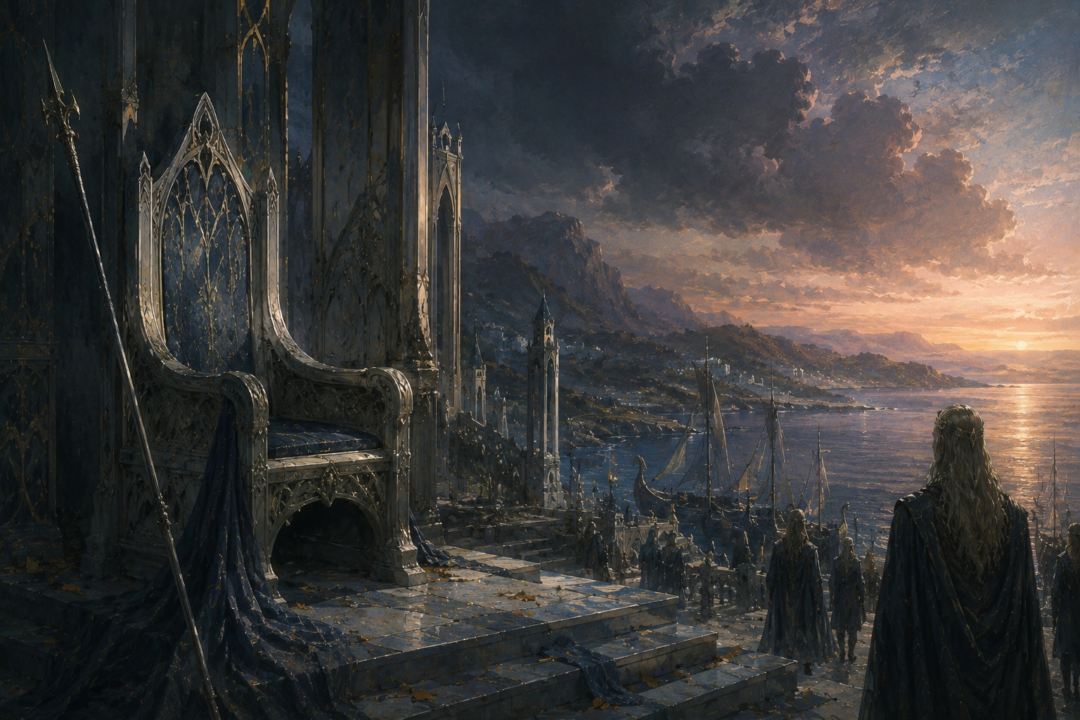
High Kingship Depends on Blood, Recognition, and History
None of this means Noldorin kingship was elective in a modern sense.
Finwë’s house unquestionably possessed unique dynastic significance. The known High Kings come from that royal lineage, and relationships between father, son, brother, and collateral branches clearly shape succession.
But “hereditary” is not the same as “automatic primogeniture.”
Fëanor claims his father’s kingship, yet the Noldor are already divided. Finarfin becomes king of those who remain in Aman. Maedhros possesses the senior Fëanorian claim but voluntarily yields it. Fingolfin gains the kingship through that renunciation and through the allegiance of the greater host. Fingon succeeds his father. Turgon succeeds his brother. Gil-galad emerges from the ruins as the final bearer of the title. After him, nobody inherits it at all.
The crown therefore carries memory.
Fëanor’s betrayal matters. Maedhros’s renunciation matters. The dispossession of his house matters. The destruction of kingdoms matters. The survival of particular branches matters. And, above all, the existence of a people capable of recognizing a High King matters.
That makes Noldorin High Kingship much more fitting to the tragedy of the First and Second Ages than a tidy family rule would be.
Finwë leaves descendants.
What he does not leave is a crown that can move forever by arithmetic.
Sources & Notes
- The Encyclopedia of Arda — High King of the Noldor: holders, succession, and the division between Aman and Middle-earth — https://www.glyphweb.com/arda/h/highkingofthenoldor.php
- The Encyclopedia of Arda — Finwë: founder of the Noldorin royal house and father of its competing branches — https://www.glyphweb.com/arda/f/finwe.php
- The Encyclopedia of Arda — Fingolfin: accession after Maedhros relinquished the senior claim — https://www.glyphweb.com/arda/f/fingolfin.php
- The Encyclopedia of Arda — Maedhros: rescue by Fingon and surrender of the kingship to Fingolfin — https://www.glyphweb.com/arda/m/maedhros.php
- The Encyclopedia of Arda — Ereinion Gil-galad: the last High King of the Noldor in Middle-earth — https://www.glyphweb.com/arda/g/gilgalad.php
Background references for the holders and transfers of Noldorin High Kingship from Finwë through Gil-galad. Primary narratives are in J.R.R. Tolkien’s The Silmarillion.