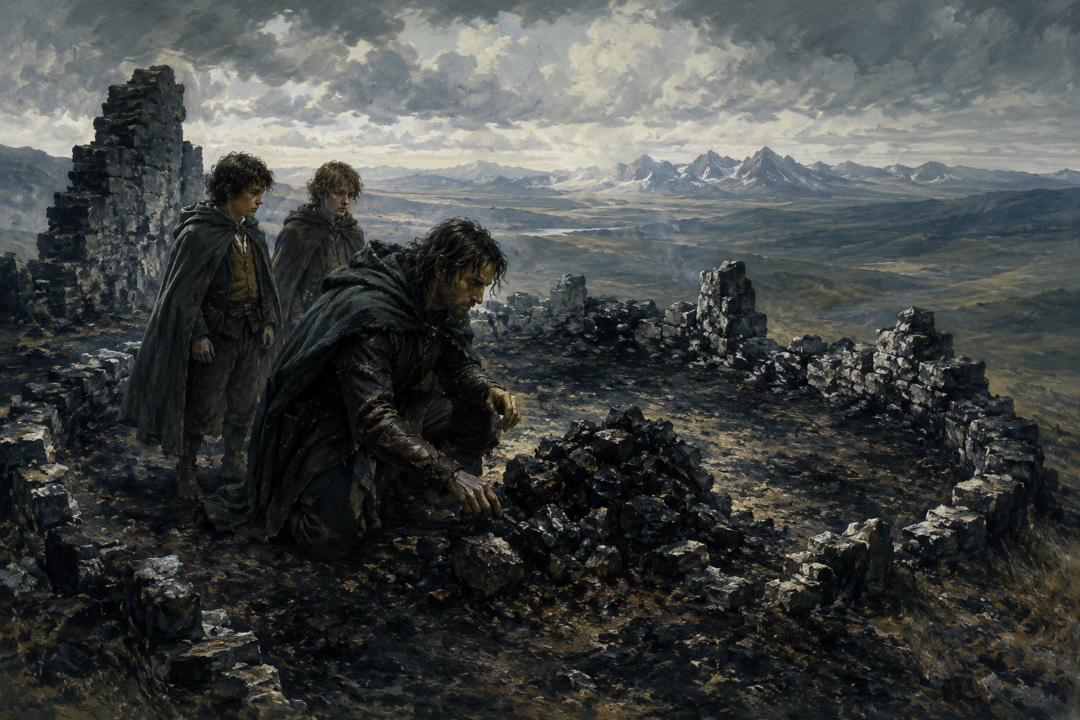
When Aragorn reaches the summit of Weathertop, he is looking for Gandalf. Instead, he finds something far less reassuring: scorched grass, blackened stones, and the remains of a fire fierce enough to have swept across the ruined crown of Amon Sûl.
To the hobbits, the damage is another ominous mystery. To Aragorn, it is evidence.
That distinction matters. Aragorn does not immediately know exactly what happened on Weathertop, and the text is careful not to give him knowledge he cannot possess. But the burned hill, a small scratched stone, and the strange flashes the travellers saw several nights earlier allow him to reconstruct part of the story.
What he learns is not simply that Gandalf has passed this way.
He learns that Gandalf was probably in danger.
And once Aragorn reaches that conclusion, Weathertop changes from a hoped-for rendezvous into the aftermath of a battle.
Weathertop Was Supposed to Give Them Answers
Aragorn's original reason for leading Frodo toward Weathertop is practical. The hill stands near the Great East Road roughly midway between Bree and Rivendell and commands an immense view of the surrounding country.
More importantly, Aragorn believes Gandalf may make for it if he is following them.
But he never treats the meeting as certain.
In The Fellowship of the Ring, Book I, Chapter 11, “A Knife in the Dark,” Aragorn warns Frodo that the hope of finding Gandalf there is faint. Weathertop is exposed, close to the Road, and obvious enough that enemies searching the wilderness may investigate it too.
That is the first important point: Aragorn approaches Amon Sûl already expecting uncertainty.
He is not walking toward a safe meeting place.
He is walking toward a place where Gandalf may have left some trace of his movements—and where the Enemy may also be waiting.
Then he discovers that something extraordinary has already happened there.
The First Clue Appeared Three Nights Earlier
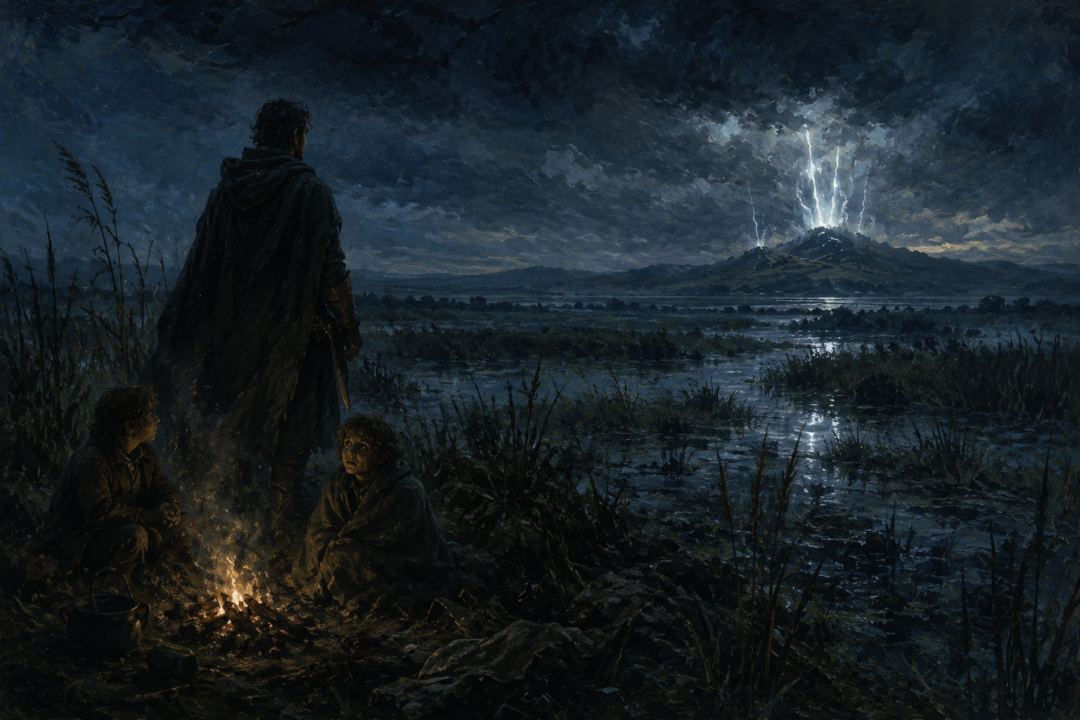
While Aragorn and the hobbits are still crossing the Midgewater Marshes, Frodo wakes during the night and sees flashes far to the east.
The light repeatedly rises and fades against the distant sky.
Aragorn cannot identify it. He compares it to lightning leaping from hilltops, but there is no confident explanation. He simply watches.
That restraint is important for understanding the later scene.
Aragorn does not somehow recognize Gandalf's power from miles away and immediately know that the wizard is fighting the Nazgûl. At the time, the flashes are only an unexplained phenomenon.
The travellers continue east.
Three days later, on October 6, they reach Weathertop.
Only then does the earlier mystery acquire a possible meaning.
The Summit Looks Like a Battlefield
Amon Sûl is no longer the great watchtower of the northern kingdom. Its tower was destroyed long before Frodo's journey, leaving a broken ring of ancient stone upon the summit.
Yet Aragorn finds signs of much more recent destruction.
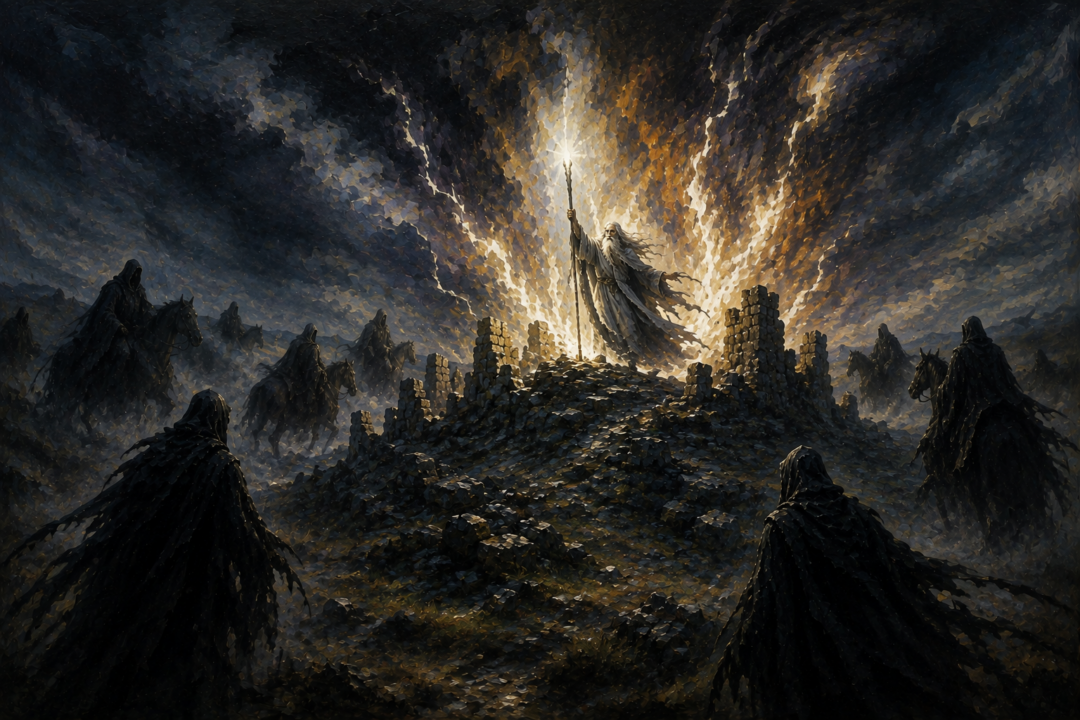
The stones of a newly made cairn are blackened. The surrounding turf has been burned to the roots. Grass within the ruined circle is scorched and shrivelled, as though flames have swept across the hilltop.
There is nobody there.
No Gandalf.
No obvious enemy.
Only the remains of fire.
Aragorn therefore has a problem very familiar to a Ranger: he must read what has been left behind.
And then he finds the crucial second piece of evidence.
Gandalf Leaves Almost the Smallest Message Possible
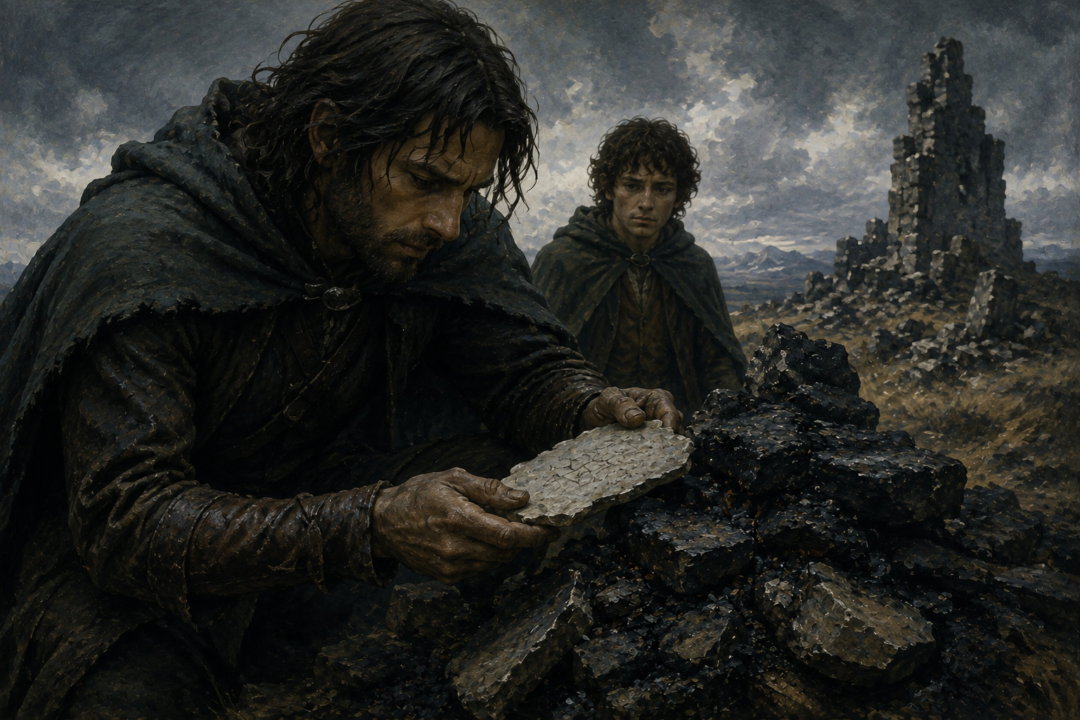
On the cairn Aragorn discovers a pale, flat stone that appears to have escaped the flames.
It bears scratches.
Aragorn interprets them cautiously as a sign left by Gandalf: a G-rune followed by three strokes, apparently indicating that Gandalf was there on October 3.
The date transforms everything.
October 3 is the night Aragorn and Frodo saw the mysterious flashes in the eastern sky.
The two pieces of evidence suddenly fit together.
The strange lights came from the direction of Weathertop.
Gandalf apparently reached Weathertop on the third.
And the summit now bears signs of intense fire.
Aragorn cannot prove every detail, but he can make a strong inference: Gandalf was on Amon Sûl when they saw the flashes.
The fire has given him the missing context for the sign.
What Aragorn Actually Concludes
Aragorn's conclusion remains admirably cautious.
He reasons that Gandalf was probably attacked.
He does not know by whom with certainty. He does not know exactly how the encounter ended. Most importantly, he does not know where Gandalf went afterward.
That limitation is central to the scene.
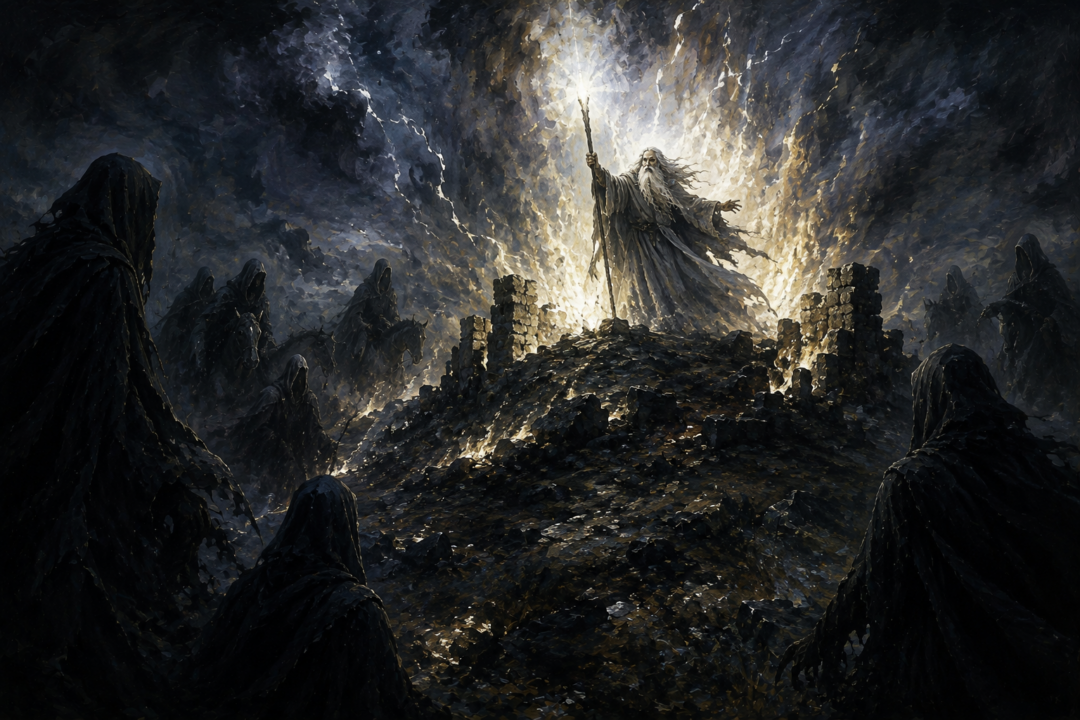
Modern readers already familiar with the whole story can easily import later knowledge into Aragorn's perspective. At the Council of Elrond, Gandalf eventually explains what happened. He had reached Weathertop and was attacked there by the Ringwraiths. The confrontation lasted through the night, and the extraordinary light and flame seen from afar were indeed signs of that struggle.
But Aragorn does not yet possess Gandalf's later account.
Standing on the burned summit, he is reconstructing events from physical evidence.
The texts therefore give us two versions of Weathertop.
First we experience it as Aragorn does: fragments, signs, deductions, and uncertainty.
Later Gandalf supplies the missing history.
Aragorn's deduction proves remarkably close to the truth.
The Fire Tells Aragorn Something Worse Than Gandalf's Absence
Finding no Gandalf would have been disappointing.
Finding evidence that Gandalf had been forced into a violent confrontation is much worse.
The scratched message is extremely brief. Aragorn reasons that Gandalf may have been hurried or unwilling to leave anything more explicit where enemies might discover it.
That means Aragorn cannot assume Gandalf is nearby, waiting to guide them.
Instead, the signs suggest that whatever Gandalf encountered was dangerous enough to force events onward.
The implications for Frodo are grim.
The enemy has reached Weathertop.
Gandalf is gone.
And Aragorn is now responsible for getting four hobbits—one of them carrying the One Ring—across the remaining wilderness to Rivendell.
Then the situation deteriorates almost immediately.
From the summit, they see distant figures moving along the Road.
Aragorn's keener sight identifies what the hobbits cannot clearly distinguish.
Black Riders are gathering.
The old battlefield has not become safe merely because Gandalf's battle is over.
Aragorn Cannot Simply Follow Gandalf
This is another subtle point in the chapter.
The burned ground tells Aragorn that something happened, but it does not provide a trail of instructions.
Gandalf's sign apparently tells him when the wizard was there, not where he went.
Aragorn therefore concludes that they must continue toward Rivendell without him.
That is precisely what makes the evidence so frustrating. Aragorn has learned enough to understand the danger, but not enough to escape it.
He now knows that Gandalf came to Weathertop.
He has good reason to connect Gandalf with the mysterious fire.
He suspects an attack.
But he cannot know Gandalf's present location or summon his help.
Knowledge has increased while their practical options have barely improved.
That is one of the scene's quiet cruelties.
Why Aragorn Later Chooses Fire Himself
That evening, fire takes on a second meaning.
The travellers descend to the sheltered dell on Weathertop's western side. There they discover wood that has been gathered and stacked. Aragorn says that Rangers have used the hollow before.
Despite the obvious risk that a fire could reveal their location, Aragorn decides to light one.
Sam immediately sees the problem: a fire advertises their presence.
But Aragorn knows something else about the enemy closing around them.
The Black Riders do not love fire and fear those who wield it.
He therefore chooses fire not because he thinks the company remains safely hidden, but because hiding is no longer a sufficient plan. Five Riders have been seen converging in the region, night is approaching, and Aragorn believes they are in immediate danger.
The decision echoes the evidence on the summit.
Gandalf apparently used fire when confronted on Weathertop.
Now Aragorn prepares fire when facing what he suspects may be the same enemy.
The parallel should not be pushed too far: the text never says Aragorn is consciously imitating Gandalf's tactics. But the juxtaposition is striking. The chapter moves from fire as evidence of a previous struggle to fire as one of the travellers' few available defenses.
Fire Does Not Make Them Safe
Aragorn understands the limits of that defense.
The Nazgûl still approach.
Five dark figures eventually appear above the dell, and the terror accompanying them overwhelms the hobbits' resistance. Frodo feels an almost irresistible compulsion to put on the Ring.
The Witch-king wounds him with a Morgul-knife.
Aragorn drives at the attackers with flaming brands, but the encounter demonstrates that fire is not some absolute weakness capable of neutralizing a Ringwraith.
It is an advantage, not a guarantee.
This distinction matters because Aragorn's actions throughout the episode are governed by imperfect choices. Every option carries danger.
Remain hidden, and the Riders may find them in darkness.
Make a fire, and they may reveal themselves.
Take the Road, and they expose themselves to pursuit.
Stay at Weathertop, and the Nazgûl are already closing in.
Leave immediately, and darkness may catch them in open country.
Aragorn is not solving a puzzle with one correct answer. He is managing a collapsing situation.
The Later Revelation Confirms His Reading
At Rivendell, Gandalf finally explains what Aragorn could only infer.
After escaping from Saruman and learning at Bree that Frodo had departed with Aragorn, Gandalf rode east. He reached Weathertop before them.
There the Nazgûl confronted him.
Gandalf later describes being besieged on the hill during the night, and his account confirms that the tremendous light and flame were produced during that confrontation. At dawn he escaped and drew some of the Riders away.
This retrospectively explains nearly every clue Aragorn encountered.
The flashes seen from the marshes were real signs of battle.
The burned summit was its aftermath.
The scratched stone marked Gandalf's presence and date.
The Riders Aragorn later saw gathering near the Road belonged to the same hunt that had already reached Amon Sûl.
What looked at first like disconnected details was one continuous pursuit.
Aragorn Is Reading a War Already in Progress
That is the deeper importance of the fire on Weathertop.
Aragorn is not merely asking, “Was Gandalf here?”
He is trying to discover what has happened ahead of him.
The answer he extracts from the ruined summit is incomplete but terrifying: Gandalf was here, something dangerous happened, and whatever attacked him may still be hunting nearby.
Weathertop therefore marks a change in Frodo's journey.
Before it, the Black Riders are pursuers glimpsed on roads, heard outside houses, or sensed somewhere behind the travellers.
At Amon Sûl, their pursuit becomes an open conflict.
Gandalf has already fought them.
Aragorn sees them converging.
Frodo will soon face them directly.
The fire is the evidence connecting those stages.
And that may be the most revealing thing about Aragorn in the entire episode. He possesses no magical vision of everything happening around him. He survives through experience, observation, caution, and inference. He reads scratched stones, burned grass, distant movement, tracks, terrain, and the behavior of his enemies.
On Weathertop, he cannot learn everything from the fire.
But he learns enough.
Someone fought on that hill.
Gandalf was there.
The danger has passed through before them.
And it has not gone away.
Sources & Notes
- The Encyclopedia of Arda — Weathertop: the ruined watch-hill, Gandalf’s battle, and Aragorn’s arrival — https://www.glyphweb.com/arda/w/weathertop.php
- The Encyclopedia of Arda — Amon Sûl: history and geography of the hill and its watchtower — https://www.glyphweb.com/arda/a/amonsul.php
- The Encyclopedia of Arda — Gandalf: his movements before Frodo’s arrival and confrontation with the Nazgûl — https://www.glyphweb.com/arda/g/gandalf.php
- The Encyclopedia of Arda — Nazgûl: the Ringwraiths pursuing Frodo and attacking at Weathertop — https://www.glyphweb.com/arda/n/nazgul.php
Background references for Amon Sûl, Gandalf’s presence there, and the Nazgûl pursuit. Primary narrative: J.R.R. Tolkien, The Fellowship of the Ring, ‘A Knife in the Dark.’