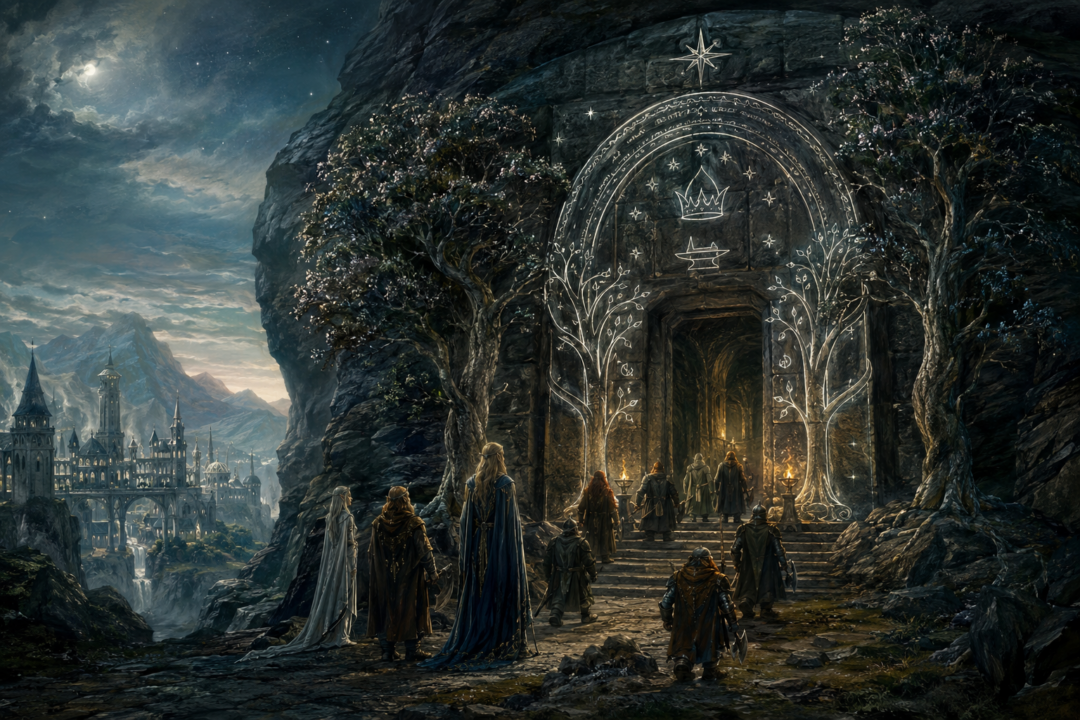
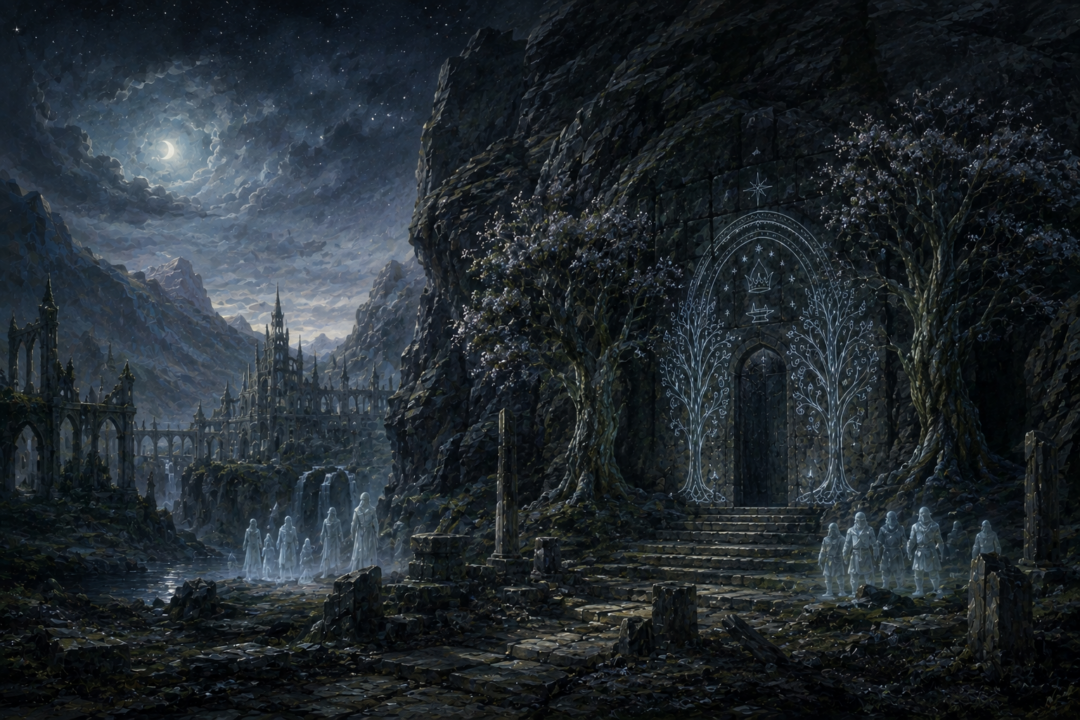
When the Fellowship finally finds the West-door of Moria, the entrance seems at first almost impossible to detect. The cliff is smooth. There are no hinges or visible seams. Only when moonlight and starlight touch the surface do silver lines appear: an arch, trees, stars, a crown, and words written in Elvish letters.
Those words contain one of the strangest little acts of openness in Dwarven history.
They announce Durin. They identify Moria. They name the Dwarf-smith Narvi and the Elf-smith Celebrimbor. Most remarkably, they tell a visitor exactly how to enter.
Yet they do not do this in Khuzdul, the private language of the Dwarves.
The inscription is Sindarin.
That distinction matters. The Doors of Durin are not merely a clever riddle guarding Moria. They survive from an extraordinary period in which the Dwarves of Khazad-dûm and the Elves of Eregion were close neighbors and collaborators. The gate publicly celebrates that relationship while preserving one of the deepest boundaries the Dwarves maintained between themselves and outsiders.
It says, in effect: friendship may open our door, but friendship does not require surrendering everything that is ours.
A Dwarven Door Written in an Elven Language
In The Fellowship of the Ring, Gandalf reads the inscription as:
“The Doors of Durin, Lord of Moria. Speak, friend, and enter. I, Narvi, made them. Celebrimbor of Hollin drew these signs.”
The wording is Sindarin, represented in the Fëanorian letters, or Tengwar, according to the mode of Beleriand. Frodo recognizes that the writing is Elvish but cannot read this particular form of it.
The inscription itself therefore embodies cooperation before its meaning is even considered.
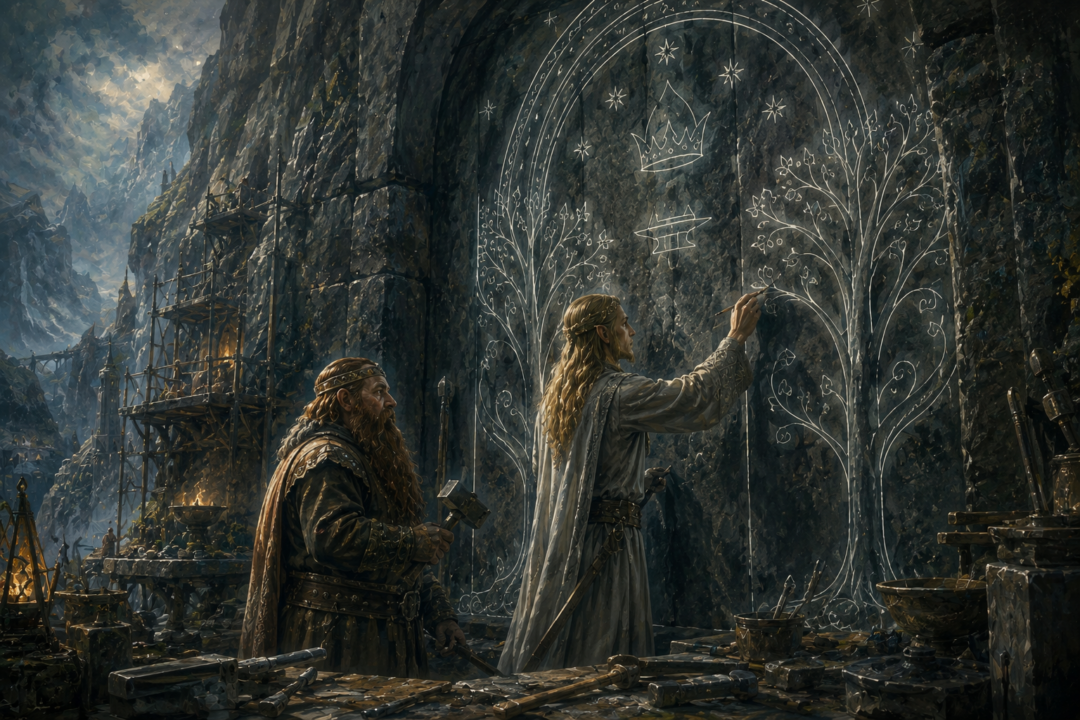
Narvi, a Dwarf, made the doors. Celebrimbor, the great Elven craftsman of Eregion, drew the signs upon them. The work bears both identities rather than disguising either one.
This was not an Elf decorating a captured Dwarven gate, nor Dwarves borrowing Elvish ornament without acknowledgment. The inscription explicitly records the two craftsmen and their different contributions.
The door is a joint work.
That makes its language especially significant. A major entrance to the greatest Dwarven realm of its age addresses those approaching from the Elvish lands to the west in Sindarin rather than demanding knowledge of the Dwarves’ own guarded tongue.
Why Khuzdul Was Different
Khuzdul was never simply another regional language.
The Dwarves were notably reluctant to teach it to outsiders. Appendix F of The Lord of the Rings explains that they were secretive concerning their own language and generally preferred to learn the languages of other peoples rather than teach their own.
This pattern extended even to their personal names.
Names such as Durin, Gimli, Balin and Thorin are presented to readers in the forms the Dwarves used publicly among outsiders, not as their private Khuzdul names. Gimli’s true inner name is never revealed.
That secrecy helps explain why the absence of Khuzdul from the West-door should not automatically be read as surprising.
The Dwarves could participate deeply in another culture’s language without abandoning their own linguistic boundary. Indeed, learning the speech of neighbors was characteristic of them.
So the inscription does something subtler than proclaiming that Elves and Dwarves had overcome every difference between them.
They had not.
Instead, it shows that genuine friendship existed alongside difference.
The Dwarves did not need to place their private language on the gate to prove their friendship with Eregion. Sindarin was precisely the appropriate language for a doorway facing an Elvish country.
The Gate Faced Eregion for a Reason
The geography strengthens the point.
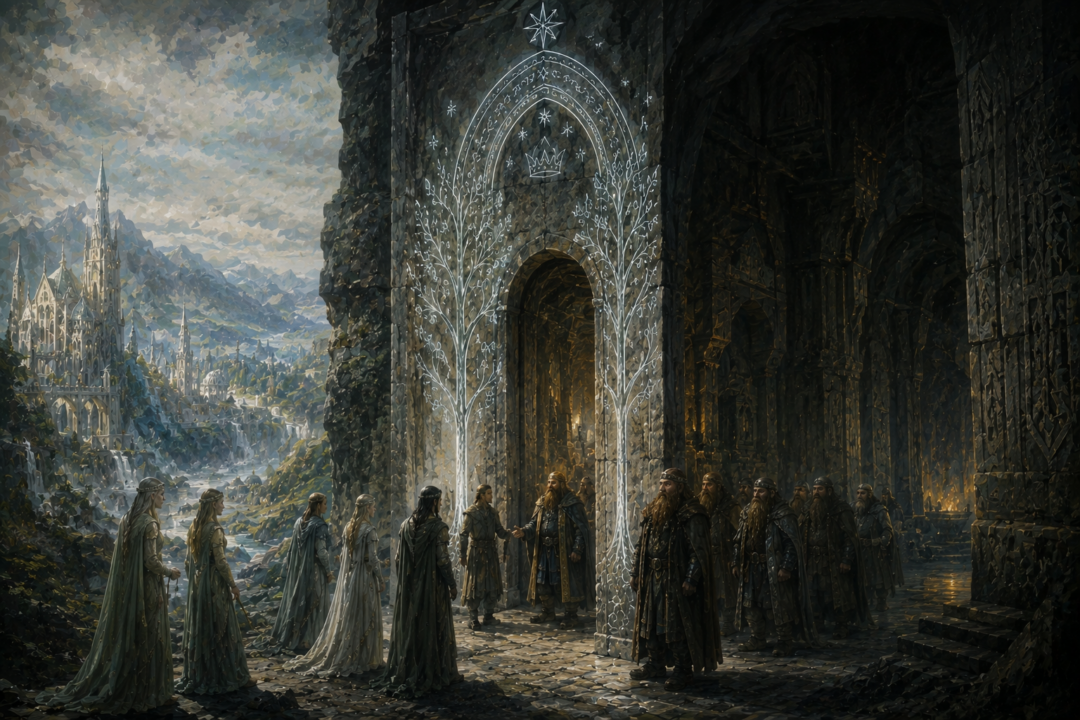
Khazad-dûm lay beneath the Misty Mountains, while Eregion stood immediately to its west. The realm of the Noldorin smiths had particularly close relations with the Dwarves of Khazad-dûm. Unfinished Tales describes the friendship that arose between them as closer than had ever before existed between Elves and Dwarves.
Material interests were certainly part of that relationship. The Elven craftsmen greatly valued mithril, which was found in Khazad-dûm. But the surviving traditions do not reduce the connection to commerce.
Narvi and Celebrimbor themselves became the enduring symbol of something more personal.
The West-door was therefore not originally the entrance to a feared ruin called Moria in the sense experienced by the Fellowship. It belonged to a living network connecting two prosperous realms.
That changes the emotional meaning of its password.
By the late Third Age, Gandalf, Aragorn, Boromir and their companions stand before a silent, abandoned city. Naturally, they assume that a secret entrance into such a dangerous place should have a difficult password.
But they are mentally approaching the door from the wrong age.
“Mellon” Was Almost Too Easy
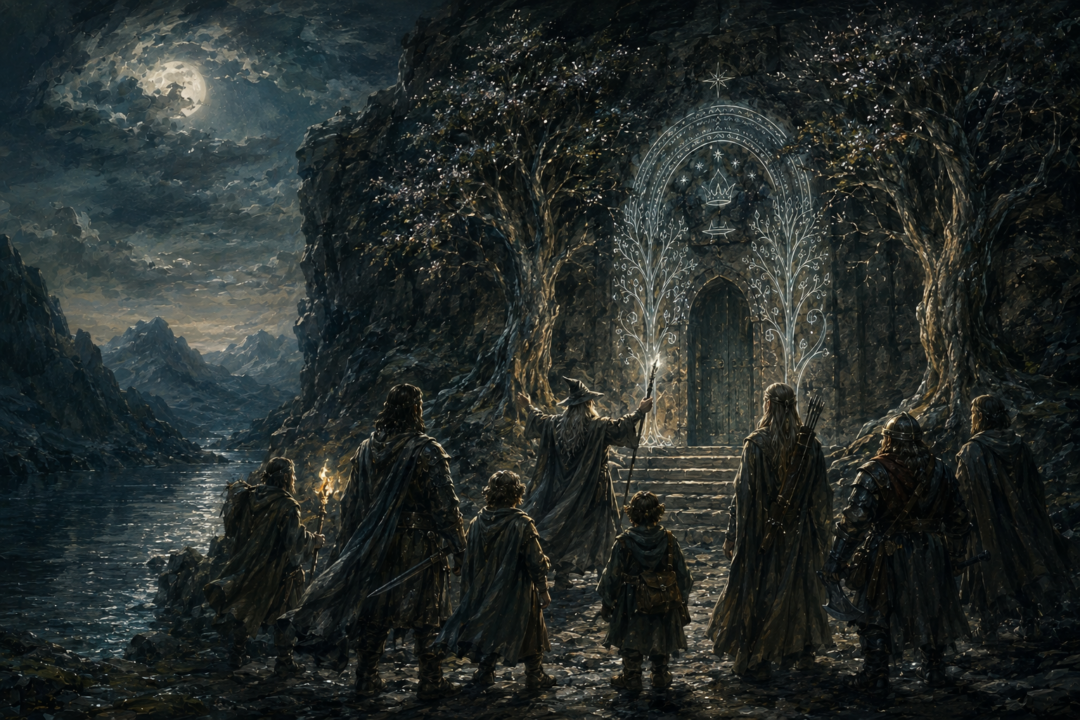
Gandalf initially interprets the inscription in the familiar way: “Speak, friend, and enter.”
Merry eventually asks what the words actually mean, prompting Gandalf to recognize another reading: “Say ‘friend’ and enter.”
The password is simply mellon, Sindarin for “friend.”
Gandalf laughs when he understands.
His mistake was not ignorance of Sindarin. It was partly a mistake of expectation. He had assumed that the door belonged to a world of secrecy and danger resembling the Moria before them.
But the inscription came from a friendlier time.
Gandalf explains that these doors probably had no need to be secret when they were made. They usually stood open, with doorwards sitting inside. The password was useful when the doors were shut.
That context makes the famous riddle less like an elaborate security puzzle and more like a surviving custom of hospitality.
A person approaching from Eregion could literally speak the Elvish word for “friend” and gain entrance.
There is tragic irony in the fact that, thousands of years later, the Fellowship finds this simplicity difficult to understand.
The world has become less trusting than the door.
Friendship Without Assimilation
Here lies the most interesting feature of the inscription.
Everything about the West-door communicates contact between peoples.
An Elf drew its signs.
A Dwarf made its structure.
Its writing uses Fëanorian letters.
Its words are Sindarin.
Its password means “friend.”
Yet none of this requires the Dwarves to reveal Khuzdul.
The distinction is worth preserving because it prevents an overly simple reading of Elven-Dwarven friendship. Friendship in Middle-earth does not necessarily erase cultural boundaries.
Khazad-dûm remained Dwarven.
Eregion remained Elven.
Narvi did not become culturally Elvish merely because Celebrimbor worked beside him, and Celebrimbor did not need access to every Dwarven secret for their collaboration to be meaningful.
The Doors therefore provide a rare picture of cooperation without sameness.
The two peoples meet at the threshold.
That is exactly where such a monument belongs.
Even the Artwork Joins the Two Worlds
The design revealed by Gandalf’s touch is also carefully associated with the peoples who made it.
The inscription identifies Narvi and Celebrimbor, while the visible emblems include signs connected with Durin and the Elves. Gandalf specifically points out the emblems of Durin and the High Elves.
Above the doorway appear stars, and beneath them a crown and an anvil. Two trees frame the entrance.
The lines themselves are made with ithildin, a substance associated with the craft of the Elves of Eregion, visible under the appropriate light.
The result is not simply a Dwarven door carrying a foreign translation.
It is a shared artistic statement.
Neither side disappears from it.
That is perhaps why the West-door feels so unlike the monumental defensive entrances associated with isolated kingdoms. Its purpose was certainly to control passage, but its surviving imagery presents connection rather than hostility.
The door announces who made it instead of hiding its makers.
It tells visitors what realm lies beyond.
And concealed within its apparently formal inscription is the means of opening it.
The Word That Survived the Friendship
The fate of Eregion gives all of this a darker edge.
The friendship represented by the gate did not endure untouched. Sauron’s war against the Elves devastated Eregion in the Second Age, and Celebrimbor was killed. Khazad-dûm shut its doors against the enemy and survived for many centuries afterward, until the awakening of Durin’s Bane brought catastrophe upon the Dwarven kingdom.
By the time Frodo sees the West-door, both societies that created it in friendship are gone from that landscape.
Eregion is empty.
Khazad-dûm is abandoned by Durin’s Folk.
Narvi and Celebrimbor belong to the distant past.
Yet their work still functions.
That may be the most moving detail of all.
The Fellowship does not enter because Gandalf discovers some forgotten Khuzdul command reserved for Dwarven kings. They do not break the doors or uncover a hidden key.
An Elf-word opens them.
Friend.
The old relationship has vanished, but its vocabulary remains embedded in the architecture.
What the Doors of Durin Actually Reveal
It would go too far to claim that the inscription was deliberately designed as a philosophical statement about Dwarven linguistic privacy. The texts never explicitly say that Narvi and Celebrimbor chose Sindarin in order to preserve the secrecy of Khuzdul.
But the contrast is nevertheless real.
The Dwarves are consistently described as guarding their own language. The West-door nevertheless addresses outsiders openly in Sindarin. Its makers are named. Its purpose is declared. Its password is hidden only by the simplicity of its wording.
So the strongest lore-grounded reading is not that Khuzdul was somehow forgotten or forbidden at the gate.
It is that Khuzdul was unnecessary.
The language of the threshold was the language through which neighbors could meet.
And that makes the Doors of Durin a surprisingly sophisticated monument to friendship in Middle-earth. They do not suggest that trust means having no secrets. They preserve Dwarven identity while making room for outsiders, Elven craft beside Dwarven craft, and an Elvish word upon the entrance to a Dwarven kingdom.
Thousands of years later, almost everything that made that arrangement possible has disappeared.
The trees of Hollin no longer shelter a thriving Elven realm. Narvi and Celebrimbor are dead. Khazad-dûm has become a place of darkness and dread.
But under moonlight and starlight, the old silver letters still appear.
And the door still remembers what its builders once expected to hear from someone arriving from the west:
friend.
Sources & Notes
- The Encyclopedia of Arda — Doors of Durin: inscription, makers, symbols, and opening word — https://www.glyphweb.com/arda/d/doorsofdurin.php
- The Encyclopedia of Arda — Khuzdul: the Dwarves’ guarded private language — https://www.glyphweb.com/arda/k/khuzdul.php
- The Encyclopedia of Arda — Narvi: Dwarf-smith who made the West-door with Celebrimbor — https://www.glyphweb.com/arda/n/narvi.php
- The Encyclopedia of Arda — Celebrimbor: Eregion’s master-smith who drew the ithildin signs — https://www.glyphweb.com/arda/c/celebrimbor.php
- The Encyclopedia of Arda — Eregion: the Elven realm west of Khazad-dûm and its friendship with the Dwarves — https://www.glyphweb.com/arda/e/eregion.php
Background references for the Sindarin inscription, its two makers, Khuzdul secrecy, and cooperation between Eregion and Khazad-dûm. Primary narrative: J.R.R. Tolkien, The Fellowship of the Ring, ‘A Journey in the Dark’; linguistic context in Appendix F.