How Beorn’s Provisions Made the Company’s Route Through Mirkwood Possible
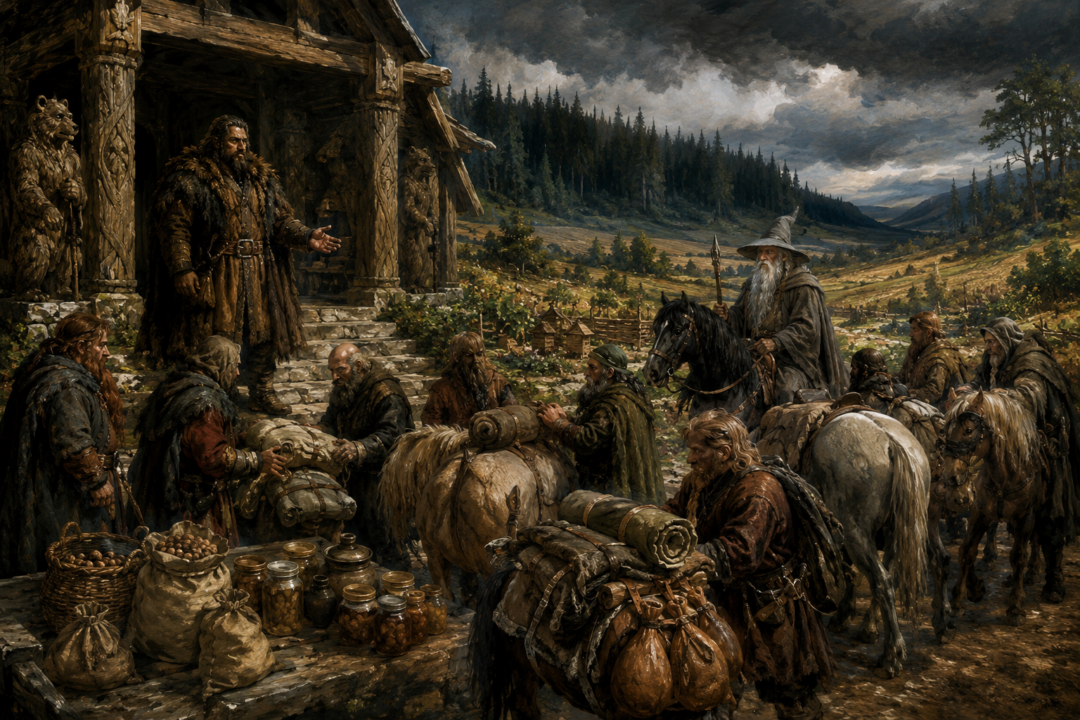
When Thorin Oakenshield’s company reached Beorn’s house, the Lonely Mountain was still far away. Yet one of the most dangerous decisions of the entire journey was already approaching: how could fourteen travelers cross Mirkwood without horses, without reliable food, and without leaving the one path that might lead them safely through?
Beorn’s answer was not merely hospitality. His food, water-skins, weapons, animals, and knowledge turned an almost undefined wilderness crossing into a route the company could realistically attempt.
The crucial point is easy to miss because the provisions appear in The Hobbit as practical details: nuts, flour, dried fruit, honey, twice-baked cakes, bows, arrows, water-skins, ponies. But these supplies were tied directly to Beorn’s understanding of Mirkwood. He knew the company could not depend upon the forest itself.
Their route therefore depended on carrying enough of the outside world into Mirkwood to survive until they reached the other side.
Beorn Changes Their Route Before He Supplies It
Before meeting Beorn, the company might naturally have continued toward the old main road through Mirkwood. Beorn warns them against doing so.
The Old Forest Road had become dangerous and unreliable. Goblins were using the approaches, and Beorn had heard that the eastern part of the road was overgrown and led toward marshes where the paths had been lost. Even if the company succeeded in crossing there, they would emerge well south of the Lonely Mountain and still face a difficult northward journey.
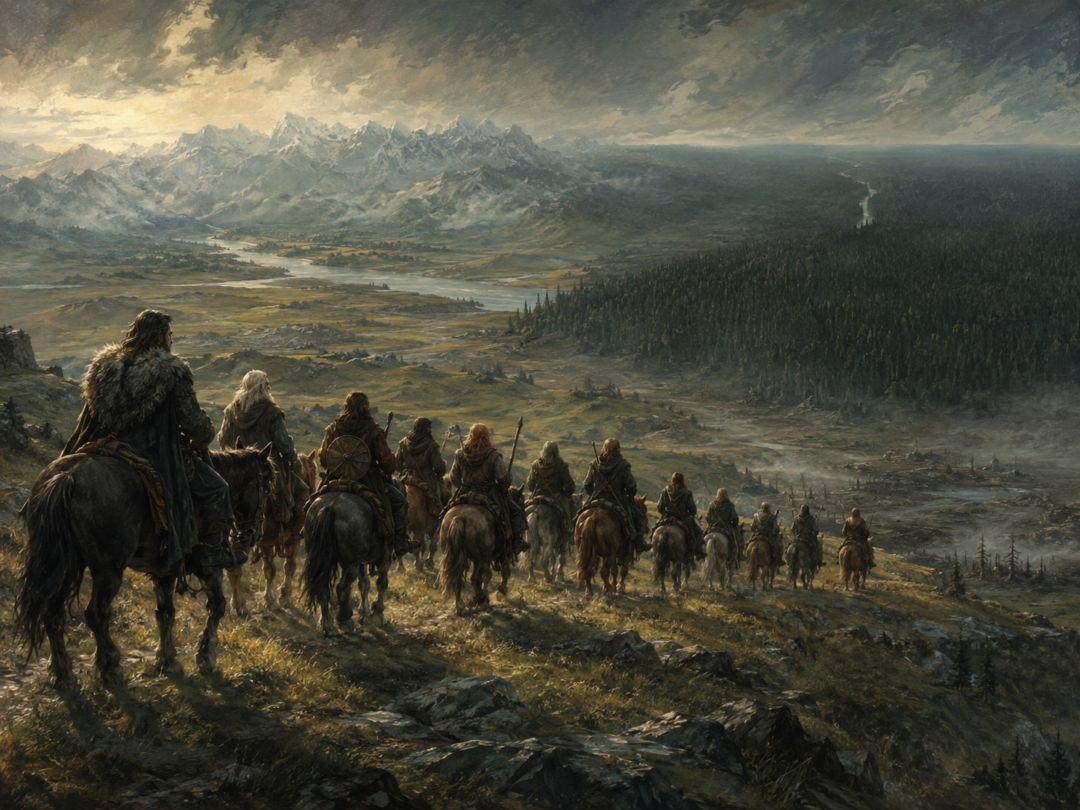
Instead, Beorn recommends a more northerly approach.
The travelers ride north from his lands toward a lesser-known entrance into Mirkwood. From there, a path runs through the forest in a direction far better suited to their destination in the north-east.
This is the first reason his provisions matter. Beorn is not simply feeding travelers who have already chosen a road. He is giving them the supplies required for the route he believes they should take.
His logistical advice and geographical advice are inseparable.
The Ponies Solve the Approach, Not the Forest Crossing
Beorn lends ponies to the dwarves and Bilbo and a horse to Gandalf. That dramatically increases the speed with which they can travel from his house toward Mirkwood.
But the animals come with a strict condition.
They must be sent back at the forest gate.
Beorn clearly has no intention of allowing his animals to disappear into Mirkwood. The company therefore receives mounted transport only for the open-country stage of the journey. Once they enter the trees, they must proceed on foot and carry their own supplies.
That transition fundamentally shapes the expedition.
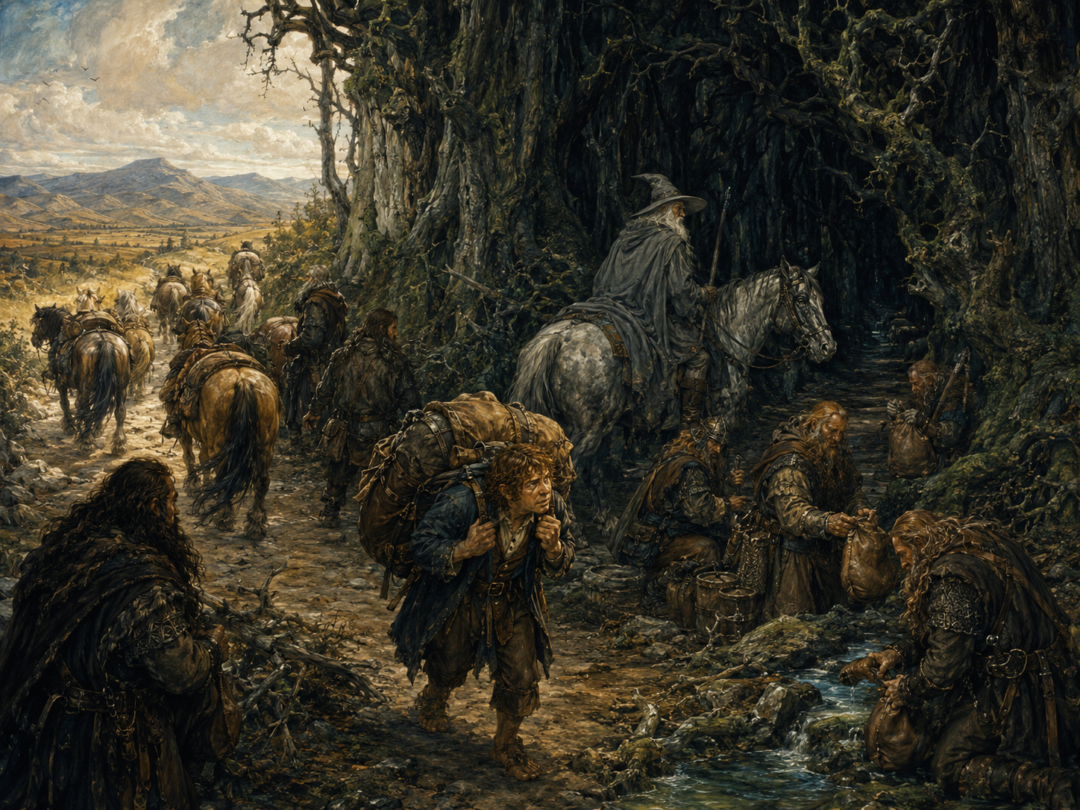
The ponies allow Beorn to load the company with substantial provisions without forcing them to carry everything immediately. During the journey toward the forest, the animals bear the burden. At the gate, the travelers unload the packs and divide their contents among themselves.
Bilbo immediately discovers what that means. His own share feels painfully heavy.
Thorin’s response captures the company’s real problem: the burden will become lighter soon enough, and before long they may wish it were heavier.
The food is not ordinary baggage. It is a diminishing measure of how much time they can survive inside the forest.
Beorn Chooses Food Designed for Distance
The supplies Beorn gives them are unusually well suited to travel.
They include nuts, flour, sealed dried fruit, honey, and twice-baked cakes capable of keeping for a long period. The cakes are particularly valuable because only a small quantity is needed to sustain strenuous marching.
Beorn intends the food to last for weeks if carefully managed.
That phrase matters.
He is not provisioning them for comfort. He is calculating endurance.
Fresh food would spoil. Heavy foods would make the already difficult foot journey worse. Hunting would tempt them away from the path. Foraging could expose them to unknown plants or other dangers.
Beorn therefore gives them preserved, portable food that reduces their need to interact with Mirkwood at all.
His provisions create a temporary barrier between the travelers and the hostile environment.
As long as their packs remain sufficiently full, they can keep walking.
Once those packs empty, the forest begins dictating their choices.
Mirkwood Cannot Be Treated Like Ordinary Wilderness
Beorn’s warning about food is unusually severe.
There is little in Mirkwood that he considers safely edible. Nuts are among the few things he mentions as potentially fit for food, but the season is not yet right when the company enters.
The animals of the forest are no solution either.
Beorn warns that its wild creatures are strange and that he doubts whether anything found there would be wholesome to eat or drink. More importantly, hunting presents another danger: attempting to shoot game in the darkness could require leaving the path.
And leaving the path is exactly what Beorn tells them never to do.
That rule transforms the entire logic of survival.
Normally, a hungry traveler might search farther from the trail, hunt animals, gather plants, or follow signs of water. In Mirkwood, those ordinary survival behaviors may be more dangerous than hunger itself.
The safe route is therefore unnaturally narrow.
The company must remain on the path even when their bodily needs pull them elsewhere.
Beorn’s provisions make obedience to that rule possible for as long as the food lasts.
The Water-Skins Are as Important as the Food
Beorn tells the company that water will not be a problem before they reach the forest because streams and springs lie along the way.
Inside Mirkwood, the situation changes.
Water is difficult to find, so he gives them skins in which to carry it. At the forest gate they fill these containers from a clear spring before beginning the crossing.
This detail becomes especially important because Beorn also warns them about a particular stream crossing the path.
They must neither drink from it nor bathe in it. Beorn has heard that the water carries an enchantment producing sleep and forgetfulness.
The warning proves justified when Bombur later falls into the stream and enters a deep enchanted sleep.
The company consequently cannot assume that visible water is usable water.
That makes the water-skins part of the same survival strategy as the preserved food. Beorn is trying to make the travelers independent of the forest’s resources.
They carry what they need because what surrounds them cannot safely be trusted.
The Route Works Only While Discipline Holds
Beorn’s plan is simple in principle.
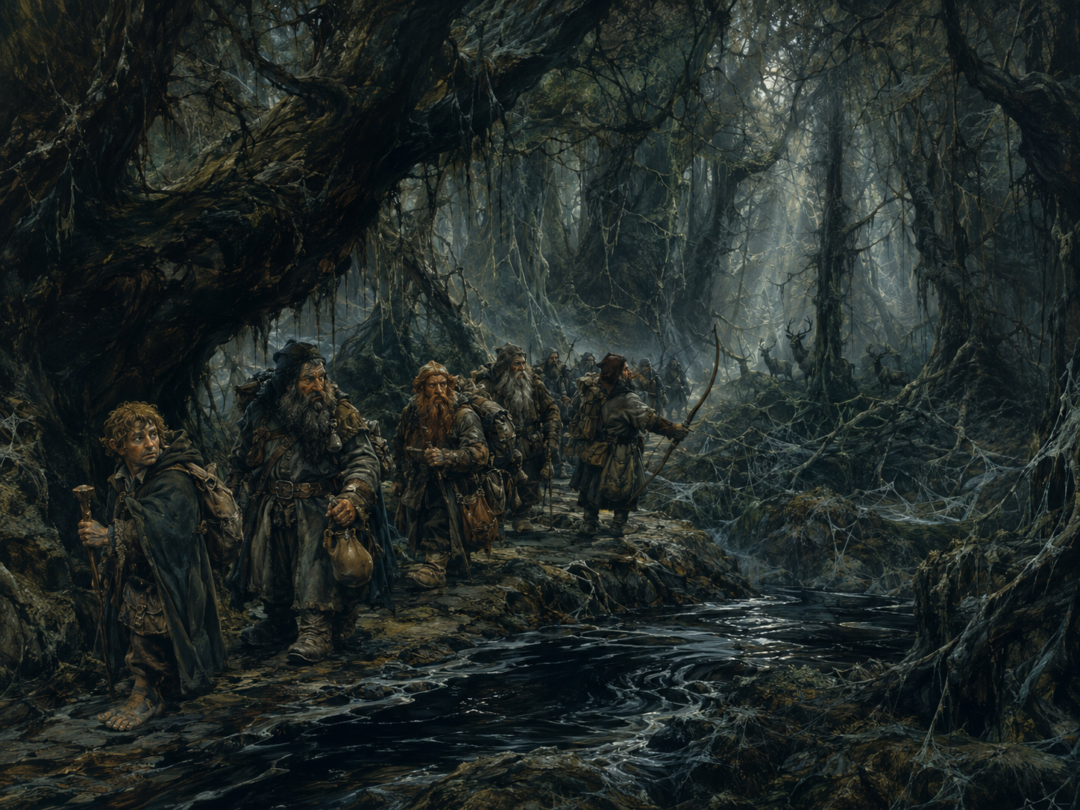
Take the northern path. Carry preserved provisions. Bring water. Stay on the path. Do not drink from the enchanted stream. Do not wander away in search of food or game.
The danger is that hunger gradually makes those instructions harder to obey.
As the company moves deeper into Mirkwood, the crossing lasts longer and becomes more exhausting than their hopes allow. Food dwindles. The forest seems endless. Bombur’s enchanted sleep forces the others to carry him, increasing their physical burden precisely while their supplies are declining.
Eventually hunger becomes severe.
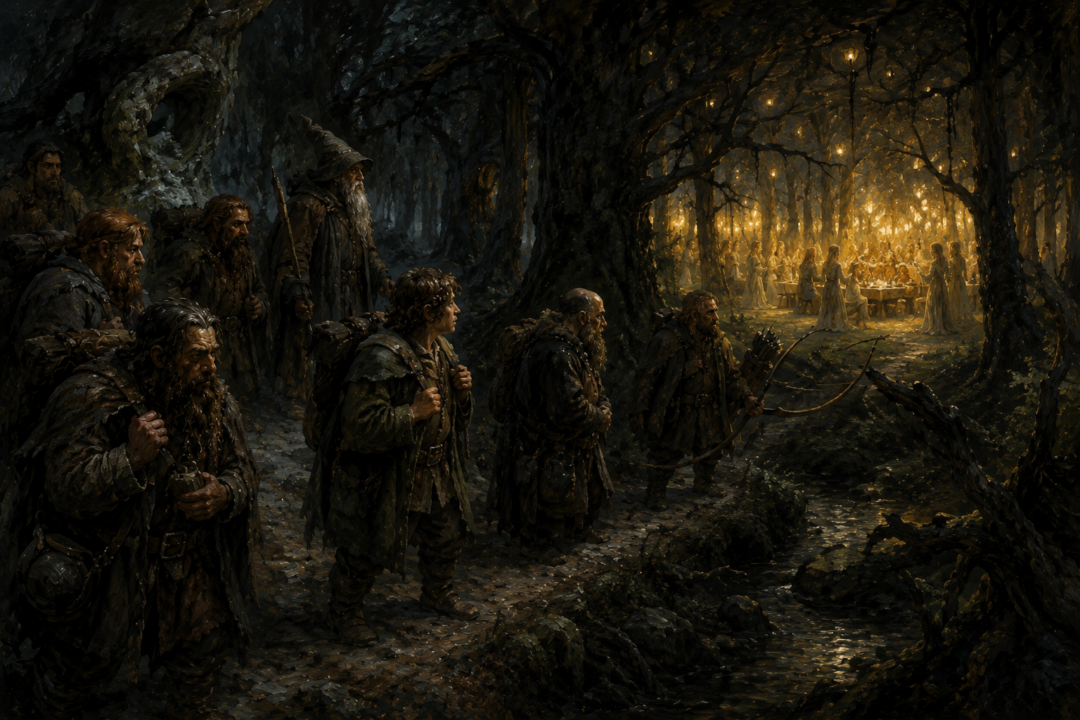
Then the travelers see lights among the trees.
The woodland feast appears to offer exactly what Beorn’s carefully controlled plan can no longer provide: food, warmth, companionship, and relief.
They leave the path.
That decision leads directly into further danger and ultimately into the hands of the Wood-elves.
It would be too strong to say that the company abandons the path solely because Beorn’s provisions have run out. Several pressures are operating at once: exhaustion, uncertainty, hunger, and the tantalizing sight of apparent feasting.
But the sequence reveals why those provisions were so important. Once the company can no longer sustain itself from what Beorn gave them, remaining completely independent of Mirkwood becomes increasingly difficult.
Beorn Gives Them a Corridor Through Hostile Country
Beorn cannot make Mirkwood safe.
He cannot accompany them through it, guarantee that the path will remain easy to follow, or supply enough food to eliminate every danger. He openly tells them that beyond the forest’s edge, they must depend upon courage, fortune, and the provisions he sends.
Yet his assistance defines the only practical strategy available to them.
The company is not supposed to conquer Mirkwood, explore it, or live from it.
They are supposed to pass through it.
That difference explains the entire provisioning scheme.
The ponies get them quickly to the correct entrance. The preserved food allows them to avoid foraging. The water-skins reduce their dependence on uncertain streams. The bows provide some defensive and hunting capacity, although Beorn specifically warns that pursuing creatures off the path would be dangerous. His geographical knowledge steers them away from the deteriorated southern road and toward a crossing that better matches their destination.
Taken together, these are not separate gifts.
They form one coherent travel plan.
The Tragedy Is That Beorn’s Plan Nearly Works
There is an understated irony in the Mirkwood chapters.
Beorn gives the company remarkably accurate advice.
The dangerous stream really is enchanted. Leaving the path really is disastrous. Food really does become scarce. The forest really does make hunting and navigation difficult. The northern route really does bring them toward the region of the Woodland Realm and eventually closer to the Lonely Mountain.
The company’s failure is not that Beorn misunderstands the forest.
It is that no finite supply can remove the human pressure created by prolonged hardship.
Hunger eventually turns discipline into temptation.
That gives Beorn’s provisions a larger significance within the journey. They represent something Middle-earth repeatedly values: preparation cannot defeat every danger, but wise preparation creates the possibility of enduring it.
Without Beorn’s food, water-skins, animals, weapons, and route knowledge, the company would have entered Mirkwood far more dependent upon a forest they had already been warned not to trust.
His hospitality does not merely make their journey easier.
It makes their chosen crossing viable at all.
Sources & Notes
- https://www.glyphweb.com/arda/b/beorn.php — Encyclopedia of Arda: Beorn’s hospitality, route advice, ponies, and provisions for Thorin’s Company
- https://www.glyphweb.com/arda/m/mirkwood.php — Encyclopedia of Arda: the forest’s scale, dangers, roads, and eastern crossing
- https://www.glyphweb.com/arda/e/enchantedriver.php — Encyclopedia of Arda: the hazardous river crossing on the Company’s forest route
- https://www.glyphweb.com/arda/c/carrock.php — Encyclopedia of Arda: Beorn’s territory and the western approach to Mirkwood
Sources document Beorn’s aid and the geographical constraints of the route through Mirkwood.