The First Age produced some of the most famous weapons in Middle-earth. Glamdring and Orcrist came from Gondolin. Anglachel became the black sword Gurthang. The Silmarils themselves inspired wars, oaths, betrayals, and some of the greatest tragedies of the Elder Days.
Yet one remarkable work associated with Gondolin was remembered for almost the opposite reason.
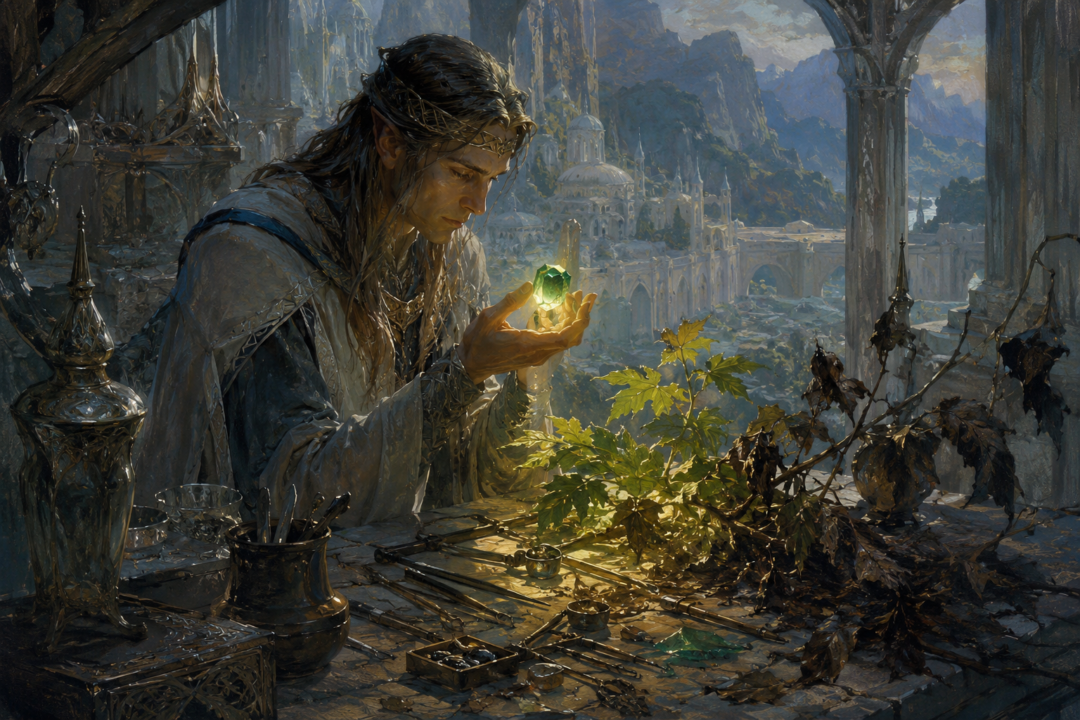
The Elessar—the green Elfstone later connected in name and symbolism with Aragorn—was not primarily a weapon, a defensive talisman, or an instrument for destroying the Enemy. In the account preserved in Unfinished Tales, its defining virtue was restoration. Withered things appeared young again through it, and the hands of its bearer could bring healing from hurt.
That distinction matters. The Elessar belongs to an age dominated by wounds, but its purpose is not to inflict another wound on the darkness.
It answers destruction with renewal.
A Green Stone in an Age of Ruin
The account of the Elessar appears among the complex traditions surrounding Galadriel and Celeborn in Unfinished Tales. Like several elements of these writings, its history is not presented as one perfectly settled narrative.
In one version, the original Elessar was made in Gondolin by Enerdhil, a jewel-smith of great renown. Another tradition connects its making with Celebrimbor. The texts therefore do not justify treating the identity of its maker as completely certain.
What remains remarkably consistent is the character of the jewel itself.
The stone was green, yet it held within it something of the clear light of the Sun. Those looking through it could perceive things that were withered or burned as restored to their earlier freshness, while its bearer was said to possess healing power through the hands.
Its symbolism is therefore established before any later connection with Aragorn.
Green growth. Sunlight. Restoration. Healing.
For a jewel originating in the Elder Days, that is striking because the First Age is filled with objects whose significance becomes bound to possession and conflict.
The Elessar points in another direction.
The Elessar Does Not Win the War
There is no major First Age battle in which the Elfstone overturns the military situation. It does not break Morgoth’s armies. It does not protect Gondolin from discovery. It does not defeat a Balrog or dragon.
That absence should not be mistaken for insignificance.
The Elessar’s role belongs largely to what happens because war has already done its damage.
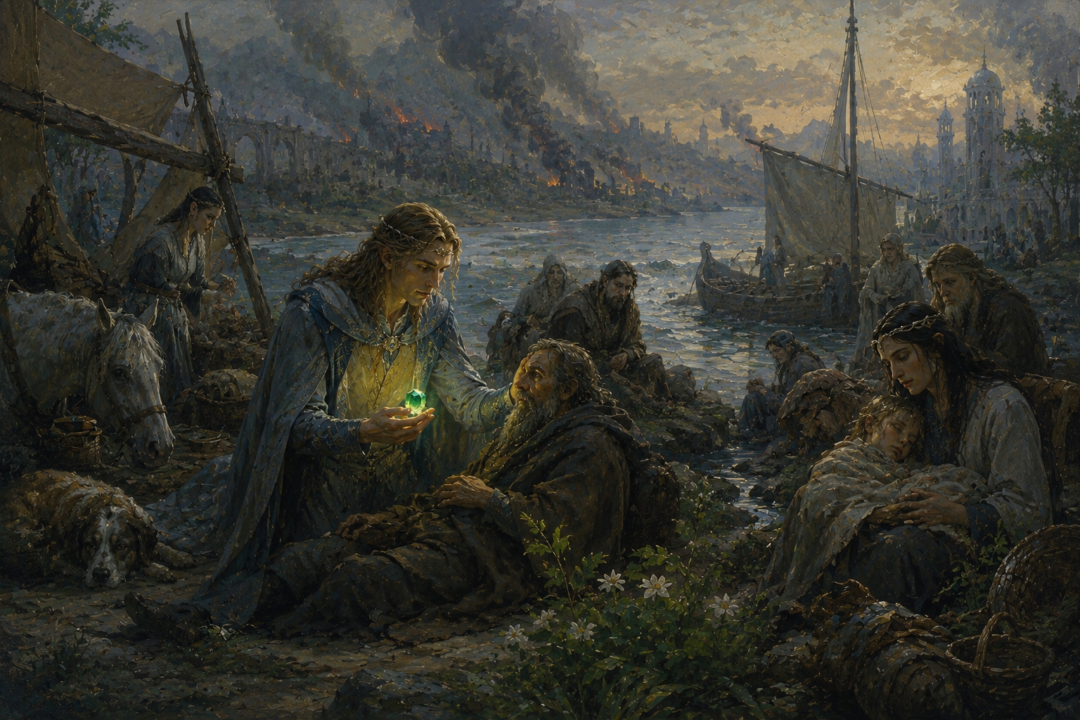
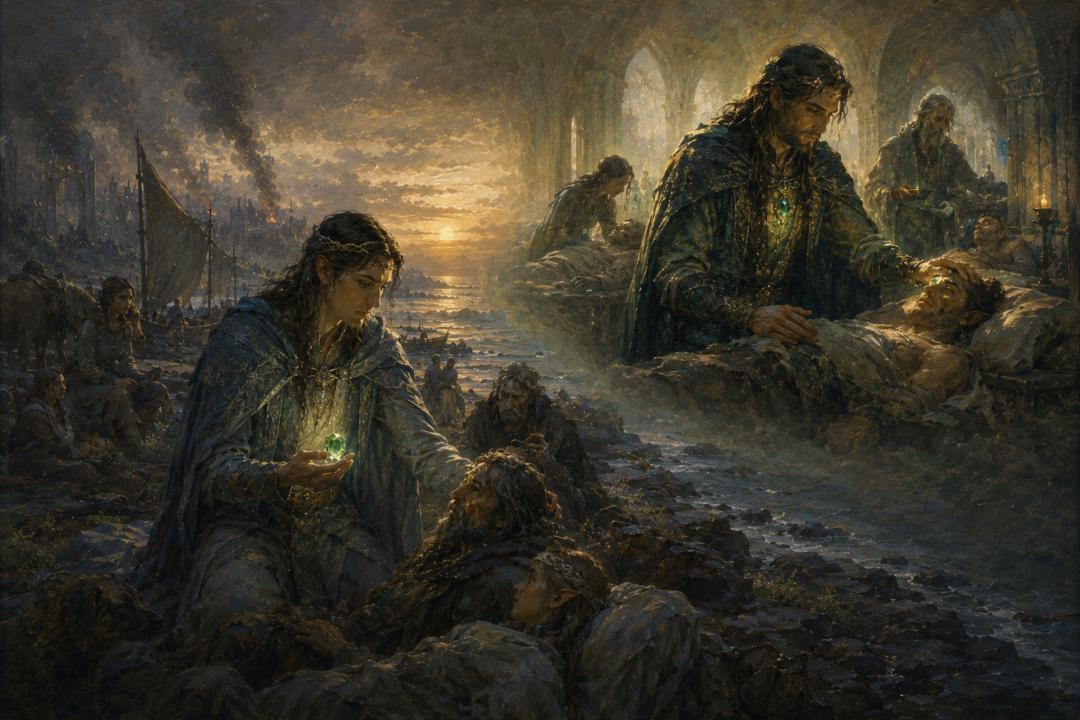
According to the account in Unfinished Tales, the jewel came to Idril of Gondolin. Before she departed Middle-earth, she gave it to her son Eärendil. At the Havens of Sirion, Eärendil possessed the stone amid refugees from the catastrophes of Beleriand.
This setting is essential to understanding the jewel.
Sirion was not simply another prosperous Elven realm. The Havens became a refuge for survivors of ruined communities. Men and Elves were there, and the tradition of the Elessar also specifically mentions beasts that had fled from the horror in the North.
There the stone’s virtue became meaningful.
The wounded were healed. For a time, things prospered and became green and fair.
The Elessar therefore does not erase the Fall of Gondolin or reverse the disasters of the First Age. Its power operates among what survives them.
Eärendil the Healer Before Eärendil the Mariner
Eärendil is usually remembered for a far greater achievement: his voyage into the West and his appeal that ultimately preceded the intervention that ended Morgoth’s domination of Middle-earth.
But the Elessar tradition gives us an earlier and quieter image of him.
Before he becomes the legendary mariner bearing a Silmaril across the heavens, he is associated with a sanctuary full of wounded survivors.
That contrast reveals something important about the Elessar.
Its power is not conquest.
It is preservation.
The jewel is connected with keeping life alive in a world increasingly overwhelmed by Morgoth’s victories. Its greatness is measured not by enemies slain but by hurts healed.
This does not mean the Elessar is presented as capable of undoing every consequence of evil. Nothing in the account suggests that it could restore the dead, rebuild every destroyed kingdom, or reverse the entire marring of Arda.
Its restorative imagery is powerful precisely because it exists within those limits.
Some losses cannot simply be cancelled.
But the living can still be tended.
Why Healing Fits the Elessar Better Than Combat
There is a deeper thematic difference between a weapon and the Elessar.
A sword may be used justly against an enemy, and Middle-earth contains many heroic warriors whose battles are necessary. The legendarium never reduces resistance to evil to something inherently wrong.
But even righteous combat usually works through destruction.
Healing works differently.
It attempts to restore something damaged toward the condition it ought to possess.
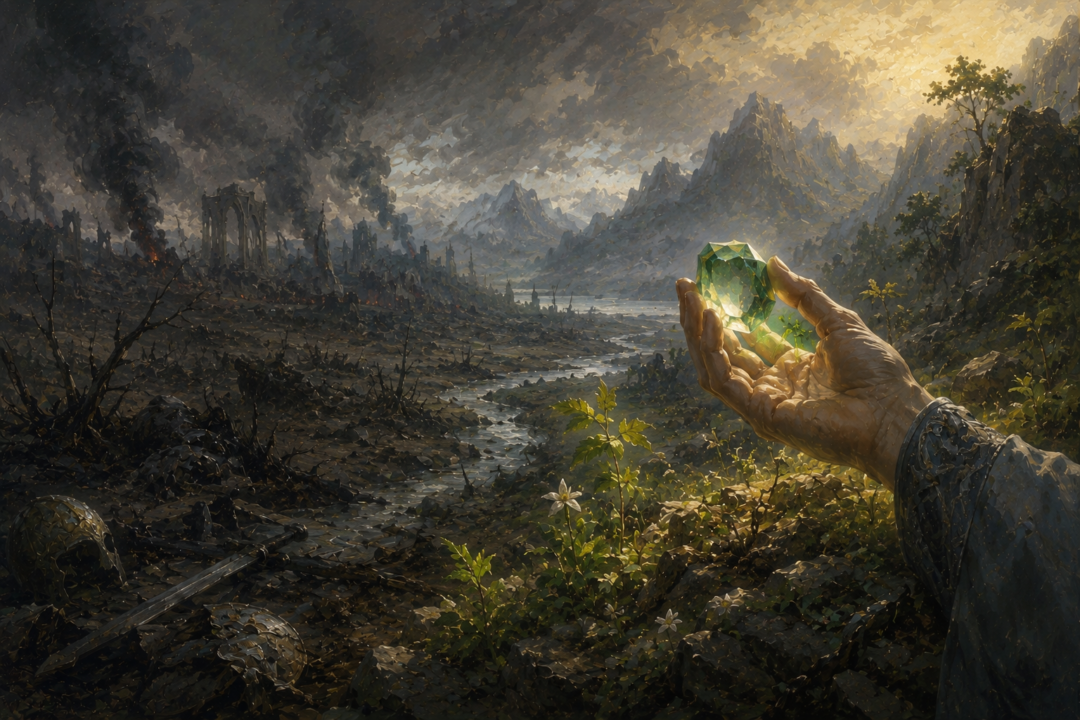
That makes the Elessar an especially appropriate counter-symbol to the devastation of Morgoth. The Enemy corrupts, burns, wounds, enslaves, and reduces living things to instruments of domination. The green stone is associated instead with freshness, growth, health, and renewal.
One reading, therefore, is that the Elessar represents a form of power that does not imitate the Enemy’s methods.
It does not dominate something else in order to prove its strength.
Its power is revealed by making the wounded whole.
The Contrast with the Silmarils
The contrast with the Silmarils is especially revealing, though it should not be pushed into a simplistic opposition.
The Silmarils are not evil objects. They preserve the unmarred light of the Two Trees, and their beauty is holy enough that evil hands cannot possess them without pain.
The catastrophe surrounding them comes largely from the possessiveness, oath, pride, and violence attached to them.
The Elessar follows a very different narrative pattern.
Its story is repeatedly connected with giving.
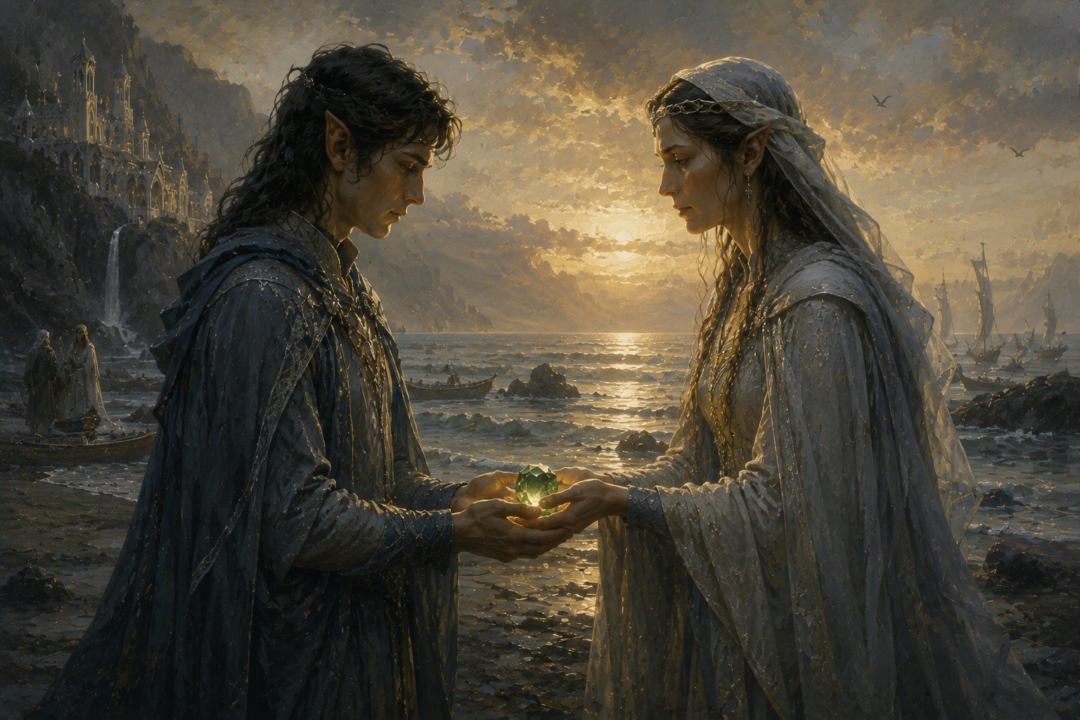
Its maker gives it away. It passes to Idril. Idril gives it to Eärendil. In later traditions surrounding the Elfstone, a corresponding jewel eventually comes into Galadriel’s keeping and ultimately passes to Aragorn.
Rather than becoming the center of an oath demanding possession, the green stone becomes meaningful through transmission.
The contrast is not “bad jewel versus good jewel.”
It is between different relationships to beautiful things.
A jewel can become something that hands close around.
The Elessar repeatedly passes through open hands.
And those same hands are associated with healing.
Even the Elessar’s History Refuses a Simple Answer
There is an important complication.
The later Elessar associated with Galadriel and Aragorn has more than one origin story.
One tradition says that the original Stone of Eärendil eventually returned from the West, brought by Olórin—Gandalf—to Galadriel. Another says that the original remained beyond the Sea and that Celebrimbor made another Elessar for Galadriel in the Second Age, resembling the earlier jewel though possessing less power.
The uncertainty should be preserved rather than artificially resolved.
But both traditions reinforce the same underlying theme.
In the version involving Celebrimbor, Galadriel’s desire is connected with her grief over the fading of Middle-earth: leaves fall, flowers fade, and the passing of time brings losses that cannot simply be corrected by another spring.
The Elessar again becomes an answer to diminishment.
Not a sword against time.
A symbol and instrument of renewal within it.
From Eärendil to Aragorn
This is why the First Age story of the Elessar casts such a revealing light on Aragorn’s eventual royal name.
In The Fellowship of the Ring, Galadriel gives Aragorn the green Elfstone before the Company leaves Lothlórien and tells him to take the name foretold for him: Elessar.
Later, after the Battle of the Pelennor Fields, Aragorn enters Minas Tirith not first as a triumphant crowned monarch but as a healer.
In the Houses of Healing, he tends Faramir, Éowyn, and Merry, using athelas and exercising the knowledge and power available to him. The old saying that “the hands of the king are the hands of a healer” becomes politically significant because healing helps reveal the returning king.
The text does not require us to claim that Aragorn’s healing ability simply comes from wearing the Elfstone. Aragorn already possesses exceptional healing knowledge and power, and he explicitly recognizes Elrond as possessing greater power in this respect.
The relationship is better understood symbolically.
Aragorn bears the name of a jewel whose ancient identity is restoration, and his kingship is revealed not merely through battlefield victory but through his ability to restore.
That is extraordinarily appropriate.
The King Is More Than the Warrior
Aragorn is unquestionably a warrior.
He fights at Helm’s Deep, commands at the Pelennor, and marches on the Black Gate knowing that the army he leads cannot defeat Sauron’s full strength by force.
But warfare is not the final purpose of his kingship.
The war makes restoration possible.
After Sauron’s fall, Aragorn’s task becomes rebuilding a kingdom, renewing old alliances, establishing peace, and presiding over a reunited realm.
The title Elessar therefore reaches beyond the jewel hanging on his breast.
A later text concerning the prophecy at Aragorn’s birth associates his future green stone with his chief renown as a healer and renewer. That tradition makes explicit something already visible in The Lord of the Rings: the returning king is identified not only by his capacity to defeat enemies, but by what becomes whole around him.
The First Age Elfstone anticipates exactly that kind of authority.
Middle-earth Does Not Need Another Weapon Forever
The Elessar comes from a world where weapons are necessary.
Gondolin itself is eventually destroyed. Sirion becomes a refuge because other homes have fallen. Eärendil’s generation inherits the consequences of catastrophes it did not create.
Yet the green stone suggests that victory cannot merely mean becoming better at destruction than the destroyer.
Eventually someone must heal what the war was fought to save.
That may be the deepest reason the Elessar is associated with healing rather than combat.
The great tragedies of the First Age leave Middle-earth with enough swords, enough graves, enough burned kingdoms, and enough victories purchased at terrible cost.
The Elfstone represents another kind of power.
A burned thing seen as green again.
A wounded creature restored.
A jewel passed from one bearer to another rather than hoarded.
And, ages later, a king whose legitimacy becomes visible when he walks among the wounded and uses his hands not to wield a sword, but to heal.
Sources & Notes
- https://www.glyphweb.com/arda/e/elessar.php — Encyclopedia of Arda: the green Elfstone’s traditions, restorative power, bearers, and connection with healing
- https://www.glyphweb.com/arda/e/earendil.php — Encyclopedia of Arda: Eärendil’s First Age life, refuge at the Havens, and possession of the Elessar
- https://www.glyphweb.com/arda/g/gondolin.php — Encyclopedia of Arda: Gondolin’s history, craftspeople, fall, and surviving royal house
- https://www.glyphweb.com/arda/h/havensofsirion.php — Encyclopedia of Arda: the refugee settlement where Eärendil and the Elessar’s healing tradition belong
Sources document the Elessar’s healing virtue, Eärendil, Gondolin, and the Havens of Sirion.