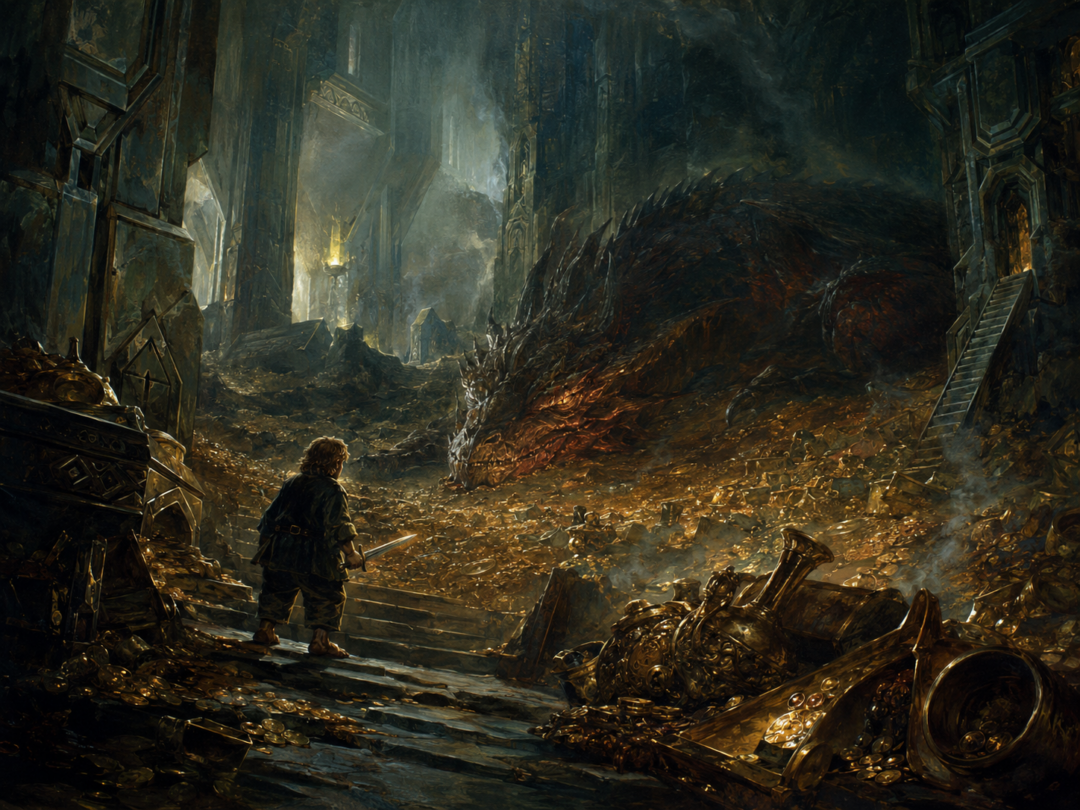
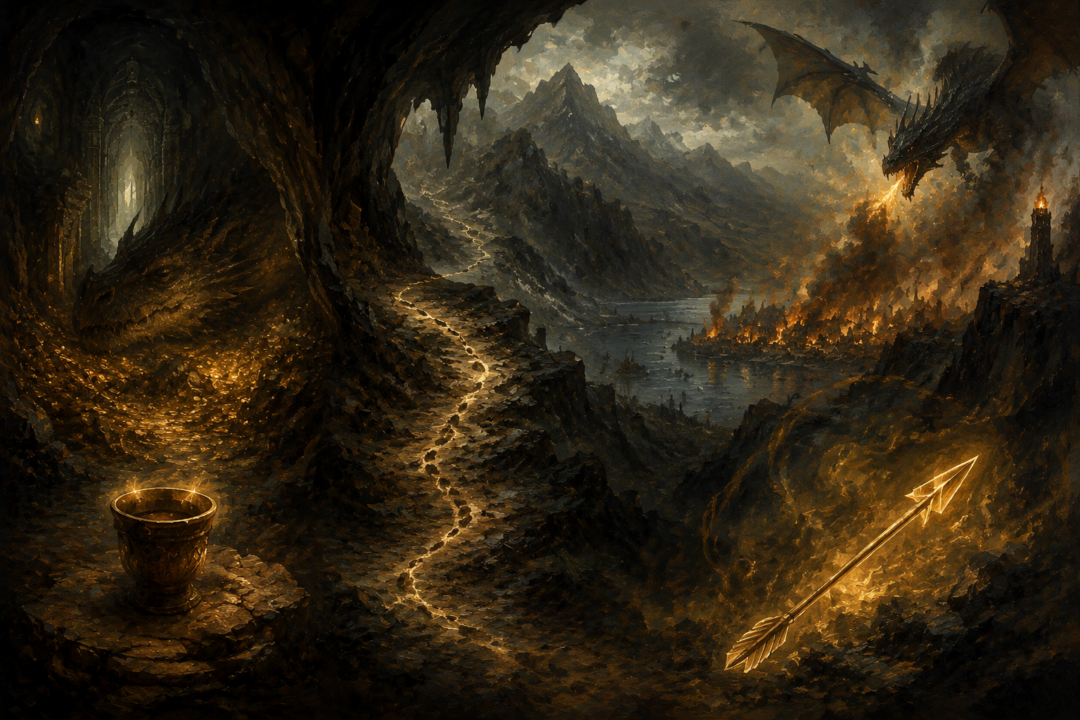
The Lonely Mountain holds many secrets, but none more dangerous than the knowledge that someone has entered it. When Bilbo Baggins slips through the hidden door of Erebor and speaks with Smaug, he believes he is only gathering information for Thorin’s company. Yet his riddling conversation with the dragon creates an unexpected consequence: Smaug learns enough about the outside world to suspect that the people of Lake-town have helped his enemies.
The tragedy of Smaug’s attack on Esgaroth is not simply that a dragon is angry. It is that Bilbo’s cleverness, designed to protect the dwarves, accidentally gives Smaug the direction he needs to strike. The scene reveals one of the central tensions of The Hobbit: courage and intelligence can achieve great things, but even good actions may carry consequences that cannot be controlled.
Bilbo’s Encounter With Smaug Reveals More Than He Intended
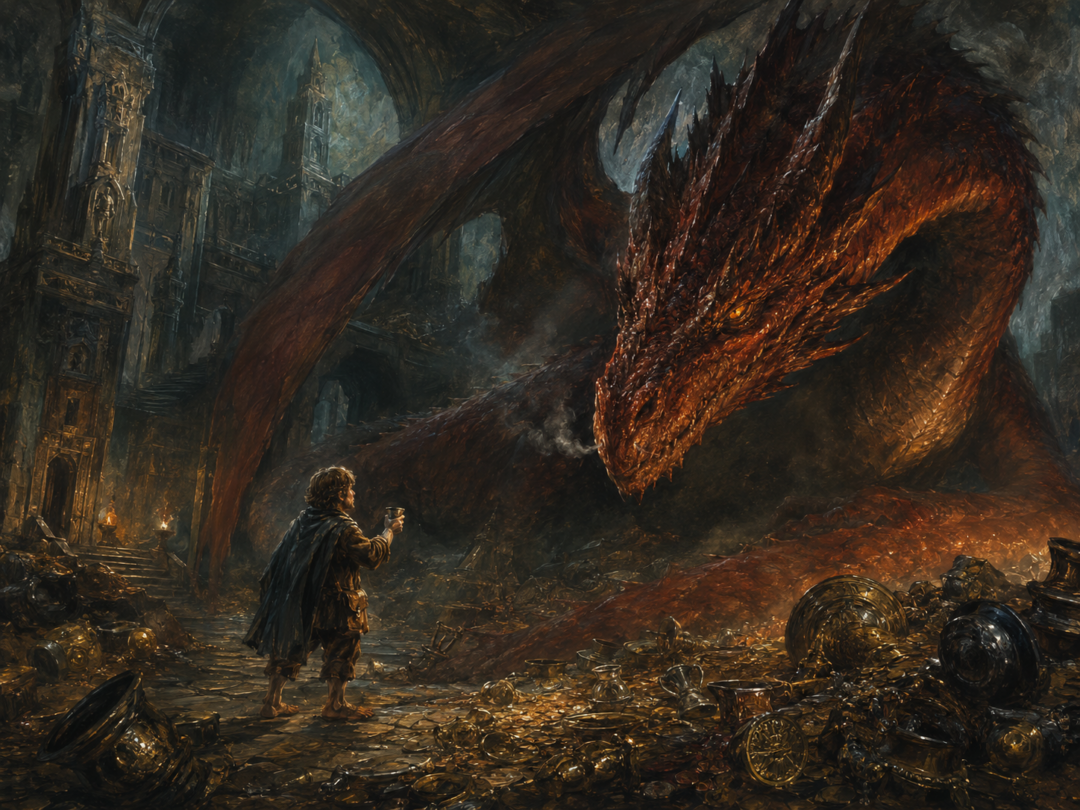
When Bilbo enters the mountain alone, his task is not to defeat Smaug. He is sent as a burglar, a role he accepts with uncertainty and fear. Inside the treasure chamber, he finds the dragon sleeping among the riches of Erebor and steals a cup, an act that awakens Smaug’s suspicion.
The conversation that follows is a battle of words rather than weapons. Bilbo refuses to give his true name and instead uses a series of descriptions and riddling phrases. He calls himself things such as “Barrel-rider,” “Luckwearer,” and “Guest,” revealing fragments of his journey without openly explaining who he is.
However, Smaug is not merely a creature of brute force. He is ancient, intelligent, and experienced in deception. He studies Bilbo’s words carefully and begins assembling the truth.
The dragon does not immediately know the full story, but he realizes that Bilbo did not reach Erebor by accident. Someone outside the mountain must have helped him.
The Clue That Leads Smaug Toward Lake-town
The key connection comes from Bilbo’s mention of the barrels. After escaping the Elvenking’s halls, Bilbo and the dwarves had hidden themselves in empty barrels and were carried down the Forest River to Lake-town.
Smaug recognizes the significance of this. A stranger appearing inside Erebor could only have reached the mountain through unusual means. The dragon reasons that the people of the Long Lake must have played a part in the company’s arrival.
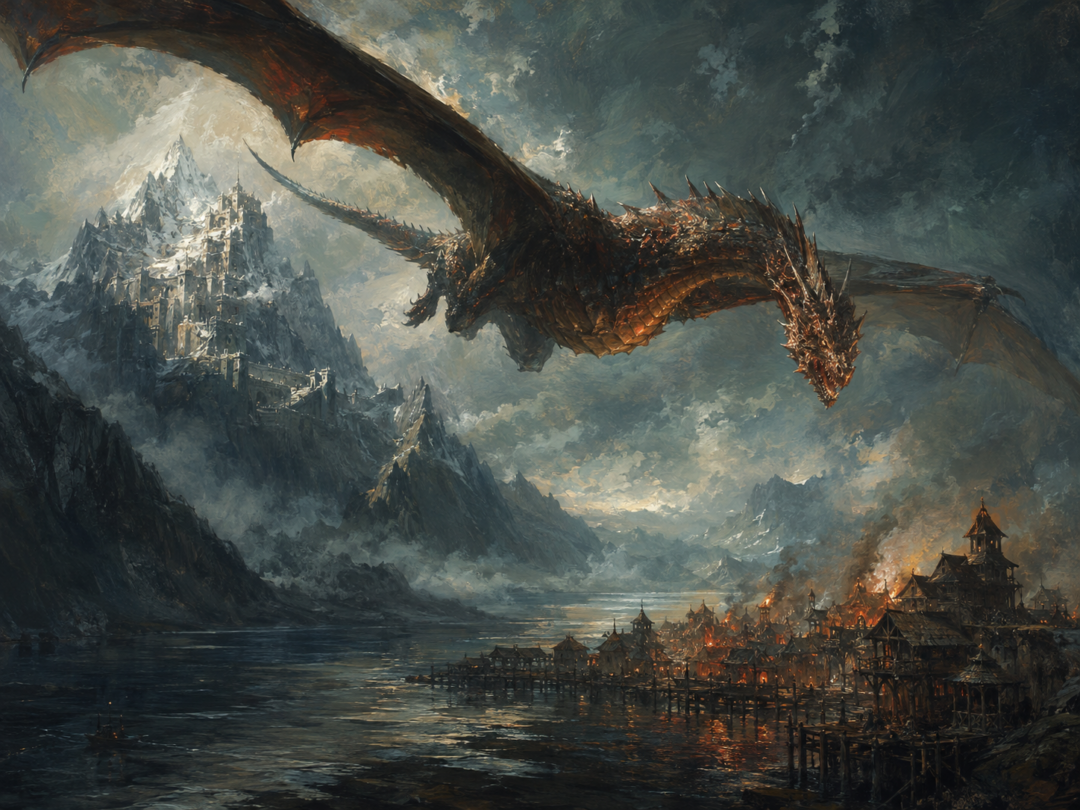
In The Hobbit, Smaug’s suspicion grows when Bilbo mentions the “Barrel-rider” name. The dragon understands that the journey involved the waterways and that the men of Lake-town may have provided assistance. He then flies south toward Esgaroth, believing that destroying the settlement will remove the support network behind Thorin’s return.
The attack is therefore not random destruction. It is a calculated response based on the information Smaug extracts from Bilbo.
Smaug’s Anger Is Also Driven by Pride and Fear
Although Bilbo’s clues point Smaug toward Lake-town, the dragon’s decision to attack is shaped by his own character. Smaug is not simply defending himself from an immediate threat. He is driven by wounded pride and the fear that someone may challenge his ownership of Erebor.
The dragon has spent years guarding the treasure of the dwarves after taking the mountain. He views the gold not as a resource but as a possession that confirms his power. The possibility that Thorin’s heirs have returned threatens the identity Smaug has built around his victory.
This makes the attack on Lake-town a display of dominance as much as a military action. Smaug wants to punish those who have aided the dwarves and prove that resistance against him is hopeless.
The irony is that his response exposes a weakness. By leaving Erebor, Smaug abandons the protection of the mountain and creates the opportunity for Bard and the defenders of Lake-town to confront him.
Bilbo’s Success Creates an Unintended Disaster
One of the most interesting aspects of the episode is that Bilbo is both successful and responsible for a disaster he never intended.
His mission inside Erebor accomplishes several important things. He discovers that Smaug has a vulnerable place beneath his left breast where armor-like scales do not fully protect him. He also confirms that the dragon is awake and understands the danger facing Thorin’s company.
Yet the information exchange comes at a cost. Bilbo’s attempt to prove his usefulness gives Smaug enough information to identify Lake-town as the likely ally of the dwarves.
This is not presented as a simple mistake by Bilbo. Tolkien’s story repeatedly shows that even thoughtful actions can have consequences beyond their original purpose. Characters must act without complete knowledge, and wisdom often comes from understanding those consequences afterward.
Bilbo does not intend harm to the people of Esgaroth. He is trying to save his companions and complete a dangerous mission. But the wider events of Middle-earth are shaped by many small choices, and even a reluctant burglar can become part of a much larger chain of cause and effect.
The Attack on Esgaroth Reveals Smaug’s Greatest Weakness
Smaug believes he is eliminating a threat by destroying Lake-town. Instead, his attack leads directly toward his downfall.
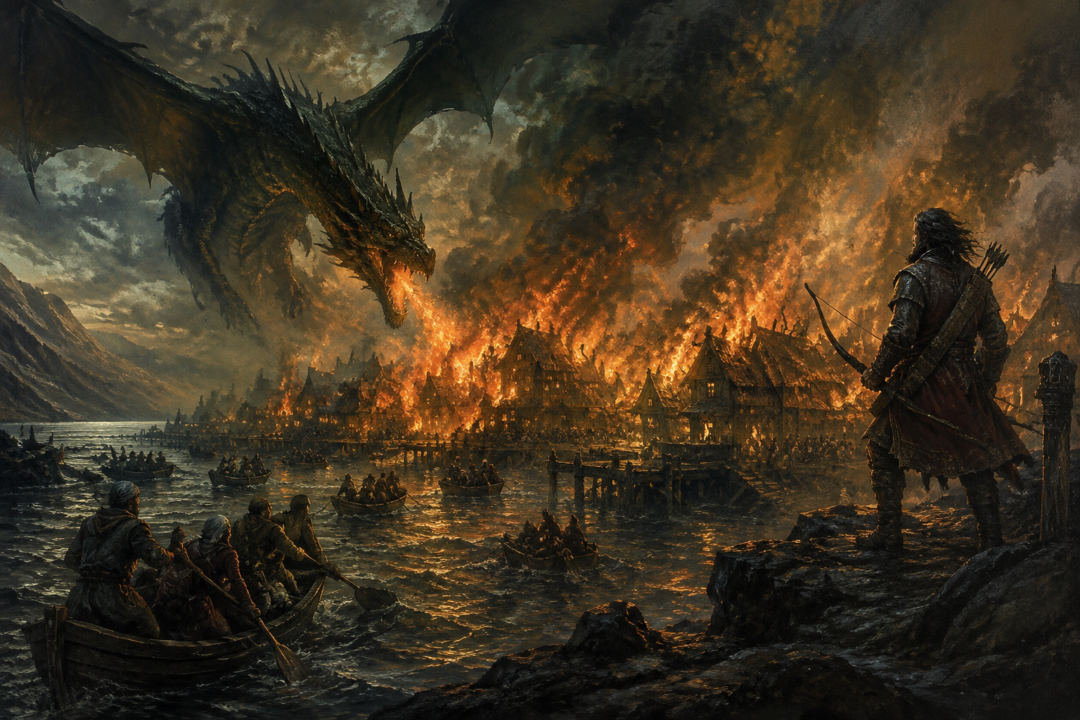
When Smaug descends upon Esgaroth, the defenders are largely powerless against him. Ordinary weapons cannot easily harm the dragon, and the town suffers terrible destruction. Yet the attack also brings Bard the Bowman into the moment when Smaug’s weakness becomes known.
Through Bilbo’s earlier observations, the vulnerability in Smaug’s armor becomes the decisive knowledge needed to defeat him. The information that helped Smaug find Lake-town eventually helps Lake-town destroy Smaug.
This reversal is one of the story’s most powerful ironies. Smaug uses knowledge gained from Bilbo to strike at his enemies, but the same chain of events provides the knowledge that ends his reign.
A Dragon’s Intelligence Cannot Replace Wisdom
Smaug is portrayed as clever, but his intelligence is limited by arrogance. He can interpret clues, manipulate conversations, and understand the motives of others, but he cannot imagine that his own choices may create danger for himself.
His reasoning is accurate in one sense: Lake-town did help the dwarves. But his conclusion that destruction will solve the problem ignores the possibility of resistance, chance, and the actions of individuals.
Bilbo, by contrast, grows throughout the journey because he learns that cleverness alone is not enough. He must also understand mercy, responsibility, and the consequences of his decisions.
The confrontation between Bilbo and Smaug is therefore not only a contest between a hobbit and a dragon. It is a contrast between two kinds of intelligence. Smaug possesses knowledge and cunning, but his pride prevents true understanding. Bilbo begins with little confidence but gradually develops the judgment needed to navigate a world far larger than his quiet home in the Shire.
The Hidden Cost of Uncovering the Mountain’s Secret
Smaug’s attack on Lake-town is remembered as a great disaster, but it begins with a quieter moment: a conversation in the darkness beneath the mountain.
Bilbo enters Erebor hoping to find a weakness in the dragon’s defenses. Instead, he accidentally reveals enough of the outside world for Smaug to identify his enemies. The event shows that secrets are powerful, and revealing even small pieces of truth can change the course of history.
Yet the story does not portray Bilbo’s actions as failure. Without his discovery of Smaug’s weakness, the dragon may have remained unstoppable. The same journey that brings danger also creates the possibility of victory.
Smaug’s attack on Lake-town is therefore one of the most carefully balanced moments in The Hobbit. A frightened hobbit’s attempt to help his friends becomes the spark for destruction — but also the beginning of the end for the greatest threat facing the North.
Sources & Notes
- https://www.glyphweb.com/arda/s/smaug.html — The Encyclopedia of Arda: Smaug infers help from Lake-town, flies south to punish it, and is exposed by Bilbo’s discovery of the gap in his armor
- https://www.glyphweb.com/arda/b/bilbobaggins.html — The Encyclopedia of Arda: Bilbo’s quest to Erebor and his riddling identities, including Barrel-rider, which supplies Smaug with a geographic clue
- https://www.glyphweb.com/arda/e/esgaroth.html — The Encyclopedia of Arda: Esgaroth/Lake-town, its role in supporting Thorin’s company, and its destruction during Smaug’s attack
- https://www.glyphweb.com/arda/b/bard.html — The Encyclopedia of Arda: Bard the Bowman’s descent from Girion and his killing of Smaug during the assault on Lake-town
- https://www.glyphweb.com/arda/e/erebor.html — The Encyclopedia of Arda: Erebor’s capture by Smaug and the historical setting for Thorin’s return and Bilbo’s entry into the mountain
Sources document Smaug’s inference from Bilbo’s riddling clues, Lake-town’s aid to the company, the attack on Esgaroth, and Bard’s response.