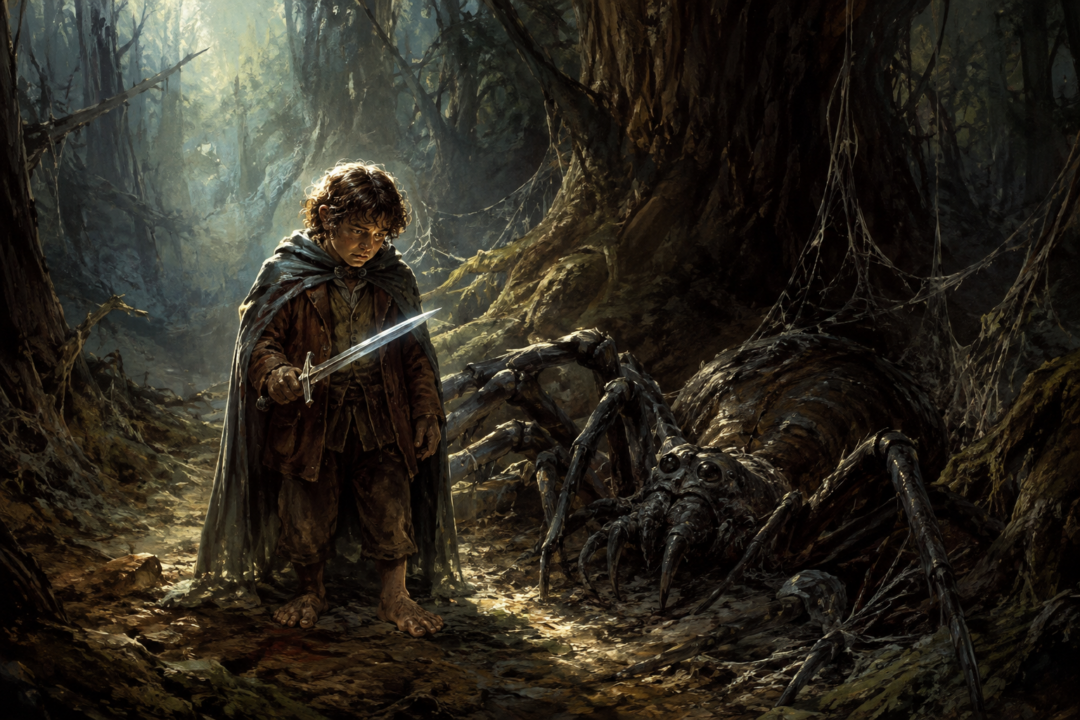
Bilbo Baggins carries his little Elvish blade through some of the most dangerous places in The Hobbit before he ever gives it a name.
He takes it from the trolls’ hoard. He carries it into the Misty Mountains. It shines in the goblin-tunnels. He draws it in the darkness near Gollum.
But it is still simply a weapon Bilbo happens to possess.
Then, deep inside Mirkwood, something changes.
Bilbo wakes to discover a giant spider binding him. There is no Gandalf nearby. The dwarves cannot help him. No stronger warrior is coming to rescue him. Bilbo must free himself and fight alone.
He kills the spider.
Only afterward does he name the blade Sting.
And almost immediately, the story asks something larger of him: not merely to save himself, but to become the person capable of saving everyone else.
The sequence matters. The text never establishes a magical rule that a sword must receive a name before its bearer can lead. Sting does not suddenly acquire new powers because Bilbo names it. But narratively, the naming marks one of the clearest thresholds in Bilbo’s journey.
Before Sting has a name, Bilbo survives.
After Sting has a name, Bilbo begins to lead.
The Sword Was Ancient Before Bilbo Was Brave
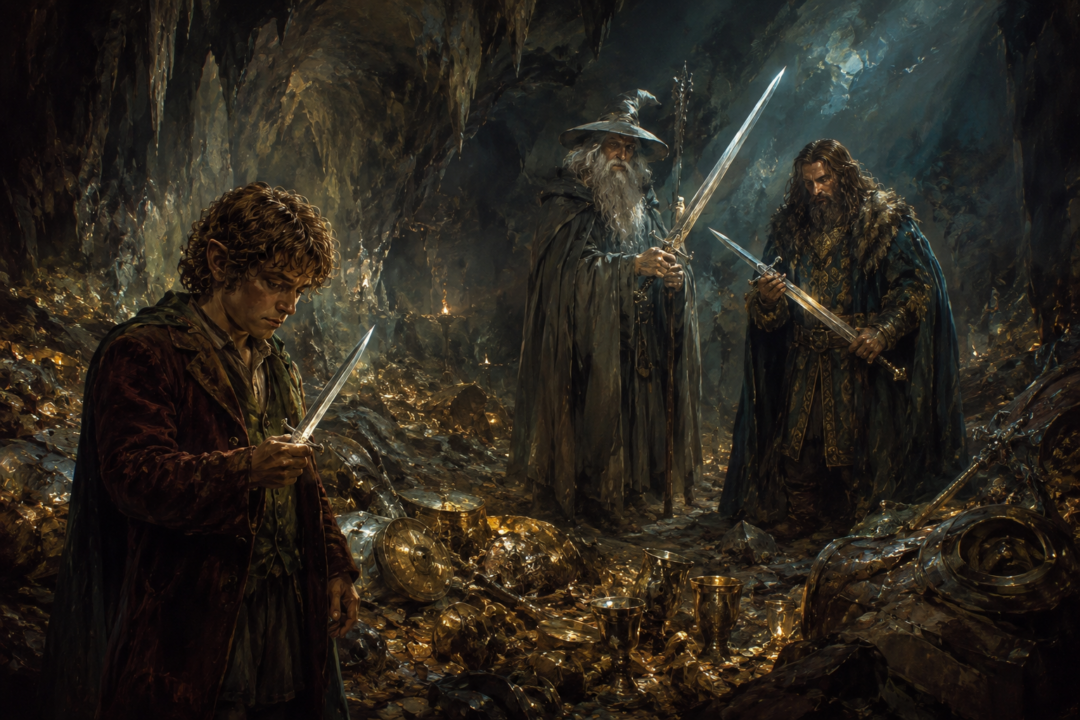
Bilbo’s weapon has a history vastly older than its new owner.
It is found with Glamdring and Orcrist in the trolls’ cave. At Rivendell, Elrond identifies those famous swords as weapons made in Gondolin, the hidden Elven city destroyed in the First Age. Bilbo’s smaller blade belongs to the same ancient world, though The Hobbit gives far less information about its original history.
That contrast is important.
Glamdring and Orcrist arrive with identities already attached to them. They have names and histories. The goblins themselves recognize and fear them.
Bilbo’s blade does not receive such a recovered name.
For a hobbit-sized bearer, it functions as a sword, but when discovered it is described as a knife in a leather sheath. Its importance is not initially obvious beside the celebrated weapons taken by Gandalf and Thorin.
That makes Sting unusually appropriate for Bilbo.
He too seems small beside his companions. He has no heroic reputation. He possesses no known experience as a warrior. Even his supposed profession as the company’s burglar initially seems almost absurd.
Both hobbit and blade enter the adventure overshadowed by grander figures.
And both will acquire their identity through deeds.
Bilbo Has Already Used the Blade — But Not Like This
The Mirkwood scene is not the first time Bilbo draws his sword.
When he is lost beneath the Misty Mountains, the blade is already useful. Its faint Elvish light helps him in the goblin tunnels, and Bilbo eventually draws it during his confrontation with Gollum.
Yet that episode remains fundamentally an escape.
Bilbo is alone, frightened and trying to find a way out. The sword gives him confidence and protection, but his great moral decision in the tunnels is ultimately an act of restraint: when he has the opportunity to kill Gollum, he does not.
That mercy becomes enormously important later in the history of the Ring.
Mirkwood tests a different part of him.
This time, an enemy physically attacks him. Bilbo awakens partly entangled in spider-web, with the creature attempting to bind him. He struggles free enough to draw his sword and fights.
There is no riddle contest. No Gandalf. No dwarven shield-wall.
Bilbo kills the spider himself.
The narrator explicitly tells us that doing so makes a profound difference to him. He feels changed—fiercer and bolder despite his hunger.
Then comes the naming:
“I will give you a name,” he says, calling the sword Sting.
The order is crucial.
Bilbo does not name the sword in anticipation of becoming heroic.
He names it after discovering that he can act heroically.
Sting Is Named After a Deed, Not a Dream
Middle-earth contains many famous named weapons, and names often carry histories with them.
Glamdring is the Foe-hammer. Orcrist is the Goblin-cleaver. Later, The Lord of the Rings will place enormous weight on the reforging and renaming of the sword that becomes Andúril.
Sting is different because Bilbo himself gives it the name we know.
He is not recovering its ancient identity from lore. As far as the published narrative tells us, “Sting” is Bilbo’s own name for it.
That distinction mirrors Bilbo’s position in the story.
He has not inherited a warrior’s reputation. Nobody has revealed that he is secretly a great prince or legendary swordsman. His courage must emerge from the choices of an ordinary hobbit placed in extraordinary circumstances.
Naming the sword therefore reads less like acquiring power than recognizing what has already happened.
Bilbo has fought alone.
Bilbo has won.
The unnamed knife has become his sword because he has finally done something with it that belongs uniquely to his own story.
And Bilbo himself now understands that he is capable of more than he believed.
The Next Crisis Requires More Than Courage
If Bilbo’s transformation ended with killing one spider, the scene would merely demonstrate personal bravery.
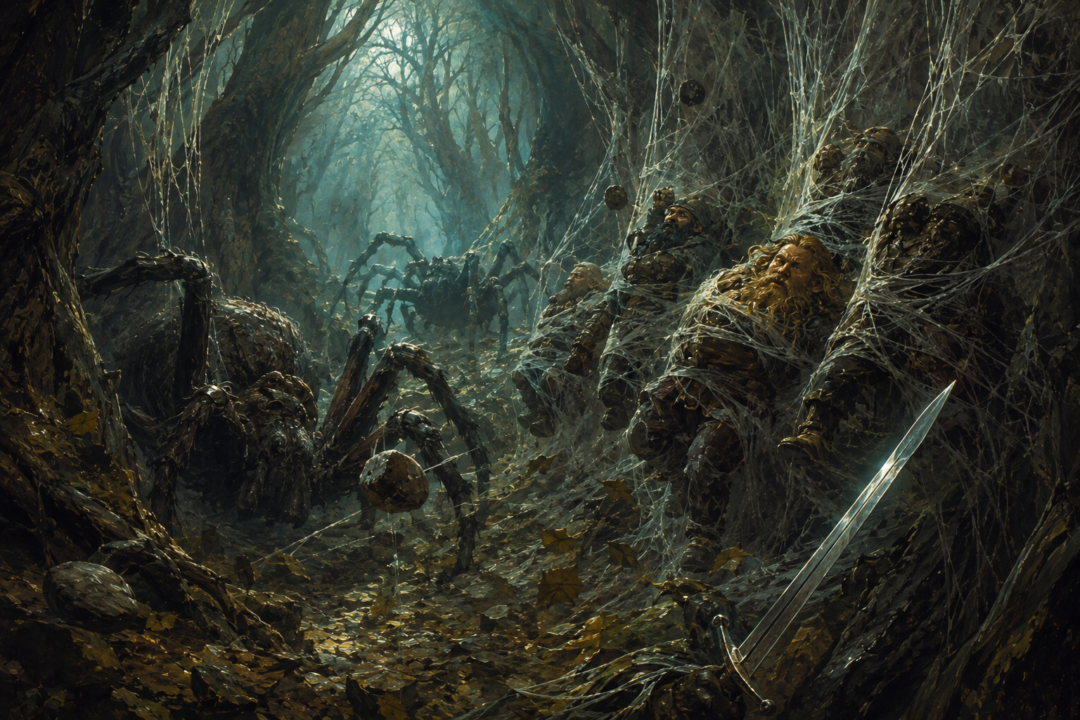
Instead, he soon discovers that the dwarves have been captured.
They are hanging in the spiders’ webs.
This changes the scale of the problem completely.
Bilbo could attempt to escape. His Ring makes that possibility especially tempting: he can become invisible, and the spiders cannot simply seize him as they seized his companions.
Instead he stays.
More importantly, he begins thinking tactically.
He uses the Ring’s invisibility. He throws stones accurately enough to kill or drive off spiders. He taunts the creatures and draws them away from the dwarves. He invents insulting names for them and uses his voice to manipulate their attention.
Then he doubles back toward the captives.
This is no longer the frightened hobbit following Gandalf and Thorin into danger.
Bilbo is planning the rescue.
The dwarves depend upon him.
Why the Naming Comes Before the Rescue
Nothing in the text says that calling the sword Sting magically transforms Bilbo into a leader.
The stronger reading is psychological and narrative.
The private fight with the spider establishes something Bilbo needs to know before he can attempt the rescue: he can function alone.
Until this point, the expedition has contained obvious authority figures. Thorin is the company’s leader. Gandalf repeatedly rescues the group from disasters. Bilbo’s usefulness has grown, especially after acquiring the Ring, but he has not become the company’s principal protector.
Mirkwood removes those supports.
Gandalf is absent.
Thorin has disappeared, though Bilbo and the remaining dwarves do not yet know that the Wood-elves have captured him.
The other dwarves are helpless in the spiders’ webs.
For once, Bilbo cannot wait for the competent person to arrive.
He is the competent person available.
Naming Sting gives a visible form to that realization.
The weapon has not changed.
The hobbit holding it has.
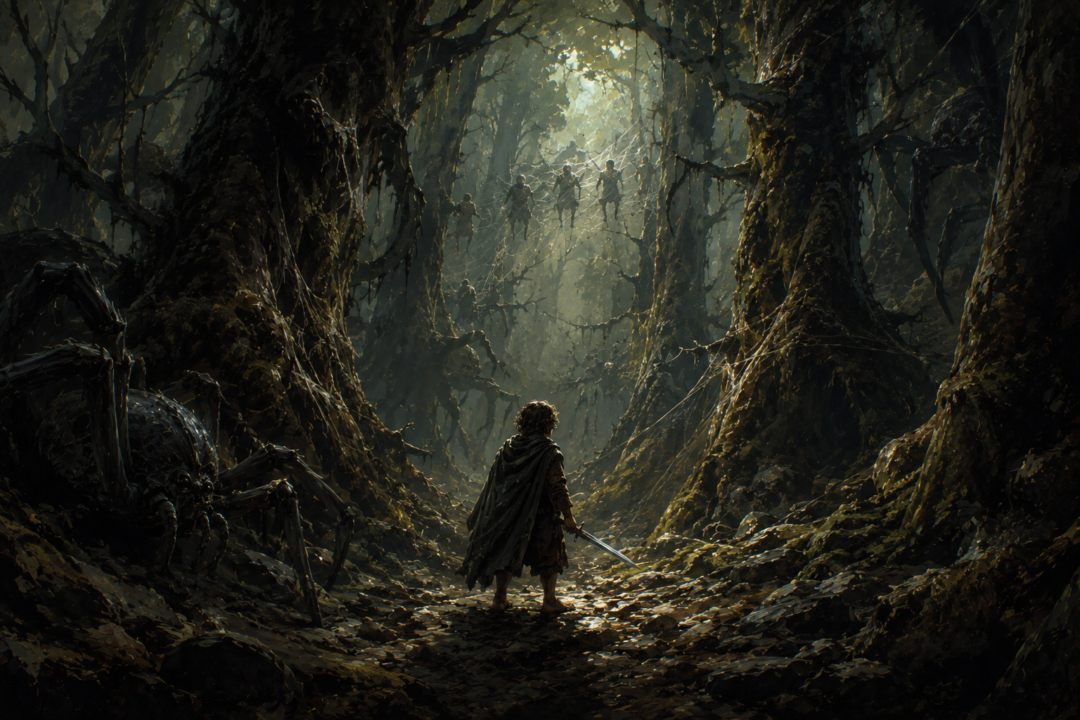
Bilbo Leads With More Than a Sword
There is another reason the sequence works so well: Bilbo does not suddenly become a conventional warrior.
He fights, certainly. But brute strength is not what saves the company.
He combines several qualities the adventure has been developing in him.
He uses stealth through the Ring.
He uses language to provoke and distract the spiders.
He uses stones, a skill the narrator associates naturally with hobbits.
He uses Sting to cut the dwarves free and to fight when necessary.
Most importantly, he takes responsibility for people other than himself.
This is a distinctive form of leadership. Bilbo does not replace Thorin as the company’s formal leader. Thorin remains king and head of the expedition.
But Bilbo increasingly becomes the person who solves crises when established authority cannot.
The spider episode is the clearest early demonstration of that change.
His courage is becoming useful to others.
There Is a Subtle Irony in the Name “Sting”
The name is wonderfully suited to Bilbo’s weapon.
Compared with the great swords of heroes, Sting is small. Bilbo himself is small. Even the name suggests something modest rather than overwhelming: not a crushing blow, but a sharp, painful strike.
That is exactly how Bilbo increasingly operates.
He survives because enemies underestimate him.
Gollum does.
The spiders do.
Later, Smaug initially confronts an unseen intruder rather than some famous warrior marching openly into his hall.
Bilbo’s smallness repeatedly becomes an advantage because Middle-earth’s powerful creatures are accustomed to measuring danger in terms of visible strength.
Sting embodies the same contradiction.
To a Man or Elf, it would be closer to a knife than a great sword.
In a hobbit’s hand, it is enough.
Sting Will Outgrow the Moment of Its Naming
The name also gains a resonance Bilbo cannot foresee.
Years later, he gives Sting to Frodo at Rivendell.
Eventually the blade enters another spider’s darkness: Shelob’s lair above Cirith Ungol.
There, its ancient Elvish craftsmanship matters again. Sting can cut webs that Sam’s Barrow-blade cannot effectively sever, and Sam later uses Sting in his desperate struggle with Shelob.
The parallel should not be overstated. The Lord of the Rings does not say Bilbo somehow foresaw this future when he named the sword.
But the recurrence is striking.
A blade named after Bilbo’s confrontation with the spiders of Mirkwood eventually helps another hobbit confront a far more terrible spider.
Sting becomes part of an inheritance of courage.
Bilbo gives Frodo more than a useful weapon. He gives him an object carrying the memory of a moment when fear did not prevent an apparently insignificant person from acting.
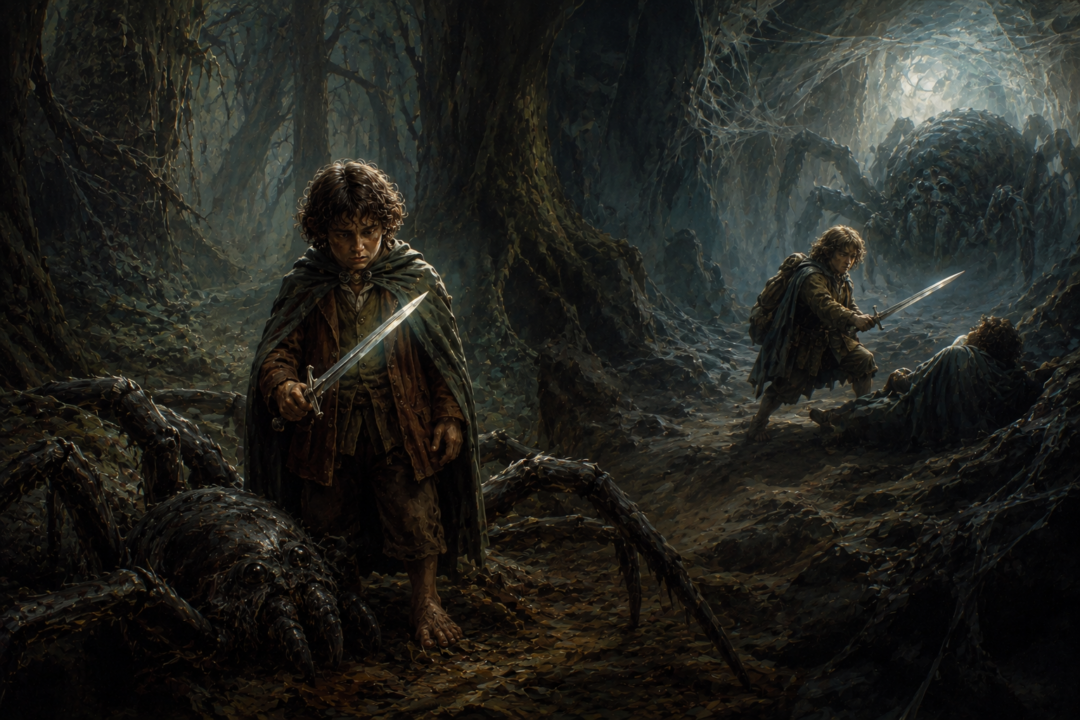
The Real Thing Bilbo Names Is His Own Courage
So does Bilbo literally have to name his sword before he can lead the spider fight?
No. There is no such rule in the lore.
But the story places the naming exactly where Bilbo needs to cross an internal threshold.
Before killing the spider, courage is something Bilbo repeatedly discovers under pressure.
Afterward, he knows he possesses it.
That knowledge matters because his next task is much harder. Killing the first spider saves Bilbo. Returning for the dwarves requires him to risk the safety he has just won.
Sting’s naming separates those two acts.
First comes survival.
Then recognition.
Then responsibility.
The little Elvish blade already possessed its sharpness and ancient craftsmanship. Giving it a name does not make it stronger.
Likewise, the courage Bilbo needs has been appearing throughout the journey. Mirkwood does not magically put it inside him.
What changes is that Bilbo finally recognizes it as his own.
That is why the moment feels larger than a hobbit naming a sword.
In the darkness of Mirkwood, with Gandalf gone and his companions helpless, Bilbo stops waiting for someone else to become the hero of the situation.
Sting receives a name.
And Bilbo, without receiving any new title at all, begins acting like the person everyone else needs.
Sources & Notes
- https://www.glyphweb.com/arda/b/bilbobaggins.html
- https://www.glyphweb.com/arda/s/sting.html
- https://www.glyphweb.com/arda/s/spiders.html
- https://www.glyphweb.com/arda/g/glamdring.html
- https://www.glyphweb.com/arda/o/orcrist.html
- https://www.glyphweb.com/arda/g/gondolin.html
Sources on Bilbo, Sting, the spiders of Mirkwood, and the older Gondolin blades Glamdring and Orcrist that frame Bilbo’s act of naming his own weapon.