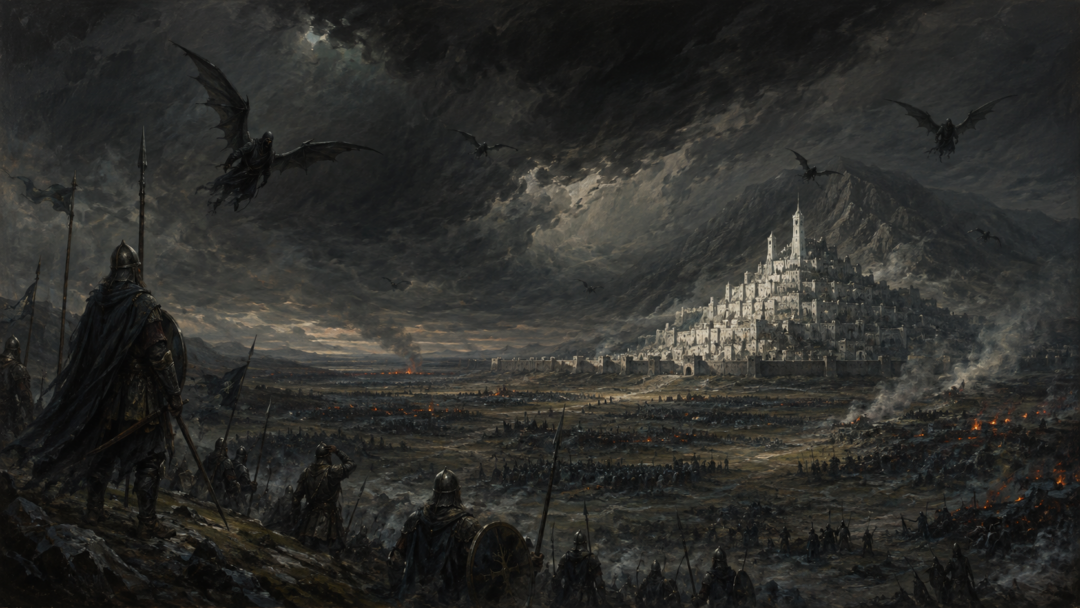
When the armies of Mordor close around Minas Tirith, the Sun has effectively disappeared.
This is not ordinary bad weather. A vast darkness has spread westward from Mordor, blotting out the daylight over Gondor. Under it, the Nazgûl circle above retreating soldiers, the defenders of Minas Tirith struggle to judge what is happening beyond their walls, and Sauron’s forces advance beneath a sky deliberately made hostile to his enemies.
At first, the military advantage seems obvious.
Darkness belongs to Mordor.
Yet the Battle of the Pelennor Fields reveals something subtler. The shadow weakens Gondor’s morale and helps Mordor control the opening stages of the assault—but it also creates uncertainty. Commanders on both sides are forced to make decisions with incomplete information, and when the battle suddenly changes, the army that created the darkness cannot completely control what happens inside it.
The Pelennor is therefore not merely a battle fought beneath an ominous sky. It is a battle about command under uncertainty.
The Darkness Is Part of Sauron’s Offensive
The shadow over Gondor is closely connected with Sauron’s assault.
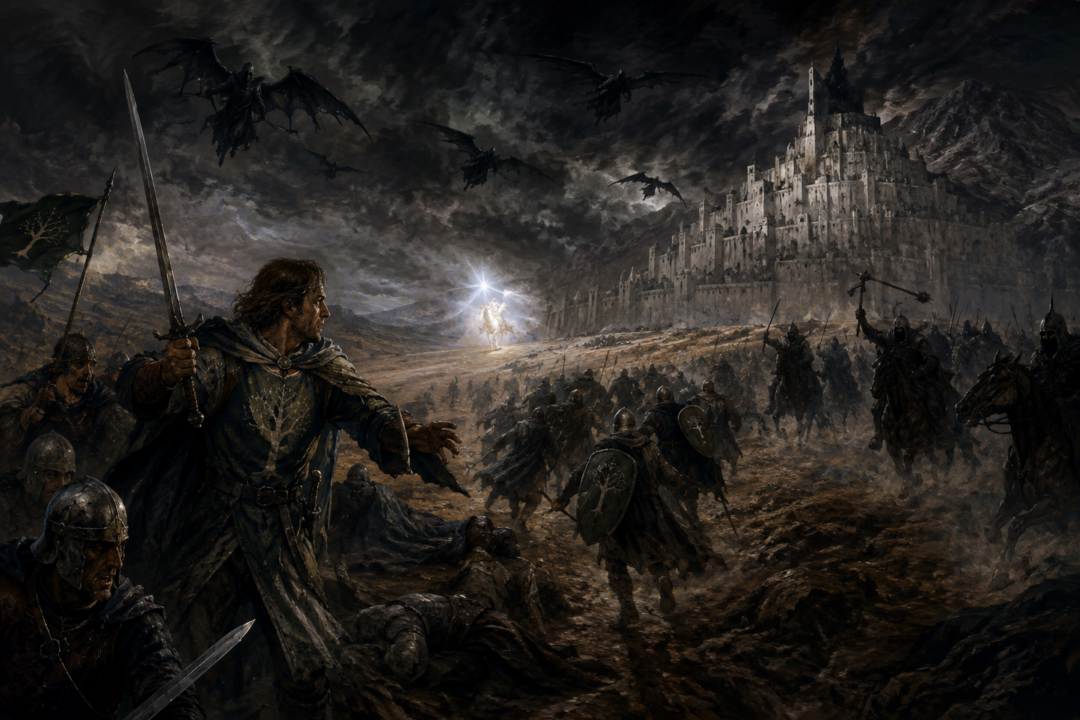
Before the siege reaches Minas Tirith, darkness begins issuing from Mordor. The chronology in Appendix B identifies March 10 as the Dawnless Day, when the darkness flows out from Mordor and spreads westward.
Its psychological effect is immediate.
The light fades. The air becomes oppressive. The Nazgûl move beneath the cloud, and their cries increase the terror already spreading among Gondor’s soldiers.
This gives Mordor an important advantage. Sauron’s war is never based entirely on numbers and weapons. Fear is itself part of his method.
The darkness amplifies that weapon.
Men defending Gondor cannot easily see the wider battlefield. They know an enormous host is approaching, but much of its movement occurs beneath a sky that seems to belong to the Enemy. The Nazgûl, whose presence already attacks courage rather than merely bodies, become even more terrifying in such conditions.
The darkness therefore functions as something close to operational preparation.
It does not win the battle by itself. But it helps create the conditions in which Mordor expects to win.
Gondor Begins Losing Command Before the Gate Falls
The most dangerous effect of the darkness on Gondor is not simply reduced visibility.
It is the collapse of confidence.
Faramir’s retreat from the outer defenses demonstrates the problem. His men are pursued across the Pelennor while the Nazgûl descend upon them. Gandalf’s intervention temporarily drives the Ringwraiths away, and the pressure seems to ease for a moment.
That scene shows how closely morale and command are connected.
Faramir is still able to hold his retreat together because his soldiers trust him. Gandalf can restore courage simply by arriving where fear is strongest.
But the overall command structure of Gondor soon becomes weaker.
When Faramir is brought back gravely wounded, Denethor falls into despair. He withdraws increasingly from the defense of the city and ultimately abandons his responsibility as Steward at precisely the moment when Minas Tirith most needs centralized command.
The darkness outside the walls has been matched by a crisis inside them.
Gandalf consequently becomes the essential coordinating figure in the defense. He moves through the city wherever the danger is greatest, encouraging soldiers and confronting threats. Prince Imrahil likewise emerges as one of Gondor’s most important active captains.
The city therefore continues fighting—but its command has become improvised.
Mordor has not merely surrounded Minas Tirith. The pressure of the siege has helped fracture the authority directing its defense.
Mordor Can See the Battle—But Not the Future
It would be easy to assume that because Sauron sends the darkness, his army somehow operates within it without disadvantage.
The text never establishes such a rule.
The darkness favors Mordor psychologically and strategically, but Orcs, Men, and their commanders still face the ordinary military problem of limited information.
That matters because Sauron’s plan depends on timing.
His host has crossed the Anduin, broken the outer defenses, occupied the Pelennor, surrounded Minas Tirith, and brought enormous siege engines against the city. By the time Grond destroys the Great Gate, the assault appears to be reaching its decisive moment.
The Witch-king enters the broken gateway.
Gondor seems almost defeated.
And then horns sound from the north.
The Rohirrim have arrived.
This is one of the central ironies of the darkness: the environment designed to terrify Gondor has not prevented a major enemy force from reaching the battlefield.
There is no statement that the darkness alone conceals Rohan’s entire approach, and Théoden’s successful arrival depends heavily on the guidance of Ghân-buri-Ghân and the Drúedain, who lead the Riders by a route that allows them to avoid the enemy blocking the main road.
But darkness contributes to the larger atmosphere of uncertainty.
Mordor controls the Pelennor without possessing perfect awareness of everything approaching it.
Théoden Solves the Problem Mordor Created
The Rohirrim face the darkness differently because Théoden does not simply ride blindly toward Minas Tirith.
He listens.
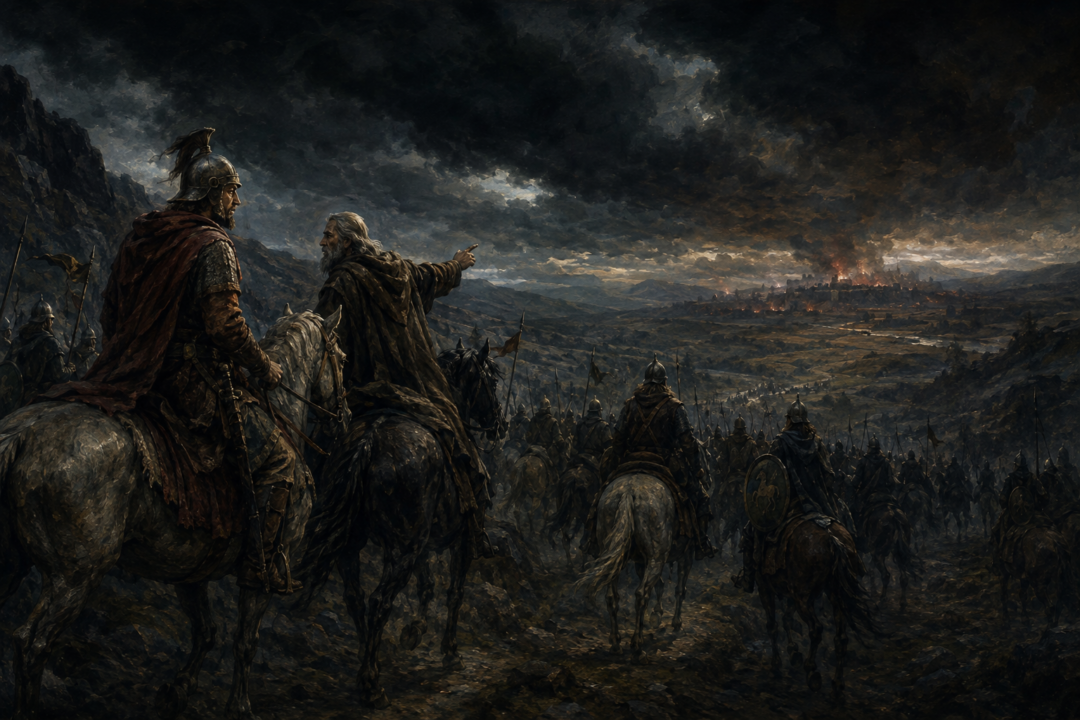
The Drúedain possess knowledge of the land that the Rohirrim do not. Ghân-buri-Ghân warns Théoden of enemies obstructing the road and offers another way forward.
This is a command decision of enormous importance.
Théoden has superior cavalry, but cavalry is useless if it arrives too late or becomes trapped before reaching the battlefield. Instead of relying only on strength, the king accepts local guidance.
That decision allows the Rohirrim to bypass the enemy position and approach the Pelennor.
In other words, Mordor creates an environment in which conventional observation becomes more difficult, but Théoden compensates by using another form of intelligence: knowledge supplied by people who understand the terrain.
That distinction matters.
Good command is not simply seeing everything.
It is recognizing what you cannot see—and finding someone who can.
Dawn Changes More Than Visibility
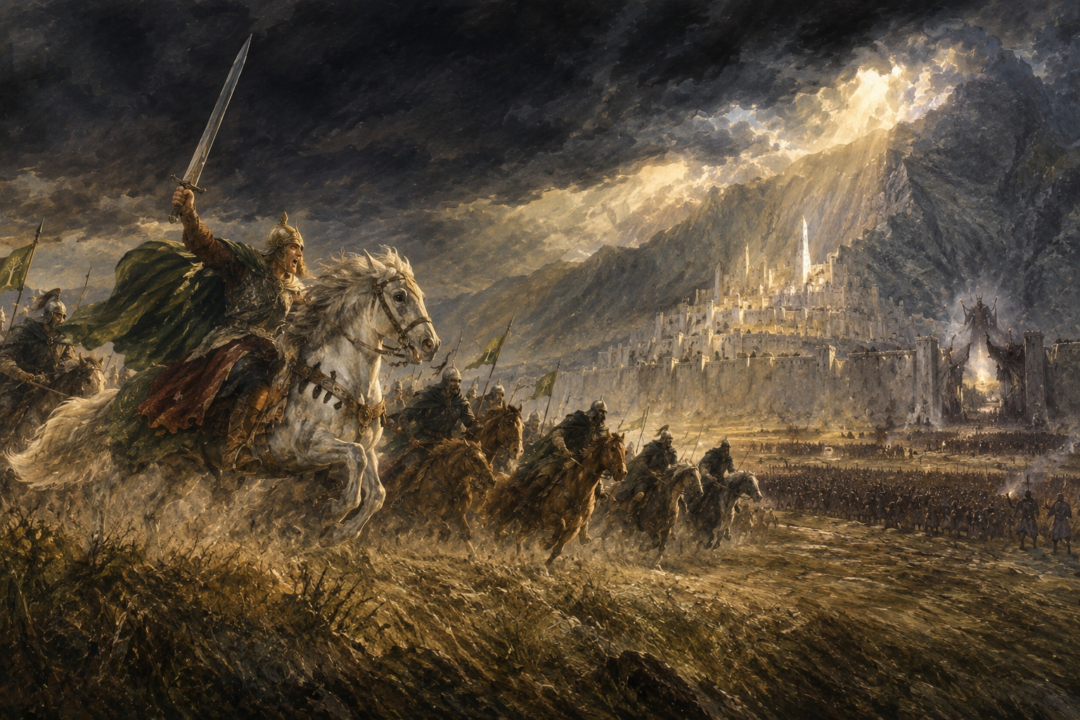
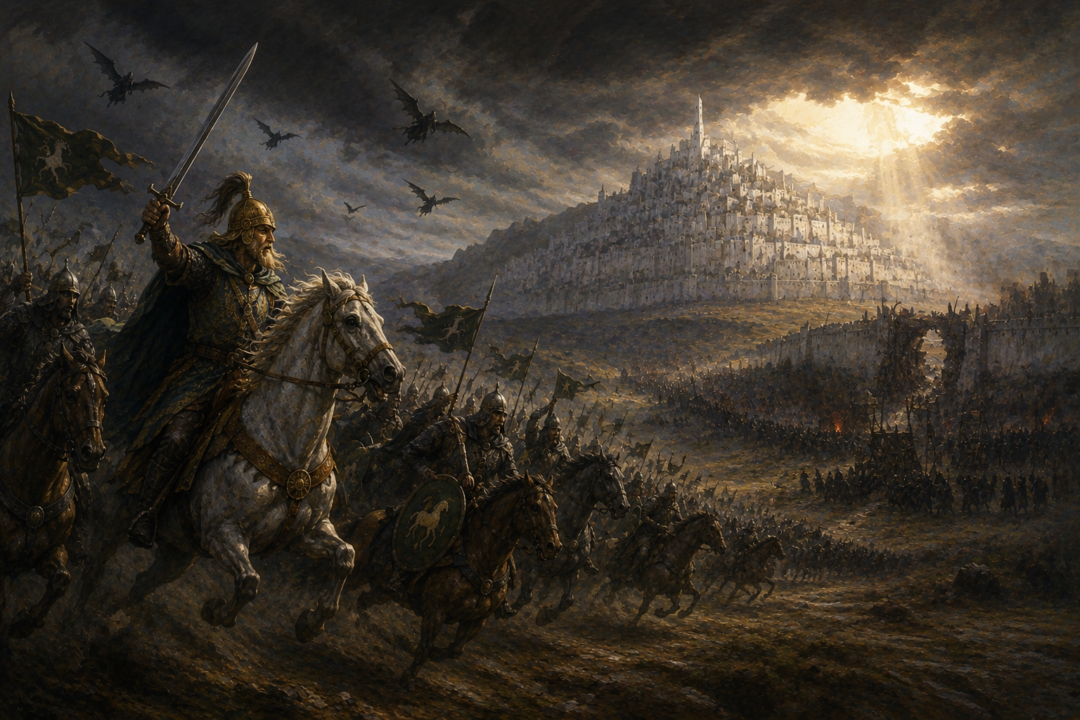
When the Rohirrim finally reach the battlefield, the atmosphere begins to change.
A wind comes from the south, the darkness starts to break, and morning returns as Théoden leads his charge.
The timing creates a powerful reversal.
Mordor began the battle beneath a darkness associated with its own strength. Rohan enters the battle as that darkness is being driven away.
The change is psychological as much as visual.
The Witch-king immediately has a new operational emergency. He abandons his confrontation at the Gate and goes to meet the unexpected cavalry attack.
This is exactly what a surprise force is supposed to do to an enemy commander: break the plan.
Until that moment, Mordor has been directing the battle.
Now Mordor is reacting.
The Witch-king must divert attention from the capture of Minas Tirith because Théoden has created a threat that cannot be ignored.
The initiative has changed hands.
The Witch-king’s Death Creates a Command Crisis of Mordor’s Own
The next transformation is even greater.
Théoden falls beneath his horse after the attack of the Lord of the Nazgûl. Éowyn and Merry then destroy the Witch-king.
Mordor has lost the captain who led the assault on Gondor.
The armies of the West also lose Théoden.
Both sides therefore experience a command shock in almost the same phase of the battle.
Yet neither army simply stops.
Éomer becomes king and assumes leadership of the Rohirrim. His reaction is fierce and emotionally charged, especially after discovering what he believes to be Éowyn’s death. The Riders rally around him and continue fighting.
On Mordor’s side, command likewise persists. Gothmog, identified as the lieutenant of Morgul, directs further forces into the battle after the Witch-king’s fall.
This is important because the Pelennor is not won by killing one enemy commander.
Mordor possesses reserves and subordinate leadership. Even after the Witch-king is destroyed, the battle remains dangerously uncertain.
Éomer Then Faces the Same Enemy: Incomplete Information
The darkness has begun to lift, but the problem of battlefield knowledge has not vanished.
Éomer eventually sees ships coming up the Anduin bearing the black sails associated with the Corsairs of Umbar.
From his perspective, this appears disastrous.
He does not yet know that Aragorn has captured the Corsair fleet and is bringing reinforcements from southern Gondor.
Éomer therefore makes a rational decision based on false-looking evidence that is actually incomplete evidence.
Believing another enemy force has arrived, he prepares for a final stand.
Then Aragorn’s banner is revealed.
The apparent disaster becomes reinforcement.
The battle changes again.
This moment exposes the deeper command problem running through the entire Pelennor campaign. No commander possesses the complete battlefield.
Denethor sees enough through the palantír to despair, but not enough to understand how events may still turn.
Mordor sees Minas Tirith apparently collapsing, but does not prevent Rohan from reaching the field.
Éomer sees hostile-looking ships and believes the battle nearly lost, without knowing who commands them.
Everyone acts inside partial knowledge.
The Darkness Represents Mordor’s Greatest Strength—and Its Limitation
The darkness over Gondor is undeniably effective.
It spreads fear. It strengthens the psychological warfare of the Nazgûl. It makes Sauron’s assault feel overwhelming before the decisive fighting has even begun.
But the Pelennor shows the limit of controlling an environment without controlling every event inside it.
Sauron can darken the sky.
He cannot guarantee what Théoden will decide.
He cannot prevent Ghân-buri-Ghân from revealing another road.
He cannot ensure that the Witch-king survives.
He cannot make Éomer break.
And he cannot stop Aragorn from arriving aboard ships Mordor expected to belong to its allies.
That is why the changing sky matters so much.
The darkness is not simply evil scenery, and the returning dawn is not merely decorative hope. Their movement accompanies a shift in command itself.
At the beginning, Mordor dictates the conditions of battle.
By morning, both armies are reacting to events they did not predict.
And on the Pelennor, the commanders who survive are not those who possess perfect knowledge.
They are those who can still act when certainty disappears.
Sources & Notes
- https://www.glyphweb.com/arda/d/dawnlessday.html
- https://www.glyphweb.com/arda/s/siegeofgondor.html
- https://www.glyphweb.com/arda/m/minastirith.html
- https://www.glyphweb.com/arda/n/nazgul.html
- https://www.glyphweb.com/arda/w/witchking.html
Sources on the Dawnless Day, the Siege of Gondor, Minas Tirith, the Nazgûl, and the Witch-king’s role in using darkness and terror against Gondor’s command.