The Northern Victory That Changed the Fourth Age: Why Dale and Erebor Mattered Beyond Gondor
When Aragorn was crowned King Elessar in Minas Tirith, the restoration of Gondor seemed to mark the political beginning of a new age. Yet hundreds of miles to the north, another pair of kingdoms had survived their own catastrophe.
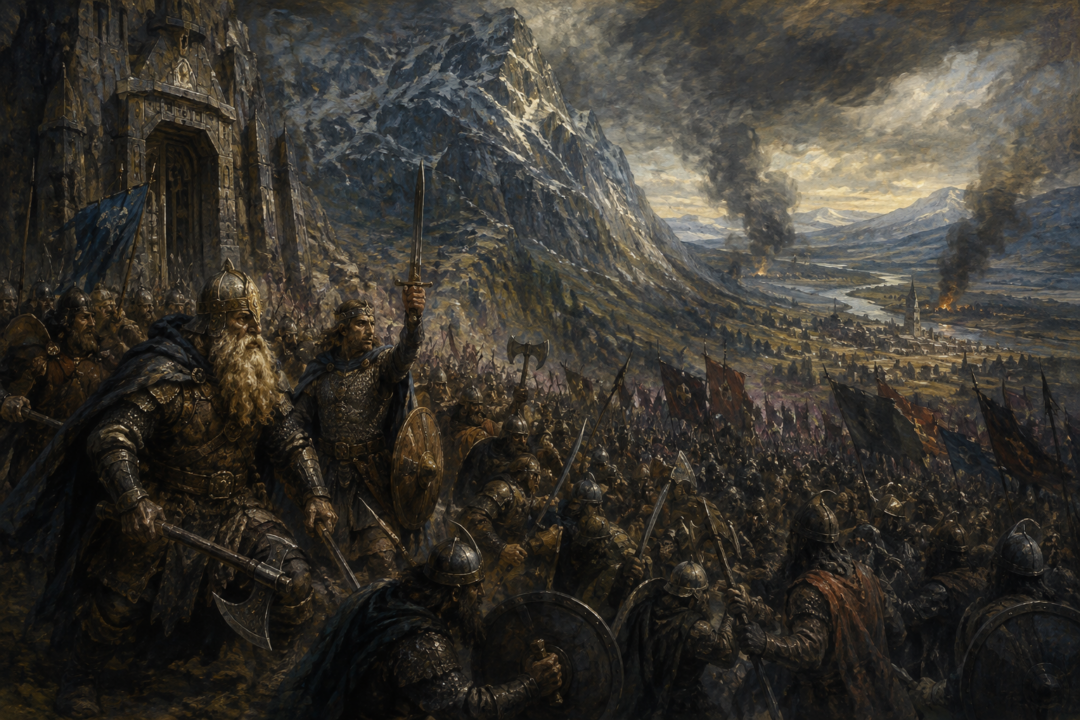
Dale and Erebor had been attacked while Gondor fought for its life. Their kings had fallen together. Their people had been driven behind the Gate of the Lonely Mountain. And only after Sauron's power was broken did the survivors emerge and drive their enemies back into the East.
That northern victory is easy to treat as a distant subplot to the War of the Ring. It was more than that.
The survival of Dale and the Kingdom under the Mountain meant that the Fourth Age did not begin with Gondor standing almost alone against the East. Instead, a restored King of the West inherited a world in which strong friendly realms still existed far beyond Gondor's traditional heartlands.
The balance of power had changed—and the Lonely Mountain was one of the reasons why.
Sauron's War Was Never Only About Minas Tirith
The great battles around Minas Tirith dominate the final stages of the War of the Ring, but Sauron's strategy was geographically much wider.
Appendix B of The Lord of the Rings records that, while the great armies were attacking Gondor, allies of Sauron who had long threatened King Brand's borders crossed the River Carnen. Brand was driven back toward Dale, where the Dwarves of Erebor came to his aid.
This was not an isolated local quarrel.
The northern lands contained several powers hostile to Sauron: Dale, Erebor, the Woodland Realm, and Lórien. Sauron's forces also attacked the Elven realms during the war. The result was a conflict being fought simultaneously across an enormous front.
Gandalf later emphasizes the importance of the northern struggle when speaking with Gimli. He asks him to consider what might have happened had Dale and Erebor fallen: enemies could have brought destruction into the northern and western lands even if Gondor survived its immediate crisis.
That observation reveals the strategic importance of Erebor.
The Lonely Mountain was not merely a wealthy Dwarven kingdom. It was a fortress standing between Sauron's eastern allies and lands farther west.
Dale and Erebor Had Already Created Something Unusual
The alliance that resisted Sauron's northern army had roots in the events of The Hobbit.
After Smaug destroyed the old kingdom beneath the Mountain, Dale also became a ruin. The death of the dragon in T.A. 2941 allowed both regions to recover. Dáin Ironfoot became King under the Mountain after Thorin Oakenshield's death, while Bard established the restored kingdom of Dale.
By the time Frodo met Glóin at Rivendell, the transformation was unmistakable. Glóin described prosperity under the Mountain and friendship with the Men of Dale. Dale had again become populous and prosperous, while the Dwarves had rebuilt much of their own realm.
That matters because neither kingdom's recovery existed in isolation.
The Men controlled fertile and inhabited lands around Dale and farther south and east, while Erebor possessed the extraordinary craft traditions and fortified halls of Durin's Folk. Their interests were different, but increasingly complementary.
The alliance was therefore more than a battlefield convenience created in 3019.
When the eastern invasion finally came, Men and Dwarves already had decades of coexistence and friendship behind them.
The Price Was Two Kings
The northern campaign was nevertheless almost a disaster.
Brand was driven back from the Carnen. At Dale, his forces joined the Dwarves of Erebor, and a great battle was fought at the feet of the Lonely Mountain.
It lasted three days.
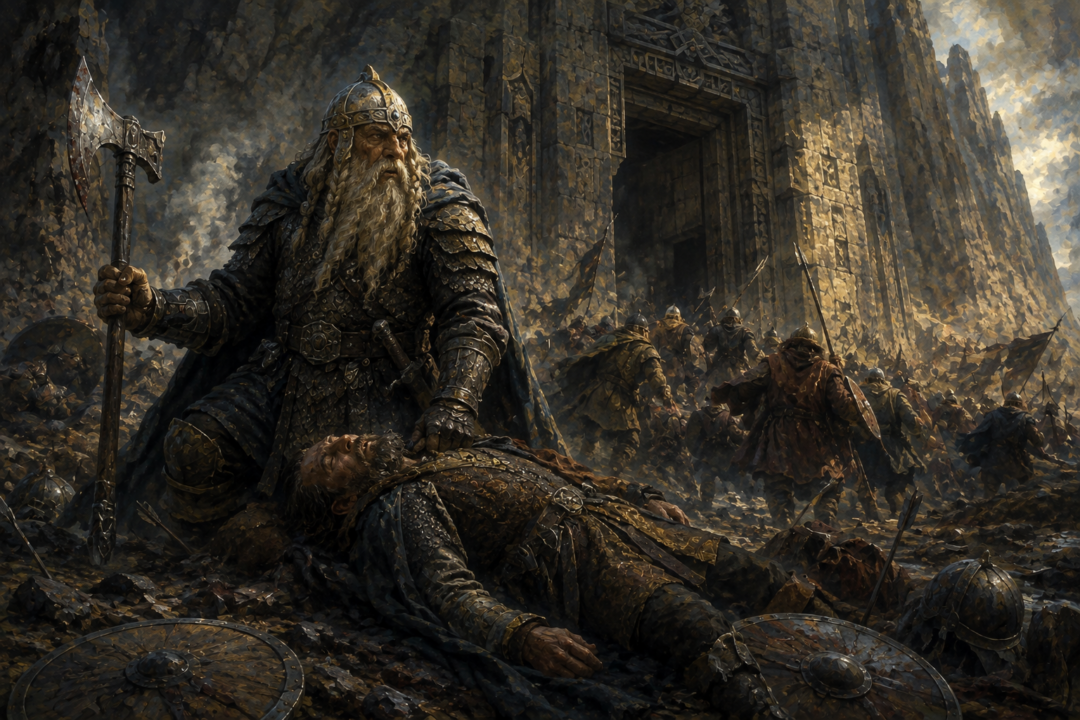
The defenders were defeated in the field. King Brand was slain, and Dáin Ironfoot also fell. According to Gandalf's later account, the aged Dwarf-king died before the Gate of Erebor defending Brand's body.
There is something deeply significant in that image.
The story that began in The Hobbit had once brought the Men of the Lake and Thorin's Dwarves close to armed conflict over the treasure of Smaug. Generations later, the heirs of those communities were dying together against a common enemy.
But their sacrifice did not produce an immediate victory.
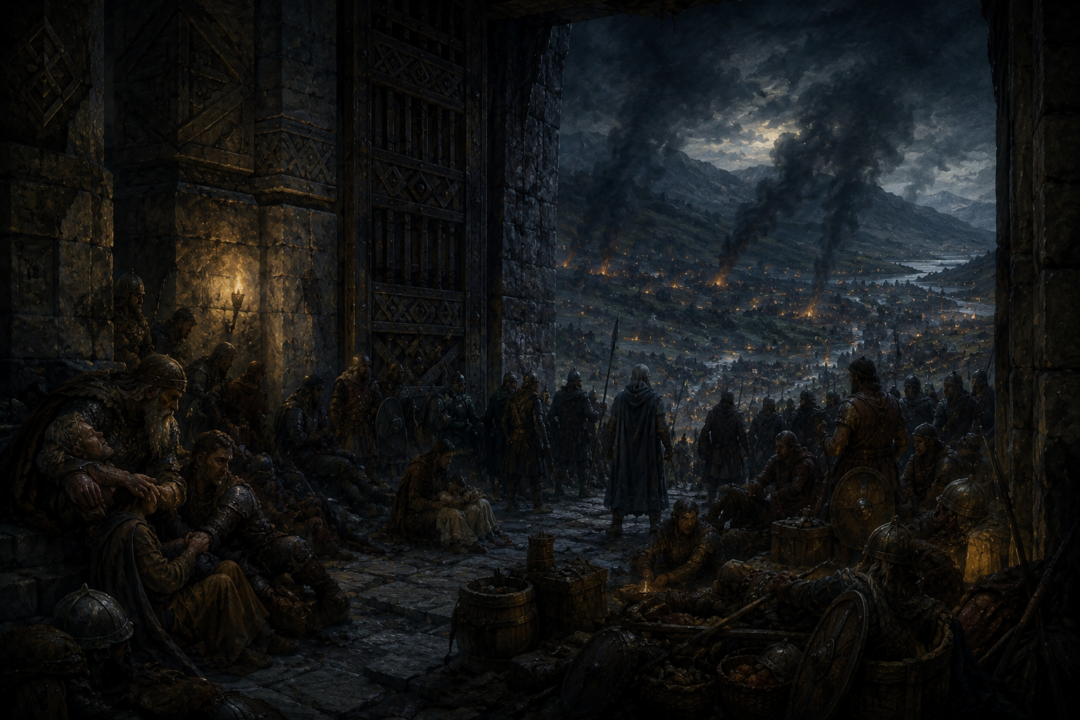
The surviving Men and Dwarves were driven inside Erebor. The Easterlings held the advantage outside.
One fact changed everything: they could not take the Gate.
Erebor Did What a Great Fortress Was Supposed to Do
This is the overlooked military importance of the Lonely Mountain.
Dale could be attacked. Armies in the open could be defeated. Kings could be killed.
Erebor could still hold.
The survivors of both peoples withdrew into the Mountain and endured a siege. The text does not provide detailed descriptions of the siege operations, troop numbers, or the precise organization of the defenders, so claims about those details would be speculation.
What it does establish is decisive enough: Sauron's northern army had won the battle outside but failed to capture the refuge behind it.
That transformed defeat into delay.
And delay was exactly what the Free Peoples needed.
On 25 March, the Ring was destroyed and Sauron fell. News of the victories in the South then reached the northern army and filled it with dismay.
The besieged responded aggressively.
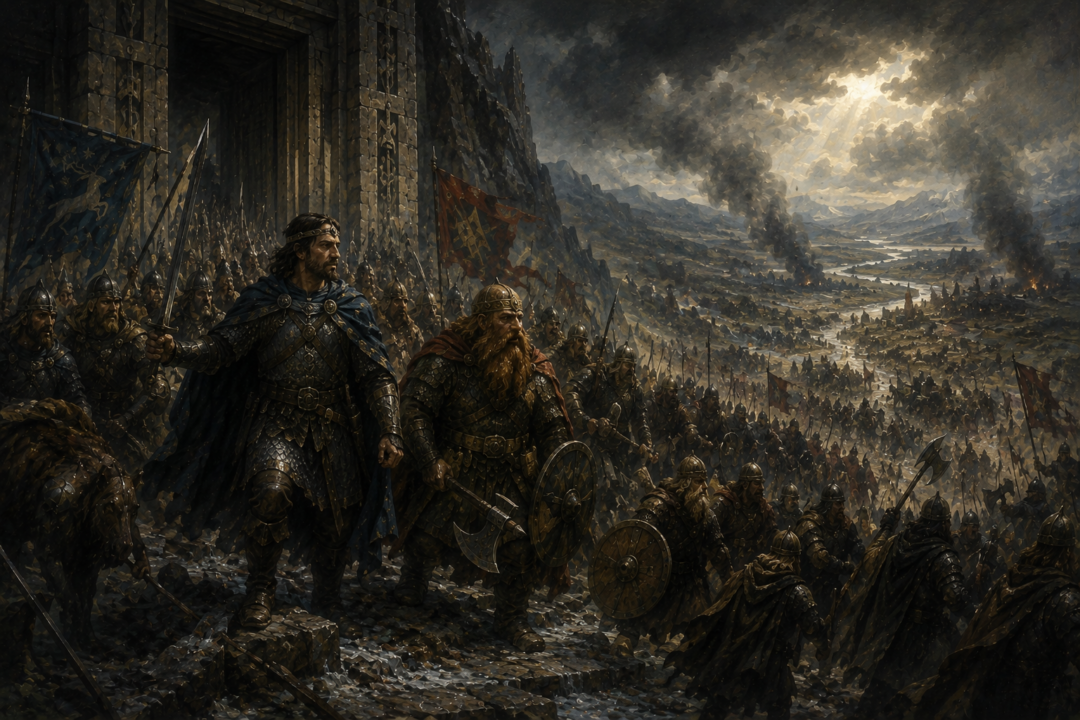
On 27 March they emerged from Erebor, routed their enemies, and drove the survivors eastward. Appendix B says that the remnant troubled Dale no more.
The northern victory therefore depended on both halves of the wider war. Dale and Erebor survived long enough for events in the South to break their enemy's confidence; then they won their own battlefield victory rather than remaining passive beneficiaries of Gondor's success.
Two Dead Kings Were Replaced by Two New Ones
The political consequences appeared almost immediately.
Brand was succeeded by his son Bard II.
Dáin was succeeded by his son Thorin III Stonehelm.
This continuity is important. Sauron's assault had killed both reigning monarchs, but it had not destroyed either kingdom or its royal succession.
The Fourth Age therefore began in the North not with a political vacuum but with two functioning allied realms under new kings.
Their next recorded action makes the new order even clearer.
Bard II and Thorin III sent ambassadors to the coronation of King Elessar.
That detail connects the battlefield beneath Erebor directly to the restored monarchy in Gondor.
These were not simply remote survivors hearing rumors of a king in the South. Their representatives participated in the establishment of the postwar political order.
What “Under the Crown and Protection” Means
Appendix B gives an unusually important description of what followed.
Dale and Erebor remained in friendship with Gondor and were under the crown and protection of the King of the West.
The exact constitutional meaning of this relationship is not explained in administrative detail, so it would be unsafe to imagine a modern system of provinces, vassalage, taxation, or direct government.
The text supports a more conservative conclusion.
Elessar's restored kingship possessed an acknowledged protective authority extending far beyond Gondor itself, while Dale and Erebor continued to have their own kings.
That produced a layered political landscape.
Bard II remained King of Dale. Thorin III remained King under the Mountain. Elessar was King of the West.
The northern realms therefore retained distinct rulers and identities while belonging to a wider order of friendship and royal protection.
That was a very different strategic situation from the fragmented world Sauron had exploited during the late Third Age.
Gondor No Longer Faced the East Alone
This may be the greatest long-term consequence of the northern victory.
The eastern boundaries of Middle-earth did not suddenly become peaceful with Sauron's destruction. Appendix A records that King Elessar and King Éomer later campaigned beyond their original realms, fighting enemies in the East and South.
Sauron was gone, but hostile peoples and old conflicts remained.
A surviving Dale and Erebor therefore mattered.
North of Gondor stood a powerful Dwarven stronghold and a restored kingdom of Northmen, both friendly to the Reunited Kingdom. They occupied a region that had just demonstrated its strategic importance during Sauron's final war.
We should not turn this into a military alliance system more precise than the texts describe. There is no detailed Fourth Age treaty giving troop commitments or borders.
But the broad balance is clear.
Had Dale and Erebor been destroyed, the northeastern world after Sauron's fall would have contained a dangerous vacuum. Instead, two friendly kingdoms survived there.
The difference was enormous.
The Victory Also Completed the Story Begun by Smaug
There is a deeper historical irony.
Smaug's attack had once destroyed Erebor and Dale together.
Their restoration also became intertwined.
Then, at the end of the Third Age, they survived together.
The treasure that had nearly divided Dwarves and Men after Smaug's death was no longer the defining fact of their relationship. By 3019, their kings stood together before the Gate, their peoples took refuge together, and their heirs emerged together to defeat the enemy.
That is one of the quiet transformations running from The Hobbit into The Lord of the Rings.
The Battle of Five Armies prevented catastrophe and made restoration possible. Decades of rebuilding turned that possibility into durable kingdoms. The Battle of Dale proved that the restored North could survive a direct assault from Sauron's allies.
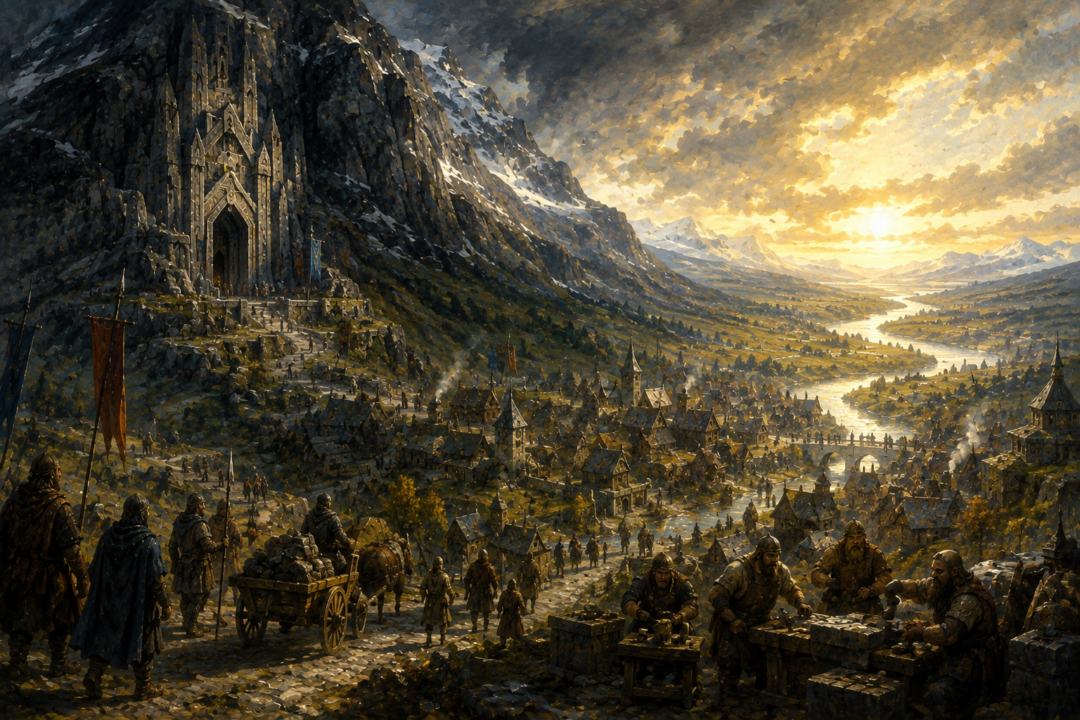
The Fourth Age Began in More Than One City
It is tempting to imagine the new political world of Middle-earth radiating outward entirely from Minas Tirith.
Certainly, the restoration of the line of Elendil was central. Aragorn united the kingship of Gondor and Arnor, and his authority reshaped the West.
But he did not inherit an empty map.
The victory in the North ensured that beyond Gondor stood allies rather than ruins.
Dale survived.
Erebor survived.
Bard II and Thorin III inherited functioning kingdoms rather than memories of kingdoms. Their ambassadors came south to Elessar's coronation, and their realms remained linked to his crown and protection.
Gandalf's warning about what might have happened if the North had fallen gives the Battle of Dale its proper scale. The defence of Erebor was not a decorative side story occurring while the "real" war happened elsewhere.
It was one of the places where the shape of the next age was decided.
Gondor's victory destroyed the central power of Sauron.
Dale and Erebor's victory ensured that, when the Shadow disappeared, there was still a strong North left to join the world that followed.
Sources & Notes
- https://www.glyphweb.com/arda/d/dale.html
- https://www.glyphweb.com/arda/e/erebor.html
- https://www.glyphweb.com/arda/b/battleofdale.html
- https://www.glyphweb.com/arda/b/brand.html
- https://www.glyphweb.com/arda/e/easterlings.html
Sources on Dale, Erebor, the Battle of Dale, King Brand, and the Easterling threat during the War of the Ring.