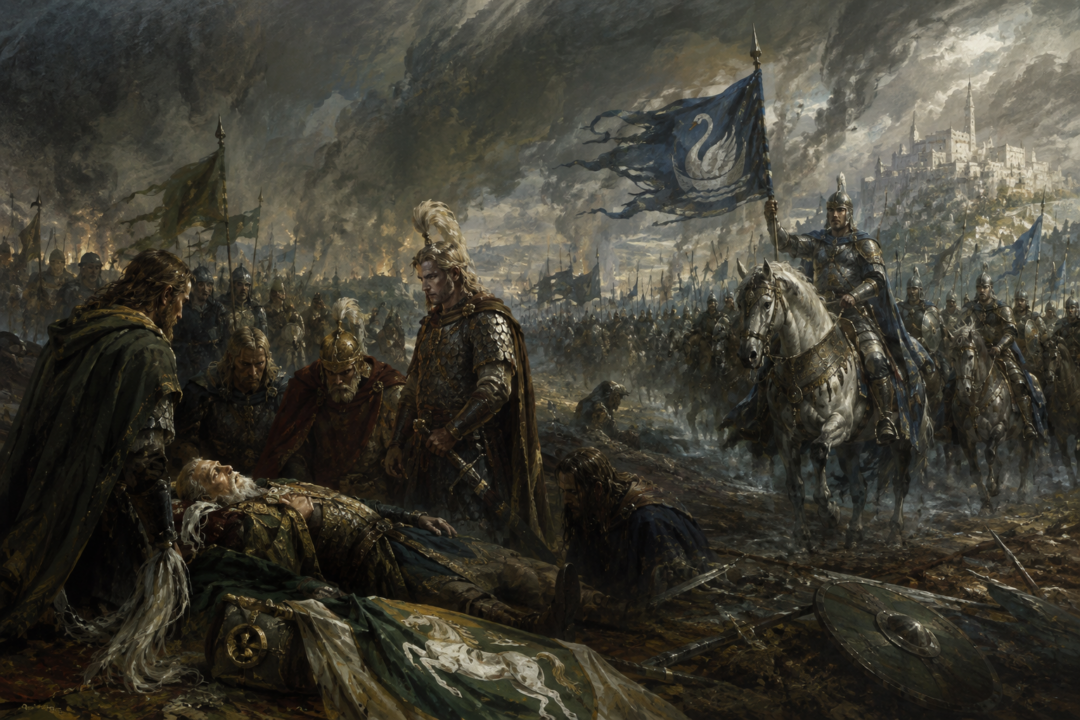
When Théoden falls on the Pelennor Fields, Middle-earth suddenly has no shortage of kings.
Théoden names Éomer as his successor before he dies. Aragorn is already approaching Minas Tirith with the heirlooms and banner of Elendil’s House. Yet inside Gondor another man quietly becomes the practical authority holding the realm together: Prince Imrahil of Dol Amroth.
That can look strange at first. Why does Imrahil take command rather than Éomer? Why not Aragorn? Why not Gandalf?
The answer reveals something important about how authority actually works in Gondor. Théoden’s death matters enormously, but it is not what gives Imrahil command. The deeper crisis is that Gondor’s own chain of government has collapsed almost simultaneously.
Denethor is dead. Faramir is incapacitated. Aragorn deliberately refuses to force his claim. Gandalf has responsibilities larger than governing Minas Tirith.
Imrahil is the senior Gondorian lord left standing at precisely the moment someone has to act.
Théoden's Death Creates Two Different Crises
The first distinction is the most important: Théoden is King of Rohan, not Gondor.
When he lies mortally wounded beneath Snowmane, his succession is handled immediately. He asks for Éomer, and before dying he hails him as king. From that point, Éomer commands the Rohirrim.
The text makes this explicit when Théoden's bearers later encounter Imrahil. They tell the prince that Théoden is dead and that Éomer is now king, riding in the battle.
So Imrahil does not replace Théoden.
Éomer does.
What Imrahil increasingly assumes is authority over the forces and affairs of Gondor.
The distinction matters because the Battle of the Pelennor Fields is being fought by allied forces that remain politically separate. Rohan has answered Gondor's call, but the Rohirrim have not become Gondorian troops. Éomer inherits Théoden's authority over his own people.
Gondor, meanwhile, is suffering a leadership disaster of its own.
Gondor's Chain of Authority Is Breaking
Before the Rohirrim even arrive, Denethor's government is already under extreme strain.
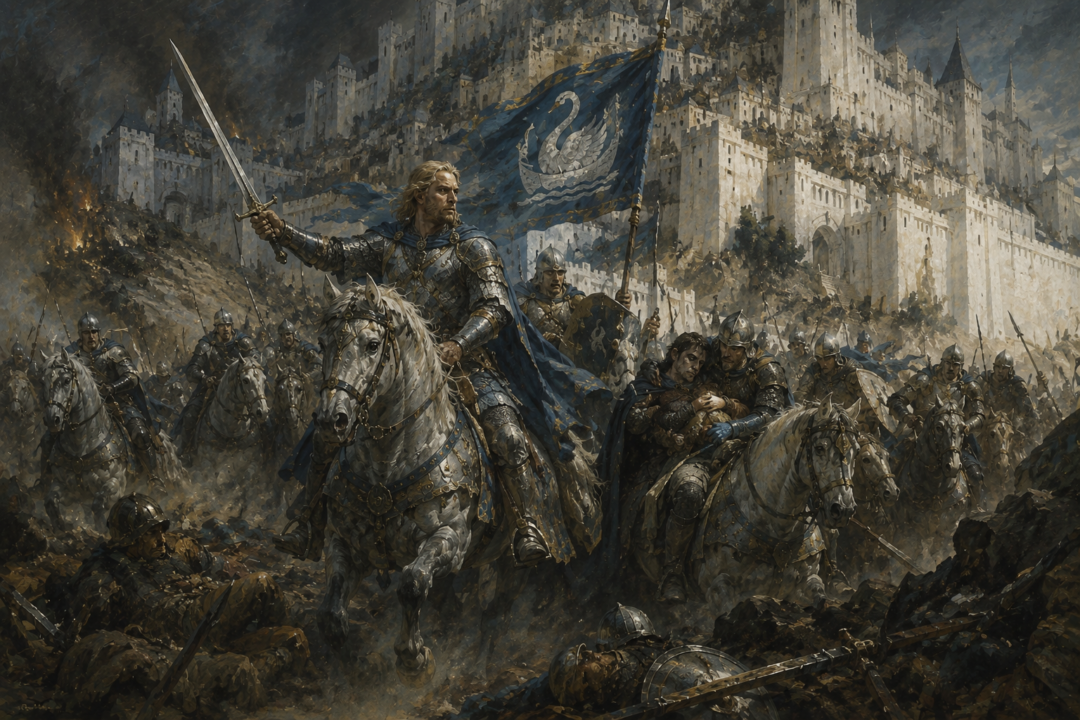
Faramir, his surviving son and heir, has been gravely wounded during the retreat from the outer defenses. Prince Imrahil personally helps save him: the charge of the knights of Dol Amroth prevents Faramir from being slain on the field, and Imrahil carries his wounded kinsman back into the City.
Denethor then descends into despair.
By the height of the battle, the ruling Steward is no longer directing Gondor's defense. He has taken Faramir toward the House of the Stewards and intends to die with him.
This produces the real command vacuum.
Gandalf encounters Imrahil while the prince is trying to gather strength for the battle. Gandalf must leave to confront the catastrophe involving Denethor and Faramir, and he gives Imrahil the crucial instruction: take command in the lord's absence.
That moment explains the military situation more directly than Théoden's death does.
Imrahil is not taking Théoden's place. He is taking responsibility for Gondor because Denethor is absent from command and Faramir cannot exercise authority.
Why Imrahil Is the Obvious Gondorian Choice
Imrahil is not merely an impressive cavalry commander who happens to be nearby.
He is Prince of Dol Amroth, lord of one of Gondor's greatest fiefs, and a kinsman of Denethor. His sister Finduilas had been Denethor's wife, making Imrahil the maternal uncle of Boromir and Faramir.
His arrival in Minas Tirith before the siege demonstrates his standing.
He comes beneath the banner of the Ship and Silver Swan with knights in full harness and hundreds of men-at-arms. Among the lords answering Gondor's summons, Dol Amroth is presented with particular distinction.
More importantly, Imrahil repeatedly behaves as a commander before anyone formally needs him to become Gondor's temporary ruler.
He participates in Denethor's councils. He understands Gondor's strategic situation. He leads the mounted sortie that rescues Faramir's retreating forces. During the Pelennor battle he rides east with Gondor's horsemen to support Éomer.
Nothing in the narrative suggests an improvised promotion of an otherwise ordinary noble.
The man who takes command is already one of Gondor's foremost active lords.
Éomer Cannot Simply Command Gondor
Éomer's position is equally clear.
He has just become King of the Mark.
That gives him enormous authority—but over Rohan.
After finding what he believes to be Éowyn's dead body, Éomer is also overcome by grief and fury. Instead of waiting for Gondor's approaching forces, he launches another violent assault.
The attack initially succeeds spectacularly, but the narrative explicitly says his fury betrays him. His Riders penetrate deeply into the enemy, only to face the mûmakil and fresh forces entering the field from Osgiliath.
Imrahil and the other Gondorian commanders ride to his aid.
This creates a revealing contrast.
Éomer is the rightful new king of Rohan, fighting with extraordinary courage, but at this stage he is emotionally consumed by what he believes to be the destruction of his family.
Imrahil is performing a different role: preserving coordination, reinforcing the Rohirrim, and maintaining Gondor's command structure.
Neither man's authority cancels the other's.
They are allied commanders representing two realms.
Why Aragorn Does Not Immediately Take Over
Aragorn presents the more complicated question.
By the end of the battle, he has arrived openly beneath the standard of Elendil's House. His claim is no longer merely something whispered among a few companions.
Yet Aragorn deliberately refuses to enter Minas Tirith as king.
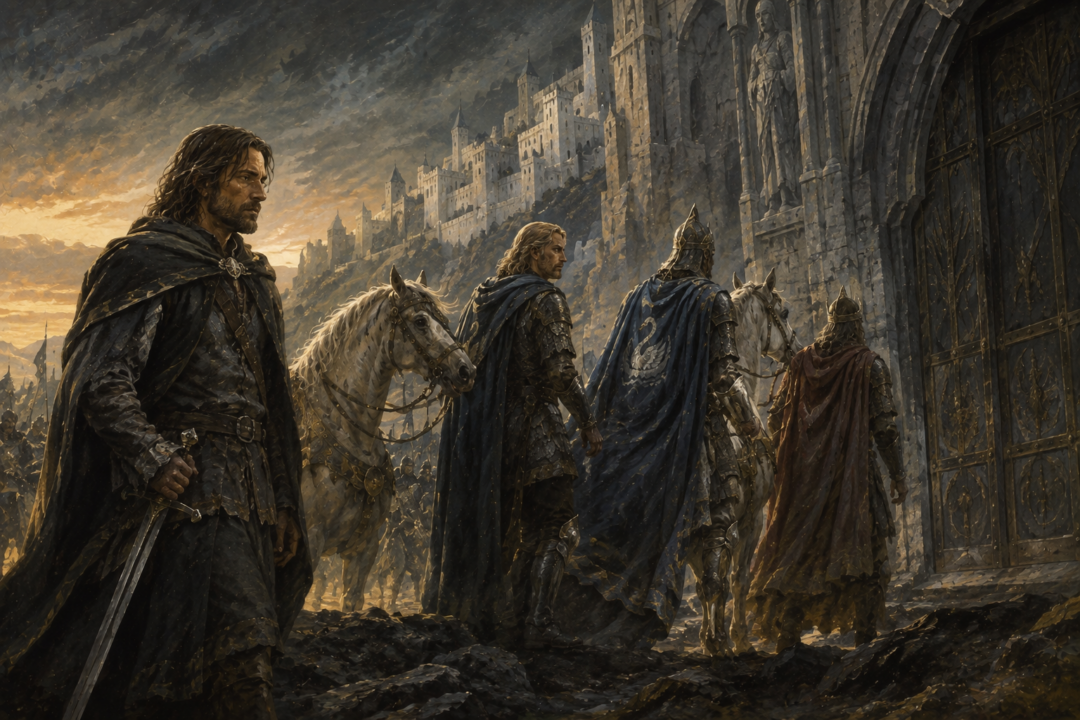
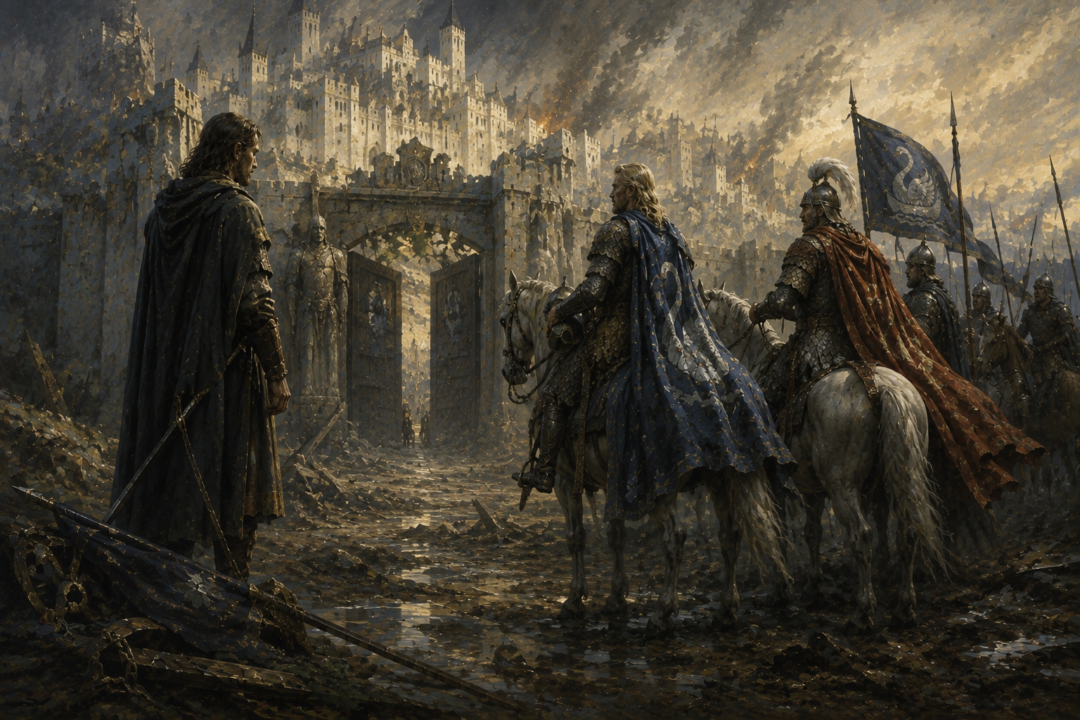
After the battle, when Aragorn, Éomer, and Imrahil approach the City, Aragorn chooses to remain outside. He judges the time unsuitable for pressing a political claim while Denethor's fate is not yet known to him.
This restraint is essential.
Aragorn possesses a hereditary claim, but he does not treat Gondor as a prize that military victory automatically entitles him to seize.
When it becomes clear that Denethor is dead and Faramir is now Steward but lies desperately ill, Imrahil raises the obvious question: who will rule the City in the meantime?
His instinct is to send for Aragorn.
Aragorn's answer is revealing. For the present he identifies himself only as Captain of the Dúnedain of Arnor and declares that the Lord of Dol Amroth should rule Minas Tirith until Faramir awakens.
So Imrahil's temporary authority ultimately receives Aragorn's explicit support as well.
Aragorn could exploit the vacuum.
Instead, he prevents the vacuum from becoming a constitutional crisis.
Why Gandalf Does Not Rule Gondor
Gandalf is another obvious candidate, especially because he has effectively directed much of Minas Tirith's defense when Denethor ceased to function as a war leader.
But Gandalf is not a Gondorian ruler.
His authority during the siege comes from necessity, wisdom, and the willingness of others to follow him—not from succession to the Stewardship.
Even after Denethor's death, Gandalf distinguishes practical emergency command from Gondor's civil government. When asked about authority in the City, he acknowledges Imrahil's position.
Later Aragorn proposes an elegant division of responsibility: Imrahil should rule the City until Faramir wakes, while Gandalf should guide their broader actions against the Enemy.
That distinction suits both men.
Imrahil can legitimately administer Gondor.
Gandalf can concentrate on the war whose stakes extend far beyond Gondor.
The Small Moment That Defines Imrahil
Perhaps the best explanation for why Imrahil is trusted comes not from a council chamber but from the battlefield.
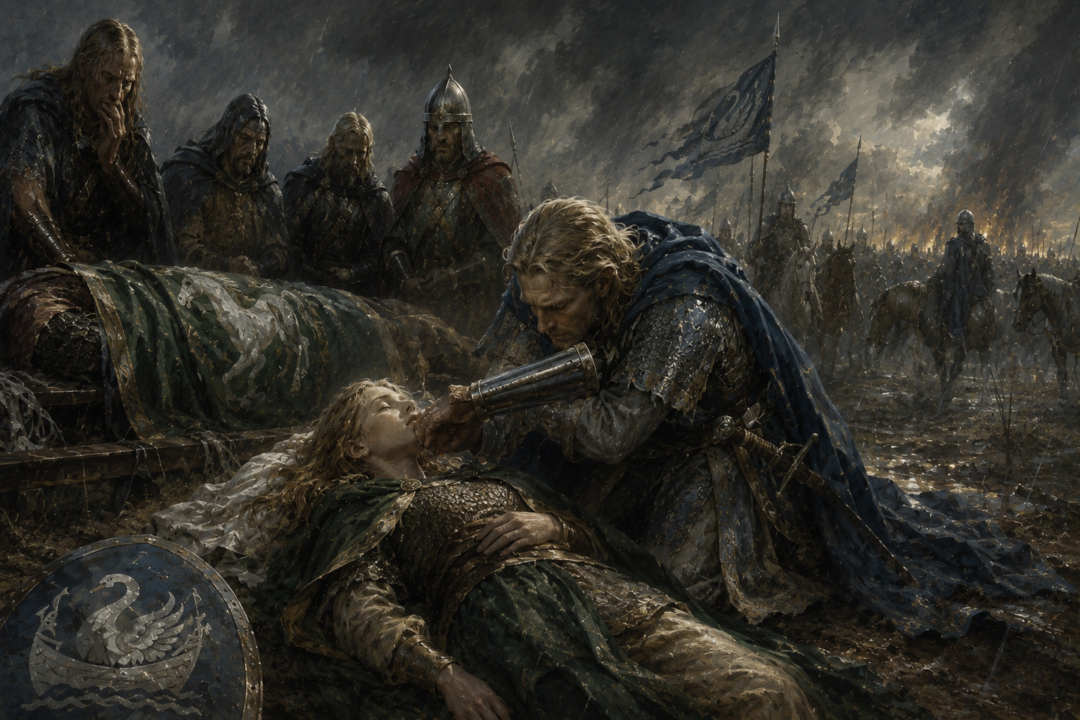
He encounters the bearers carrying Théoden and Éowyn toward Minas Tirith.
Imrahil dismounts and kneels before Théoden's bier, honoring the fallen king. Then he examines Éowyn.
The Rohirrim believe she is dead.
Imrahil is not satisfied with appearances. He tests for breath using the polished surface of his vambrace and detects the faint mist showing that she still lives. He immediately sends for aid.
Then he returns to the battle.
The episode is easy to overlook beside the destruction of the Witch-king, Éomer's charge, and Aragorn's arrival. Yet it captures Imrahil's character with unusual economy.
He honors the dead without neglecting the living.
He notices what others have missed.
He gives the necessary order.
Then he goes where he is needed next.
That is almost a miniature version of his role in Gondor's wider crisis.
Imrahil Rules Because He Does Not Reach for Power
There is a final irony in Imrahil's rise to temporary authority.
He never behaves like a man trying to acquire it.
When the question of Gondor's government arises, he suggests Aragorn. Later, when the captains debate their next move, Imrahil openly accepts Aragorn as his liege-lord even before Aragorn formally claims the throne.
At the same time, he refuses to abandon his immediate responsibilities. He reminds the council that while he stands in the Steward's place, he must think first of Gondor's people and ensure that the realm remains defended.
That balance explains why he is such a convincing emergency ruler.
Imrahil recognizes Aragorn's greater claim without pretending that recognition frees him from present duty.
He can submit without becoming passive.
He can command without becoming ambitious.
And he can act decisively without confusing temporary necessity with permanent sovereignty.
The Hidden Order Beneath the Chaos
The Pelennor Fields appear to destroy every hierarchy at once.
A king dies beneath his horse. His heir believes his sister dead and rides toward apparent ruin. Gondor's Steward abandons his command. The Steward's heir lies unconscious. The returning king waits outside the walls rather than forcing his entrance.
Yet political order survives.
Éomer succeeds Théoden and rules the Rohirrim.
Faramir legally succeeds Denethor as Steward, though he cannot yet govern.
Imrahil stands in Faramir's place and governs Minas Tirith temporarily.
Gandalf guides the strategy against Sauron.
Aragorn waits until his kingship can be acknowledged rather than imposed amid confusion.
That is why saying simply that "Imrahil takes command when Théoden falls" misses the deeper structure.
Théoden's fall changes the leadership of Rohan. Imrahil's authority emerges because Gondor simultaneously loses its functioning Steward and his heir.
In the middle of perhaps the greatest military crisis Gondor has faced in centuries, authority does not pass to whoever possesses the strongest sword or the most famous bloodline.
It passes, temporarily, to the man already doing the work.
Prince Imrahil does not seize Gondor at its weakest moment.
He holds it together until its rightful order can stand again.
Sources & Notes
- The Encyclopedia of Arda — Imrahil: his position as Prince of Dol Amroth, relationship to Denethor’s house, and participation in the Pelennor battle and march on Mordor. https://www.glyphweb.com/arda/i/imrahil.html
- The Encyclopedia of Arda — Battle of the Pelennor Fields: the battle sequence involving Théoden’s death, Éomer’s command of Rohan, and Imrahil’s role among Gondor’s forces. https://www.glyphweb.com/arda/b/battleofthepelennor.html
- The Encyclopedia of Arda — Éomer Éadig: Théoden’s named heir and the new King of Rohan, clarifying why Éomer’s authority was over the Rohirrim rather than Gondor. https://www.glyphweb.com/arda/e/eomer.html
- The Encyclopedia of Arda — Captains of the West: Imrahil’s place beside Aragorn, Gandalf, and Éomer in the allied command after the Pelennor victory. https://www.glyphweb.com/arda/c/captainsofthewest.html
Sources document Imrahil’s rank and kinship, Théoden and Éomer’s Rohirric succession, and the allied command structure during and after the Pelennor battle.